July 29, 2026
The Hidden Complexity Behind a $22 Million Engineering Decision
Spend enough time studying large-scale mineral processing projects and a pattern emerges: the most consequential decisions rarely occur at the ground-breaking ceremony or the first blast. They happen quietly, in engineering offices, when a project owner commits capital to detailed design work. That commitment signals something the market often underestimates: the transition from planning to preparation for construction. The Lycopodium PLS wet plant contract at Pilgangoora, valued at $22 million, is precisely that kind of decision.
Understanding what this contract actually means requires working through several layers of technical, commercial, and strategic context that don't surface in a headline figure alone.
When big ASX news breaks, our subscribers know first
What a Wet Plant Actually Does in Spodumene Processing
For readers unfamiliar with hard-rock lithium processing, the wet plant is the operational heart of a spodumene concentration facility. When ore is blasted from the pit at Pilgangoora, it arrives at the processing facility as a heterogeneous mix of spodumene-bearing pegmatite and waste mineralogy. The wet plant's job is to transform that raw material into a saleable, high-grade spodumene concentrate through a sequence of water-assisted separation processes. Understanding spodumene extraction helps clarify why these design decisions carry such significant downstream implications.
The typical unit operations within a lithium wet plant include:
- Scrubbing and screening to remove clay coatings and size-classify ore ahead of separation
- Dense media separation (DMS), which exploits the density difference between spodumene and gangue minerals using a ferrosilicon-water medium
- Flotation circuits, which use reagent chemistry to selectively attach air bubbles to target minerals, allowing further upgrading of concentrate quality
- Dewatering stages, including thickeners and filters, to reduce moisture content ahead of product stockpiling and shipping
The design complexity of these circuits at the scale contemplated under the P2000 program is substantial. Each unit operation must be sized, sequenced, and integrated with precise hydraulic balancing. Get it wrong at the design stage and the consequences cascade through recovery rates, concentrate quality, and ultimately the price achieved per tonne of product at the port.
Why Detailed Engineering Is a Distinct and Critical Phase
The engineering lifecycle of a processing plant moves through several well-defined phases, each adding progressively greater definition to the project's technical and cost profile. Furthermore, understanding how lithium mining works at a fundamental level underscores why each stage carries its own distinct risk profile:
- Scoping and prefeasibility studies establish whether the project concept is technically viable and economically rational at an order-of-magnitude level.
- Feasibility studies sharpen the concept with site-specific data, producing capital cost estimates typically accurate to within plus or minus 20–25%.
- Front-End Engineering Design (FEED) translates the feasibility basis into a technically mature design, selecting major equipment, defining process flow diagrams, and producing cost estimates accurate to approximately plus or minus 10–15%.
- Detailed engineering converts FEED outputs into fully construction-ready documentation: exact equipment specifications, piping and instrumentation diagrams (P&IDs), civil and structural drawings, electrical schematics, and procurement packages ready for vendor tendering.
It is this fourth phase that Lycopodium has now been contracted to execute for the Pilgangoora wet plant. The distinction matters because detailed engineering is what transforms an engineering concept into something a construction contractor can actually price and build. Without it, a final investment decision carries unacceptable cost uncertainty.
Detailed engineering typically represents between 3% and 8% of total project capital expenditure in large-scale mineral processing developments. Using that industry benchmark, the $22 million contract value implies that the wet plant component of the P2000 expansion alone carries a meaningful capital footprint within the broader program budget.
From FEED to Detailed Design: Why Continuity Matters
One of the less-discussed dynamics in major processing plant development is the institutional knowledge problem. Every processing plant is, to a meaningful degree, a custom engineering solution. Site-specific constraints including ore variability, water availability, ground conditions, and elevation profiles all shape design assumptions during FEED. Those assumptions become embedded in thousands of individual decisions that populate the FEED documentation.
When a new engineering firm picks up a project at the detailed design stage without having conducted the FEED work, it faces an information asymmetry that creates real technical risk. Assumptions must be re-examined, sometimes re-tested, and occasionally revised. That process costs time and money, and in some cases introduces errors that only surface during construction or commissioning.
Lycopodium's prior completion of FEED work for the P2000 wet plant means this particular risk is largely absent from the current engagement. The engineering team arriving at the detailed design phase is working from documentation it produced, with design assumptions it made, on a site it already understands. According to Lycopodium's own case studies, this prior site involvement through the Mid-Stream Demonstration Plant has given the firm exposure to the site's processing chemistry and infrastructure constraints well beyond the main concentrator circuit.
That accumulated site knowledge is genuinely difficult to replicate and represents a competitive moat for the incumbent. The definitive feasibility study work that underpins major expansion decisions similarly rewards engineering continuity throughout subsequent project phases.
The P2000 Expansion: What a Doubling of Throughput Actually Means
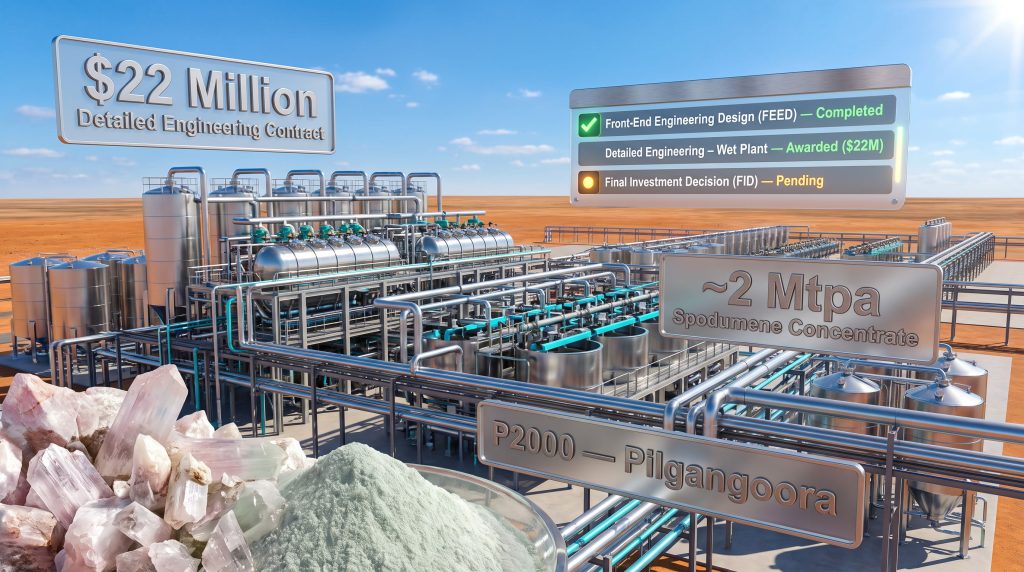
The P2000 program targets a processing throughput of approximately 2 million tonnes per annum (Mtpa) of spodumene concentrate at Pilgangoora. To contextualise the scale of that ambition, consider the following comparison:
| Metric | Current Operation | P2000 Target |
|---|---|---|
| Processing capacity target | Existing nameplate | ~2 Mtpa spodumene concentrate |
| Wet plant engineering phase | Completed | Detailed engineering underway |
| Engineering contractor | Lycopodium (FEED) | Lycopodium (Detailed Engineering) |
| Contract value (detailed engineering) | N/A | $22 million |
| Final Investment Decision | Sanctioned | Pending |
Achieving 2 Mtpa of spodumene concentrate output would position Pilgangoora among the highest-capacity hard-rock lithium operations globally. That scale also introduces processing design challenges that don't exist at smaller throughputs: ore variability management across multiple pit sources, reagent consumption optimisation at volume, and the hydraulic engineering demands of moving very large slurry volumes through a connected circuit.
Engineering Readiness as the Gateway to Project Sanction
The relationship between detailed engineering completion and a final investment decision is not incidental. In the resources sector, a project owner presenting an FID case to a board or to external capital providers must demonstrate capital cost accuracy within a defined confidence band. That confidence can only be achieved after detailed engineering has been substantially completed, because it is only at that stage that equipment costs can be firmly quoted, civil volumes can be quantified from detailed drawings, and construction schedules can be built with genuine logic.
The $22 million detailed engineering contract is therefore not just a work package for Lycopodium. It is a prerequisite deliverable on the critical path to project sanction. Without it, the P2000 FID cannot proceed with the level of cost confidence that project governance frameworks demand. As reported by Mining Monthly, the contract award represents a significant milestone in the broader P2000 program timeline.
| Project Milestone | Stage Status |
|---|---|
| Front-End Engineering Design (FEED) | Completed by Lycopodium |
| Detailed Engineering (Wet Plant) | Awarded to Lycopodium ($22M) |
| Final Investment Decision (FID) | Pending, supported by engineering progress |
| Target Processing Capacity (P2000) | ~2 Mtpa spodumene concentrate |
No formal FID timeline has been publicly confirmed. However, the commencement of detailed engineering work is the clearest available signal that project readiness is advancing toward the threshold at which a sanction decision becomes executable.
The Ore Sorting Dimension: A Complementary Technology Shift
Running alongside the wet plant engineering work, PLS has been advancing an aggressive adoption of ore sorting technology at Pilgangoora. Ore sorting involves the pre-concentration of ore before it enters the wet plant circuit, using sensor-based systems to eject waste rock at the earliest possible processing stage.
The implications for wet plant design are significant and not widely appreciated by generalist observers. If ore sorting successfully removes a material proportion of waste rock ahead of the wet plant feed, the effective grade of material entering the dense media and flotation circuits improves. This can allow for either a reduction in wet plant throughput requirements for equivalent concentrate output, or an improvement in recovery rates and concentrate quality at equivalent throughput.
The integration of ore sorting ahead of a wet plant circuit represents a departure from conventional processing design philosophy. Where traditional flowsheets accept run-of-mine variability and manage it within the wet plant, ore sorting pushes selectivity upstream, effectively allowing the wet plant to be designed around a higher-grade, more consistent feed profile.
The engineering decisions made during Lycopodium's current detailed design phase will need to account for the feed profile assumptions associated with ore sorting adoption. This is precisely the kind of site-specific technical context that an incumbent engineering firm with FEED knowledge is best placed to manage. In addition, developments in direct lithium extraction are further reshaping how processing engineers approach integrated lithium recovery across the broader sector.
Western Australian Mining Services: A Sector in Recalibration
The award of this contract does not occur in isolation from broader Western Australian mining services dynamics. Grant Thornton's commentary on mining contractors facing renewed activity reflects a discernible shift in project owner behaviour: companies that deferred expansion and development decisions during the sharp lithium price correction of 2023 and 2024 are now re-engaging engineering firms to rebuild project readiness ahead of anticipated demand recovery.
This recalibration creates a specific set of pressures in the specialist mineral processing engineering segment:
- Demand for experienced lithium processing engineers is recovering simultaneously across multiple major project owners in the Pilbara and broader Western Australian region.
- The pool of engineers with direct experience in large-scale spodumene wet plant design and commissioning is narrow relative to total project pipeline.
- Engineering firms with incumbent positions on major projects, as Lycopodium holds at Pilgangoora, are particularly well-insulated from competitive displacement as the sector recovers.
For the broader WA mining services sector, the Lycopodium PLS wet plant contract at Pilgangoora is a data point in a larger narrative: detailed engineering activity at major lithium operations is resuming, and with it comes the near-term precursor to construction mobilisation, procurement, and capital deployment that sustains the regional contractor and supplier ecosystem.
The next major ASX story will hit our subscribers first
Frequently Asked Questions: Lycopodium PLS Wet Plant Contract at Pilgangoora
What is the Lycopodium PLS wet plant contract at Pilgangoora?
It is a detailed engineering services contract valued at $22 million, awarded by PLS Group to Lycopodium for the design of the wet plant component within the P2000 expansion program at the Pilgangoora lithium operation in Western Australia. Work commenced immediately upon award.
What is the difference between FEED and detailed engineering?
FEED establishes the technical basis of design: process flow diagrams, major equipment selection, and capital cost estimates to a defined accuracy level. Detailed engineering converts those FEED outputs into fully construction-ready documentation, including precise equipment specifications, P&IDs, structural and civil drawings, and procurement packages. Detailed engineering provides a substantially higher level of cost and schedule confidence than FEED.
How does the wet plant contract relate to the broader P2000 expansion?
The P2000 program targets approximately 2 Mtpa of spodumene concentrate output at Pilgangoora. The wet plant is a core processing circuit within that expansion, responsible for upgrading ore into saleable concentrate. Completion of detailed engineering for the wet plant is a prerequisite step on the path to a formal final investment decision for the P2000 program.
Why was Lycopodium selected for the detailed engineering contract?
Lycopodium completed the preceding FEED work for the P2000 wet plant, which provides continuity of engineering knowledge across project phases. The firm also has prior involvement in the Mid-Stream Demonstration Plant at Pilgangoora, giving it accumulated site-specific design familiarity that reduces technical risk for the project owner.
When is a final investment decision on P2000 expected?
No formal FID timeline has been publicly disclosed. Commencement of the detailed engineering phase is a standard prerequisite before project sanction can occur with sufficient capital cost confidence. The progression to this phase signals meaningful advancement in project readiness, though FID timing will ultimately depend on engineering outcomes, market conditions, and board-level decisions.
Key Takeaways for Investors and Industry Observers
The Lycopodium PLS wet plant contract at Pilgangoora carries several layers of significance that extend well beyond the headline contract value:
- The $22 million detailed engineering award moves P2000 from conceptual planning into construction-ready design, a step that materially closes the gap to a viable FID.
- Engineering continuity from FEED through to detailed design is a genuine risk mitigation mechanism, preserving institutional knowledge of site-specific design constraints and reducing the likelihood of costly re-work.
- Ore sorting integration at Pilgangoora adds a layer of design complexity that an incumbent engineering firm is uniquely positioned to manage through the detailed design phase.
- Sector-wide engineering activity in Western Australian lithium processing is recovering, with project owners re-engaging specialist contractors as the market stabilises following the price correction cycle.
- If sanctioned, the P2000 expansion would establish Pilgangoora as one of the world's highest-capacity spodumene concentrate producers, a position with meaningful long-term strategic implications for global lithium supply chains.
This article contains forward-looking statements and projections based on publicly available information. Final investment decisions, project timelines, and production outcomes are subject to change based on engineering results, market conditions, and corporate governance processes. This content does not constitute financial advice. Readers should conduct independent research and consult qualified advisors before making investment decisions.
Want To Be First When the Next Major Lithium Discovery Hits the ASX?
Discovery Alert's proprietary Discovery IQ model scans ASX announcements in real time, instantly identifying significant mineral discoveries across lithium and 30+ other commodities — so subscribers can act before the broader market reacts. Explore historic discovery returns on Discovery Alert's dedicated discoveries page and begin your 14-day free trial today to position yourself ahead of the next major find.