
July 29, 2026
When Capital Discipline Becomes a Growth Catalyst
There is a recognisable pattern in the lifecycle of resource companies that have survived a commodity downturn: the ones that emerge strongest are not necessarily those with the largest reserves, but those that used the difficult period to build financial and operational muscle. The discipline required to survive a lithium price cycle becomes, paradoxically, the exact discipline needed to execute a credible expansion when conditions shift.
That dynamic is now playing out in real time at Kathleen Valley in Western Australia, where the underground operation has reached a pivotal inflection point. The Liontown Kathleen Valley expansion has moved from a concept shelved during weaker market conditions into an active, funded, and structurally de-risked programme with a clear decision timeline.
When big ASX news breaks, our subscribers know first
Understanding the Strategic Pivot Behind the Expansion
From Balance Sheet Repair to Deliberate Capital Deployment
Approximately six months before the June 2026 quarterly results, management's stated priority was financial resilience. The focus was on tightening operating costs, improving plant reliability, and building cash reserves against a backdrop of lithium price uncertainty. That phase has now concluded.
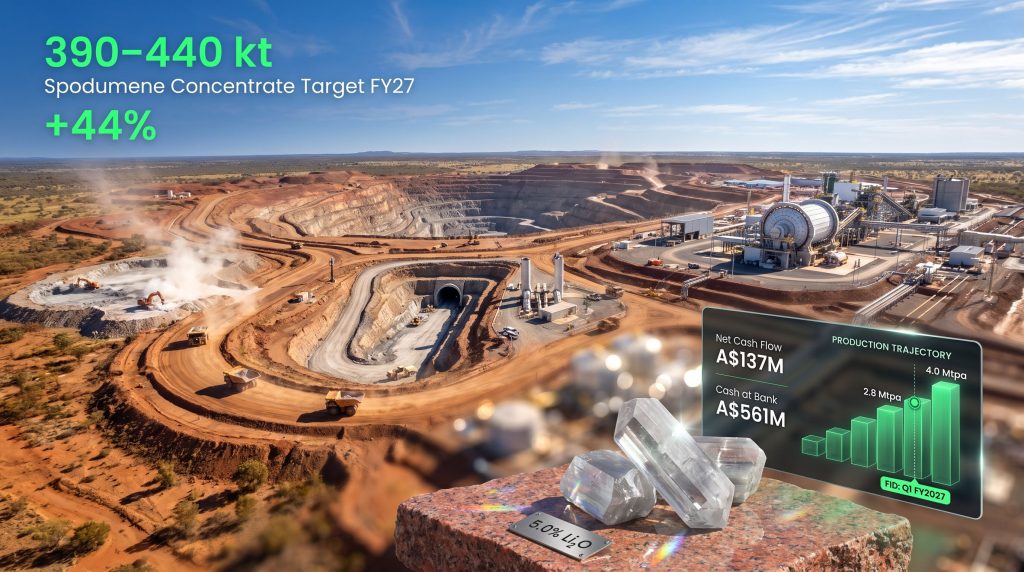
The June quarter delivered A$137 million in net cash flow, a company record that lifted the cash balance from A$424 million to A$561 million. That is not merely an accounting outcome. It signals that the operation has crossed the threshold from consumption to generation, and that the expansion conversation has shifted from aspiration to execution. Reviewing Liontown financial results from earlier periods makes this turnaround particularly striking.
The significance of a A$561 million cash position for a single-asset lithium producer cannot be understated. It provides the financial runway to fund pre-Final Investment Decision (FID) works without equity dilution, absorb construction cost variability, and maintain operational resilience if lithium prices soften during the expansion window.
Why Operational Data Matters More Than Feasibility Assumptions
One of the less-discussed aspects of the Liontown Kathleen Valley expansion study is that it is being built on live operational data rather than pre-production estimates. When Liontown first developed its feasibility case for Kathleen Valley, the underground mine had not yet been commissioned. Ore blends, geotechnical behaviour, processing characteristics, and infrastructure requirements were modelled from drilling data and analogous operations.
The expansion study now being refreshed has access to actual throughput rates, real recovery curves, observed ore hardness, and equipment performance data. This is a materially stronger analytical foundation, and it reduces the probability of the cost blowouts and schedule delays that have plagued other Australian lithium projects. Furthermore, understanding underground lithium mining at scale reveals just how significant this data advantage truly is.
The Liontown Kathleen Valley Expansion: Structural Components and Capital Commitments
Breaking Down the Staged Build vs. a Single Capacity Jump
The expansion to approximately 4.0 million tonnes per annum (Mtpa) is not being executed as a single large commitment. Instead, it follows a staged architecture where early-works investments are made ahead of the FID, which is expected by the end of Q1 FY2027. This structure serves two purposes: it advances the project timeline so construction can commence promptly after FID approval, and it limits financial exposure if the decision is ultimately not to proceed.
The pre-FID capital ceiling is A$77 million, with FY2026 early-works cash spend guided at A$15 to A$18 million. The distinction between these two figures is important for investors. The A$15 to A$18 million represents actual cash leaving the business in the current financial year, while the A$77 million represents the total capital that could be deployed across all pre-FID activities if the full programme proceeds on schedule.
Key Infrastructure Components Already Committed or Underway
| Expansion Component | Strategic Purpose | Capital Commitment |
|---|---|---|
| 5.5MW Ball Mill Procurement | Increase plant throughput and improve lithium recovery rates | ~A$12 million |
| Northwest Flats Pre-Development Drilling | Resource definition and mine scheduling | Part of early-works budget |
| Stage 1 Mine Services Area (Permanent) | Support expanded mining fleet and workforce | Part of early-works budget |
| Northwest Flats Underground Development | Additional portals, ventilation, power and water infrastructure | Part of early-works budget |
| Third Paste Plant Pump | Enable simultaneous pastefill across multiple orebodies | Part of early-works budget |
| Expansion Project Team Mobilisation | Enabling infrastructure and project management | Part of early-works budget |
The Ball Mill as the Highest-Conviction Early Commitment
The A$12 million ball mill procurement deserves particular attention because it represents the single largest discrete commitment within the early-works programme. Ball mills are long-lead items, typically requiring 12 to 18 months from order to site delivery, which means procuring this equipment now is functionally a statement of intent regardless of the formal FID outcome.
A 5.5MW ball mill at this scale is designed to handle harder ore types with greater efficiency, which is relevant to Kathleen Valley specifically. As the underground mine accesses deeper ore zones, ore hardness can increase, and a more powerful mill ensures that throughput targets are not constrained by processing bottlenecks. The Kathleen Valley project page details how this infrastructure fits within the broader site development plan.
June Quarter Operational Performance: The Evidence Behind the Expansion Case
Record Results Across Multiple Metrics
| Operational Metric | June Quarter Result |
|---|---|
| Net Cash Flow | A$137 million (record) |
| Cash at Bank (Quarter-End) | A$561 million |
| Revenue | A$235 million |
| Spodumene Concentrate Sold | 108,489 dry metric tonnes (dmt) |
| Spodumene Concentrate Produced | 103,111 dmt at 5.0% Li₂O average grade |
| Underground Development Metres | 3,316 metres (35% increase quarter-on-quarter) |
| Ore Mined (Underground) | 356 kilotonnes |
| Process Plant Availability | 92% |
| Lithium Recovery Rate | 63% average (rising to 70% on consistent underground ore) |
What 92% Plant Availability Actually Means
Process plant availability of 92% is a technically meaningful benchmark in hard rock lithium processing. Plant downtime in spodumene operations typically arises from liner wear in crushing circuits, maintenance on flotation cells, and scheduled inspections of thickeners and filtration systems. A 92% availability rate indicates that the operation has moved beyond the teething phase, with maintenance cycles now integrated into production scheduling rather than reactive.
This matters for the expansion thesis because it demonstrates that the existing infrastructure is reliable enough to serve as the foundation for a capacity step-up, rather than requiring wholesale replacement before expansion can proceed.
The Recovery Rate Story: Why 63% to 70% Is a Significant Band
Lithium recovery in spodumene flotation is influenced by ore mineralogy, particle size distribution, reagent chemistry, and feed grade consistency. The reported average recovery of 63%, rising to 70% when processing consistent underground ore, contains an important operational insight. In addition, the broader significance of spodumene lithium extraction underscores why closing this recovery gap carries substantial commercial weight.
The gap between 63% and 70% recovery is not a plant performance failure. It reflects the reality that during the ramp-up phase, the processing plant receives a blend of ore from different sources with varying mineralogical characteristics. As underground ore becomes the dominant feed, recovery rates structurally improve because flotation circuits can be optimised for a more consistent input.
This means the expansion's value proposition is partially embedded in ore blend management, not purely in throughput volume. As the mine reaches its 2.8 Mtpa run-rate target by end-FY27, the blend should naturally shift toward the higher-recovery profile, creating an embedded upgrade in concentrate output without requiring additional plant modifications.
Development Metres as a Leading Indicator
Why 3,316 Metres in One Quarter Is a Company Milestone
Underground development metres are the single most important leading indicator for future production capacity at Kathleen Valley, and the 3,316 metres achieved in the June quarter represents a 35% increase on the prior quarter and a new company record.
The logic connecting development metres to production capacity follows a clear chain:
- Development metres physically open access to ore zones within the underground mine geometry
- Greater ore access allows multiple simultaneous mining fronts to operate concurrently
- Parallel mining fronts increase the tonnage rate that can be extracted per week
- Higher weekly extraction rates are what drives the processing plant toward its throughput targets
- The 2.8 Mtpa ore mining run-rate by end-FY27 is directly contingent on maintaining development momentum throughout FY27
- The subsequent 4.0 Mtpa expansion target then layers additional capacity on top of this established access infrastructure
Northwest Flats and the Geometry of Expansion
The Northwest Flats orebody is central to the expansion geometry. Developing additional portals, ventilation infrastructure, power reticulation, and water management systems into Northwest Flats is what enables the operation to add ore supply from a second major source simultaneously with the primary orebody. This is not simply redundancy — it is the architectural requirement for moving from a sequential mining operation to a parallel one.
The third paste plant pump is directly connected to this strategy. Pastefill is the process by which waste material is mixed with cement and pumped back underground to fill mined-out voids, providing ground support and enabling safe extraction of adjacent ore. With only two pumps, simultaneous pastefill across multiple active orebodies creates scheduling constraints. Consequently, a third pump removes that bottleneck entirely, enabling the Northwest Flats development to proceed in parallel with existing operations. The scope of the Liontown underground expansion illustrates precisely why this infrastructure investment is so strategically timed.
Production Trajectory and FY27 Guidance
The Path From Current Output to 4.0 Mtpa
Production Trajectory Overview:
─────────────────────────────────────────────────────
Current Phase:    Underground ramp-up → 2.8 Mtpa mining run-rate (target: end FY27)
FY27 Guidance:    390–440 kt spodumene concentrate production
Expansion Phase:  Staged build-out → ~4.0 Mtpa (subject to FID by Q1 FY27)
─────────────────────────────────────────────────────
The FY27 production guidance range of 390 to 440 kilotonnes of spodumene concentrate is the transitional milestone between the current ramp-up phase and the expansion phase. Meeting this guidance range would require continued improvement in development rates, sustained plant availability above 90%, and gradual recovery rate uplift as the underground ore fraction of total feed increases.
FID Timeline and What Investors Should Monitor
The FID for the Kathleen Valley expansion is expected by the end of Q1 FY2027. Between now and that decision point, the key variables to monitor include:
- Progress of the expansion study, particularly cost estimates and capital intensity for the full 4.0 Mtpa build-out
- Underground development metres in Q1 and Q2 FY27 as a proxy for execution capability
- Lithium spodumene concentrate pricing and demand signals from battery-grade lithium chemical producers
- Ball mill delivery timeline as a practical constraint on construction commencement
- Northwest Flats early-development results, which will inform the ore scheduling assumptions underpinning the expansion business case
The next major ASX story will hit our subscribers first
Key Risks and Investment Considerations
Lithium Price Sensitivity
The expansion plan has been deliberately structured to preserve optionality. The staged early-works approach and the FID timeline mean that a deterioration in lithium market conditions before Q1 FY27 could delay or restructure the expansion decision without stranding significant committed capital. This is a meaningful risk management feature, not just project management discipline.
However, investors should note that pre-FID capital of up to A$77 million is not fully recoverable if the expansion does not proceed. Long-lead equipment such as the ball mill may have secondary market value, but purpose-built underground infrastructure has limited alternative use. Liontown stock performance over recent periods reflects how sensitively the market responds to these expansion signals.
Execution Risk in Underground Development
Maintaining the development momentum necessary to achieve the 2.8 Mtpa mining run-rate by end-FY27 requires consistent quarterly development performance at or above the June quarter record of 3,316 metres. Underground development can be disrupted by geotechnical events, equipment availability, ventilation constraints, and workforce availability. Any sustained reduction in development rates in FY27 would push the run-rate target beyond end-FY27, with downstream effects on the expansion timeline.
Capital Cost Escalation Risk
The pre-FID capital ceiling of A$77 million provides a framework, but full expansion capital costs will be substantially larger and are not yet publicly disclosed pending the completion of the expansion study. Australian mining construction costs have been subject to inflationary pressure from labour, energy, and materials over recent years. Furthermore, any cost escalation in the expansion study could affect the economics of the FID. Analysts tracking lithium market expansion trends have noted that capital discipline will remain the defining variable for producers navigating this environment.
Summary: The Kathleen Valley Expansion Investment Thesis at a Glance
| Strategic Dimension | Current Status |
|---|---|
| Balance Sheet Strength | A$561 million cash; record quarterly cash flow of A$137 million |
| FY27 Production Target | 390 to 440 kt spodumene concentrate |
| Ore Mining Run-Rate Target | 2.8 Mtpa by end-FY27 |
| Expansion Capacity Target | ~4.0 Mtpa (subject to FID) |
| FID Timeline | End of Q1 FY27 |
| Pre-FID Capital Exposure | Up to A$77 million |
| Key Early-Works Commitment | ~A$12 million ball mill procurement |
| FY2026 Early-Works Budget | A$15 to A$18 million |
| 12-Month Share Price Performance | +44% (vs. ASX 200: +3%) |
The Liontown Kathleen Valley expansion represents a case study in how operational credibility, balance sheet discipline, and technically grounded project development can combine to create a compelling growth thesis. The strength of the June quarter results, the record development metres achieved underground, and the deliberate staged structure of the early-works programme together reflect a materially different quality of expansion preparation than what was originally contemplated before the mine entered production.
Whether the FID proceeds on schedule will depend on factors both within and outside management's control. What is within their control, and what the June quarter demonstrated convincingly, is that the physical and financial foundations for that decision are now firmly in place.
This article is general in nature and does not constitute financial advice. Past operational performance and cash flow results are not necessarily indicative of future outcomes. Investors should consider their own circumstances and seek independent financial advice before making investment decisions. Forecasts, production targets, and FID timelines are subject to change based on market conditions, operational outcomes, and management decisions.
Want to Catch the Next Major ASX Mineral Discovery Before the Market Does?
Discovery Alert's proprietary Discovery IQ model delivers real-time alerts on significant ASX mineral discoveries, transforming complex geological and market data into actionable investment insights for both short-term traders and long-term investors — explore historic discoveries and the returns they generated to understand what early positioning can mean, then begin your 14-day free trial at Discovery Alert to secure your market-leading edge.