July 29, 2026
The Commodity That Outgrew Its Origin Story
For most commodities, the demand story stays relatively stable for decades. Iron ore feeds steel mills. Copper wires buildings. Coal generates power. However, lithium has done something unusual in the space of just a few years: it has developed an entirely new demand identity, one that is rapidly rivalling the use case that originally propelled it into the investment spotlight.
The Rio Tinto lithium demand shift to grid storage is not a minor footnote in a quarterly earnings report. It represents a fundamental structural change in how the world's largest miners must now think about one of the most closely watched commodities in the energy transition. When a company of Rio Tinto's scale begins repositioning its lithium strategy around energy storage infrastructure rather than purely around electric vehicle supply chains, the implications extend well beyond a single miner's production roadmap.
When big ASX news breaks, our subscribers know first
BESS vs. EVs: The Demand Divergence That Changes Everything
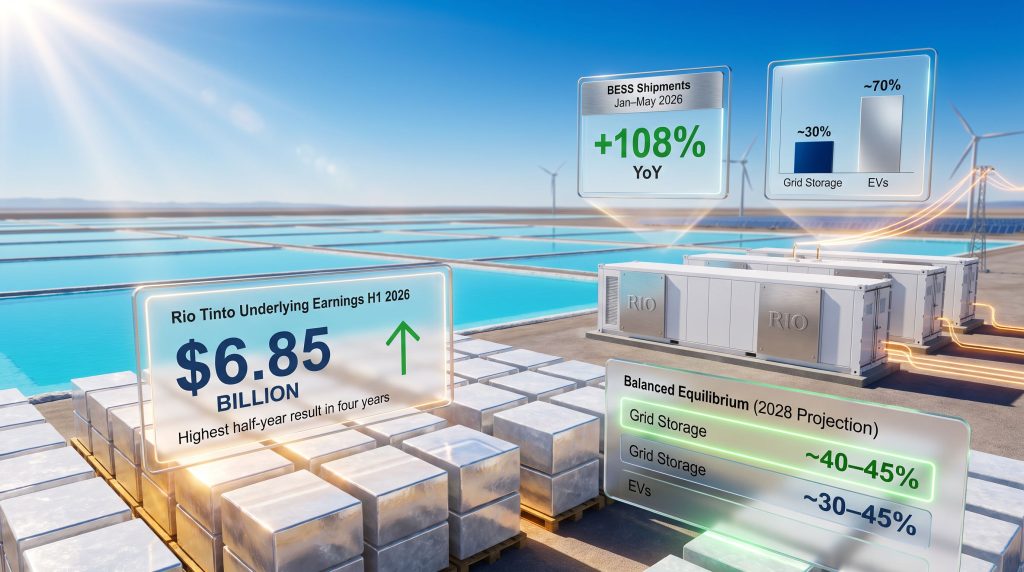
The numbers behind this shift are striking. Battery energy storage system (BESS) shipments surged approximately 108% year-over-year in the first five months of 2026, while electric vehicle sales growth registered a comparatively modest 1% year-over-year over the same period. This is not a rounding error or a data anomaly. It is the clearest statistical expression yet of a structural inflection point that industry analysts have been anticipating for years.
To understand why this divergence matters, it helps to know what drove the previous decade of lithium demand. The battery storage-driven lithium boom created an almost singular narrative around EV adoption, pulling institutional capital, government incentives, and mining investment into a single demand funnel. That concentration made lithium's price trajectory unusually sensitive to EV sales cycles, consumer sentiment, interest rate environments, and policy subsidy regimes, all of which are volatile by nature.
Grid storage operates on an entirely different demand logic. The buyers are not individual consumers weighing up affordability or range anxiety. They are utility companies, grid operators, and large-scale infrastructure programmes executing multi-year procurement contracts. This changes the fundamental demand characteristics of the market:
- Utility procurement is contract-backed and relatively predictable over multi-year horizons
- Grid storage deployment is driven by regulatory mandates and capital programmes rather than consumer discretionary spending
- Demand is geographically distributed across the US, Europe, China, Australia, and emerging markets simultaneously
- Storage buildout is being accelerated by a convergence of renewable integration targets, energy security priorities, and AI-driven data centre power infrastructure requirements
Grid storage now accounts for approximately 30% of global lithium demand, a threshold that permanently alters the commodity's risk profile. S&P Global has identified stationary energy storage as the fastest-growing source of lithium demand worldwide, with uptake accelerating across multiple continents at once.
| Demand Segment | YoY Growth (Jan–May 2026) | Estimated Share of Total Lithium Demand |
|---|---|---|
| Battery Energy Storage Systems (BESS) | +108% | ~30% |
| Electric Vehicles (EVs) | +1% | ~70% |
Rio Tinto's Strategic Repositioning: More Than a Product Pivot
Rio Tinto CEO Simon Trott, speaking to investors in late July 2026 alongside the company's half-year results, acknowledged that the company is observing meaningful demand shifts across its commodity portfolio, with grid storage performing more strongly than prior modelling had anticipated. This is a significant admission from the leader of one of the world's largest diversified miners, because it implies that internal demand forecasting frameworks built around EV-centric assumptions are now being revised in real time.
The company's response has been deliberate rather than reactive. Rio Tinto markets battery-grade lithium hydroxide specifically designed for energy storage applications, a product-market alignment that positions it to serve both high-performance EV battery chemistries and the rapidly expanding grid-scale lithium iron phosphate (LFP) sector. Furthermore, the global lithium market outlook increasingly supports this dual-market approach as demand diversification accelerates.
Battery-grade lithium hydroxide is the preferred input for high-energy-density battery applications. LFP chemistry, which dominates the grid storage segment, can be produced from both lithium hydroxide and carbonate feedstocks, giving hydroxide producers flexibility across multiple end markets simultaneously.
Rio Tinto is targeting approximately 200,000 tonnes per year of lithium capacity by 2028, with future expansion decisions explicitly conditioned on market conditions and return thresholds. This capital discipline stance is worth noting carefully. During the 2021–2023 lithium boom, several producers aggressively expanded capacity in anticipation of demand that arrived more slowly than projected, contributing to a pronounced oversupply cycle and significant price deterioration. Rio Tinto's optionality-based approach allows it to accelerate or defer capacity additions without committing to irreversible capital outlays in a still-volatile price environment.
The Financial Foundation Behind the Long Game
Rio Tinto reported underlying earnings of $6.85 billion for the six months ended 30 June 2026, its strongest half-year result in four years. This 43% rise in interim profit was primarily driven by surging copper earnings and broadly elevated commodity prices across the portfolio, partially offset by softer iron ore performance.
This financial context matters enormously for understanding the company's lithium strategy. A balance sheet generating $6.85 billion in half-year earnings provides the runway to absorb near-term lithium price softness without being forced into distressed project decisions. Smaller, single-commodity lithium producers operating in the same price environment face an entirely different calculus, often confronting pressure to defer capex, dilute equity, or accept unfavourable offtake terms during demand transition periods.
Rio Tinto's diversified earnings base, spanning copper, iron ore, aluminium, and lithium, functions as a natural hedge against commodity-specific cycles. This structural advantage is particularly valuable during the current transitional phase, where lithium prices remain pressured despite fundamentally improving long-run demand dynamics.
The Three Forces Accelerating Grid Storage Lithium Demand
Understanding the scale and durability of the BESS demand wave requires looking beneath the headline growth figures. Three structural forces are converging simultaneously:
-
Renewable energy integration requirements. As wind and solar capacity continues to expand globally, grid operators require increasingly large storage buffers to manage intermittency. Storage is not optional in a high-renewable grid architecture; it is a technical necessity. This creates a demand floor that is insensitive to energy price cycles.
-
AI and data centre power infrastructure. The explosive growth of artificial intelligence computing has created an enormous and largely underappreciated new source of energy storage demand. Data centres require reliable, uninterruptible power, and the grid-adjacent battery storage market serving this sector is expanding rapidly. Rio Tinto has specifically referenced this use case in its lithium market positioning, suggesting that internal demand modelling now incorporates AI infrastructure as a distinct demand driver.
-
Energy security imperatives. Geopolitical disruption to energy supply chains across Europe, Asia, and North America has accelerated national and corporate investment in grid resilience. Battery storage is a central component of energy security architecture, and procurement timelines in this segment are being compressed by policy urgency.
Lithium Chemistry: Why Product Specification Matters More Than Ever
One dimension of the grid storage shift that receives less attention than headline demand figures is the chemistry-level implication for lithium producers. Not all lithium products are equal in the context of a diversifying end-use market.
LFP batteries, which now dominate large-scale stationary storage deployments, have different feedstock requirements than the nickel-manganese-cobalt (NMC) chemistries that have historically been preferred for high-performance EV applications. LFP can tolerate a wider range of lithium input qualities, but battery-grade specifications remain essential for industrial procurement standards.
Producers primarily oriented toward spodumene lithium extraction or lower-purity carbonate products face a potential product-mix disadvantage as grid storage demand intensifies. Spodumene, the hard-rock lithium mineral mined at operations such as the Greenbushes mine in Western Australia, must be converted into either carbonate or hydroxide to be usable in battery manufacturing. The conversion step adds cost and complexity, but it also determines which end markets a producer can access. Hydroxide-capable producers retain the broadest market access across both EV and storage applications.
How Does Extraction Technology Influence Product Quality?
Advances in direct lithium extraction technology are also reshaping how producers approach product specification. DLE methods can yield higher-purity lithium outputs from brine sources more efficiently than conventional evaporation pond techniques, potentially improving the economics of hydroxide conversion and expanding the range of deposits that can serve battery-grade end markets. In addition, lithium carbonate supply dynamics remain a critical variable for producers assessing which feedstock pathway best aligns with the growing grid storage opportunity.
Demand Scenario Modelling: Where Is This Heading by 2030?
The pace of grid storage growth introduces meaningful uncertainty into long-run lithium demand modelling. Several scenarios are now plausible depending on how quickly renewable deployment scales, how aggressively AI infrastructure buildout continues, and whether EV adoption re-accelerates from its current slower growth phase.
| Scenario | EV Demand Share | Grid Storage Share | Price Stability Outlook |
|---|---|---|---|
| EV-Dominated (Pre-2024 Baseline) | ~80% | ~15–20% | High volatility, cycle-dependent |
| Transitional Balance (2026 Current) | ~70% | ~30% | Moderate, with improving floor |
| Balanced Equilibrium (2028 Projection) | ~55–60% | ~40–45% | Structurally more stable |
| Storage-Led Growth (Post-2030 Upside) | ~45–50% | ~50%+ | Utility-contract anchored |
Rio Tinto has signalled that demand is expected to become considerably more balanced between EVs and energy storage within approximately two years. According to Reuters reporting on Rio Tinto's lithium outlook, this rebalancing carries meaningful implications for price floor dynamics and long-term contract structures. A market where half of lithium demand is driven by utility-scale procurement rather than consumer EV sales is a structurally different pricing environment than the one that has prevailed since 2015.
The next major ASX story will hit our subscribers first
Investor Implications: Reclassifying Lithium as an Energy Infrastructure Commodity
The investment case for lithium is undergoing a quiet but consequential reclassification. For much of the past decade, lithium was modelled primarily as an EV supply chain input, with demand forecasts tied directly to automotive sales volumes and battery attach rates. That framework increasingly undervalues the commodity's exposure to the energy infrastructure investment cycle.
If grid storage is already absorbing 30% of global lithium demand and is projected to approach demand parity with EVs within two years, then lithium's long-run demand profile more closely resembles an energy infrastructure input than a consumer electronics or automotive commodity. This has direct implications for how discount rates, demand elasticity, and price floor assumptions should be modelled in project valuations.
For investors monitoring the Rio Tinto lithium demand shift to grid storage specifically, several metrics deserve close attention:
- BESS deployment volumes by region, reported quarterly, as a leading indicator of lithium offtake acceleration
- Rio Tinto's lithium hydroxide production ramp toward the 200,000 tonne per year 2028 target as a capacity utilisation signal
- The EV-to-BESS demand ratio as a structural diversification health metric for the broader lithium market
- Lithium hydroxide versus carbonate price spreads as a proxy for the intensity of grid storage demand pulling on hydroxide supply
- Copper earnings trajectory at Rio Tinto, which directly funds the financial headroom supporting the company's patient lithium strategy
Furthermore, analysts tracking the energy storage demand drivers for lithium have noted that the commodity's risk profile is evolving in ways that traditional EV-centric valuation models have not yet fully captured. Consequently, investors who update their frameworks to reflect grid storage as a primary demand variable may identify pricing inefficiencies in both producer equities and long-run offtake contract valuations.
Disclaimer: This article is intended for informational and educational purposes only and does not constitute financial advice. Forecasts, projections, and scenario models discussed herein involve inherent uncertainty and should not be relied upon as predictions of future outcomes. Readers should seek independent financial advice before making investment decisions.
FAQ: Rio Tinto and the Grid Storage Lithium Demand Shift
Why is grid storage growing so much faster than EV demand for lithium in 2026?
Grid storage growth reflects the convergence of multiple structural forces: accelerating renewable energy deployment, grid resilience investment, and AI-driven data centre power infrastructure. EV demand growth has moderated due to consumer affordability pressures and the normalisation of post-pandemic adoption curves, creating a significant divergence in near-term growth rates.
Does stronger grid storage demand mean EV lithium demand is declining?
Not in absolute terms. EVs still represent approximately 70% of total lithium consumption. The divergence reflects grid storage growing at a dramatically faster rate, not an absolute contraction in automotive demand. The net effect is a more diversified and structurally resilient demand base for lithium overall.
What is Rio Tinto's 2028 lithium production target?
Rio Tinto is targeting approximately 200,000 tonnes per year of lithium capacity by 2028, with future expansion decisions contingent on market conditions and return thresholds rather than locked-in capital commitments.
How does demand diversification affect long-term lithium prices?
A demand base more evenly split between EVs and grid storage reduces the commodity's vulnerability to single-sector demand shocks. Utility-driven grid storage procurement is largely contract-backed and policy-mandated, which supports a more stable long-run price floor compared to a market dominated by consumer-facing automotive sales cycles.
What type of lithium chemistry does grid storage primarily require?
Large-scale BESS deployments predominantly use LFP chemistry, which can be produced from both lithium carbonate and hydroxide feedstocks. Battery-grade lithium hydroxide remains the preferred input for high-energy-density applications across both EV and stationary storage segments, giving hydroxide-capable producers the broadest end-market access.
Want to Know Which ASX Lithium Discoveries Could Benefit From the Grid Storage Boom?
As lithium's demand profile shifts structurally toward energy infrastructure, identifying the right exploration opportunities early becomes critical — Discovery Alert's proprietary Discovery IQ model scans ASX announcements in real time, instantly alerting subscribers to significant mineral discoveries before the broader market reacts. Explore historic examples of major discovery returns and begin a 14-day free trial at Discovery Alert to position yourself ahead of the next major lithium or battery metals find.