July 28, 2026
The Structural Economics Behind Long-Term Spodumene Supply Contracts
When lithium prices collapsed by more than 80% between late 2022 and early 2025, the casualties were not just spot market traders. Junior mining developers who had relied on the assumption of persistently high spodumene prices to attract equity financing found themselves stranded, unable to advance projects to production without a credible commercial anchor. The aftermath of that correction fundamentally changed how sophisticated actors in the lithium supply chain think about risk allocation.
Consequently, it accelerated a decisive shift toward binding, long-duration offtake agreements as the preferred mechanism for de-risking development-stage projects. Understanding spodumene extraction basics is therefore essential context for evaluating this structural evolution in how lithium supply is contracted, which sits at the heart of the Rock Tech Transamine offtake agreement — a deal that carries implications extending well beyond a single Canadian mining project.
When big ASX news breaks, our subscribers know first
From Spot Markets to Binding Supply Contracts: A Critical Minerals Inflection Point
The spot market served lithium developers well during the supercycle of 2021 and 2022, when prices for spodumene concentrate peaked above US$8,000 per dry metric tonne. However, spot exposure cuts both ways. The same volatility that generated extraordinary windfalls during the upswing exposed unhedged developers to existential risk during the correction. Spodumene prices retraced to below US$800 per tonne by early 2025, a level at which many proposed projects became economically marginal without committed offtake to underpin project finance.
The consequence is a market dynamic in which offtake agreements have taken on a quasi-financing function. A binding purchase commitment from a credible counterparty not only provides revenue visibility but also serves as a prerequisite for engaging project lenders and equity investors. In this context, the Rock Tech Transamine offtake agreement represents a textbook application of that principle.
Furthermore, the broader critical minerals demand environment makes this shift even more pronounced, as governments and industry players alike scramble to secure stable supply chains.
Binding offtake agreements have evolved from pure commercial instruments into foundational elements of junior mining project finance architecture, particularly in the critical minerals sector where price volatility remains elevated.
What the Rock Tech Transamine Offtake Agreement Actually Covers
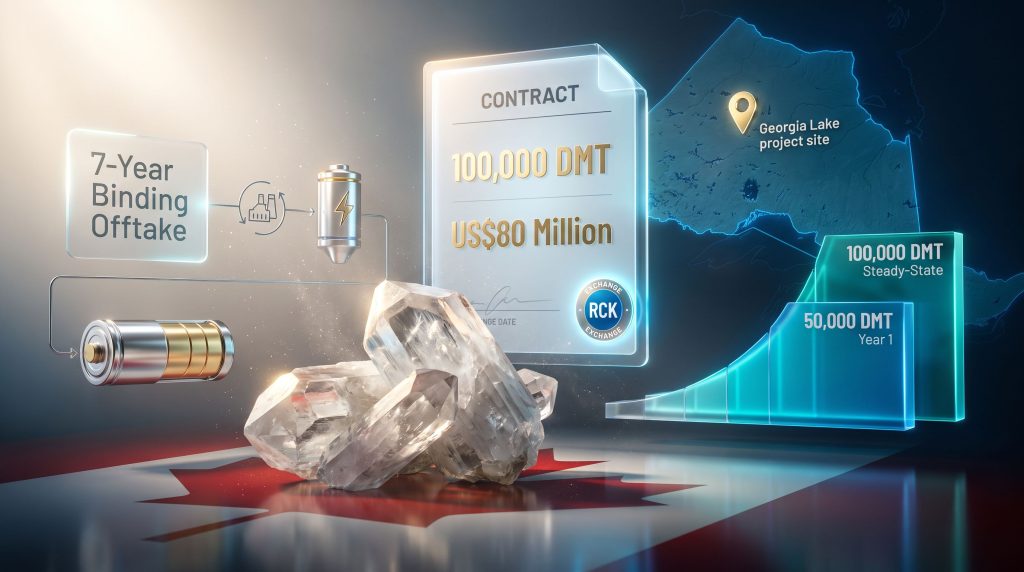
The agreement is a binding, seven-year commercial contract between Rock Tech Lithium (TSXV: RCK) and Geneva-headquartered commodity trader Transamine SA. Under its terms, Rock Tech will supply spodumene concentrate sourced from its Georgia Lake project in northern Ontario, with annual volumes scaling from 50,000 dry metric tonnes (DMT) in the first year to a steady-state rate of 100,000 DMT in subsequent years.
The core commercial parameters are summarised below:
| Parameter | Detail |
|---|---|
| Agreement Type | Binding offtake, spodumene concentrate |
| Supply Source | Georgia Lake Project, Ontario, Canada |
| Initial Term | 7 years from first delivery |
| Extension Option | Up to 5 additional years |
| Year 1 Volume | 50,000 dry metric tonnes |
| Steady-State Volume | 100,000 DMT per year |
| Volume Tolerance | ±10% in Rock Tech's favour |
| Delivery Commencement | Expected 2028 |
| Pricing Benchmark | Fastmarkets 6% Li₂O, CIF China |
| Prepayment Facility | Up to US$80 million |
| Repayment Window | 24 months from first delivery |
| Interest Rate | 3-month CME Term SOFR + 2.95% |
The volume tolerance clause is a noteworthy detail. A ±10% flexibility provision exercisable in Rock Tech's favour protects the company against operational variability during the commissioning and early ramp-up phases, which are historically the most unpredictable periods of any mine's production life.
Both parties have agreed to revisit and finalise all material delivery terms once a definitive feasibility study has been completed, meaning the 2028 target and all volume commitments remain subject to revision at that milestone. For additional context on this deal's structure, Rock Tech's announcement provides further detail on the binding nature of the arrangement.
Georgia Lake: The Deposit Underpinning the Supply Commitment
Grade, Resource, and Competitive Context
Georgia Lake is Rock Tech's primary lithium asset and is located in the Thunder Bay mining district of northern Ontario. The deposit carries an indicated resource grade of 0.82% Li₂O, based on resource estimation work completed in July 2022. While this grade sits within the range typical of hard-rock lithium pegmatite deposits globally, its significance is amplified by its location within a Canadian jurisdiction that offers access to low-carbon hydro power, established mining infrastructure, and proximity to planned North American battery manufacturing capacity.
For context, spodumene concentrate delivered to market is typically upgraded to a standard specification of around 6% Li₂O content through dense media separation and flotation processing. The gap between the in-situ grade of 0.82% Li₂O and the 6% Li₂O delivery specification determines the strip ratio of ore to product and is a key input into processing plant design and capital cost estimates.
The Integrated Mine-to-Converter Model
What distinguishes Rock Tech's broader strategy from a conventional junior mining play is the company's stated intention to operate as a vertically integrated producer. The Georgia Lake project is designed to supply spodumene feedstock to Rock Tech's planned Red Rock converter facility, which would transform the concentrate into battery-grade lithium hydroxide or lithium carbonate for direct use in cathode active material manufacturing.
This integration matters commercially because the margin capture across the lithium value chain is heavily weighted toward the downstream conversion stage. Understanding the full journey from spodumene to lithium salts illustrates why controlling both the mining and conversion steps allows a company to capture a meaningfully larger share of the value embedded in each tonne of lithium that eventually enters a battery cell.
The Transamine offtake covers the upstream spodumene concentrate portion of that chain, effectively monetising the mine's output while the converter is being developed and financed. Rock Tech's leadership has described the agreement as a foundational step toward establishing a stable, domestically anchored supply of battery-grade lithium materials for Canada and allied nations.
Understanding the Pricing Architecture: Benchmark Linkage and Floor Protection
How Fastmarkets Spodumene Pricing Works
The pricing mechanism in the Rock Tech Transamine offtake agreement is referenced against the Fastmarkets spodumene concentrate benchmark for minimum 6% Li₂O content, delivered CIF China. This benchmark functions as the primary global price discovery reference for spodumene, and its use as a contractual pricing anchor is standard practice for Australian, Canadian, and African hard-rock lithium producers.
Because concentrates from different mines vary in actual Li₂O content delivered, the contract includes grade adjustment provisions that modify the realised price based on the actual lithium content of each parcel. A shipment grading above the 6% benchmark earns a premium; material below specification is discounted accordingly.
The Floor Price Provision and Why It Matters
The inclusion of a qualified floor price is the element of the pricing structure that carries the most significance for project economics and financing discussions. Floor prices create an asymmetric risk profile in which downside revenue exposure is bounded while the seller retains full participation in upside price movements.
Comparing the major pricing model types clarifies why the benchmark-with-floor structure is particularly suited to the current environment:
| Pricing Model | Revenue Certainty | Upside Participation | Market Risk Exposure |
|---|---|---|---|
| Fixed Price | High | None | Low |
| Benchmark-Linked with Floor | Moderate | Yes | Moderate |
| Pure Spot Market | Low | Full | High |
| Hybrid Floor Plus Ceiling | High | Partial | Low |
Given that spodumene prices collapsed from above US$8,000/t to sub-US$800/t within roughly two years, a floor price provision represents meaningful structural protection for a project whose financing viability depends on a minimum revenue threshold. In addition, technologies such as direct lithium extraction are reshaping cost structures across the sector, adding further complexity to how pricing floors are calibrated.
The US$80 Million Prepayment Facility: Non-Dilutive Finance Embedded in an Offtake
How Prepayment Facilities Work in Mining
Prepayment facilities in the mining sector are a form of commodity-backed lending in which a trading counterparty or financial institution advances capital to a developer in exchange for the right to purchase future production at agreed terms. The advance is repaid through the progressive set-off of product deliveries rather than through conventional cash debt service, which aligns repayment cash flows with operational production.
From a developer's perspective, a prepayment facility is attractive because it is non-dilutive, meaning it does not require the issuance of additional equity. For shareholders of a junior developer like Rock Tech Lithium, this is a structurally important distinction.
Conditions Governing Access to the Facility
Access to the US$80 million framework embedded in the Rock Tech Transamine offtake agreement is conditional on the satisfaction of several prerequisites:
- Completion of a definitive feasibility study establishing project economics with engineering-grade precision
- Full project equity financing confirmed and committed
- Regulatory permitting obtained across all relevant jurisdictions
- Land access agreements formalised with relevant stakeholders
- Due diligence completion by Transamine, covering project fundamentals and counterparty risk
- Facility terms finalised and documented in binding legal agreements
- Prepayment funds advanced up to US$80 million to support construction
- First delivery achieved in 2028, triggering the 24-month repayment window via concentrate set-off
Critical Investor Caveat: The US$80 million prepayment facility represents a framework agreement, not committed capital. It does not constitute a binding funding commitment at this stage and should not be interpreted as confirmed project financing.
Interest Rate Structure and Financing Cost Context
The facility accrues interest at 3-month CME Term SOFR plus 2.95%. With SOFR rates in mid-2026 reflecting the prevailing interest rate environment, this pricing places the facility's all-in cost within a range broadly comparable to senior secured project finance but with materially lower covenant complexity. For a pre-production mining developer, access to this type of capital at these terms would represent a significant improvement over conventional alternatives such as convertible notes or royalty financing.
The next major ASX story will hit our subscribers first
Annualised Revenue Scenarios: What 100,000 Tonnes Means at Different Price Points
Illustrative revenue modelling across a range of spodumene price scenarios provides a useful framework for contextualising the agreement's potential financial significance. The following estimates are indicative only and subject to grade adjustments, floor price provisions, processing costs, and prevailing market conditions.
| Spodumene Price (per DMT, 6% Li₂O) | Year 1 Revenue (50,000 DMT) | Steady-State Revenue (100,000 DMT) |
|---|---|---|
| US$700/t | ~US$35 million | ~US$70 million |
| US$900/t | ~US$45 million | ~US$90 million |
| US$1,200/t | ~US$60 million | ~US$120 million |
| US$1,500/t | ~US$75 million | ~US$150 million |
Note: All revenue figures are purely illustrative. Actual realised revenue will depend on delivered grade, applicable floor price provisions, inflation adjustments, and market pricing at the time of delivery.
Transamine SA: What a Geneva Commodity Trading House Brings to the Deal
Transamine is a Geneva-based commodity trading organisation operating across a range of industrial and battery metals. Geneva has historically functioned as a global hub for commodity trading intermediaries, hosting some of the world's largest physical commodity trading operations. Trading houses in this category typically bridge the gap between upstream producers and downstream industrial buyers who require predictable supply in specified quantities and grades.
For a development-stage company like Rock Tech Lithium, partnering with an established trading house carries institutional credibility advantages that extend beyond the purely commercial. A counterparty with active market relationships on both the supply and demand side of the lithium market lends a degree of transactional legitimacy that is particularly relevant when the agreement is being used to support project financing discussions. The Rock Tech and Transamine JV background provides useful context on how this commercial relationship first developed.
How This Deal Compares to Sector Benchmarks
Placed in the context of offtake agreements executed by comparable development-stage lithium companies, the Rock Tech Transamine offtake agreement sits toward the stronger end of the structural spectrum:
| Feature | Rock Tech / Transamine | Typical Junior Developer Benchmark |
|---|---|---|
| Contract Duration | 7 years plus 5-year option | 3 to 5 years |
| Annual Volume | Up to 100,000 DMT | 20,000 to 60,000 DMT |
| Pricing Mechanism | Benchmark-linked with floor | Often fixed or spot-referenced |
| Prepayment Facility | Up to US$80 million | Rare for junior developers |
| Repayment Method | Delivery set-off plus cash | Cash only |
The combination of a seven-year initial term, significant annual volume, benchmark-linked pricing with downside protection, and an embedded prepayment facility framework is uncommon among junior lithium developers. Furthermore, it reflects a more sophisticated commercial structure than most deals at this stage of project development.
Canada's Lithium Supply Chain Ambitions and Where Georgia Lake Fits
Ontario's northern mining corridor offers a combination of attributes that few jurisdictions globally can replicate: established hard-rock mining expertise, access to abundant low-carbon hydroelectric power, proximity to planned North American electric vehicle and battery manufacturing facilities, and a regulatory framework that is internationally recognised for its standards and predictability.
Western nations, led by the United States, Canada, Australia, and several European nations, have increasingly sought to diversify critical mineral supply chains away from Chinese processing dominance. China currently accounts for the large majority of global lithium hydroxide conversion capacity, and the absence of a diversified Western processing base has become a recognised strategic vulnerability. The lithium carbonate market dynamics further illustrate why securing Western conversion capacity has become a policy priority for allied nations.
Rock Tech's integrated mine-to-converter model directly addresses this structural gap. By combining a Canadian spodumene source with a domestic conversion facility, the company is positioning itself to supply battery-grade lithium chemicals that would otherwise need to be sourced through Chinese processing infrastructure. The Transamine agreement provides the commercial foundation for the upstream mining component of that strategy.
Key Takeaways for Investors and Industry Observers
- The offtake is binding, providing Rock Tech with a genuine commercial anchor rather than a non-binding memorandum of understanding, which remains a common but weaker instrument in the sector
- Volume scale is meaningful: At 100,000 DMT per year at steady state, this positions Georgia Lake among the more significant spodumene supply commitments from a Canadian development-stage asset
- The floor price is the critical pricing detail: It limits downside revenue exposure during lithium market troughs while preserving full participation in price recoveries
- The prepayment facility is a framework, not committed capital: Investors should note that disbursement remains contingent on feasibility study completion, equity financing, permitting, and due diligence
- The feasibility study is the next material catalyst: All binding terms, timelines, and facility access are gated behind this milestone, making its completion the most consequential near-term event for the project
- The 2028 delivery target carries timeline risk: Permitting, construction, and commissioning timelines for hard-rock lithium projects in Canada have historically been subject to extension, and investors should model a range of scenarios accordingly
Disclaimer: This article is intended for informational purposes only and does not constitute financial advice. Forward-looking statements, revenue projections, and timeline estimates are speculative in nature and subject to material risks and uncertainties. Investors should conduct independent due diligence and seek professional advice before making investment decisions.
Want to Catch the Next Major Lithium Discovery Before the Market Does?
Discovery Alert's proprietary Discovery IQ model scans ASX announcements in real time, instantly identifying significant mineral discoveries — including lithium and other critical minerals — and delivering actionable alerts to subscribers ahead of the broader market. Explore Discovery Alert's discoveries page to see how historic mineral discoveries have generated substantial returns, and begin a 14-day free trial to secure a market-leading edge.