July 28, 2026
The Long Road to Bankability: Inside Europe's Most Significant Hard-Rock Lithium Development
Mineral deposits rarely arrive with perfect timing. They exist on geological timescales, indifferent to commodity cycles, policy shifts, and the urgency of industrial transformation. What separates a resource from a mine is not geology alone, but the convergence of economic viability, regulatory clearance, financing capacity, and market demand, all aligning within a narrow enough window to justify committing hundreds of millions of dollars to the ground. For the Barroso lithium project in northern Portugal, that convergence is now being tested in real time, with the completion of its Barroso lithium project feasibility study in 2026 marking the most consequential single milestone in its multi-decade history.
When big ASX news breaks, our subscribers know first
From Ceramics Deposit to Battery-Age Asset: A Revaluation Decades in the Making
When geologists first mapped the Barroso region's mineral potential in the 1980s, the conversation revolved entirely around feldspar and quartz, raw materials prized by European ceramics manufacturers. The spodumene-bearing pegmatites that would later attract global attention were present, but commercially irrelevant in an era when lithium demand was measured in tonnes, not millions of tonnes.
The structural revaluation of the deposit is a textbook case of what happens when industrial demand shifts faster than geology can be mapped. The same mineralogical characteristics that once made Barroso a niche ceramics feedstock supplier now position it as a potential cornerstone of European battery supply chains. Spodumene concentrate, the primary lithium-bearing mineral product from hard-rock deposits, is the gateway raw material for lithium hydroxide and lithium carbonate production, the chemicals that ultimately find their way into EV battery cathodes.
This pattern of legacy industrial mineral assets being reassessed through a critical minerals lens is not unique to Portugal. Similar revaluations have occurred across Europe, from lepidolite deposits in the Czech Republic to spodumene occurrences in Finland and Sweden. What distinguishes Barroso is the combination of scale, resource confidence, and the advanced stage of its technical studies.
What the Barroso Lithium Project Feasibility Study Actually Confirms
Resource Scale and Geological Confidence
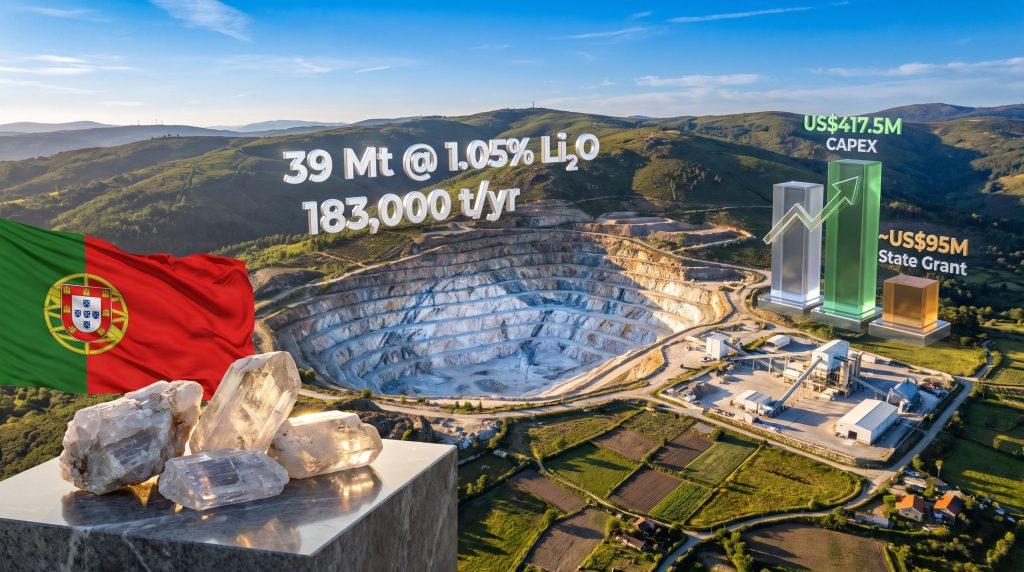
The Barroso lithium project feasibility study is anchored by a mineral resource of approximately 39 million tonnes grading 1.05% Li₂O, with a substantial proportion classified within the Measured and Indicated categories. This classification matters enormously in the financing context, because lenders and equity investors require geological confidence that meets bankable study standards before committing capital at project scale.
The definitive feasibility study mine plan draws on a probable ore reserve of 20 million tonnes, representing roughly half of the total resource. This conservative extraction basis reflects standard practice for initial mine plans, where the emphasis is on resource quality and conversion confidence rather than maximising declared reserves. The remaining Inferred resource component represents genuine exploration upside that could extend mine life beyond the initial DFS parameters if future drilling converts material into higher-confidence categories.
Processing Design and Product Specification
The processing flowsheet is designed to produce spodumene concentrate grading approximately 5.5% Li₂O, which sits comfortably within the specification range demanded by downstream lithium chemical converters. This grade threshold is commercially important because concentrate below roughly 5.0% Li₂O typically attracts price penalties from Chinese and South Korean converters, who must process additional gangue material through their calcination and leaching circuits.
| Parameter | DFS Figure |
|---|---|
| Initial Mine Life | 14 years |
| Run-of-Mine Ore Throughput | ~1.5 million tonnes per annum |
| Total Life-of-Mine Concentrate Output | ~2.56 million tonnes |
| Average Annual Production | ~183,000 tonnes per year |
| Product Grade | ~5.5% Li₂O spodumene concentrate |
An annual throughput of 1.5 million tonnes of run-of-mine ore positions Barroso as a mid-scale operation by Australian hard-rock lithium standards, where projects like Pilgangoora and Wodgina process multiple times that volume. Within the European context, however, there is no comparable operating benchmark. Barroso is, by a considerable margin, the most advanced hard-rock lithium development project within the EU.
Capital Cost Structure and the Financing Equation
The capital cost breakdown is one of the most scrutinised components of any DFS, and Barroso's figures reveal both the scale of the investment required and the mechanisms available to reduce private capital exposure.
| Cost Component | Value (USD) |
|---|---|
| Initial CAPEX (excluding contingency) | US$377 million |
| Initial CAPEX (including contingency) | US$417.5 million |
| Portuguese State Grant (reported) | ~US$95 million |
| Net External Financing Requirement (pre-contingency) | ~US$283 million |
The reported Portuguese government grant of approximately US$95 million is a structurally significant figure. It reduces the net external financing requirement to around US$283 million before contingency, which meaningfully changes the financing conversation. Projects that require 100% private capital must navigate a more demanding credit assessment process than those that arrive at lenders with sovereign co-investment already committed.
State participation, regardless of its mechanism, signals a level of governmental endorsement that de-risks the project in the perception of institutional lenders and development finance institutions.
Financing Context: A reported ~US$95 million Portuguese government grant reduces the external capital requirement to approximately US$283 million pre-contingency. For development finance institutions and export credit agencies evaluating Barroso, sovereign co-investment of this scale is a meaningful credit signal, though investors should note that final financing terms depend on numerous variables that remain subject to negotiation.
Capital Intensity and the Global Peer Comparison
Understanding whether Barroso's DFS economics are competitive requires contextualising the numbers against global spodumene benchmarks. At US$417.5 million for a 183,000 tpa concentrate operation, the implied capital intensity is approximately US$2,280 per annual tonne of concentrate capacity. This figure is broadly comparable to greenfield hard-rock lithium developments in Australia, though direct comparisons require adjustment for several jurisdictional variables.
European construction costs typically carry a premium over Australian equivalents due to:
- Higher labour cost structures and union agreement obligations
- More stringent environmental mitigation and impact management requirements
- Greater infrastructure integration complexity in established agricultural and residential landscapes
- More elaborate community engagement and stakeholder management processes
These factors mean that Barroso achieving Australian-comparable capital intensity is arguably a stronger result than the raw number implies. The project team has had to engineer a solution that meets European regulatory standards while remaining competitive on a cost-per-tonne basis with operations in one of the world's most established hard-rock lithium jurisdictions.
A Timeline Shaped by Regulatory Complexity
The Barroso project's development timeline has not been linear. Understanding the sequence of deferrals provides important context for investors assessing schedule risk.
| Milestone | Reported Timing |
|---|---|
| DFS originally targeted | 2024 |
| DFS revised target | End-2025 |
| DFS revised target (updated) | First half of 2026 |
| DFS completion (announced) | 2026 |
| First production (earlier guidance) | 2027 |
| First production (revised guidance) | 2028 |
The iterative deferral of DFS completion from 2024 through to 2026 reflects the genuine complexity of advancing a large-scale open-pit mining project within a densely regulated European permitting environment. Portugal's environmental licensing framework is multi-tiered, involving national environmental agencies, regional planning authorities, and specialist bodies with jurisdiction over specific impact categories including water, biodiversity, and cultural heritage.
What makes Barroso's permitting environment particularly unusual is the UNESCO designation of the Barroso region as a Globally Important Agricultural Heritage System (GIAHS). This classification, awarded to recognise traditional agropastoral systems of exceptional cultural and ecological value, creates an overlay of international scrutiny that goes beyond standard national environmental assessment. The intersection of industrial mining development with a UNESCO-recognised cultural landscape is a genuinely uncommon regulatory configuration, and one that has required the project team to develop environmental management frameworks that address both Portuguese national standards and the international expectations associated with GIAHS protection.
Community opposition within the agricultural communities of the Barroso region has been a persistent feature of the project's development history. Unlike many mining projects where opposition comes primarily from urban environmental advocates, Barroso faces resistance from established rural communities with multigenerational connections to the land and its agricultural traditions. This dynamic demands sustained, good-faith stakeholder engagement rather than standard consultation compliance.
What Comes After the DFS: The Path to a Final Investment Decision
Completing a definitive feasibility study is a foundational milestone, but it is not a Final Investment Decision. The DFS creates the technical and economic platform from which four parallel workstreams must advance simultaneously.
-
Project financing involves engaging debt and equity capital markets with a bankable study as the primary technical document, alongside offtake agreements and environmental permits as supporting evidence of project viability.
-
Front-end engineering and design (FEED) advances the technical specifications from DFS-level accuracy to construction-ready engineering drawings, typically improving cost estimate accuracy from plus or minus 15% to plus or minus 5%.
-
Commercial negotiations focus on finalising offtake agreements with downstream lithium consumers. In the current market environment, European battery cell manufacturers and automotive OEMs represent the strategically optimal offtake partners for a project marketing EU-origin spodumene.
-
Construction preparation includes mobilising contractor relationships, establishing procurement strategies, and securing long-lead equipment orders that could otherwise delay construction commencement once FID is achieved.
Timeline Reality Check: The gap between DFS completion and Final Investment Decision for projects of this scale typically spans 12 to 24 months, contingent on financing close, permitting finality, and offtake security. Investors should calibrate production timeline expectations against this structural reality, not the DFS completion date alone.
The next major ASX story will hit our subscribers first
Lithium Price Dynamics and the Market Timing Challenge
The Barroso lithium project feasibility study economics must be assessed against a lithium price backdrop that has been extraordinarily volatile. Spodumene concentrate prices rose from below US$500 per tonne before 2021 to above US$8,000 per tonne at the peak of the 2022 lithium price cycle, before collapsing to sub-US$1,000 per tonne ranges through 2024 and into 2025.
This price volatility creates a genuine challenge for DFS economics interpretation. Project developers typically model economics using a long-run price assumption derived from analyst consensus or proprietary market modelling, rather than prevailing spot prices. The specific price deck used in the Barroso DFS is a critical variable for independent project assessment, and analysts will scrutinise whether the assumed long-run spodumene price is conservative, consensus, or optimistic relative to prevailing market forecasts.
A sustained recovery toward US$1,200 to US$1,500 per tonne of spodumene concentrate, a range that multiple industry analysts have proposed as a plausible long-run equilibrium given the cost structure of marginal producers, would materially improve project NPV and strengthen the bankability argument. The financing close timeline for Barroso will depend in part on whether lithium market sentiment recovers sufficiently to attract the risk capital required for a first-of-kind European hard-rock lithium mine.
The EU Regulatory Framework and What It Means for Project Advancement
The EU Critical Raw Materials Act, which established binding targets for domestic extraction, processing, and recycling of strategic raw materials, creates a policy environment broadly supportive of projects like Barroso. The CRMA mandates that the EU produce at least 10% of its annual consumption of strategic raw materials domestically by 2030, with additional targets for processing and recycled content. Furthermore, the framework for European critical raw materials supports projects that demonstrate domestic supply chain value, and Barroso aligns closely with those strategic objectives.
Whether or not Barroso ultimately receives formal Strategic Project designation under the CRMA, the regulatory architecture creates conditions that are structurally supportive of European lithium development. Projects operating within the EU can access EU-level financing instruments, benefit from streamlined administrative coordination between member states, and point to a durable policy rationale when making the case to institutional lenders.
It is important to note that policy frameworks and project-specific approvals are distinct categories. The existence of the CRMA and Portugal's National Lithium Strategy establishes a favourable backdrop, but neither constitutes a confirmed commitment of government support to a specific project. Investors should assess project-specific approvals and confirmed financing commitments independently from the broader policy environment.
Supply Chain Logic: Why European Offtake Is Commercially Differentiated
One dimension of Barroso's commercial positioning that deserves closer attention is the emerging compliance premium associated with EU-origin battery raw materials. The EU Battery Regulation, which came into force progressively from 2023, establishes mandatory due diligence requirements for battery supply chains, including traceability obligations and carbon footprint declarations.
For European automotive OEMs and battery cell manufacturers, sourcing from a certified EU-origin producer like Barroso offers tangible compliance advantages over sourcing from non-EU jurisdictions where supply chain documentation may be less rigorous. In addition, advances in lithium extraction technologies are increasingly relevant to how downstream converters evaluate feedstock partners, and Barroso's processing design reflects awareness of these evolving standards.
Gigafactory projects announced across Germany, France, Sweden, Poland, and Hungary represent the natural demand anchor for European-sourced spodumene. The geographic proximity of Barroso to these manufacturing corridors reduces transport costs and carbon footprint relative to Australian or African supply, further reinforcing the sustainability narrative that EU battery regulations are beginning to price into procurement decisions.
Key Risk Factors for Investors to Monitor
Any balanced assessment of Barroso's development trajectory must account for the risk factors that could alter timelines, economics, or project viability.
- Permitting complexity remains the most structurally distinctive risk for Barroso given the UNESCO GIAHS overlay and multi-authority licensing framework
- Social licence sustainability in an established agricultural community requires long-term engagement investment that differs from greenfield developments in uninhabited terrain
- Lithium price recovery is a necessary condition for financing close at attractive terms, and the pace of that recovery remains uncertain
- Construction cost inflation in European markets could erode the DFS capital estimate's accuracy by the time construction commences
- Offtake agreement timing relative to gigafactory ramp schedules will determine whether Barroso's production profile aligns with available buyer demand
Frequently Asked Questions: Barroso Lithium Project DFS
What is the total resource size at Barroso?
The project's mineral resource is estimated at approximately 39 million tonnes grading 1.05% Li₂O, with a meaningful proportion classified in the Measured and Indicated categories. The DFS mine plan is anchored by a probable ore reserve of 20 million tonnes.
What product does Barroso produce?
Barroso is designed to produce spodumene concentrate grading approximately 5.5% Li₂O, used as feedstock by lithium chemical converters to produce battery-grade lithium hydroxide or lithium carbonate for EV battery manufacturing.
What does the project cost to build?
The DFS reports an initial capital cost of US$377 million excluding contingency, rising to US$417.5 million including contingency. A reported Portuguese government grant of approximately US$95 million reduces the net external financing requirement to around US$283 million.
When could first production occur?
Earlier guidance pointed to 2027, subsequently revised to 2028. The DFS completion in 2026 is the foundational step toward a Final Investment Decision, which itself typically takes 12 to 24 months to achieve at projects of this scale.
What is the mine life?
The DFS outlines an initial mine life of 14 years, based on a 20 million tonne probable ore reserve processed at approximately 1.5 million tonnes of run-of-mine ore per annum.
What the Barroso DFS Signals for European Critical Mineral Ambition
The completion of the Barroso lithium project feasibility study is more than a single project milestone. It is empirical evidence that hard-rock lithium projects can be advanced to bankable study standard within the EU regulatory environment, a proposition that was still theoretical as recently as three years ago.
The economics confirmed by the DFS, the capital intensity achieved, the product specification targeted, and the financing structure assembled will become reference points for the next generation of European lithium developers in Portugal, the Czech Republic, Finland, and beyond. Whether those developers can replicate Barroso's path in a compressed timeframe will depend on whether the permitting frameworks that exist on paper translate into predictable, timely administrative outcomes on the ground. For further detail on the project's technical parameters, the Barroso preliminary economic assessment provides useful background context on earlier-stage economic modelling that preceded the DFS.
For investors, Barroso now sits in the most uncertain but potentially most rewarding phase of its development, the gap between DFS completion and construction commencement where capital risk is highest, information is most valuable, and the project's fundamental investability is being stress-tested in real time. Consequently, Savannah Resources' project page offers a useful reference point for tracking official project updates as financing and permitting workstreams progress.
Broader Significance: Barroso's trajectory is functioning as a live test case for the EU's ability to bring domestic critical mineral supply online before its battery manufacturing ambitions create supply gaps that cannot be bridged by policy statements alone.
This article contains forward-looking statements and financial projections based on publicly available DFS data and independent analysis. All figures are subject to change as the project advances through financing, permitting, and construction phases. This content does not constitute financial advice. Readers should conduct independent due diligence before making investment decisions.
Want to Track the Next Major Mineral Discovery Before the Market Does?
Discovery Alert's proprietary Discovery IQ model delivers real-time alerts on significant ASX mineral discoveries, transforming complex geological data into actionable investment insights for both short-term traders and long-term investors — explore Discovery Alert's discoveries page to understand how historic finds have generated substantial returns, and begin your 14-day free trial today to position yourself ahead of the broader market.