July 28, 2026
The Spodumene Bottleneck That Western Battery Supply Chains Cannot Afford to Ignore
Hard rock lithium supply chains have a structural fault line that most investors and policymakers only began to appreciate after the electric vehicle boom exposed it. The world's battery manufacturing ambitions depend heavily on spodumene concentrate, a lithium-bearing mineral feedstock that must meet a minimum lithium oxide (Li₂O) content of around 6% before it can be economically processed into battery-grade lithium hydroxide or lithium carbonate. For much of the last decade, the ability to mine, process, and trade that feedstock has been concentrated in a narrow band of jurisdictions.
That concentration problem is now reshaping how lithium developers, commodity traders, and downstream manufacturers approach supply agreements. The Rock Tech Transamine spodumene supply deal, executed between Rock Tech Lithium and Geneva-based commodity trading house Transamine SA, represents one of the more structurally sophisticated responses to this challenge yet seen from a pre-production Canadian lithium developer.
When big ASX news breaks, our subscribers know first
Why Spodumene Feedstock Security Has Become Non-Negotiable
Spodumene extraction sits at the top of the hard rock lithium processing chain. It is the raw output of a lithium pegmatite mine after crushing, flotation, and concentration, and it serves as the primary feedstock for lithium chemical converters that produce the hydroxide and carbonate compounds used in battery cathode manufacturing.
The reason feedstock security has climbed the priority list for Western industrial planners is straightforward. Converter facilities, which require substantial capital investment and long commissioning timelines, cannot attract project debt without guaranteed upstream supply. Similarly, mines cannot attract financing without committed downstream buyers. This creates a bilateral dependency that has historically been resolved through long-term offtake agreements, and increasingly through prepayment structures that transfer capital from buyer to producer ahead of first output.
What has changed in the post-2022 environment is the pricing architecture within those agreements. The spodumene price cycle between 2021 and 2025 was one of the most violent in any battery materials market. Prices for spodumene concentrate at 6% Li₂O CIF China surged from below US$500 per tonne in early 2021 to above US$8,000 per tonne at the 2022 peak, before collapsing back below US$800 per tonne by mid-2024. That collapse decimated the economics of projects that had been advanced on the assumption of elevated pricing and fundamentally changed what lenders and offtake counterparties demand from new agreements.
"The lithium price correction of 2022 to 2025 did not just punish investors. It rewrote the terms on which new projects can be financed, and floor price mechanisms have moved from optional sweeteners to non-negotiable prerequisites in virtually every new spodumene offtake structure."
What the Rock Tech Transamine Spodumene Supply Deal Actually Contains
The agreement between Rock Tech Lithium and Transamine SA covers spodumene concentrate production from the Georgia Lake project in Ontario, Canada. The project is wholly owned by Rock Tech and represents one of the more advanced hard rock lithium development assets in a Five Eyes-aligned jurisdiction outside of Australia.
Core Commercial Terms at a Glance
| Parameter | Detail |
|---|---|
| Agreement Type | Binding long-term offtake |
| Counterparty | Transamine SA (Geneva, Switzerland) |
| Supply Source | Georgia Lake Project, Ontario, Canada |
| Initial Contract Term | 7 years from first delivery |
| Extension Option | Up to 5 additional years |
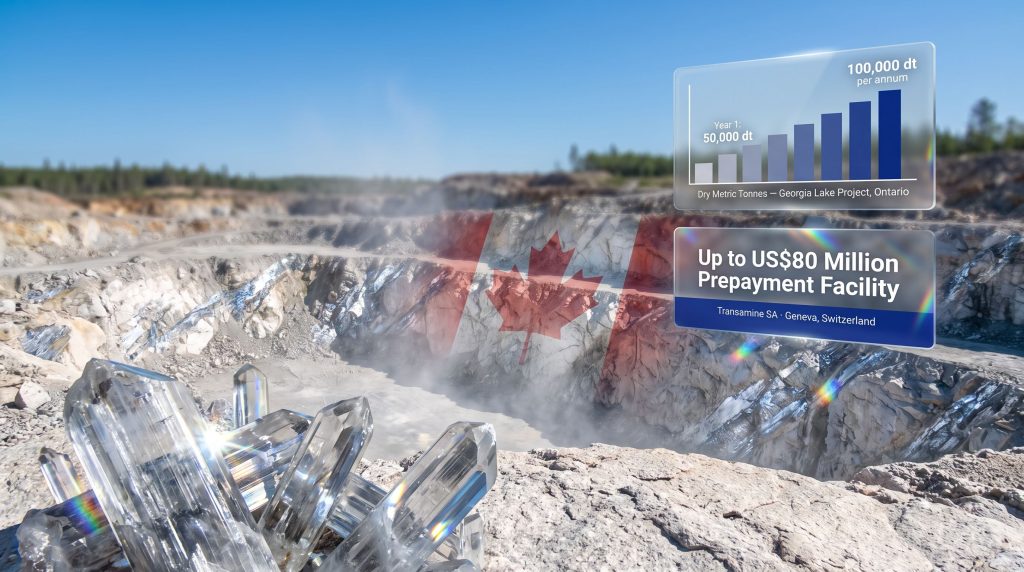
| Year 1 Volume | 50,000 dry metric tonnes |
| Steady-State Volume | 100,000 dry metric tonnes per annum |
| Volume Tolerance | ±10% in Rock Tech's favour |
| Pricing Benchmark | Fastmarkets spodumene 6% Li₂O CIF China |
| Price Adjustment | Delivered grade adjustment mechanism |
| Floor Price | Qualified floor price mechanism included |
| Prepayment Facility | Up to US$80 million |
| Prepayment Rate | 3-month CME Term SOFR + 2.95% per annum |
| Prepayment Repayment | Via deliveries over 24 months from first shipment |
| Delivery Commencement | 2028 (subject to DFS outcomes and permitting) |
The volume ramp from 50,000 dry metric tonnes in year one to 100,000 dry metric tonnes annually thereafter reflects standard commissioning risk management practice in hard rock mining offtakes. Mines in their first year of production routinely face throughput variability as processing circuits are optimised and ore characterisation data is refined, so a stepped volume structure gives the operator room to meet contractual obligations without the penalty exposure that a flat volume commitment would create.
The ±10% volume tolerance being structured in Rock Tech's favour is a seller-friendly provision worth noting. In many commodity offtake agreements, volume tolerances are symmetrical or buyer-favoured, particularly when the buyer holds significant leverage as a capital provider. The fact that this tolerance operates to Rock Tech's benefit suggests a degree of commercial parity in the negotiation, which may reflect the trust built through the parties' prior joint venture relationship.
How the Pricing and Floor Price Mechanisms Work
The Fastmarkets Benchmark Explained
Pricing under the agreement references the Fastmarkets assessed price for spodumene concentrate at a minimum 6% Li₂O content, quoted on a CIF China basis. This benchmark is the most widely used reference point in the global spodumene market, even for cargoes destined for non-Chinese processors. The CIF China convention exists because China has historically been the dominant consumer of spodumene feedstock, and market price discovery has therefore occurred primarily through Chinese import transactions.
A grade adjustment mechanism is embedded in the pricing formula. Because actual delivered concentrate will rarely match exactly 6% Li₂O, the agreement includes a calculation that scales the settlement price up or down based on measured Li₂O content at delivery. This protects both parties: the buyer avoids overpaying for subgrade material, and the seller receives credit for concentrate that outperforms the benchmark specification.
Why the Floor Price Clause Is Now a Standard Feature
The floor price mechanism in the Rock Tech Transamine deal serves a dual commercial purpose. For the mine developer, it establishes a minimum revenue threshold below which spodumene will not be supplied, protecting project economics during periods of market weakness. For project lenders, it provides the revenue floor that debt service models require to generate satisfactory debt service coverage ratios.
The floor price is described as qualified, meaning it is subject to conditions relating to resale market dynamics, inflation-linked adjustments, and project financing requirements rather than being a fixed absolute number. This structure is increasingly common in post-2023 lithium offtake agreements, precisely because the price collapse of that period demonstrated how quickly unprotected mining project economics can deteriorate when commodity markets reverse. Furthermore, the lithium carbonate market dynamics of recent years have reinforced why such protections are now considered essential rather than optional.
The US$80 Million Prepayment Facility: Development Finance Through Commodity Trading
How Prepayment Facilities Function in Pre-Production Mining
A development prepayment facility is a mechanism through which an offtake buyer advances capital to a mine developer before production begins. Unlike conventional project debt, where repayment occurs in cash with interest, a prepayment facility is repaid through physical commodity deliveries. The buyer essentially pays for future concentrate before it exists, receiving repayment in the form of discounted or credited tonnes over the early production period.
This structure is particularly well-suited to pre-production developers for three reasons:
- It does not require the developer to have operating cash flow at the time of drawdown, removing a key barrier to accessing conventional debt.
- It aligns the financial interests of the buyer and the developer, since the buyer's repayment depends on the mine actually producing.
- It reduces upfront equity dilution compared to raising the equivalent capital through share issuance on junior equity markets.
The Georgia Lake Prepayment: Financial Parameters
The prepayment facility available under the Rock Tech Transamine agreement reaches up to US$80 million. Interest accrues at the three-month CME Term SOFR rate plus 2.95% per annum. CME Term SOFR replaced LIBOR as the standard floating rate benchmark for US dollar-denominated lending following the global transition away from interbank offered rates, completed in mid-2023.
Repayment occurs through spodumene deliveries over a 24-month window beginning at first shipment. The final quantum and specific terms of the facility remain subject to completion of the definitive feasibility study, satisfactory due diligence by Transamine, and confirmation of permitting status.
"For a pre-production developer navigating elevated interest rates and subdued junior mining equity valuations, access to US$80 million in commodity-backed development finance represents a potentially transformative capital injection, particularly given that mid-scale hard rock lithium projects typically require total development capital in the range of several hundred million dollars."
The Definitive Feasibility Study: The Gating Event for Everything
Almost every material commercial term in the Rock Tech Transamine spodumene supply deal is explicitly contingent on outcomes from the definitive feasibility study for the Georgia Lake project. This is not unusual for pre-DFS offtake agreements, but it is important for market participants to understand what the DFS actually determines and why its conclusions can reshape contractual terms.
A DFS for a hard rock lithium project of this nature typically encompasses:
- Updated mineral resource and ore reserve estimation under JORC or NI 43-101 standards.
- Detailed metallurgical testwork to establish recoveries, concentrate grades, and process plant design parameters.
- Infrastructure planning including site access, power supply, water management, and tailings storage.
- Capital cost estimation to a level of accuracy typically within 15 to 20 percent of the final construction cost.
- Operating cost modelling incorporating labour, reagents, energy, and logistics.
- Mine scheduling and production planning across the life of mine.
The DFS outputs determine whether the 100,000 dry metric tonne annual steady-state volume is physically achievable within the mine's production profile, and whether the 2028 delivery commencement timeline is realistic given permitting and construction schedules. Both the volumes and the delivery start date are subject to mutual revision following DFS completion, which means investors should treat the 2028 target as an aspiration rather than a fixed commitment at this stage.
The next major ASX story will hit our subscribers first
Product Optionality: A Clause That Could Redefine the Commercial Relationship
One of the more strategically interesting provisions in the Rock Tech Transamine deal is the product optionality clause, which allows some or all contracted deliveries to transition from spodumene concentrate to battery-grade lithium hydroxide monohydrate or lithium carbonate. This reflects the growing industry interest in lithium salts conversion as a value-add pathway for hard rock lithium producers seeking to capture more of the processing margin.
This transition would be triggered if Rock Tech's planned Red Rock Lithium Converter, a downstream processing facility, requires Georgia Lake concentrate as internal feedstock rather than directing it to external sale. If activated, it would require both parties to negotiate and agree on conversion mechanisms, revised product specifications, pricing formulas adjusted for chemical conversion economics, and updated delivery schedules.
The commercial implications of this clause are significant. Spodumene concentrate trading and battery-grade lithium chemical distribution are fundamentally different businesses. The logistics, storage requirements, customer relationships, and margin structures are distinct. For Transamine, pivoting from a spodumene trading role to a battery chemical distribution role would represent a meaningful evolution of its commercial model. For Rock Tech, it would represent the fulfilment of its stated vertical integration ambition.
The RTT Lithium JV: Why This Deal Was Achievable
The Rock Tech Transamine spodumene supply deal did not emerge from a cold commercial negotiation. The two companies had previously established RTT Lithium SA, a joint venture entity designed to coordinate spodumene supply logistics and support Rock Tech's converter development strategy. According to Global Mining Review, that prior institutional relationship meant the commercial due diligence groundwork, counterparty familiarity, and trust-building necessary for a binding long-term agreement with a prepayment facility had already been substantially completed.
This context matters for understanding why the deal structure is as sophisticated as it is. Binding long-term offtakes with floor price mechanisms and US$80 million prepayment facilities do not typically arise from first-contact negotiations between parties with no prior history.
Rock Tech's broader supply chain construction also includes a feedstock supply agreement signed in 2024 with C&D Logistics to support its German converter project, and a February 2025 binding business combination agreement with Swiss junior mining company Arcore to merge subsidiaries and create a new European entity. These moves collectively sketch the architecture of a Canadian mine-to-European converter supply chain being assembled through sequential bilateral agreements. Furthermore, innovations such as direct lithium extraction are increasingly being considered alongside conventional hard rock pathways as the industry seeks to diversify its processing toolkit.
Benchmarking the Deal Structure Against Market Norms
| Feature | Rock Tech Transamine | Typical Market Practice |
|---|---|---|
| Contract Duration | 7 years + 5-year option | 5 to 10 years standard |
| Volume Ramp | 50,000 dt to 100,000 dt | Phased ramp common |
| Pricing Reference | Fastmarkets 6% Li₂O CIF China | Industry standard benchmark |
| Floor Price | Yes, qualified | Increasingly standard post-2023 |
| Prepayment Facility | Up to US$80 million | Common in pre-production deals |
| Product Optionality | Spodumene or hydroxide/carbonate | Less common; reflects integration strategy |
| DFS Adjustment Clause | Yes | Standard in pre-DFS offtakes |
| Volume Tolerance | +/- 10% in seller's favour | Often symmetrical or buyer-favoured |
Frequently Asked Questions: Rock Tech Transamine Spodumene Supply Deal
What is the Rock Tech Transamine spodumene deal?
It is a binding long-term offtake agreement under which Transamine SA will purchase spodumene concentrate from Rock Tech Lithium's Georgia Lake project in Ontario, Canada. The initial term covers seven years, with an option for up to five additional years.
When will spodumene deliveries begin?
Deliveries are currently targeted to commence in 2028, subject to the completion of a definitive feasibility study, permitting approvals, and any mutually agreed revisions to delivery terms.
How much spodumene will be purchased annually?
Contracted volumes start at 50,000 dry metric tonnes in the first delivery year and increase to 100,000 dry metric tonnes per annum thereafter, with a volume tolerance of plus or minus 10% in Rock Tech's favour.
How is the spodumene priced?
Pricing references the Fastmarkets benchmark for spodumene concentrate at a minimum 6% Li₂O content on a CIF China basis, with adjustments for the actual Li₂O grade of material delivered. A qualified floor price mechanism is also included.
What is the US$80 million prepayment facility?
It is a development financing mechanism under which Transamine may advance up to US$80 million to Rock Tech to support Georgia Lake project construction. The facility carries interest at three-month CME Term SOFR plus 2.95% per annum and is repaid through spodumene deliveries over the first 24 months of production.
Can deliveries transition to lithium hydroxide or carbonate?
Yes. The agreement includes a provision allowing some or all deliveries to be restructured as offtake for battery-grade lithium hydroxide monohydrate or lithium carbonate, subject to mutual agreement on product specifications, pricing, and conversion mechanics.
What This Agreement Reveals About the Evolving Spodumene Market
The Rock Tech Transamine spodumene supply deal is notable not just for its individual terms but for what it signals about the direction of the broader market. Three structural observations stand out.
First, commodity trading firms are increasingly functioning as development financiers for Western critical mineral projects. As Investing News Network reports, the willingness of a Geneva-based trading house to commit up to US$80 million in prepayment capital to a Canadian pre-production lithium project reflects the growing recognition that securing long-term feedstock access requires capital deployment, not just contractual commitment.
Second, the floor price mechanism has become institutionally embedded in new spodumene offtake structures. The 2022 to 2025 price cycle has effectively made floor price provisions a standard feature of any deal that expects to attract project financing, and the Rock Tech Transamine agreement is consistent with this emerging norm.
Third, the product optionality clause points toward a future in which the distinction between mining companies and battery chemical producers becomes increasingly blurred. If Rock Tech successfully activates this provision by commissioning its Red Rock Lithium Converter, the Georgia Lake project would evolve from a raw material export operation into an integrated battery materials supply node, a fundamentally different and higher-value position in the critical minerals value chain.
The milestones remaining between agreement execution and first shipment are substantial: DFS completion, permitting in Ontario, finalisation of prepayment terms, and mine construction. Each carries its own timeline and execution risk. However, the commercial architecture now in place, combining long-term volume commitment, pricing protection, and development capital access, represents a more bankable foundation than most pre-production lithium projects have managed to assemble in the current market environment.
Want to Know When the Next Major Mineral Discovery Hits the ASX?
Discovery Alert's proprietary Discovery IQ model scans ASX announcements in real time, delivering instant alerts on significant mineral discoveries — including lithium and other critical battery materials — so subscribers can act ahead of the broader market. Explore historic discovery returns to understand the scale of opportunity, and begin a 14-day free trial at Discovery Alert to position yourself at the forefront of the next major find.