July 27, 2026
The Hidden Economics of Used EV Batteries Most Buyers Never Consider
Most conversations about electric vehicle ownership eventually arrive at the same question: what happens to the battery? For years, that question has been framed as an environmental concern, a cost liability, or a resale risk. Yet the more analytically interesting question runs in an entirely different direction. What if the battery is not the problem to be managed, but the asset to be unlocked?
The economics of used EV battery value are significantly more layered than the used-car market currently reflects. Buyers and sellers applying traditional vehicle valuation logic to electric vehicles are working with an incomplete model, one that treats the battery as a depreciating component rather than what it is increasingly becoming: a multi-stage energy asset with productive commercial lives that can extend well beyond the vehicle itself.
Understanding this distinction is no longer an academic exercise. It has direct implications for pricing, negotiation, financing, and the long-term economics of EV ownership.
When big ASX news breaks, our subscribers know first
Three Questions That Determine What a Used EV Battery Is Actually Worth
Before assigning any value to a used EV battery, it helps to recognise that the answer changes dramatically depending on what you intend to do with it. Three distinct valuation questions apply simultaneously:
- What is the battery worth inside the vehicle as a driver of resale price?
- What is the battery worth outside the vehicle in a second-life storage application?
- What is the battery worth at end of life as a source of recoverable materials?
Each question generates a different number, and conflating them is one of the most common errors in used EV transactions.
Battery Chemistry: The Variable Most Listings Ignore
The chemical composition of a battery pack is arguably the most consequential factor in determining its value across all three pathways, yet it is rarely disclosed clearly in used vehicle listings. The three dominant chemistries in current EV fleets each carry distinct profiles:
| Chemistry | Common Vehicles | Recycling Value | Second-Life Suitability | Key Characteristic |
|---|---|---|---|---|
| NMC (Nickel Manganese Cobalt) | Tesla Model Y, Hyundai Ioniq 5 | Higher (cobalt and nickel content) | Strong | Estimated £480-£820 scrap value for a 75 kWh pack |
| LFP (Lithium Iron Phosphate) | Tesla Model 3 SR, BYD range | Lower (no cobalt or nickel) | Very strong | Approximately £35-£90 scrap value for a 14 kWh pack; superior cycle longevity offsets lower material value |
| NCA (Nickel Cobalt Aluminium) | Older Tesla models | Moderate to high | Moderate | High energy density but greater thermal sensitivity affects reuse suitability |
A critical but widely underappreciated point: LFP batteries, which are increasingly dominant in the market due to their lower manufacturing cost and longer cycle life, carry significantly less recycling scrap value than NMC chemistries. However, their thermal stability and ability to withstand far more charge cycles without meaningful degradation makes them consistently superior candidates for second-life stationary storage. This means the recycling value and the second-life value of LFP packs move in opposite directions, a nuance that catches many buyers and sellers off guard.
State of Health: The Metric That Anchors All Three Valuation Pathways
State of Health, expressed as a percentage of original capacity retained, is the single most influential variable in used EV battery valuation. It determines which value pathway a battery enters, and how much it is worth within that pathway.
Key insight: A battery's State of Health is not simply a measure of degradation. It is the entry ticket to an entirely different commercial ecosystem. Packs above roughly 75% SoH typically qualify for second-life applications. Packs below 60-70% SoH are generally directed toward material recovery.
How SoH affects used EV resale pricing:
| State of Health | Likely Price Impact Relative to Comparable Vehicle |
|---|---|
| 95-100% | Minimal discount beyond standard depreciation |
| 85-94% | Moderate discount; typically acceptable to most buyers |
| 75-84% | Noticeable discount; buyers may request warranty or price adjustment |
| Below 75% | Significant discount; approaching second-life or recycling value threshold |
An important technical distinction that rarely appears in mainstream coverage: SoH figures reported by a vehicle's onboard dashboard typically measure total pack capacity, not individual cell or module health. A pack with an aggregate SoH of 82% may contain individual modules with far greater variance, some close to new condition, others significantly degraded. Independent diagnostic equipment that assesses cell balance and module-level health, not just pack-level SoH, provides a materially more accurate picture and can change a transaction's economics considerably.
Warning: Buyers relying solely on manufacturer dashboard readings may receive optimistic figures that do not reflect real-world degradation patterns across individual cells. Independent SoH certification from specialist diagnostic services is increasingly the standard for informed transactions. For a broader perspective on secondhand EVs in Australia, battery life and health remain central concerns among buyers.
Beyond SoH: Three Additional Technical Factors
Three further variables shape used EV battery value in ways that headline SoH figures do not fully capture:
- Usable capacity in kWh: Larger packs carry more intrinsic material value and more potential second-life utility, independently of SoH percentage.
- Charge cycle composition: High-frequency DC fast charging accelerates lithium plating and electrode degradation more than standard AC charging, producing faster capacity fade at a given odometer reading. Two batteries with identical mileage can have substantially different SoH depending on their charging history.
- Thermal exposure history: Packs regularly operated in extreme heat or cold accumulate degradation that may not be fully visible in SoH readings. Thermal history logs, where accessible through vehicle data systems, can reveal degradation patterns invisible to standard diagnostics.
A Three-Pathway Framework for Used EV Battery Valuation
Pathway One: Value Inside the Vehicle
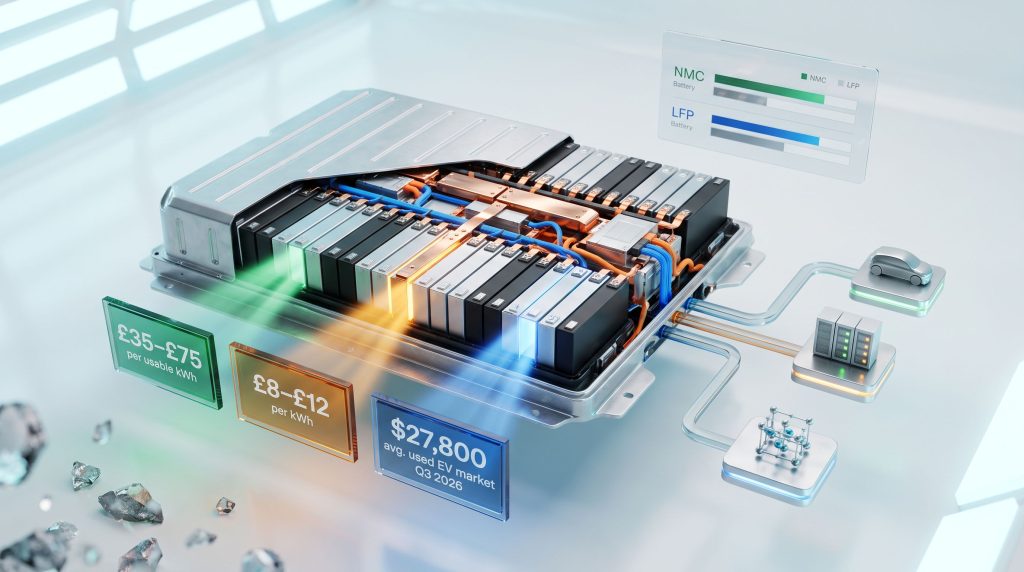
When a used EV is sold as a complete vehicle, battery condition directly anchors the transaction. According to Recurrent's market data, the used EV market in the United States averaged approximately $27,800 in Q3 2026, with battery health emerging as one of the primary variables distinguishing otherwise comparable listings.
Certified battery health reports from specialist platforms and manufacturer-authorised diagnostics are increasingly used to justify asking prices or negotiate discounts. The practical implication is straightforward: a documented, independently verified SoH report adds measurable transactional value, while an undocumented or poorly performing battery can reduce resale value by tens of percentage points relative to a comparable vehicle with a clean battery health record.
Pathway Two: Second-Life and Stationary Storage Value
This is the pathway that most fundamentally reshapes the economics of used EV batteries, and the one most participants in the used vehicle market currently overlook entirely. The battery storage expansion occurring globally is creating substantial new demand for functional packs repurposed for stationary energy applications.
Researchers tracking the battery value chain, including specialists in circular energy storage systems, increasingly expect batteries entering the market today to generate positive economic value across their entire lifetime. Rather than recycling representing the primary outcome, the expectation is that most functional packs will first be refurbished, potentially reused in other vehicles, then repurposed for stationary energy storage before material recovery becomes relevant, sometimes across a productive life spanning several decades.
Functional used traction battery packs are estimated to trade at approximately £35-£75 per usable kWh for grid and stationary storage applications. This is materially higher than the equivalent scrap value of the same pack, which typically falls in the range of £8-£12 per kWh in raw material terms.
Second-life applications creating this demand:
- Grid frequency balancing and peak demand management
- Commercial and industrial backup power infrastructure
- Residential solar energy storage integration
- Off-grid and remote community energy supply
- Renewable energy output smoothing for wind and solar installations
Core insight: A battery that no longer satisfies the range expectations of an EV driver may still retain 70-80% of its original capacity, more than sufficient for stationary storage applications where energy density and weight are irrelevant constraints. The vehicle becomes commercially obsolete. The battery frequently does not.
Pathway Three: Recycling and Material Recovery
When a pack is no longer suitable for automotive or stationary storage use, material recovery becomes the final value stage. Furthermore, the economics vary considerably by chemistry, making it essential to understand what materials a given pack contains before determining its end-of-life value.
| Material | Relevance | Value Driver |
|---|---|---|
| Lithium | All chemistries | Battery-grade lithium carbonate demand across all sectors |
| Cobalt | NMC and NCA only | Highest per-unit recovery value; geographically constrained supply |
| Nickel | NMC and NCA | Critical for energy density; strong and growing industrial demand |
| Copper | All chemistries | Wiring and current collectors; consistent commodity demand |
| Manganese | NMC | Lower individual value but recoverable at scale |
A 75 kWh NMC pack, such as that found in a Tesla Model Y, carries estimated recoverable material value of approximately £480-£820. A 14 kWh LFP pack, such as a Tesla Powerwall 3 unit, yields approximately £35-£90 in scrap value, reflecting the absence of cobalt and nickel. General scrap value for most packs falls in the range of £8-£12 per kWh in raw material terms, though NMC and NCA chemistries will consistently sit at the upper end of this range. Advances in the battery recycling process are, however, gradually improving recovery rates across all chemistries.
The Depreciation Paradox: When Vehicle Value Falls and Battery Value Holds
China's EV Market as a Case Study in Disaggregated Value
China's electric vehicle market provides the most visible contemporary illustration of a dynamic that will eventually play out across every major automotive market. Intense competition among manufacturers including BYD and domestic rivals has driven used EV prices down sharply, with some vehicles retaining as little as 40% of their original value after just three years.
This rapid depreciation has been widely interpreted as structural evidence that electric vehicles are becoming disposable consumer electronics. However, a more rigorous analytical interpretation separates two simultaneous and distinct trends.
- Vehicle platform depreciation, driven by rapid technology cycles, software obsolescence, and aggressive new-vehicle pricing compressing used-car valuations.
- Battery asset retention, driven by growing commercial demand for functional battery packs across stationary energy storage markets that are entirely independent of vehicle trends.
These two trends can move in opposite directions at the same time. A vehicle's resale value can collapse while the battery pack it contains continues to hold or even grow in commercial relevance to the energy storage sector.
The Fleet Age Signal: A Wave of Battery Supply Is Coming
The average age of an electric vehicle on Chinese roads is currently approximately 1.8 years, compared with more than 8 years for conventional internal combustion engine vehicles. This gap reflects the extraordinary pace of EV adoption rather than unusually short ownership periods.
The strategic implication is considerable. As this young fleet matures, a large and sustained pipeline of end-of-life and mid-life battery packs will enter secondary markets over the next decade. Industry analysts project that the market for post-automotive battery applications will be many times larger by 2035 than it is today, creating an entirely new industrial ecosystem spanning testing, remanufacturing, repurposing, and material recovery. The battery raw materials market is already responding to these structural shifts with significant investment activity.
Second Life vs. Recycling: Where Does the Value Actually Sit?
The economic case for prioritising second-life deployment over immediate recycling is compelling under most scenarios. Second-life reuse of used EV batteries typically generates significantly more economic value than immediate material recovery. Functional packs may trade at £35-£75 per usable kWh for storage applications, compared with only £8-£12 per kWh in raw material scrap value.
| Value Pathway | Estimated Value per kWh | Best Suited To | Key Requirement |
|---|---|---|---|
| Second-life grid storage | £35-£75 per usable kWh | LFP and NMC packs above roughly 70% SoH | Functional pack; diagnostic certification |
| Second-life residential storage | £25-£60 per usable kWh | LFP packs with high cycle life remaining | Integration capability; applicable warranty |
| Whole-pack automotive resale | Varies; up to approximately $5,000 for large, healthy packs | High SoH packs with documented history | Compatible vehicle application |
| Recycling and material recovery | £8-£12 per kWh (NMC higher) | Degraded or damaged packs | Processing infrastructure |
Which pathway a battery enters depends on:
- SoH above approximately 70-75%: Strong candidate for second-life storage or automotive reuse
- SoH between 60-70%: Borderline; economics depend on chemistry, pack configuration, and refurbishment cost
- SoH below 60% or physical damage: Typically directed to recycling
- Chemistry: LFP packs with high remaining cycle life consistently favour second-life deployment; NMC packs with degraded capacity may favour recycling due to higher cobalt and nickel recovery value
A Practical Guide to Assessing Used EV Battery Value
For Used EV Buyers
- Commission an independent SoH assessment before completing any purchase. Do not rely on onboard dashboard readings, which can be optimistic and do not reflect module-level variance.
- Identify the battery chemistry from the vehicle specification sheet or manufacturer documentation before assessing pricing.
- Review the charging history where available. Frequent DC fast charging relative to total mileage signals accelerated degradation that may not be fully reflected in aggregate SoH figures.
- Confirm battery warranty transferability. Many manufacturers offer battery warranties covering 8 years or 100,000 miles. Confirm whether coverage applies to second owners.
- Benchmark SoH-adjusted pricing against comparable listings with documented battery health to determine whether an asking price appropriately reflects battery condition.
For Used EV Sellers
- Obtain a certified battery health report before listing. A documented SoH assessment can justify a higher asking price and accelerate the sale by removing buyer uncertainty.
- Disclose chemistry and pack size proactively. Informed buyers will pay a premium for transparency and documented specifications.
- Consider the second-life pathway if the vehicle is approaching end of automotive utility. Selling the battery pack separately to a specialist refurbisher may yield more than a distressed whole-vehicle sale. Platforms specialising in used EV batteries are increasingly active in this space, connecting sellers with repurposing operators directly.
For Battery Pack Buyers in the Second-Life and Parts Market
- Verify SoH through independent diagnostic equipment, not seller-provided data.
- Assess cell balance and module-level health in addition to aggregate pack SoH.
- Examine thermal history through available data logs where accessible.
- Confirm compatibility with the intended application before committing to a purchase.
The next major ASX story will hit our subscribers first
The Emerging Battery Value Chain: Structural Shifts Already Underway
How the Market Infrastructure Is Developing
The growing recognition that used EV batteries carry substantial post-automotive commercial value is beginning to reshape how vehicles are financed, insured, priced, and dismantled at scale. Several structural developments are already accelerating this transition:
- Battery passports and digital health records are being developed across multiple regulatory jurisdictions to create standardised, verifiable records of battery history, directly enabling more accurate second-life valuation and transaction confidence.
- Specialist battery testing and refurbishment businesses are scaling rapidly in anticipation of the growing pipeline of end-of-life packs from maturing EV fleets.
- Automotive insurers are beginning to incorporate battery replacement cost and residual value into total-loss and depreciation modelling, recognising that battery condition materially affects the economics of write-off versus repair decisions.
- Fleet operators and leasing companies are exploring battery value retention as a mechanism for reducing total cost of ownership across vehicle lifecycles, treating the battery as a separable asset rather than a depreciating component.
Why the Internal Combustion Comparison Matters
The economic trajectory of a used EV battery has no meaningful parallel in conventional automotive history. An ageing internal combustion engine does not become a grid asset. It cannot be repurposed for residential energy storage. It cannot stabilise electricity supply or absorb surplus renewable generation. Once its automotive utility is exhausted, its remaining value is largely confined to scrap metal and spare parts markets.
Analytical framing: Rather than a linear decline toward waste, the economic life of an EV battery increasingly resembles a waterfall model. Each stage extracts value before passing the asset to the next application, with material recycling representing the final stage rather than the default outcome. This cascade structure is unique in automotive history and has no equivalent in conventional powertrain economics.
Within the next decade, it is plausible that a five to seven year old electric vehicle could reach a point where the battery pack represents a substantial proportion of the vehicle's total remaining value. In some market segments, the battery may eventually be worth more than the rest of the vehicle combined, a scenario that would fundamentally alter how used EVs are financed, insured, and traded. Innovations such as direct lithium extraction technology are, furthermore, improving the economics of material recovery at every stage of this cascade.
Frequently Asked Questions: Used EV Battery Value
How Much Is a Used EV Battery Worth?
Value depends on chemistry, state of health, pack size, and intended use. Functional packs for second-life storage may trade at £35-£75 per usable kWh. Recycling scrap value typically ranges from £8-£12 per kWh, though NMC packs with significant cobalt and nickel content can yield considerably more. Whole-pack resale on the parts market ranges from a few hundred dollars for small modules to approximately $5,000 or more for large, healthy packs with documented history.
Does Battery Health Affect Used EV Resale Price?
Yes, significantly. Undocumented or degraded battery health can reduce a used EV's resale value by tens of percentage points relative to a comparable vehicle with an independently certified health report.
What Is the Difference Between LFP and NMC Battery Value?
LFP packs carry lower recycling scrap value due to the absence of cobalt and nickel but typically offer stronger second-life economics due to superior cycle longevity and thermal stability. NMC packs carry higher material recovery value at end of life but may degrade more quickly under demanding use conditions. A recent battery recycling breakthrough is, however, beginning to narrow this gap by improving lithium recovery yields from LFP chemistries specifically.
What Is Second-Life Battery Use?
Second-life use refers to repurposing a used EV battery pack for stationary energy storage applications once it no longer meets automotive range requirements. Common applications include grid frequency balancing, commercial backup power systems, and residential solar storage integration.
When Does a Used EV Battery Get Recycled Rather Than Reused?
Packs with state of health below approximately 60-70%, or those that have sustained physical damage, are typically directed to recycling. The threshold varies by intended application and the economics of refurbishment for a given chemistry and configuration.
How Do I Determine My EV Battery's State of Health?
Independent diagnostic services, manufacturer-authorised service centres, and specialist battery health platforms can provide SoH assessments. Onboard vehicle displays offer an estimate but may not accurately capture real-world degradation at the module level.
Battery Value Is Becoming the Defining Variable in Used EV Economics
Three converging forces are making battery valuation increasingly central to every used EV transaction:
- Technology cycles are compressing. Consumers replace vehicles for software upgrades, faster charging capability, and extended range, not because batteries have failed. This leaves large volumes of technically functional packs entering secondary markets well ahead of their useful end of life.
- Stationary storage demand is growing. The commercial market for functional used packs is expanding independently of vehicle market trends, creating a pricing floor beneath used EV battery value that did not previously exist.
- Recycling economics are maturing. Even fully degraded packs now retain meaningful material value, particularly for NMC and NCA chemistries, ensuring that no stage of the battery's life is economically stranded.
For anyone buying, selling, financing, or insuring a used electric vehicle, the practical implication is direct. Understanding battery chemistry, state of health, and the available value pathways is no longer a technical detail reserved for specialists. It is the foundation of any accurate valuation, and increasingly the difference between a well-priced transaction and a costly misjudgement.
This article is intended for informational and educational purposes only. It does not constitute financial, investment, or legal advice. Valuations and market estimates referenced reflect available data at time of writing and are subject to change. Readers should conduct independent due diligence before making purchasing, selling, or investment decisions related to electric vehicles or battery assets.
Want to Stay Ahead of the Mineral Discoveries Powering the Battery Revolution?
As demand for lithium, cobalt, nickel, and other battery materials accelerates alongside the growing second-life EV battery economy, Discovery Alert's proprietary Discovery IQ model delivers real-time alerts on significant ASX mineral discoveries the moment they are announced — turning complex resource data into actionable investment insights. Explore how historic mineral discoveries have generated substantial returns and begin your 14-day free trial at Discovery Alert to position yourself ahead of the market.