July 27, 2026
The Engineering Beneath the Surface: Why Brine Lithium Process Design Determines Project Success
Most discussions about lithium projects gravitate toward resource size, share price momentum, or commodity price forecasts. What receives far less attention is the engineering architecture that separates a credible development asset from a perpetually delayed project. In brine lithium development specifically, the process flowsheet is not a secondary consideration; it is the backbone of project economics. Recovery rates, energy consumption, purity specifications, and evaporation pond design collectively determine whether a project can generate competitive operating costs at commercial scale. Understanding how lithium brines work is therefore essential for evaluating any brine lithium project approaching a definitive feasibility study.
The Argosy Rincon lithium project DFS in Argentina is currently one of the more technically detailed brine lithium feasibility programmes active in South America's Lithium Triangle. What makes it worth examining in depth is not simply the resource size or geographic location, but the specificity of the process validation data emerging from active testwork programmes, and what those results reveal about commercial-scale viability.
When big ASX news breaks, our subscribers know first
Understanding Brine Lithium Processing: A Technical Foundation
Before analysing the Rincon project's specific DFS workstreams, it is worth establishing how lithium brines work and how brine lithium processing fundamentally differs from hard-rock lithium extraction, because the distinction shapes every capital and operating cost assumption in the feasibility model.
How Brine Lithium Projects Work
Brine lithium deposits exist as lithium-enriched saline solutions beneath salt flats, or salars. Unlike spodumene mining, which involves drilling, blasting, crushing, and chemical conversion, brine extraction is more analogous to a continuous fluid management and chemical refining operation.
The general processing sequence involves:
- Brine extraction from subsurface aquifers via production wells drilled into the salar
- Solar evaporation concentration across large engineered pond systems, progressively increasing lithium concentration while precipitating unwanted salts such as sodium chloride and potassium chloride
- Purification using selective chemical processes to remove magnesium, boron, sulfate, and calcium impurities that would degrade final product quality
- Conversion of the purified lithium solution into a saleable product, typically lithium carbonate or lithium chloride
The critical variable that distinguishes high-performing brine operations from underperforming ones is the magnesium-to-lithium ratio of the native brine. High magnesium content dramatically increases purification complexity and reagent consumption. Salars with favourable magnesium-to-lithium ratios, such as the Atacama in Chile, achieve processing costs that remain among the lowest in global lithium production. The Rincon salar's brine chemistry is a material factor in the project's process design choices, particularly the selection of solvent extraction as the primary purification method.
Why Solvent Extraction Matters for Brine Projects With Challenging Chemistry
Solvent extraction, sometimes called liquid-liquid extraction, is a selective separation technique that uses an organic solvent to preferentially extract lithium ions from a brine solution while leaving impurities behind. It is a more capital-intensive approach than simpler evaporation-only methods but delivers substantially higher purity outputs, particularly in brines where impurity profiles make conventional processing less effective.
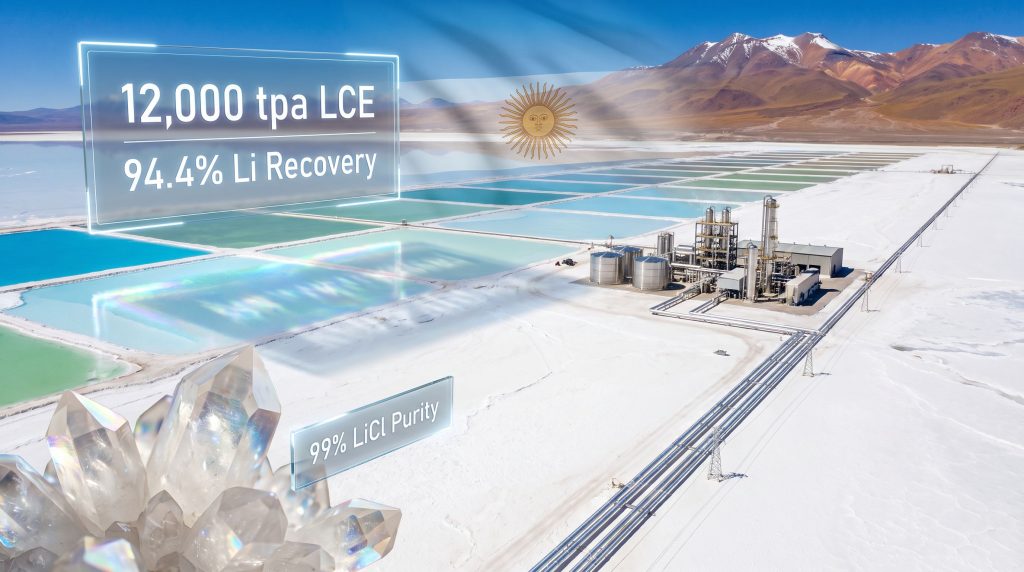
Pilot-scale testwork at the Rincon project has produced a lithium chloride purity of 99% alongside a lithium recovery rate of up to 94.4%. Both figures are commercially meaningful. A 94.4% recovery rate means that for every 100 units of lithium present in the raw brine processed, approximately 94.4 units make it into the final product stream. In brine operations, where recovery losses compound across large volumes, each percentage point of recovery improvement translates directly into revenue.
"Recovery efficiency in brine lithium processing is not a secondary technical detail. It is a primary determinant of project-level economics. A difference of even 3 to 5 percentage points in lithium recovery, applied across a 12,000 tonne per annum operation, represents a significant quantity of lost revenue annually at any realistic lithium carbonate price."
The Rincon Project's DFS Architecture: Phased Strategy and Process Flowsheet
The Argosy Rincon lithium project DFS in Argentina is structured around a phased development model that begins with solid lithium chloride as the first commercial product rather than battery-grade lithium carbonate. This is a strategically significant design choice that is often misunderstood by observers expecting all lithium projects to target battery-grade output from day one.
Why Solid Lithium Chloride as a Phase 1 Product Makes Commercial Sense
Solid lithium chloride is a marketable intermediate product with established industrial demand, particularly in aluminium production, air conditioning systems, and certain chemical manufacturing processes. More importantly for project development logic, targeting lithium chloride as an initial product delivers:
- Reduced upfront capital intensity by avoiding the additional processing equipment required for carbonate conversion in the initial phase
- Simplified operational complexity during commissioning and ramp-up, when unexpected processing challenges are most likely to emerge
- Earlier cash flow generation, which can partially fund subsequent phase development toward battery-grade products
- Technical optionality, preserving the ability to upgrade to lithium carbonate or lithium hydroxide without redesigning core upstream infrastructure
- Risk segmentation, separating the demonstration of upstream brine-to-chloride performance from the additional complexity of downstream battery-grade conversion
This sequenced approach reflects a capital-disciplined philosophy that is particularly relevant in the current lithium carbonate market environment, where spot prices for battery-grade lithium carbonate have experienced significant volatility since their 2022 peak. Projects that committed to full battery-grade processing infrastructure at maximum scale during the peak pricing period are now carrying substantially higher capital burdens relative to current revenue projections.
The Complete Rincon Process Flowsheet
The Rincon flowsheet is engineered as a scalable sequential chain:
| Stage | Process | Key Output |
|---|---|---|
| 1 | Raw brine extraction from salar | Lithium-bearing brine |
| 2 | Solar evaporation pre-concentration | Concentrated lithium brine |
| 3 | Solvent extraction | 99% purity lithium chloride solution |
| 4 | Forced evaporation | Energy-efficient concentration |
| 5 | Crystallisation | Solid lithium chloride (Phase 1 product) |
| 6 | Carbonate/hydroxide conversion | Battery-grade product (Phase 2+) |
Each stage has undergone dedicated testwork as part of the DFS programme, with engineering completion for the crystallisation and evaporation pond workstreams targeted for the end of September 2026.
Forced Evaporation and Energy Efficiency: An Underappreciated Cost Driver
One of the less-discussed but economically significant DFS workstreams at Rincon involves forced evaporation, for which testwork was conducted in Europe to assess energy consumption performance against the specific brine chemistry characteristics of the Rincon salar.
In brine lithium processing, forced evaporation uses thermal or mechanical energy to concentrate lithium solutions beyond what solar evaporation alone can achieve within economically viable timeframes. It is a critical bridging step between solar pre-concentration and final crystallisation, and its energy intensity per tonne of lithium output is a primary operating cost variable.
The European testwork confirmed high energy efficiency for the selected forced evaporation technology applied to Rincon brine. This is commercially important for two reasons. First, it reduces operating cost assumptions in the DFS model relative to less efficient alternatives. Furthermore, it validates the compatibility of the chosen technology with the specific ionic composition of Rincon brine, which can behave differently from standardised test brines used in generic equipment qualification programmes.
Infrastructure Advantages: The Capital Cost Equation That Separates Rincon From Remote Peers
Infrastructure access is one of the most consequential and least visible factors in brine lithium project economics. Remote salar locations in the Puna plateau can require hundreds of millions of dollars in enabling infrastructure, including power generation, water supply systems, and access road construction, before a single tonne of lithium is processed.
The Rincon project's location in Salta Province provides pre-existing access to three critical infrastructure categories:
- Grid power via an agreement with the Salta Electricity Distribution Company
- Industrial water supply sufficient for large-scale brine processing operations
- Transport connectivity supporting both construction logistics and operational supply chains
The 40 MW Power Agreement: What It Actually Means
The energy infrastructure position at Rincon deserves specific attention because it represents a genuinely unusual asset for a project at DFS stage. Argosy holds a formal agreement with the Salta Electricity Distribution Company for dedicated power supply, with engineering and feasibility works completed for infrastructure capable of delivering up to 40 MW to the project site.
The delivery mechanism involves a 33 kV medium-voltage connection sourced directly from the 500 kV Argentina National Grid, transmitted via an 8.6 km dedicated transmission line to the Rincon site. For context, 40 MW is a substantial power allocation that would support not only the 12,000 tpa Phase 1 operation but potentially provide headroom for future processing capacity expansion without requiring renegotiation of the power supply framework.
"In brine lithium project economics, power and water infrastructure can represent between 15% and 25% of total capital expenditure for remote operations. Pre-negotiated grid connectivity at the scale secured by the Rincon project represents a structural capital cost advantage that should be reflected in DFS capital intensity benchmarks relative to less-connected peers."
Project Ownership, Resource Scale, and JORC Credibility
Argosy Minerals holds 77.5% of Puna Mining, the entity that directly owns the Rincon project, with contractual rights enabling an increase to 90%. The project's JORC Mineral Resource Estimate stands at 731,801 tonnes of lithium carbonate equivalent, a resource scale sufficient to underpin a multi-decade commercial operation at 12,000 tpa target production.
For comparison purposes, it is worth noting that both the Argosy Rincon lithium project DFS in Argentina and Rio Tinto's separately owned Rincón project operate in Salta Province but represent entirely independent assets with different ownership structures, technical approaches, and development timelines. The naming similarity has created persistent confusion in media coverage, but the two projects share no operational or ownership connection.
| Feature | Argosy Rincon | Rio Tinto Rincón |
|---|---|---|
| Operator | Argosy Minerals (ASX) | Rio Tinto |
| Target Capacity | 12,000 tpa LCE | 3,000 tpa (Phase 1) |
| Development Stage | DFS and FEED in progress | Pilot plant operational |
| JORC Resource | 731,801 t Li₂CO₃ eq | Separate JORC resource |
| Power Infrastructure | 40 MW grid-connected | Not publicly specified |
The next major ASX story will hit our subscribers first
Argentina's Regulatory and Investment Landscape: Context Without Overstating Project-Specific Impact
The broader Argentina lithium brine market is underpinned by substantial natural endowment. Argentina contains an estimated 21% of the world's identified lithium resources according to the US Geological Survey, and the Puna plateau region of Salta Province represents one of the highest-grade brine concentrations globally. The country's position within the Lithium Triangle alongside Chile and Bolivia makes it a structurally important jurisdiction for battery supply chain development.
Argentina's RIGI framework, introduced in 2024 as a large investment incentive regime, is designed to attract significant capital into mining and energy sectors by providing tax stability and regulatory predictability for qualifying investments. Whether specific projects benefit from this framework depends on individual project characteristics and application processes, and it should not be assumed that any project automatically receives such designation.
What is relevant for the Rincon DFS timeline is that Argentina's evolving mining regulatory environment, combined with Salta Province's existing infrastructure base, creates a generally supportive operational context for projects at advanced feasibility stages.
Key Technical Metrics Summary and DFS Milestone Tracker
| Metric or Milestone | Status or Result |
|---|---|
| Solvent extraction purity | 99% lithium chloride achieved |
| Lithium recovery rate | Up to 94.4% at pilot scale |
| Forced evaporation efficiency | High efficiency confirmed (European testwork) |
| Crystallisation testwork | Ongoing, September 2026 completion target |
| Evaporation pond engineering | In progress, September 2026 completion target |
| Power infrastructure | 40 MW, 33 kV, 8.6 km line, engineering complete |
| Regulatory production approval | 12,000 tpa approval received April 2024 |
| DFS and FEED progression | Active as of mid-2026 |
What Investors and Analysts Should Watch as DFS Completion Approaches
The Capital Intensity Benchmark
When the full DFS is published, the most analytically revealing figure will be capital expenditure per tonne of annual production capacity. This metric, expressed as dollars per tonne per annum of lithium carbonate equivalent, provides a direct comparison against peer projects in Argentina and Chile. Given Rincon's pre-existing infrastructure access, grid power agreement, and process validation results, a below-sector-average capital intensity outcome would represent a meaningful endorsement of the project's commercial positioning.
The Operating Cost Structure
Operating cost per tonne of lithium carbonate equivalent will be the second critical DFS output. The combination of grid-connected power at competitive electricity rates, validated high-efficiency forced evaporation, and a 94.4% lithium recovery rate collectively suggest potential for a competitive operating cost position. However, DFS-stage numbers carry inherent uncertainty, and investors should apply appropriate caution to pre-DFS cost estimates until formal study results are published.
Is FEED Transition a Meaningful De-Risking Signal?
Progression from DFS to Front-End Engineering Design represents the transition from feasibility validation to construction-ready engineering. A successful DFS outcome followed by FEED initiation would signal that the project's technical and economic parameters have been confirmed to bankable study standards. Furthermore, direct lithium extraction technology advancements across the broader sector may influence how the Rincon process flowsheet is benchmarked against emerging alternatives. This is typically a prerequisite for formal engagement with project finance providers and strategic offtake counterparties.
Disclaimer: This article is intended for informational purposes only and does not constitute financial advice. All references to project economics, timelines, and feasibility outcomes involve forward-looking statements subject to material uncertainty. Investors should conduct independent due diligence and consult qualified financial advisers before making investment decisions. Past exploration or testwork results are not necessarily indicative of future commercial outcomes.
Want to Stay Ahead of the Next Major Lithium Discovery on the ASX?
Discovery Alert's proprietary Discovery IQ model delivers real-time alerts the moment significant mineral discoveries — including lithium brine projects — are announced on the ASX, turning complex geological data into actionable investment insights for both short-term traders and long-term investors. Explore historic examples of major discoveries and their returns, then begin your 14-day free trial to position yourself ahead of the broader market.