July 24, 2026
The Three Tiers That Determine Whether India Becomes a Battery Superpower
Most industrial transformations begin not with a policy announcement, but with a quiet shift in the economics of dependency. When the cost of importing something becomes structurally riskier than the cost of building domestic capacity, capital begins to move. That is precisely the inflection point the India battery chemicals ecosystem has reached. The forces driving this shift are not speculative; they are measurable, multi-sectoral, and compounding in the same direction simultaneously.
Understanding what this moment means for investors, manufacturers, and policymakers requires a clear-eyed look at where India actually sits across each layer of the battery value chain, what the demand trajectory looks like in concrete terms, and which structural barriers could slow what is otherwise shaping up to be one of the most significant industrial pivots in the country's modern economic history.
When big ASX news breaks, our subscribers know first
Understanding the Full Battery Value Chain: Where India Stands Today
The battery raw materials market is best understood as three interconnected tiers, each with distinct capital requirements, technology intensities, and strategic vulnerabilities.
| Value Chain Tier | Key Components | India's Current Status |
|---|---|---|
| Upstream | Lithium, cobalt, nickel, graphite | Largely import-dependent |
| Midstream | Cathode/anode materials, electrolytes, separators | Early-stage, growing domestic capacity |
| Midstream | Cell manufacturing | Rapidly expanding under PLI incentives |
| Downstream | Pack assembly, copper/aluminium foils | Established capability |
| Downstream | Battery recycling | Emerging, policy-supported |
India's downstream capabilities are genuinely competitive. Pack assembly, copper foil handling, and aluminium component integration have matured over several years of consumer electronics and automotive manufacturing experience. The midstream layer, however, tells a more complicated story. Conductive carbon black producers are pivoting toward battery-grade specifications, specialty graphite processing is expanding, and electrolyte chemical production is gaining traction, but cathode active materials (CAM) and separator manufacturing remain in very early stages.
The upstream tier is where India's strategic exposure is most acute. There is no domestic lithium, nickel, or cobalt processing operating at commercial scale. This is not merely an industrial gap; it is a geopolitical vulnerability that traces directly back to a single dominant supplier.
How Severe Is India's Import Dependency Problem?
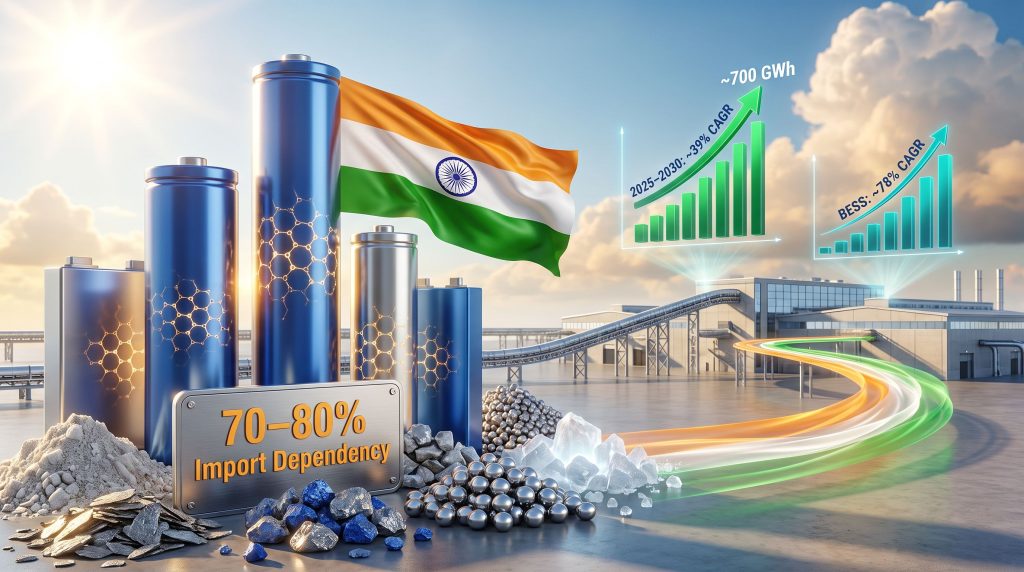
Estimates consistently place India's reliance on imported lithium-ion battery materials and finished cells at approximately 70 to 80 percent of total requirements. China is the primary source of upstream inputs, including processed lithium compounds, refined cobalt, synthetic graphite anode materials, and cathode precursor chemicals. This concentration creates a structural fragility that goes beyond simple cost exposure.
When a single nation controls the refining capacity for multiple critical minerals simultaneously, the downstream consumer nations face a compounding vulnerability rather than isolated single-commodity risk. India's battery supply chain currently exhibits exactly this characteristic.
The four minerals at the heart of the problem each carry distinct supply dynamics:
- Lithium is predominantly refined in China, with primary ore sourced from Australia and South America. Furthermore, India's lithium supply strategy has been increasingly directed toward securing Australian supply agreements to reduce this exposure.
- Cobalt supply is heavily concentrated in the Democratic Republic of Congo at the mining level, with Chinese refining dominating the processed output
- Nickel faces a more distributed supply base, but Indonesian nickel processing capacity is increasingly integrated with Chinese industrial capital
- Graphite, both natural and synthetic, is an area of particularly acute concern, with China controlling an estimated 70 to 80 percent of global anode-grade graphite supply according to industry tracking data
Compared to other emerging battery manufacturing nations such as Indonesia, which is leveraging its nickel endowment to integrate upstream, or Morocco, which is developing phosphate-based cathode chemistry advantages, India's mineral security position is among the most exposed of any country pursuing large-scale battery industrialisation.
What Is Driving ACC Demand Growth in India?
The demand projections underpinning the India battery chemicals ecosystem buildout are not marginal; they represent growth rates that fundamentally restructure the economics of domestic manufacturing investment.
| Period | Projected CAGR | Estimated Demand (End of Period) |
|---|---|---|
| 2025 to 2030 | ~39% | ~700 GWh |
| 2030 to 2035 | ~27% | Significantly higher |
Starting from an estimated 40 GWh in 2025, India's advanced chemistry cell demand is projected to reach approximately 700 GWh by 2030, according to analysis from brokerage firm Nuvama. The composition of that demand growth is instructive:
- Electric vehicles represent the largest absolute volume driver, with battery demand from the EV sector projected to grow at approximately 35 percent annually through 2030
- Battery energy storage systems (BESS) are the fastest-growing application segment by rate, with demand projected to expand at a CAGR of approximately 78 percent through 2030
- Consumer electronics and industrial applications represent smaller but stable demand pools that support base-load chemical production economics
The BESS growth rate warrants particular attention. India's renewable energy buildout is creating grid stability requirements that cannot be resolved through generation capacity alone. As solar and wind penetration rises, the need for dispatchable storage scales non-linearly with intermittent generation capacity. This dynamic means BESS demand is not merely growing; it is structurally obligated to grow as India pursues its broader energy transition targets.
Globally, advanced chemistry cell demand is projected to grow at around 20 percent CAGR during 2025 to 2030, before moderating to approximately 8 percent during 2030 to 2035. The global market is also expected to see utilisation rates recover as current excess manufacturing capacity, particularly in China, is absorbed by demand growth. This rebalancing creates a window during which Indian domestic producers may be able to establish market position before global pricing dynamics tighten again.
How Government Policy Is Constructing the Foundation
The Production Linked Incentive scheme for advanced chemistry cells commits ₹18,100 crore in structured manufacturing incentives, targeting 50 GWh of domestic cell production capacity as its baseline objective. This is a foundation, not a ceiling. More than 10 manufacturers have announced approximately 178 GWh of planned battery manufacturing capacity across various stages of commitment and development, creating a substantial downstream demand signal for domestic chemicals and materials suppliers.
The National Critical Mineral Mission adds a complementary upstream dimension, targeting domestic exploration, processing, and recycling of lithium, nickel, cobalt, and graphite. Battery Waste Management Rules are simultaneously establishing the regulatory architecture for a circular economy model that could, over time, reduce primary mineral dependency through secondary recovery.
Policy frameworks of this type do not guarantee commercial success, but they fundamentally alter the risk calculus for private capital allocation. The question for investors is not whether government policy supports the direction of travel, but whether specific companies can execute within the window that policy creates.
One area where current frameworks show clear gaps is in the technology transfer and skilled workforce development required to bridge the distance between announced capacity and operational commercial-scale production. Pilot-scale success in battery materials chemistry does not translate automatically to gigawatt-hour-scale manufacturing efficiency. In addition, Indian lithium investment patterns suggest that private capital is beginning to align with these government frameworks, though execution risk remains considerable.
Which Battery Chemistry Will Define India's Industrial Trajectory?
Lithium iron phosphate chemistry has emerged as the dominant technology for both EV and stationary storage applications globally, and its trajectory within the India battery chemicals ecosystem is likely to mirror this pattern. The reasons are structural rather than temporary:
- Cost: LFP cells have achieved significant cost advantages over nickel-manganese-cobalt (NMC) chemistries, particularly at the pack level
- Safety: The absence of cobalt and the inherent thermal stability of the iron-phosphate cathode structure reduces thermal runaway risk
- Cycle life: LFP chemistry delivers superior calendar and cycle longevity for stationary storage applications
- Supply chain alignment: Iron and phosphate are substantially more geographically distributed than cobalt and nickel
The material implications of LFP dominance are significant for Indian producers specifically. Beneficiary materials include iron phosphate, synthetic graphite, conductive carbon black, carbon nanotubes, electrolyte salts, and lithium hexafluorophosphate. Demand for cobalt-intensive NMC precursors moderates in an LFP-dominant scenario, which is actually an advantage for India given its limited cobalt supply chain integration.
Emerging chemistry frontiers including silicon-carbon anodes, lithium manganese iron phosphate (LMFP), sodium-ion, and solid-state technologies remain earlier-stage but represent the next wave of investment opportunity. Silicon-carbon anodes in particular are attracting significant research investment globally because they offer energy density improvements over graphite without abandoning existing cell manufacturing infrastructure.
The next major ASX story will hit our subscribers first
Which Indian Companies Are Positioning for Battery Chemicals Leadership?
Several established Indian specialty chemical companies have made disclosed investments in advanced battery materials. PCBL Chemical, Himadri Speciality Chemical, and Balaji Amines represent examples of industrial players repositioning existing chemical manufacturing expertise toward battery-grade specifications. According to industry analysis of India's battery chemicals sector, these chemical majors are increasingly prioritising battery-grade output as a strategic growth vertical.
| Battery Material Segment | Domestic Activity Level | Key Opportunity |
|---|---|---|
| Conductive carbon black | High | Established producers pivoting to battery-grade |
| Specialty graphite and anode materials | Growing | Significant import substitution potential |
| Electrolyte chemicals | Early-stage | High-value opportunity with domestic precursor base |
| Cathode active materials (CAM) | Very early | Requires upstream mineral security first |
| Separators | Nascent | High import dependency remains |
The conductive carbon black segment represents the nearest-term commercial opportunity for Indian producers because the technical gap between existing industrial-grade production and battery-grade specification is narrower than in cathode or separator manufacturing. Companies with established carbon black assets are the most naturally positioned to capture early battery chemicals revenue without requiring entirely new process technology.
Ancillary materials including copper foil and aluminium foil used in current collector applications are also areas where India's existing metals processing capability can be leveraged, though achieving the ultra-thin gauge specifications and surface quality required for high-performance cell manufacturing remains technically demanding.
How Battery Recycling Fits Into India's Long-Term Material Security Strategy
Recycling is increasingly recognised not as an environmental compliance obligation but as a strategic mineral recovery mechanism. End-of-life lithium-ion cells contain recoverable concentrations of lithium, cobalt, nickel, and copper that can re-enter the battery supply chain, effectively creating a secondary domestic mineral source over time. This battery recycling breakthrough approach being pioneered elsewhere offers India a clear template for developing its own closed-loop recovery infrastructure.
India's Battery Waste Management Rules have established extended producer responsibility frameworks that are beginning to formalise collection and processing obligations. Commercial-scale hydrometallurgical recycling, which achieves higher recovery rates than pyrometallurgical alternatives for lithium specifically, remains underdeveloped domestically. This represents both a current weakness and a medium-term investment opportunity.
The longer-term strategic value of recycling compounds as EV fleet penetration increases. A country that deploys hundreds of gigawatt-hours of batteries between 2025 and 2035 is simultaneously creating a domestic secondary mineral resource base that will begin maturing approximately eight to twelve years after initial deployment.
The Biggest Structural Barriers to Ecosystem Maturity
Acknowledging the opportunity requires equal attention to the structural barriers that could constrain realisation:
- Upstream mineral gap: Without domestic lithium, nickel, or cobalt processing at scale, midstream chemical manufacturers remain dependent on imported precursors, limiting the depth of import substitution achievable even with strong downstream manufacturing capacity
- Technology readiness distance: The gap between laboratory demonstration and commercial-scale battery-grade materials production is frequently underestimated; yield losses, consistency requirements, and quality certification timelines add years to commercialisation schedules
- Capital intensity: Full value chain development across mining, processing, chemical manufacturing, cell production, and recycling requires capital deployment of an order of magnitude beyond what current announced investments represent
- Workforce and knowledge gaps: Battery electrochemistry, materials science, and cell engineering require specialist technical knowledge that takes years to accumulate at institutional scale; India's talent pipeline in these disciplines is growing but remains thin relative to the scale of ambition
Furthermore, direct lithium extraction technologies may offer India a pathway to reduce processing timelines for domestically sourced brine deposits, though commercial deployment at scale remains a medium-term prospect rather than an immediate solution.
Investment Thesis: A Decade-Long Structural Opportunity
The convergence of four independent demand drivers creates an investment thesis that is broader than any single policy cycle:
- EV fleet electrification progressing at approximately 35 percent CAGR through 2030
- Grid-scale BESS deployment expanding at approximately 78 percent CAGR through 2030
- Government-mandated domestic content requirements creating a regulatory floor for local supply chain development
- Global supply chain diversification pressure generating commercial openings for non-Chinese battery material suppliers
Disclaimer: Growth rate projections referenced throughout this article represent analyst estimates and should not be interpreted as guaranteed outcomes. Actual demand trajectories will depend on EV adoption rates, grid investment execution, policy continuity, and global macroeconomic conditions. Investors should conduct independent due diligence before making investment decisions based on sector-level projections.
Near-term returns are most accessible in segments where India already has competitive capability: conductive carbon black, specialty graphite processing, electrolyte salt chemistry, and ancillary foil materials. CAM and separator manufacturing represent longer-duration return profiles that require upstream mineral security as a prerequisite.
The import substitution timeline is not uniform across the value chain. Realistic commercial-scale import substitution in conductive additives and graphite anode materials could emerge within three to five years. CAM domestication is a seven-to-ten-year project at minimum, contingent on critical mineral supply chain development proceeding in parallel.
Frequently Asked Questions: India Battery Chemicals Ecosystem
What is India's ACC demand forecast for 2030?
India's advanced chemistry cell demand is projected to reach approximately 700 GWh by 2030, growing from around 40 GWh in 2025 at a CAGR of roughly 39 percent, based on Nuvama research analysis.
What does the PLI-ACC scheme cover and how large is the incentive pool?
The Production Linked Incentive scheme for advanced chemistry cells provides ₹18,100 crore in manufacturing incentives targeting 50 GWh of domestic cell production capacity, covering cell-level manufacturing with performance-linked disbursement structures.
Which battery chemistry is expected to dominate India's EV and storage markets?
Lithium iron phosphate (LFP) chemistry is expected to remain dominant due to its cost advantages, thermal safety characteristics, and superior cycle life, particularly for stationary storage applications.
What critical minerals does India currently import for battery production?
India imports the substantial majority of its lithium compounds, refined cobalt, processed nickel, and anode-grade graphite, with China as the primary supplier across most categories.
How does India's battery recycling policy support domestic material security?
Battery Waste Management Rules establish extended producer responsibility frameworks that mandate collection and processing of end-of-life cells, creating the regulatory foundation for a secondary mineral recovery industry that can reduce primary import dependency over time.
What is the difference between cathode active materials and anode active materials in battery manufacturing?
Cathode active materials (CAM) such as lithium iron phosphate or NMC compounds determine the voltage and energy density characteristics of a cell. Anode active materials (AAM), predominantly graphite with emerging silicon additions, store the lithium ions during charging. Both are classified as midstream battery chemicals and are currently imported in large volumes by Indian cell manufacturers.
Which segments of the battery value chain offer the strongest near-term investment case in India?
Conductive carbon black, specialty graphite and anode material processing, and electrolyte chemical manufacturing offer the strongest near-term investment cases due to existing domestic industrial capability, lower technology readiness gaps, and significant import substitution potential relative to capital required. A comprehensive overview of India's EV battery strategies provides further detail on how these near-term opportunities are being prioritised at the policy level.
The Architecture of India's Battery Industrial Future
The transition from structural import dependency to meaningful domestic production capability across the India battery chemicals ecosystem will not be linear, and it will not be rapid across all value chain tiers simultaneously. However, the direction is no longer ambiguous.
Three milestones will define whether ecosystem maturity is genuinely achieved: first, the commissioning of commercial-scale CAM production using domestically processed mineral inputs; second, the emergence of internationally competitive separator manufacturing capacity; and third, the operationalisation of closed-loop recycling at sufficient scale to meaningfully reduce primary mineral import requirements.
The next five years are structurally differentiated from the previous decade by the coincidence of demand scale, policy architecture, private capital commitment, and geopolitical pressure that did not coexist in the same way before. Whether that structural difference translates into durable industrial capability will depend on execution quality across the private sector and on whether mineral security investments at the upstream tier keep pace with the downstream ambition already clearly in motion. Research into India's midstream battery production potential suggests that the midstream tier, in particular, represents the most critical bottleneck to address if full value chain integration is to be achieved.
Readers seeking additional context on India's energy transition and battery manufacturing policy landscape can explore related coverage at ET EnergyWorld via energy.economictimes.indiatimes.com, which provides ongoing reporting on India's clean energy industrial developments.
Want to Identify the Next Major Mineral Discovery Before the Market Does?
Discovery Alert's proprietary Discovery IQ model delivers real-time alerts on significant ASX mineral discoveries — including those tied to the critical minerals powering India's battery revolution — instantly translating complex data into actionable investment insights for traders and long-term investors alike. Explore historic discoveries and the substantial returns they generated, then begin your 14-day free trial at Discovery Alert to position yourself ahead of the market.