July 23, 2026
Global supply chain vulnerabilities in battery manufacturing have created unprecedented opportunities for emerging economies to establish strategic positions in critical technology value chains. While established manufacturing hubs in Asia continue to dominate lithium-ion production, policy frameworks targeting industrial capacity building, mineral resource security, and technology ecosystem development are reshaping competitive dynamics across multiple regions. The convergence of electrification demand growth, raw material scarcity, and geopolitical supply chain diversification creates complex strategic scenarios for countries seeking energy transition leadership. Furthermore, the India EV battery ecosystem represents a pivotal example of how emerging markets are positioning themselves to capture value in the rapidly evolving battery manufacturing sector.
Current Strategic Position Assessment
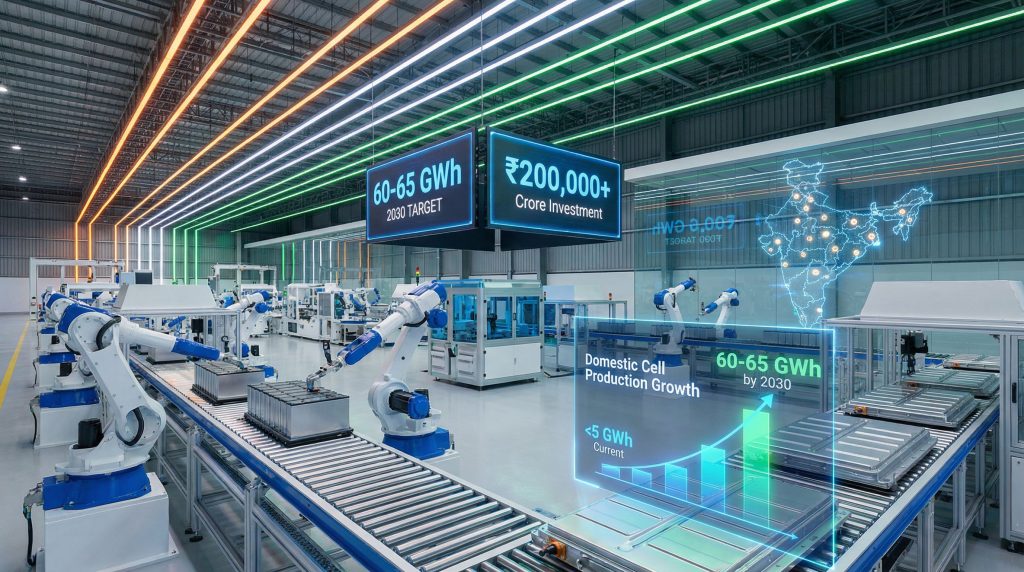
India's positioning within global battery manufacturing represents a fundamental shift from import dependency toward integrated domestic capability development. Current domestic cell production operates below 5 GWh annually, creating substantial import reliance reaching 85-90 percent across battery system components. This structural dependency encompasses finished cells, raw materials, and specialised manufacturing equipment, requiring comprehensive intervention across multiple value chain segments.
Strategic Component Analysis: India's Battery Ecosystem Development (2024-2026)
| Strategic Component | Current Status | 2030 Projection | Implementation Risk |
|---|---|---|---|
| Domestic Cell Production | <5 GWh | 60-65 GWh | High |
| Import Dependency | 85-90% | 40-50% | Medium |
| Manufacturing Investment | ₹75,000 crore | ₹200,000+ crore | Medium |
| Technology Localisation | 10-20% | 60-70% | High |
The Production-Linked Incentive scheme for Advanced Chemistry Cells allocates ₹18,100 crore toward accelerated industrialisation, targeting 50 GWh committed capacity through participating industrial groups. This financial framework represents government recognition that private sector battery manufacturing requires substantial risk mitigation to achieve commercial viability against established international producers.
Manufacturing investment trajectories indicate current allocations of ₹75,000 crore with projections exceeding ₹200,000 crore by 2030. These capital requirements reflect the complexity of establishing integrated battery-grade lithium refinery capabilities, encompassing cathode, anode, electrolyte, and separator manufacturing technologies that differ fundamentally from existing automotive assembly operations.
Technology localisation metrics currently range between 10-20 percent, primarily concentrated in pack assembly rather than upstream cell manufacturing. Achieving projected 60-70 percent localisation by 2030 requires development of fundamentally different technical capabilities, intellectual property frameworks, and supply chain integration across battery chemistry, thermal management, and quality control systems.
Domestic demand projections indicate India EV battery ecosystem requirements reaching 11-13 GWh by fiscal year 2025, establishing baseline market scale for domestic manufacturing viability. However, demand growth acceleration beyond this baseline depends on broader EV adoption rates, policy incentive effectiveness, and cost competitiveness versus internal combustion engine alternatives across different vehicle segments.
When big ASX news breaks, our subscribers know first
Strategic Pathways for Battery Manufacturing Self-Sufficiency
Accelerated Domestic Manufacturing Scale-Up Framework
Manufacturing capacity expansion scenarios present divergent pathways based on execution effectiveness, technology transfer success, and market demand realisation. The optimistic scenario projects 150+ GWh committed capacity operational by 2030, requiring sustained policy support, successful international technology partnerships, and accelerated domestic demand growth across commercial and passenger vehicle segments.
Manufacturing Expansion Scenario Analysis:
• Optimistic Pathway: 150+ GWh committed capacity operational by 2030
• Base Case Scenario: 80-100 GWh with structured technology transfer phases
• Conservative Scenario: 40-60 GWh due to implementation delays and market constraints
• Risk Mitigation: Phased capacity addition aligned with demand growth validation
The base case scenario targeting 80-100 GWh capacity emphasises structured technology transfer arrangements with established global manufacturers. This approach balances rapid scale-up objectives with technology absorption requirements, enabling domestic companies to develop manufacturing expertise gradually while achieving commercial production volumes.
Conservative projections acknowledging potential execution delays reflect realistic constraints including regulatory approval timelines, skilled workforce development, supply chain establishment, and market demand validation. The 40-60 GWh range represents achievable capacity expansion under constrained implementation conditions.
Current domestic manufacturing focus on pack assembly rather than cell production creates strategic gaps requiring upstream capability development. Cell manufacturing involves sophisticated technical processes including electrode coating, electrolyte formulation, separator production, and quality control systems that represent distinct competency requirements compared to existing automotive assembly operations. Additionally, advances in lithium industry innovations are transforming manufacturing processes globally.
Global Raw Material Security Through Strategic Acquisitions
International mineral asset acquisition represents critical infrastructure for long-term battery manufacturing competitiveness. India's consortium-based approach involves public sector undertakings including Hindustan Copper Limited pursuing advanced-stage bidding for overseas exploration and production assets in South America, Australia, and Canada.
Strategic Mineral Acquisition Framework:
• Lithium asset exploration in South America, Australia, and Canada
• Consortium-based risk distribution across multiple public sector entities
• Integrated processing capability development for imported raw materials
• Secondary recovery systems targeting industrial waste streams
Spodumene lithium extraction capabilities target conversion of mineral ore containing 1-6 percent lithium content into battery-grade lithium compounds suitable for cell manufacturing. This processing pathway enables India to import less refined raw materials and capture downstream value addition through domestic conversion operations.
The technology framework for spodumene processing involves either sulfuric acid leaching followed by precipitation or advanced direct lithium extraction methodologies. Each processing pathway presents distinct capital investment requirements, energy consumption profiles, and environmental control specifications that influence overall cost competitiveness.
Current challenges in raw material security include limited domestic conversion capacity at commercial scale, resulting in imported lithium often being traded internationally rather than processed domestically. This creates inefficient value chains where raw material access fails to translate into integrated battery manufacturing capability.
Recovery systems for critical minerals energy transition from industrial waste streams including red mud, tailings, and fly ash have demonstrated technical feasibility through recent gallium and cadmium production initiatives. However, commercial scalability remains constrained by high capital investment requirements and uncertain return profiles that limit private sector participation.
Technology Ecosystem Development and Innovation Infrastructure
The National Critical Mineral Mission demonstrates structured progress with 46 blocks auctioned against a 100-block target, while the National Geoscience Data Repository hosts approximately 90,000 exploration reports. This infrastructure development creates transparency frameworks enabling private sector evaluation of mineral opportunities and technical collaboration.
Innovation Ecosystem Development Metrics:
• 46 critical mineral blocks auctioned (46% of 100-block target achieved)
• 90,000+ exploration reports in National Geoscience Data Repository
• 212 mineral blocks auctioned in 2025-26 (versus <100 annually previously)
• 25 mines operational in past year (compared to 58 in previous decade)
Procedural reforms including automatic declaration of preferred bidders, digital end-to-end auction processes, and accelerated approval frameworks have tangibly improved mining sector efficiency. These systemic improvements create enabling environments for technology ecosystem development and private sector participation in critical mineral value chains.
Private sector engagement remains limited in critical mineral recovery from industrial waste due to high capital investment requirements and uncertain commercial returns. This gap indicates that policy incentives for secondary sourcing require enhancement to achieve technical feasibility translation into commercial viability.
Technical education partnerships with global technology providers represent essential infrastructure for workforce development supporting battery manufacturing scale-up. Current domestic expertise concentrates in assembly operations rather than upstream cell manufacturing, requiring substantial capability building in electrochemistry, materials science, and quality control systems.
Cost Competitiveness Analysis for Global Market Position
Battery Cost Structure and Pricing Dynamics
Battery systems currently represent 35-40 percent of total EV pricing across vehicle segments, with global cost reductions reaching approximately 20 percent year-over-year in 2024 due to supply oversupply conditions. This cost trajectory creates both competitive opportunity for new market entrants and pricing pressure requiring efficient manufacturing operations to achieve commercial viability.
India's Cost Competitiveness Framework:
• Labour cost advantages in assembly and processing operations
• Proximity benefits to growing domestic demand markets
• Potential energy cost reductions through renewable grid integration
• Scale disadvantages versus established Chinese and Korean producers
Manufacturing cost competitiveness depends on achieving sufficient production scale to absorb fixed capital investments in specialised equipment, quality control systems, and technical workforce development. Current greenfield development requirements create higher initial capital costs compared to established producers operating mature manufacturing facilities.
Energy cost profiles present potential competitive advantages through India's expanding renewable energy infrastructure. Battery manufacturing requires substantial electricity consumption for thermal management, chemical processing, and quality control operations, making renewable energy access a significant cost factor for long-term competitiveness.
Labour cost advantages in assembly and processing operations provide structural benefits, though these advantages diminish as manufacturing automation increases and technical skill requirements expand. The transition from assembly-focused operations to integrated cell manufacturing requires higher-skilled workforce development with corresponding wage implications.
Proximity to domestic demand markets offers logistical cost advantages and responsiveness benefits, particularly as India EV battery ecosystem demand growth accelerates. Local manufacturing reduces transportation costs, currency exchange risks, and supply chain disruption exposure compared to import-dependent strategies.
Technology Transfer and Intellectual Property Considerations
Joint venture partnerships with established global manufacturers represent the primary pathway for technology transfer and manufacturing expertise development. These arrangements balance rapid capability acquisition with intellectual property protection requirements, enabling domestic companies to access proven manufacturing processes while developing independent technical competencies.
Technology Acquisition Strategy Components:
-
Structured joint venture partnerships for manufacturing process transfer
-
Phased localisation requirements promoting technology absorption
-
Intellectual property frameworks protecting domestic innovation development
-
Research and development infrastructure investment for independent capability building
Gradual technology absorption through phased localisation requirements enables domestic manufacturers to develop expertise systematically while achieving commercial production volumes. This approach reduces technology transfer risks while ensuring sustainable competitive capability development beyond initial partnership arrangements.
Investment in research and development infrastructure supports long-term technology independence by building domestic innovation capabilities in battery chemistry, thermal management, and manufacturing process optimisation. These investments complement technology transfer arrangements by developing complementary technical competencies.
Current technology transfer challenges include sophisticated technical requirements for cathode, anode, electrolyte, and separator production that represent distinct competency areas requiring specialised equipment, process control systems, and quality assurance methodologies.
Strategic Risk Assessment and Mitigation Frameworks
Geopolitical Supply Chain Vulnerability Analysis
Critical dependencies on international supply chains create strategic vulnerabilities requiring comprehensive mitigation strategies. Lithium carbonate and hydroxide imports from South America, cobalt sourcing from Central Africa, and nickel supply chains concentrated in Indonesia and Philippines represent concentration risks requiring diversification initiatives.
Supply Chain Risk Matrix:
| Critical Material | Primary Sources | Alternative Sources | Risk Mitigation |
|---|---|---|---|
| Lithium Compounds | South America | Australia, Canada | Domestic processing |
| Cobalt | Central Africa | Canada, Australia | Chemistry optimisation |
| Nickel | Indonesia, Philippines | Canada, Russia | Strategic stockpiling |
| Technology Equipment | China, Japan, South Korea | Europe, North America | Joint ventures |
Technology equipment imports from China, Japan, and South Korea create dependencies on specialised manufacturing machinery, quality control systems, and process optimisation technologies. Mitigation strategies include joint venture arrangements with equipment manufacturers and development of domestic technical service capabilities.
Strategic stockpiling of critical materials provides buffer capacity against supply chain disruptions, though storage costs and material degradation considerations limit practical stockpiling horizons. Optimal stockpile sizing requires balancing security benefits with capital carrying costs and inventory management complexity.
Alternative chemistry development including sodium-ion battery technologies offers potential diversification from lithium-ion dependencies. Approximately 10-12 firms globally are advancing sodium-ion commercialisation, which could reduce critical material concentration risks while utilising more abundant sodium resources.
Market Demand and Technology Evolution Scenarios
EV adoption projections present divergent scenarios affecting battery manufacturing capacity requirements and technology pathway selection. Aggressive scenarios projecting 30 percent fleet electrification by 2030 create substantial demand growth requiring rapid manufacturing scale-up and supply chain development.
EV Market Penetration Scenarios (2030 Projections):
• Aggressive Scenario: 30% fleet electrification (49% CAGR growth)
• Moderate Scenario: 20% fleet electrification with gradual adoption
• Conservative Scenario: 15% fleet electrification due to cost and infrastructure constraints
• Sectoral Distribution: Two-wheeler dominance, commercial three-wheeler rapid adoption
Technology evolution toward advanced battery chemistries including solid-state electrolytes, silicon anodes, and alternative cathode materials could require manufacturing capability adaptation and equipment investment updates. These evolution pathways present both opportunity and risk for domestic manufacturing investment strategies.
Market segmentation across two-wheeler, three-wheeler commercial, passenger vehicles, and stationary storage creates diverse technical requirements and cost optimisation priorities. Manufacturing strategies require flexibility to address multiple market segments with distinct performance, cost, and reliability specifications. In addition, emerging battery recycling breakthrough technologies may reshape value chain dynamics.
Grid-scale renewable energy integration creates substantial stationary storage demand requiring different battery specifications compared to transportation applications. This market diversification provides demand stability while requiring manufacturing capability across multiple battery chemistry and performance categories.
Alternative Technology Pathways and Innovation Opportunities
Sodium-Ion Battery Development as Strategic Diversification
Sodium-ion battery technologies offer strategic advantages for India EV battery ecosystem development through reduced dependence on lithium imports and utilisation of abundant domestic sodium resources. Current global development involves 10-12 companies advancing commercial-scale sodium-ion production, primarily targeting stationary energy storage applications.
Sodium-Ion Technology Framework:
• Abundant sodium resource availability domestically
• Reduced critical material import dependencies
• Optimised performance for stationary energy storage applications
• Lower material costs compared to lithium-ion chemistries
Performance characteristics of sodium-ion batteries include lower energy density compared to lithium-ion systems, making them suitable for applications where weight and volume constraints are less critical. Stationary storage for grid-scale renewable integration represents the primary commercial opportunity for sodium-ion technology deployment.
Manufacturing process similarities between sodium-ion and lithium-ion batteries enable production capability sharing while reducing technology development risks. Existing lithium-ion manufacturing equipment can often be adapted for sodium-ion production with modifications to electrolyte handling and quality control systems.
Cost advantages from abundant sodium availability and reduced critical material requirements could enable competitive positioning in price-sensitive market segments including grid storage and commercial vehicle applications where performance requirements allow sodium-ion viability.
Advanced Recycling and Circular Economy Integration
Recovery of critical minerals from industrial waste streams represents underexplored opportunities for secondary sourcing and supply chain resilience. Recent production advances in gallium and cadmium recovery from red mud, tailings, and fly ash demonstrate technical feasibility though commercial scalability remains constrained.
Circular Economy Development Framework:
-
Industrial waste mineral recovery from red mud and fly ash
-
Battery end-of-life material recovery and processing systems
-
Manufacturing waste stream optimisation and recycling integration
-
Secondary market development for recovered critical materials
Battery recycling infrastructure development enables recovery of lithium, cobalt, nickel, and other critical materials from end-of-life battery systems. Effective recycling operations can provide 15-20 percent of new battery material requirements while reducing environmental disposal concerns and import dependency.
Processing technology for mineral recovery from industrial waste requires substantial capital investment and specialised technical capabilities, limiting private sector participation without policy incentives addressing commercial viability gaps. Government support mechanisms could accelerate circular economy development.
Secondary market development for recovered materials requires quality standards, pricing mechanisms, and supply chain integration enabling recycled materials to compete with primary mineral sources in battery manufacturing applications.
The next major ASX story will hit our subscribers first
Investment Strategy and Market Positioning Implications
Strategic Recommendations for Stakeholder Success
Industrial policy makers should prioritise critical mineral processing facility approvals while enhancing coordination between central and state incentive programmes. Technical education partnerships with global technology providers require systematic development to support workforce capabilities for battery manufacturing scale-up. Moreover, India aims to build a full EV battery ecosystem within the next two to three years, according to government officials.
Policy Maker Strategic Priorities:
• Accelerated critical mineral processing facility approval frameworks
• Enhanced coordination between central and state incentive programmes
• Technical education partnerships with international technology providers
• Regulatory stability frameworks supporting long-term investment confidence
Private sector participants should focus on midstream processing capabilities rather than complete vertical integration, enabling capital efficiency while capturing value addition opportunities. Strategic partnerships for technology transfer and market access provide pathways for capability development without excessive risk concentration.
Investment in recycling infrastructure creates long-term competitive advantages through secondary material sourcing capabilities and environmental compliance benefits. Early infrastructure development positions companies advantageously as recycling requirements expand with EV adoption growth.
International investors should evaluate joint venture opportunities with established Indian industrial groups while considering raw material processing facilities near ports for potential export markets. Regulatory stability and policy continuity assessment frameworks guide investment risk evaluation and capital allocation decisions. Furthermore, comprehensive reports on India's battery ecosystem potential provide valuable insights for strategic planning.
Global Competitive Positioning Analysis
India's positioning as a battery manufacturing hub requires cost competitiveness versus established producers in China, South Korea, and emerging competitors in Southeast Asia. Competitive advantages include large domestic market demand certainty, government policy support frameworks, and established automotive manufacturing ecosystem integration.
Competitive Advantage Assessment:
• Large domestic market providing demand certainty and scale economies
• Government policy support through fiscal incentives and regulatory frameworks
• English-language business environment facilitating international partnerships
• Established automotive manufacturing ecosystem enabling supply chain integration
Competitive challenges include late market entry versus established global producers, higher initial capital costs due to greenfield development requirements, and limited domestic technical expertise in advanced battery chemistry manufacturing.
Infrastructure development requirements for transportation, energy supply, and skilled workforce present both challenges and opportunities for competitive positioning. Early infrastructure investment creates competitive advantages while requiring substantial upfront capital commitments.
Regional manufacturing hub strategy depends on developing cost competitiveness while maintaining quality standards and delivery reliability. Success requires balancing domestic market priorities with export potential to achieve optimal scale economies and capacity utilisation.
This analysis incorporates strategic scenario modelling based on available government statements and industry data. Investment decisions should consider additional due diligence on specific company capabilities, project implementation status, and evolving regulatory frameworks. Market projections involve inherent uncertainty and may differ from actual outcomes based on technology evolution, policy changes, and global economic conditions.
Looking to Capitalise on India's Battery Manufacturing Revolution?
Discovery Alert's proprietary Discovery IQ model delivers real-time alerts on significant ASX mineral discoveries, instantly empowering subscribers to identify actionable opportunities in critical minerals like lithium, cobalt, and nickel that are driving India's ambitious EV battery ecosystem development. Understand why historic mineral discoveries can generate substantial returns by exploring Discovery Alert's dedicated discoveries page, showcasing exceptional outcomes from major finds that have reshaped global supply chains.