July 23, 2026
India's Battery Technology Gap: Why Domestic R&D Is No Longer Optional
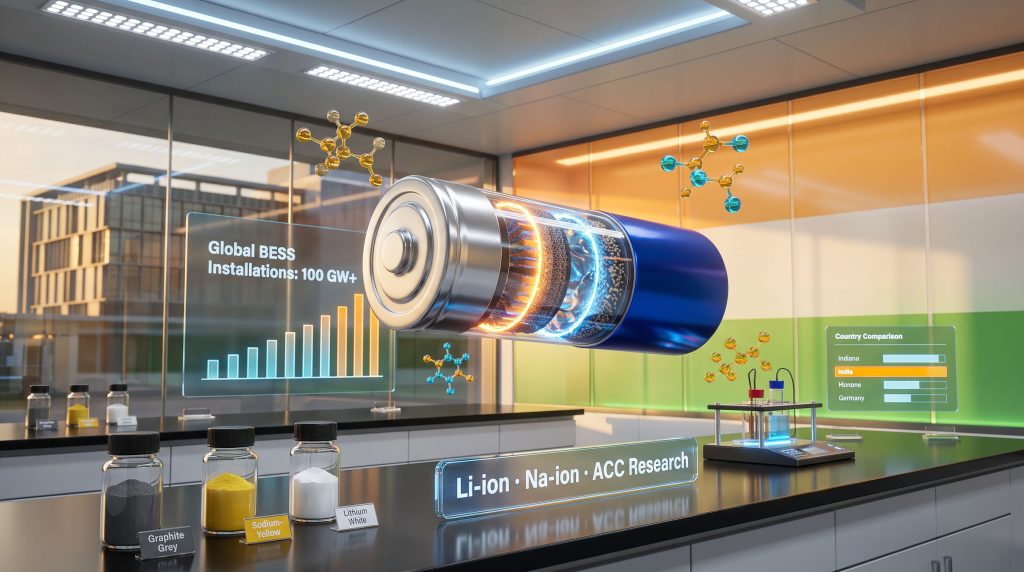
The global energy storage industry is undergoing a structural reset. Annual battery energy storage system (BESS) installations surpassed 100 GW for the first time in 2026, according to Wood Mackenzie's inaugural global BESS integrator ranking, with Sungrow leading the field. For India, this milestone is as much a warning signal as it is a market opportunity. The country consumes enormous volumes of imported battery cells, yet its domestic research and manufacturing ecosystem remains nascent relative to the scale of its renewable energy ambitions. That mismatch is precisely what makes the establishment of the Pace Digitek battery R&D center in India so strategically significant.
This is not simply a corporate infrastructure announcement. It represents a deliberate attempt to compress the distance between fundamental battery science and commercial deployment within a single domestic value chain, at a time when the economics of energy storage are becoming increasingly complex. Furthermore, understanding the broader battery metals landscape is essential context for appreciating why India is investing in this direction now.
When big ASX news breaks, our subscribers know first
The Cost Paradox Reshaping India's Storage Ambitions
Why Falling Cell Prices Don't Tell the Full Story
At first glance, the battery storage outlook appears favourable. Lithium-ion battery costs have fallen by approximately 93% over the past 15 years, a trajectory that mirrors the solar photovoltaics cost curve and has made energy storage projects viable in markets where they were previously uneconomical. Yet this headline figure obscures a more uncomfortable reality at the system level.
According to Lazard's most recent levelised cost of storage (LCOS) analysis, the cost of deploying a 100 MW, four-hour BESS has risen to approximately $210/MWh to $292/MWh — representing a 27% increase since 2020. The divergence between falling cell prices and rising total system costs reflects the growing complexity of balance-of-plant engineering, grid interconnection requirements, and supply chain volatility that affect large-scale projects.
For India, this cost dynamic creates a specific urgency. The country's commercial and industrial (C&I) battery storage sector is already characterised by highly variable payback economics. Unlike rooftop solar, where operators understand and accept payback periods of three to five years, BESS project economics in India's C&I segment remain difficult to standardise across facility types. Domestically developed, cost-optimised battery solutions could meaningfully shift these economics by reducing the import-cost premium embedded in current system pricing.
Rising system costs, even against a backdrop of cheaper cells, underscores why indigenous battery R&D is increasingly a market-creation instrument, not just a technology investment.
What the Pace-Lineage Research Centre Actually Does
The Corporate Structure Behind the Facility
Pace Digitek is an Indian infrastructure and energy solutions company with operations spanning energy, telecom, and information and communications technology (ICT). Its subsidiary, Lineage Power Private Limited (LPPL), is the entity responsible for designing, manufacturing, supplying, and deploying BESS, telecom power systems, and associated energy infrastructure. Lineage Power operates an existing BESS manufacturing facility in Bidadi, Karnataka, providing the commercial production backbone that the new research centre in Pune is intended to serve.
The Pace Digitek battery R&D center in India, formally designated the Pace-Lineage Research Centre, is located in Pune, Maharashtra, in collaboration with the Indian Institute of Science Education and Research (IISER) Pune. This geographic and institutional pairing is deliberate. Pune sits within Maharashtra's dense engineering ecosystem and hosts one of India's most capable physical sciences research institutions, giving the centre immediate access to advanced instrumentation and a pipeline of research talent. Notably, Pace Digitek's BESS facility recently won India's largest single-location BESS DC package from SECI, underscoring the company's commercial credibility alongside its research ambitions.
Research Domains: A Multi-Chemistry, Materials-First Approach
The centre's scientific mandate covers several technically demanding domains simultaneously:
| Research Domain | Specific Focus Areas |
|---|---|
| Advanced Chemistry Cells (ACC) | Lithium-ion (Li-ion) and sodium-ion (Na-ion) cell chemistries |
| Electrode Materials Science | Coating optimisation, microstructure tuning, porosity engineering |
| Electrolyte Design | Novel electrolyte formulations for improved stability and temperature range |
| Electrochemical Evaluation | Capacity retention, cycling stability, impedance analysis |
| Cell Parameter Optimisation | Iterative refinement of design variables to meet performance targets |
| Domestic Supply Chain Validation | Raw material purity, consistency, and electrochemical performance benchmarking |
Each of these disciplines contributes to a compound outcome: batteries that perform better across more operating conditions and can be manufactured using inputs sourced from within India.
Breaking Down the Technical Work
The research methodology at the Pace-Lineage Research Centre involves several interconnected processes:
-
Material coating optimisation adjusts electrode surface chemistry to reduce charge transfer resistance and slow degradation during cycling.
-
Microstructure and porosity tuning engineers the internal architecture of electrode materials, directly affecting how quickly lithium or sodium ions can move through the cell, which determines both power density and cycle life.
-
Electrolyte design develops formulations that remain stable across wider temperature ranges, a critical factor for Indian climate conditions where ambient temperatures can vary considerably between regions and seasons.
-
Electrochemical impedance spectroscopy and cycle testing produce systematic datasets on how cells age, enabling the team to identify failure modes before they appear in deployed systems.
-
Domestic supplier qualification assesses whether Indian-sourced battery-grade materials meet the chemical purity and electrochemical consistency standards required for reliable cell production.
This last point carries particular strategic weight. Qualifying domestic suppliers for battery-grade materials is one of the most technically demanding steps in building an indigenous supply chain, and it is one that many countries attempting to indigenise battery production have underestimated.
The Sodium-Ion Question: Hedge or Horizon?
Why Pursuing Both Li-Ion and Na-Ion Simultaneously Matters
The centre's dual focus on lithium-ion and sodium-ion chemistries reflects a sophisticated technology positioning strategy. Lithium-ion currently dominates the storage market, with its dramatic cost reductions making it the default choice for most grid-scale and distributed applications. However, sodium-ion is gaining commercial momentum globally for a specific class of applications: stationary energy storage where gravimetric energy density is less critical than cost and material availability.
The sodium advantage is structural rather than incremental. Sodium is significantly more abundant than lithium, geographically distributed across many countries including India, and does not carry the same supply concentration risk associated with lithium extraction. In addition, the global lithium market is currently dominated by a small number of countries and producers, making sodium-ion research a genuine materials sovereignty opportunity for India.
What is less commonly understood outside specialist circles is that sodium-ion cells also avoid cobalt and, in some chemistries, nickel entirely, sidestepping two of the most geopolitically sensitive elements in the lithium-ion supply chain. The tradeoff is lower energy density, which explains why sodium-ion is unlikely to displace lithium-ion in electric vehicles in the near term but is increasingly competitive for grid storage where physical footprint constraints are more manageable.
Researching both chemistries in parallel allows Pace Digitek to make evidence-based technology selections as the market evolves, rather than committing prematurely to a single path.
IISER Pune and the Academic-Industry Bridge
How Research Partnerships Accelerate Applied Battery Development
The collaboration model between Lineage Power and IISER Pune mirrors frameworks that have proven successful in more established battery R&D ecosystems. South Korean institutions such as POSTECH have collaborated closely with major manufacturers on advanced cell chemistry. In the United States, Argonne National Laboratory partnerships have delivered foundational advances in cathode materials. In Japan, academic-industry R&D networks have underpinned decades of cell engineering refinement.
For India, the IISER Pune partnership provides access to capabilities that would be prohibitively capital-intensive to replicate independently:
- Advanced electron microscopy for electrode microstructure characterisation
- Spectroscopic tools for electrolyte and interface analysis
- Electrochemical impedance spectroscopy systems for cell diagnostics
- A pipeline of graduate researchers and postdoctoral scientists with specialised training in materials chemistry and electrochemistry
This last point deserves emphasis. India produces one of the largest cohorts of engineering and science graduates globally each year. The challenge has historically been channelling that talent into applied battery research rather than allowing it to flow predominantly into software, IT services, or emigration. Structured academic-industry collaborations of this type create retention pathways and build the institutional knowledge base that sustains long-term innovation capability.
India's Global Competitive Position in Battery R&D
Benchmarking Against Established Battery Nations
Understanding where India's emerging battery R&D ecosystem sits relative to global leaders provides important context for evaluating what the Pace Digitek battery R&D center in India represents at an industry level:
| Country/Region | R&D Model | Key Strengths | Primary Gap for India to Address |
|---|---|---|---|
| China | State-coordinated mega-labs + manufacturer R&D centers | Scale, vertical integration, speed to market | Comparable institutional density |
| South Korea | Chaebol-led research with university linkage | Advanced cell chemistry, EV-focused precision | IP ownership and licensing leverage |
| United States | National lab networks + deep-tech startup ecosystem | Materials science innovation, diversity of approaches | Applied commercialisation infrastructure |
| European Union | Horizon-funded research consortia + Gigafactory R&D | Sustainability-driven regulatory design | Manufacturing scale and cost competitiveness |
| India (Emerging) | PLI-incentivised industry R&D + academic collaboration | Domestic market scale, cost structure, engineering talent | Domestic IP base and supplier qualification |
The table above makes clear that India's competitive advantage is not yet in IP richness or institutional depth, but in its addressable market scale, cost structure, and the volume of engineering talent available to be mobilised through structured research programmes. Facilities like the Pace-Lineage Research Centre begin the process of converting that latent advantage into deployable technology capability.
The Bidadi-Pune Strategic Axis
One dimension of the Pace Digitek approach that distinguishes it from pure research investments is the direct operational linkage between the Pune R&D centre and the Bidadi manufacturing facility. Research outputs — including improved material formulations, optimised cell architectures, and qualified domestic suppliers — do not need to traverse a lengthy commercialisation gap before reaching production.
This integrated R&D-to-manufacturing model reduces what battery industry practitioners sometimes call the valley of death: the commercialisation gap between laboratory demonstration and production-scale deployment that consumes capital and erodes first-mover advantage. By designing the research programme around an existing manufacturing base, Pace Digitek is attempting to compress that timeline structurally. Consequently, advances in direct lithium extraction and battery recycling breakthroughs may further inform the centre's materials research agenda as the field evolves.
The next major ASX story will hit our subscribers first
What to Watch: Milestones That Signal Real Progress
Near-Term Indicators
Progress at the Pace-Lineage Research Centre will be most visible through a set of measurable outputs over the coming 12 to 24 months:
- Publication of peer-reviewed research papers or patent filings arising from the IISER Pune collaboration
- Formal qualification of one or more domestic Indian suppliers for battery-grade electrode or electrolyte materials
- Announced improvements to cell performance metrics at the Bidadi manufacturing facility attributable to research outputs
- Expansion of the research scope to include additional chemistries or storage modalities, such as solid-state electrolytes or flow battery materials
Longer-Term Strategic Implications
If the centre delivers on its mandate, the implications extend well beyond Pace Digitek's own commercial position. Furthermore, the facility's success could meaningfully strengthen critical minerals and energy security at a national level, reducing India's vulnerability to external supply shocks.
- A credible domestic battery IP base reduces India's vulnerability to technology licensing costs from foreign patent holders, which currently represent a hidden cost embedded in every imported battery system
- Validated domestic suppliers create a supply chain foundation that other Indian BESS manufacturers can also leverage, producing ecosystem-level benefits beyond the initiating company
- Demonstrated Indian battery R&D capability could position the country as a technology exporter in the longer term, not merely a manufacturing destination for foreign cell chemistry
Disclaimer: Forward-looking statements regarding technology development timelines, market outcomes, and commercial results involve inherent uncertainty. The analysis presented here reflects publicly available information and should not be construed as investment advice. Readers should conduct their own due diligence before making any investment decisions related to companies or sectors discussed.
Frequently Asked Questions: Pace Digitek Battery R&D Centre in India
What is the Pace-Lineage Research Centre?
The Pace-Lineage Research Centre is a dedicated battery technology research and development facility established by Pace Digitek through its Lineage Power Private Limited subsidiary. It focuses on advanced chemistry cells, including both lithium-ion and sodium-ion technologies, as well as battery materials science and domestic supply chain validation.
Where is the Pace Digitek battery R&D center in India located?
The facility is located in Pune, Maharashtra, in western India. It operates in collaboration with the Indian Institute of Science Education and Research (IISER) Pune.
What makes sodium-ion research particularly relevant for India?
Sodium is more geographically abundant than lithium and is present across a wider range of countries, including India. Sodium-ion batteries avoid some of the most geopolitically sensitive materials in the lithium-ion supply chain and are well-suited to stationary grid storage applications where energy density constraints are less demanding than in electric vehicles.
How does the IISER Pune partnership benefit the research programme?
IISER Pune provides access to advanced scientific instrumentation, deep expertise in materials chemistry and electrochemistry, and a research talent pipeline. The partnership accelerates access to capabilities that would be highly capital-intensive to replicate independently within an industrial setting.
What is Lineage Power's existing manufacturing presence?
Lineage Power Private Limited operates a BESS manufacturing facility in Bidadi, Karnataka, providing the production infrastructure into which research outputs from the Pune centre can be directly integrated.
For ongoing coverage of India's energy storage sector and global battery technology developments, readers can explore analysis and reporting available through ESS News (pv magazine group) at ess-news.com.
Want to Track the Next Major Battery Minerals Discovery Before the Broader Market?
Discovery Alert's proprietary Discovery IQ model delivers real-time alerts on significant ASX mineral discoveries — including the critical battery metals driving India's energy storage ambitions — transforming complex geological data into actionable investment insights. Explore historic discoveries and their extraordinary returns, then begin your 14-day free trial to position yourself ahead of the market.