July 23, 2026
The Geological Architecture That Makes Hard-Rock Lithium Exploration So Compelling
Archean greenstone belts represent some of the most ancient and mineralogically complex geological environments on Earth, and their role as hosts to lithium-bearing pegmatite systems is only now receiving the commercial attention it deserves. Unlike sedimentary brine deposits, which dominate lithium production in South America's Lithium Triangle, hard-rock spodumene systems embedded within these ancient belts offer a fundamentally different extraction and processing pathway. Understanding why this matters requires examining both the geological mechanics and the investment logic that flows from them.
Within this context, the Battery Age Falcon Lake Lithium Project Ontario is emerging as a technically compelling case study in how systematic land consolidation, disciplined drilling, and multi-element mineralisation can intersect to create a genuinely differentiated exploration asset in one of the world's most stable mining jurisdictions.
When big ASX news breaks, our subscribers know first
Why Greenstone Belt Geology Underpins the Falcon Lake Thesis
The Caribou Lake-O'Sullivan Greenstone Belt in Ontario sits within the broader Superior Province of the Canadian Shield, one of the most extensively studied Archean geological terranes globally. Greenstone belts form when ancient oceanic and volcanic sequences are compressed and deformed over billions of years, creating structural corridors that act as pathways for mineralising fluids and pegmatite intrusions.
Spodumene-bearing pegmatites, the primary hard-rock source of battery-grade lithium, typically form when late-stage granitic magmas evolve under high volatile pressure, concentrating lithium, cesium, tantalum, and other incompatible elements into crystalline structures. The key characteristic that makes these systems economically attractive is their tendency to form thick, continuous lenses rather than erratic, narrow veins. Furthermore, spodumene extraction from these environments benefits from well-understood processing chemistry that has been refined over decades.
Spodumene pegmatites hosted within greenstone belt corridors often exhibit predictable structural controls along regional fault and shear systems, which means systematic mapping and geochemical sampling can significantly narrow the search space for high-value drill targets before a single hole is collared.
Compared to brine-hosted lithium systems, hard-rock spodumene deposits generally carry higher lithium grades expressed as lithium oxide (Li₂O) percentage, and they benefit from well-established processing chemistry using conventional flotation and acid roasting techniques. In contrast, lithium brines require fundamentally different recovery methods, including evaporation ponds or emerging technologies. The trade-off with hard-rock systems is higher upfront capital intensity, but Ontario's existing mining infrastructure partially offsets this disadvantage.
Drill Results That Command Attention: The 2024 Winter Programme in Detail
The geological thesis at Falcon Lake is not simply theoretical. The 2024 winter diamond drilling campaign returned intercepts that sit comfortably within the upper tier of early-stage hard-rock lithium exploration globally. Industry convention generally treats intersections grading above 1.0% Li₂O as economically meaningful at the exploration stage, with grades exceeding 1.5% Li₂O over substantial widths considered genuinely high-quality.
The results from Falcon Lake exceed these benchmarks across multiple holes:
| Drill Hole | Interval (m) | Grade (Li₂O %) | Depth from Surface (m) |
|---|---|---|---|
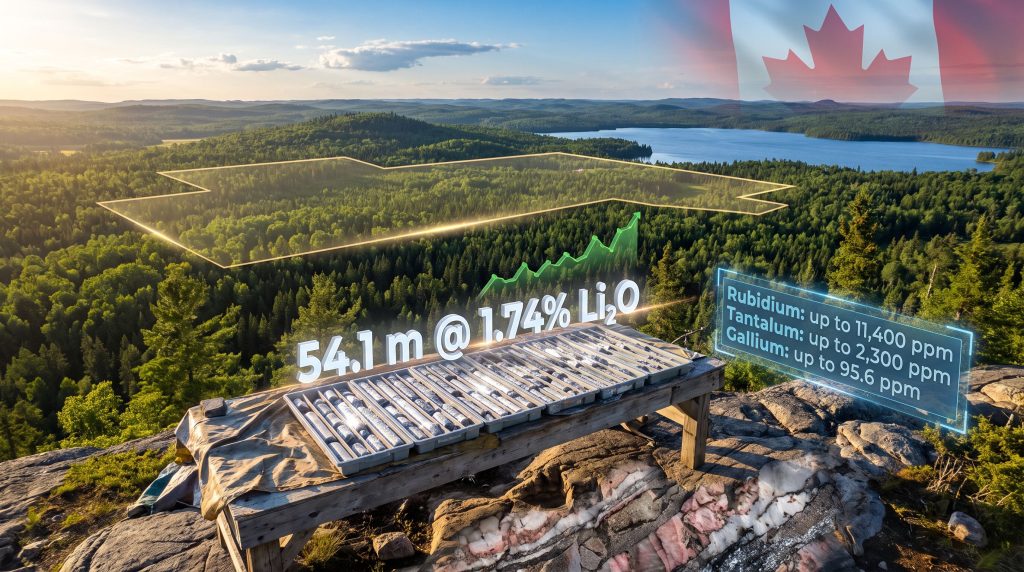
| 24FL-107 | 54.1 m | 1.74% | 100.85 m |
| 24FL-108 | 55.95 m | 1.47% | 222.2 m |
| Additional intercept | 43.0 m | 1.62% | 22.55 m |
| Additional intercept | 19.7 m | 1.62% | Various |
| Additional intercept | 21.6 m | 1.46% | Various |
Several factors within this dataset deserve closer scrutiny beyond the headline grades:
-
Interval thickness matters as much as grade. Intercepts of 54 metres and 55 metres are not narrow, high-grade shoots but broad, potentially bulk-mineable zones. In mining economics, the width of mineralisation directly influences strip ratios, stope geometry, and dilution assumptions.
-
Depth distribution signals structural continuity. The fact that meaningful grades were intersected at both near-surface depths (22.55 metres) and at 222 metres down-hole suggests the pegmatite system has vertical persistence, a prerequisite for a credible resource estimate under NI 43-101 standards.
-
Open corridors multiply optionality. When mineralised systems remain open along strike and at depth, as appears to be the case at Falcon Lake, each additional drill campaign has the potential to expand the resource envelope rather than simply confirm what is already known.
The Critical Minerals Basket: Why Lithium Is Only Part of the Story
One of the most underappreciated dimensions of the Battery Age Falcon Lake Lithium Project Ontario is its multi-element profile. While the project is marketed primarily as a lithium asset, assay data reveals elevated concentrations of four additional critical minerals that could materially alter the project's economic architecture.
| Critical Mineral | Recorded Concentration | Primary Industrial Application |
|---|---|---|
| Rubidium | Up to 11,400 ppm | Electronics, specialty glass, medical imaging |
| Caesium | Up to 2,600 ppm | Atomic clocks, drilling fluids, photoelectric cells |
| Tantalum | Up to 2,300 ppm | Capacitors, aerospace components, medical devices |
| Gallium | Up to 95.6 ppm | Semiconductors, LEDs, solar cells |
Each of these elements carries its own supply chain dynamics and strategic significance:
Rubidium at concentrations approaching 11,400 ppm is exceptionally elevated. Global rubidium supply is highly concentrated, with very few deposits worldwide containing economically recoverable quantities. Rubidium's primary commercial application in specialty electronics and emerging quantum computing hardware means demand growth trajectories are difficult to model but potentially significant.
Tantalum at up to 2,300 ppm sits within a supply chain that is heavily dependent on Central African production, primarily the Democratic Republic of Congo. Western governments and electronics manufacturers have long flagged tantalum sourcing as a critical risk factor. A tantalum-bearing deposit in a stable Canadian jurisdiction carries implicit strategic value that extends beyond spot price calculations.
Gallium has attracted significant attention following Chinese export restriction announcements on the element in 2023. With gallium being indispensable in compound semiconductors used in 5G infrastructure, defence electronics, and next-generation solar cells, even modest concentrations of 95.6 ppm within a large tonnage system could represent meaningful co-product revenue. Consequently, the broader critical minerals demand narrative further strengthens the investment case for multi-element projects of this nature.
Lithium projects that carry elevated concentrations of technology-critical metals are increasingly assessed as multi-commodity assets rather than single-element plays, a framing that can attract different categories of strategic capital including technology manufacturers, defence primes, and critical mineral funds.
Ontario as a Lithium Jurisdiction: Infrastructure, Regulation, and Relationships
Geology alone does not determine project value. Jurisdictional risk, regulatory efficiency, and social licence are equally important variables in any serious project assessment framework.
Ontario offers a combination of attributes that few alternative lithium jurisdictions can match:
-
Ontario's Mining Act provides a well-established, internationally recognised framework for claim staking, exploration permitting, and environmental compliance. The regulatory pathway from exploration to production, while not short, is predictable.
-
Proximity to Thunder Bay connects Falcon Lake to established mining services infrastructure, including drilling contractors, assay laboratories, equipment suppliers, and logistics networks. This proximity reduces the mobilisation costs and logistical uncertainty that inflate early-stage exploration budgets in more remote regions.
-
Indigenous consultation frameworks in Ontario are structured and transparent. Battery Age has maintained First Nation partnership agreements since the project's 2023 inception, which represents a meaningful head start in the community relationship-building process that underlies all successful Canadian mining development.
-
Ontario's proximity to North American battery manufacturing corridors is strategically relevant. The province has attracted significant EV-related manufacturing investment, and the geographic logic of sourcing lithium from within-province or within-region supply chains is compelling for manufacturers seeking to reduce supply chain exposure.
A Project That Has Been Built Systematically: The Falcon Lake Timeline
The evolution of the Falcon Lake project since 2023 reflects a disciplined, staged approach to exploration and land consolidation that experienced mining investors recognise as a positive signal about management intent.
-
Early 2023: Initial exploration commences, with foundational fieldwork and the establishment of First Nation partnership agreements providing the social and regulatory foundation for future activities.
-
2024 Winter: A diamond drilling campaign delivers high-grade spodumene intercepts and confirms multi-element critical mineral concentrations across multiple holes, validating the geological model.
-
Pre-2026: Progressive claim staking builds the project footprint to approximately 51 km², establishing a district-scale land position before the current expansion.
-
2026 expansion: An additional 46 mineral claims are staked, extending the land package approximately 7 km to the east and bringing the total project area to approximately 60 km².
-
2026 fieldwork programme: Geological mapping, prospecting, and geochemical sampling are planned across the newly acquired ground to identify and rank future drill targets.
The land package has expanded by more than 40% from its earlier ~42.8 km² footprint to its current configuration, a trajectory that signals deliberate consolidation rather than reactive opportunism.
The next major ASX story will hit our subscribers first
What the 2026 Fieldwork Programme Must Deliver
The staking of 46 additional mineral claims is a land position move, not a resource expansion in itself. The value embedded in that 7 km eastward extension will only be unlocked through disciplined fieldwork that translates geological potential into drill-ready targets.
The four primary technical objectives for the 2026 programme can be framed as follows:
-
Corridor extension testing: Determining whether the mineralised pegmatite system that generated the 2024 drill results continues into the newly acquired eastern ground is the single most important geological question the programme must address.
-
Target prioritisation: Geochemical sampling and structural mapping will be used to rank prospective areas by geological confidence and grade potential, ensuring that any future drilling is deployed against the highest-probability targets rather than conducted on a grid basis.
-
Resource definition preparation: Building a comprehensive geological database, including lithological logs, structural measurements, and geochemical datasets, is the foundational work required to support a future maiden resource estimate under NI 43-101 standards.
-
Stakeholder and environmental baseline work: Continuing community engagement and gathering environmental baseline data are not merely compliance activities; they are prerequisites for future permitting processes and form part of the social licence that underpins long-term project viability.
How Falcon Lake Compares Within the Canadian Hard-Rock Lithium Landscape
| Project | Jurisdiction | Stage | Key Differentiator |
|---|---|---|---|
| Falcon Lake | Ontario, Canada | Exploration / Drilling | Multi-element pegmatite, 60 km² district-scale package |
| Ontario lithium peers | Ontario, Canada | Various | Greenstone belt geology, Tier-One jurisdiction |
| Quebec pegmatite projects | Quebec, Canada | Various | Proximity to battery manufacturing corridors |
| NWT hard-rock projects | Northwest Territories | Early-stage | Remote logistics, higher capital intensity |
Ontario and Quebec are widely considered the two most strategically significant Canadian lithium provinces from a battery supply chain integration perspective. Quebec benefits from hydroelectric power for processing and proximity to established concentrator infrastructure, while Ontario offers superior logistics connectivity and a larger existing industrial base.
What distinguishes Falcon Lake from single-commodity lithium peers at a comparable stage of development is not just its multi-element profile, but the combination of district-scale land position, demonstrated high-grade drilling results, and a Tier-One jurisdiction. Furthermore, innovation in direct lithium extraction technologies may eventually offer additional processing flexibility for projects of this nature. These factors collectively reduce the number of binary risk factors that typically limit junior explorer valuations.
Risk Factors Every Investor Should Understand
The following analysis contains forward-looking elements and speculative assessments. This is not financial advice. Investors should conduct their own due diligence and consult a licensed financial adviser before making investment decisions.
Even compelling exploration-stage assets carry material risks that must be evaluated honestly:
-
Mineralisation continuity risk is the foundational uncertainty at every pre-resource project. Drill intercepts, however impressive, do not guarantee that mineralisation extends continuously between holes or into unexplored ground.
-
Lithium price sensitivity remains acute. Lithium carbonate and lithium hydroxide spot prices have experienced significant volatility since their 2022 peak, and project economics at any stage of development are directly exposed to this variability. Shifts in the global lithium market can influence investor sentiment and funding conditions for junior explorers almost immediately.
-
Permitting and consultation timelines in Ontario are structured but not instantaneous. Indigenous consultation requirements, while manageable with early engagement, can extend development schedules if community concerns are not addressed proactively.
-
Capital requirements for district-scale exploration are substantial. Junior explorers funding systematic programmes across 60 km² face recurring equity raising requirements, and dilution remains a standard cost of advancing through the exploration pipeline.
Three Scenarios for How Falcon Lake Could Evolve
Projecting development pathways for early-stage lithium projects requires scenario thinking rather than linear forecasting:
Scenario A: Organic advancement. Battery Age progresses independently through resource definition, prefeasibility studies, and permitting, ultimately developing Falcon Lake as a standalone operation or toll-processing arrangement. This pathway maximises equity value but requires sustained access to capital markets.
Scenario B: Strategic partnership. A larger mining house or battery supply chain participant acquires a project stake in exchange for funding and offtake rights, accelerating the exploration timeline while sharing the upside. This model has become increasingly common as battery manufacturers seek upstream security of supply.
Scenario C: Acquisition. As the project's resource base grows and the multi-element profile becomes better understood, Falcon Lake could become an acquisition target within a broader consolidation of Canadian critical mineral assets. The combination of hard-rock lithium and critical mineral co-products in a Tier-One jurisdiction creates the kind of strategic scarcity that has historically attracted acquisition premiums.
The structural gap between current North American lithium production capacity and projected demand from electric vehicle and grid storage sectors through 2030 and beyond means that early-stage projects with demonstrated high-grade mineralisation in stable jurisdictions will continue to attract strategic interest regardless of near-term commodity price volatility. The Battery Age Falcon Lake Lithium Project Ontario sits at a genuinely interesting inflection point in its development, with the 2026 fieldwork programme representing the next critical test of whether the geological model holds across a significantly expanded land package.
Readers seeking additional context on Ontario's lithium exploration landscape and Canada's critical minerals strategy can explore related reporting and analysis available via Mining Technology.
Want to Stay Ahead of the Next Major Critical Minerals Discovery?
Discovery Alert's proprietary Discovery IQ model scans ASX announcements in real time, instantly identifying high-potential mineral discoveries across lithium, tantalum, gallium, and more than 30 other commodities — turning complex data into actionable investment insights for traders and long-term investors alike. Explore how historic mineral discoveries have generated substantial returns, then begin your 14-day free trial at Discovery Alert to position yourself ahead of the market.