July 22, 2026
The Long Game in Lithium: Why Scale and Patience Define the Next Cycle
Commodity markets have a well-documented tendency to punish short-term thinkers and reward those with the capital, conviction, and patience to act when sentiment is at its lowest. The history of copper, iron ore, and coal is littered with examples of operators who expanded at cycle peaks and suffered the consequences, while those who built capacity during downturns emerged as dominant low-cost producers when prices recovered. Lithium is now entering that same crucible, and the Wesfarmers Mt Holland lithium expansion is one of the clearest expressions of counter-cyclical capital discipline the Australian mining sector has seen in years.
When big ASX news breaks, our subscribers know first
What Makes Mt Holland Different From Other Lithium Projects?
Understanding the significance of this A$1.45 billion expansion requires first appreciating what Mt Holland actually is, and why its structure separates it from the broader field of spodumene producers.
Mt Holland sits in Western Australia's Eastern Goldfields, a region with established mining infrastructure, a deep labour pool, and geological characteristics that have made it one of the most productive hard-rock lithium districts on earth. The deposit hosts spodumene, a lithium-bearing pyroxene mineral that is processed into concentrate before being refined into battery-grade lithium hydroxide. What distinguishes Mt Holland from many of its peers is not just the grade or scale of the orebody, but the fully integrated supply chain that Covalent Lithium — the 50/50 joint venture between Wesfarmers (ASX: WES) and Chilean lithium giant SQM (NYSE: SQM) — has constructed around it.
Spodumene extraction at Mt Holland involves processing concentrate that travels to the Kwinana lithium hydroxide refinery, located south of Perth, where it is converted into a finished product directly usable by battery manufacturers. This mine-to-refinery integration insulates the operation from the extreme volatility that affects pure spodumene producers, who are entirely exposed to spot concentrate pricing. By retaining the ability to capture downstream margin at Kwinana, Covalent has structural earnings diversity that most hard-rock lithium operations simply do not possess.
The Capital Architecture: What Has Already Been Spent?
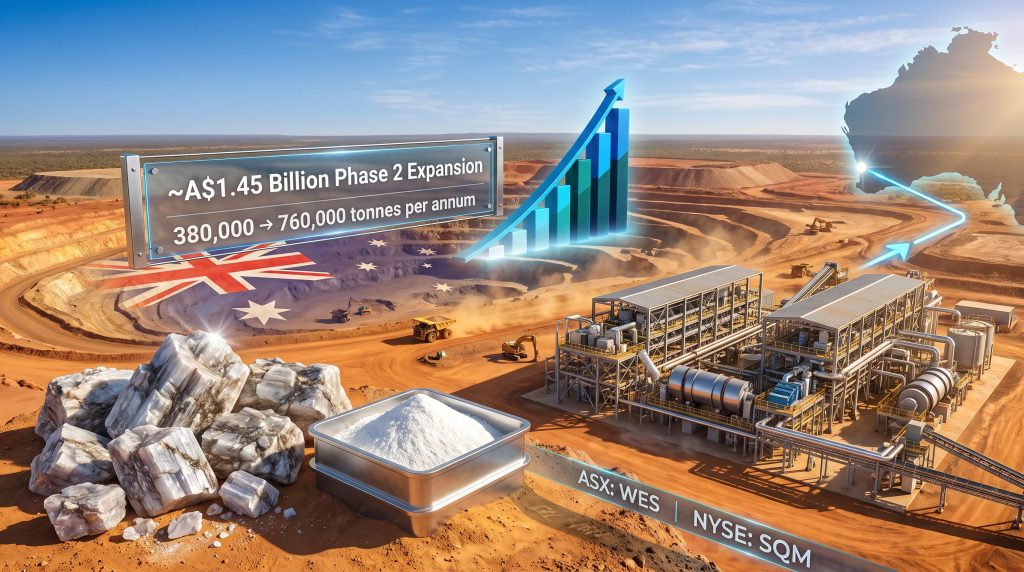
The newly approved expansion sits on top of a substantial existing capital base. Prior to the Phase 2 final investment decision, approximately A$2.6 billion had already been committed across the Mt Holland mine, its original concentrator plant, and the Kwinana refinery. The expansion adds a further A$1.45 billion, split equally between the two joint venture partners at up to A$715 million each, bringing total cumulative investment to well over A$4 billion.
| Stage | Capital Committed |
|---|---|
| Mt Holland mine + original concentrator | Included in ~A$2.6B total prior spend |
| Kwinana lithium hydroxide refinery | Included in ~A$2.6B total prior spend |
| Phase 2 expansion (approved July 2026) | ~A$1.45 billion |
| Total cumulative investment | ~A$4+ billion |
That level of sunk capital also creates a powerful internal logic for the expansion. Once the fixed cost base of the mine and refinery is established, increasing throughput volume is the most efficient mechanism available to reduce per-unit operating costs, which leads directly to the financial rationale behind Phase 2.
The Engineering Reality of the Phase 2 Expansion
The approved expansion is not a simple capacity bolt-on achieved through debottlenecking or incremental equipment upgrades. It involves substantive new processing infrastructure with two distinct components that work together to deliver both volume growth and cost reduction.
Second Concentrator Plant
A duplicate concentrator facility will be constructed to run in parallel with the existing plant, enabling a step-change in spodumene output. Production is targeted to increase from the current nameplate capacity of approximately 380,000 tonnes per annum to 760,000 tonnes per annum, a precise doubling of throughput. Construction is expected to commence in the second half of 2027, with first production from the expanded capacity targeted for the first half of 2030.
Ore Sorting Technology: A Deeper Look
The inclusion of an ore sorting facility in the Phase 2 scope is arguably the more technically significant component, and one that is often underappreciated by generalist investors. Ore sorting uses sensor-based technologies — typically X-ray transmission or laser-induced breakdown spectroscopy — to analyse individual rock fragments on a conveyor belt in real time. Material that falls below an economic grade threshold is diverted before it enters the concentrator, while higher-grade ore proceeds to processing.
The practical implication at Mt Holland is substantial. Hard-rock spodumene deposits invariably contain zones of lower-grade or mineralogically complex material that would traditionally be classified as waste or sub-economic ore and sent to the tailings facility. Ore sorting allows this material to be assessed and selectively recovered, effectively expanding the economically mineable ore inventory without proportional increases in drilling, blasting, or mining costs. The consequence is a lower effective strip ratio and improved recovery per tonne of rock moved, both of which contribute directly to unit cost reduction.
This is particularly relevant in the context of the current lithium price environment, where the ability to squeeze more value from the same volume of mined material is a meaningful competitive differentiator.
| Metric | Current | Post-Expansion |
|---|---|---|
| Spodumene concentrate output (tpa) | ~380,000 | ~760,000 |
| Construction commencement | N/A | H2 2027 |
| First expanded production | N/A | H1 2030 |
| Expansion capital | N/A | ~A$1.45 billion |
| Each partner's capex share | N/A | Up to A$715 million |
Counter-Cyclical Capital Allocation: The Investment Logic Explained
Lithium spot prices have declined sharply from the extraordinary levels reached during the 2022 to 2023 supercycle. Lithium carbonate and hydroxide prices, which briefly exceeded USD 80,000 per tonne in China during late 2022, had fallen to a fraction of those levels by mid-2026, driven by a combination of demand growth deceleration in some Western EV markets, accelerated production ramp-ups in Australia and South America, and significant additions from emerging African hard-rock producers.
Against this backdrop, committing A$1.45 billion to double output appears counterintuitive. However, the logic becomes clear when the investment is examined through a cost-curve lens rather than a spot-price lens.
The fundamental principle of counter-cyclical capital allocation is that the time to build is when construction costs are manageable, permitting queues are short, and competition for skilled contractors is low. Operators who wait for price recovery to confirm their investment thesis typically find themselves building into a heated market at peak construction costs, only completing capacity expansion when the next price cycle has already peaked.
For Covalent, the strategic calculus works as follows:
- Fixed cost dilution: The mine, processing infrastructure, and Kwinana refinery represent a largely fixed overhead base. Doubling concentrate output spreads these costs across twice the volume, reducing the all-in cost per tonne materially.
- Ore sorting efficiency gains: Recovering previously sub-economic ore improves overall yield from the same geological resource base, lowering cost per tonne of lithium units produced.
- Refinery feed optionality: Additional spodumene concentrate creates the foundation for a future refinery capacity increase at Kwinana, enabling higher-margin downstream production once market conditions support it.
- Positioning for the price recovery: With construction commencing in 2027 and first production in 2030, the expanded capacity is timed to coincide with a period when multiple demand forecasts suggest the lithium supply-demand dynamics will tighten again.
What This Means for Covalent's Global Cost Position
Mt Holland is already considered a low-to-mid cost producer among global hard-rock spodumene operations. The combination of a relatively high-grade deposit, modern processing infrastructure, and the integrated refinery pathway gives Covalent a structural cost advantage over many peers. The Phase 2 expansion is designed to push that cost position further down the global curve.
This matters enormously from an investor and competitive strategy perspective. In commodity markets, cost-curve positioning is not merely an operational metric. It determines which producers remain profitable at cycle troughs, which ones capture outsized margins when prices recover, and ultimately which assets survive across multiple commodity cycles.
Producers in the top quartile of the cost curve face existential pressure during prolonged price downturns. Those in the bottom quartile tend to grow market share, as higher-cost competitors curtail production or exit entirely. By investing now, Covalent and its parent companies are systematically working to entrench a cost position that will be structurally difficult for higher-cost producers to compete against when the next demand wave materialises.
The SQM Partnership: What Chilean Expertise Brings to the Table
SQM's involvement in Covalent Lithium is not simply a financial co-investment. The Chilean company is one of the world's largest and lowest-cost lithium producers, with primary operations in the Atacama Desert, where lithium brines explained represent some of the highest-grade and lowest-cost lithium resources anywhere on earth. SQM's participation brings global supply chain relationships, established offtake networks across battery manufacturers in Asia and Europe, and deep technical expertise in lithium processing chemistry.
SQM's leadership has conveyed that lithium demand fundamentals remain supported by the structural requirements of the global energy transition, and that Covalent's Mt Holland project is well placed on the global cost curve to meet that demand at competitive pricing levels. The commitment of up to A$715 million from SQM reflects not merely financial obligation but a forward view that the integrated mine-to-refinery model represents a strategically valuable asset class for the coming decade.
The next major ASX story will hit our subscribers first
Wesfarmers' Broader Strategic Framing
For many investors, the natural question is what a company best known for Bunnings hardware stores, Kmart, and Officeworks is doing deploying multi-billion dollar capital into a volatile commodity cycle. The answer lies in how Wesfarmers has framed its lithium exposure internally and externally.
CEO Rob Scott has consistently communicated that the Mt Holland investment is structured around long-duration, through-cycle return expectations, not short-term commodity optimism. Wesfarmers entered the lithium space with the explicit thesis that the energy transition would drive sustained structural demand for battery-grade lithium over a multi-decade horizon, and that the integrated mine-to-refinery model would provide a more defensible economic position than pure upstream commodity exposure.
The Phase 2 approval reinforces that framing. Rather than deferring the decision until lithium prices recovered and investment economics looked more comfortable in the short term, Wesfarmers and SQM opted to act during the trough, accepting near-term earnings drag in exchange for a superior long-term cost position and expanded optionality in the downstream refinery.
The Kwinana Refinery: The Downstream Prize
A less frequently discussed dimension of the Phase 2 expansion is its explicit connection to Kwinana's future. The additional spodumene concentrate that Phase 2 will generate is specifically intended to underpin a future capacity increase at the Kwinana lithium hydroxide refinery. Furthermore, lithium hydroxide, as a finished battery chemical, commands a meaningful premium over raw spodumene concentrate and is the direct feedstock for the lithium-iron-phosphate and nickel-manganese-cobalt battery chemistries that dominate EV manufacturing.
Retaining commercial flexibility to sell a portion of the additional concentrate to international buyers — rather than committing all output to Kwinana — provides a sensible hedge against refinery underperformance or periods where spot concentrate pricing makes export more attractive than domestic processing.
Risks That Informed Investors Should Weigh
No analysis of a multi-billion dollar commodity investment during a price trough would be complete without a balanced assessment of the downside scenarios. Several material risks deserve explicit acknowledgment.
- Prolonged price weakness: If lithium hydroxide prices remain depressed beyond 2030, the return profile of the expansion deteriorates. The investment thesis is predicated on a price recovery coinciding with expanded production.
- Execution complexity: Running a mine expansion, installing an ore sorting facility, and scaling a parallel concentrator simultaneously is operationally complex. Kwinana's own ramp-up history illustrated the challenges of commissioning novel lithium processing infrastructure.
- Oversupply persistence: Continued additions from South American brine projects and emerging African hard-rock operations could delay the supply-demand rebalancing that underpins the investment case.
- Capital deployment risk for Wesfarmers shareholders: An additional A$715 million capital commitment in a commodity with near-term pricing uncertainty represents a meaningful balance sheet allocation for a conglomerate with retail earnings dependencies.
This article contains forward-looking statements and analysis based on publicly available information. It does not constitute financial advice. Investors should conduct independent research and consult a licensed financial adviser before making any investment decisions.
Australia's Role in the Global Lithium Supply Chain
The Wesfarmers Mt Holland lithium expansion carries implications that extend well beyond a single project. Australia's lithium industry is already recognised as the world's largest producer of hard-rock spodumene, and integrated operations like Mt Holland represent the most advanced expression of domestic value-add processing. Moving beyond raw ore and concentrate exports toward finished battery chemicals is a structural industrial evolution that positions Western Australia as a more sophisticated participant in global battery supply chains.
Furthermore, direct lithium extraction technologies emerging alongside hard-rock operations are adding additional strategic dimensions to how the industry evolves globally. When tier-one, well-capitalised operations invest through downturns at this scale, they consolidate market share in ways that smaller, higher-cost projects cannot replicate.
The competitive moat being built at Mt Holland through this expansion is not just operational — it is financial, structural, and temporal. According to Wesfarmers' latest operational update, by the time the next lithium demand wave arrives, the expanded Covalent operation will have had years to optimise its processing trains, refine its ore sorting parameters, and reduce unit costs to levels that will make it very difficult for late-stage or higher-cost entrants to compete effectively.
That is the real significance of this decision. It is not simply about doubling output. It is about shaping where Mt Holland sits in the global lithium industry hierarchy for the decade ahead.
Want to Track the Next Major ASX Mineral Discovery Before the Market Does?
Discovery Alert's proprietary Discovery IQ model scans ASX announcements in real time, instantly identifying high-potential opportunities across lithium and 30+ other commodities — turning complex geological data into actionable investment insights. Explore how historic discoveries have generated extraordinary returns on Discovery Alert's dedicated discoveries page, and begin your 14-day free trial today to position yourself ahead of the broader market.