July 22, 2026
The Logistics Revolution Quietly Reshaping Africa's Battery Minerals Race
Securing a lithium deposit is no longer the hardest part of supplying the global battery industry. Getting the material to port reliably, affordably, and at scale has emerged as the defining competitive variable separating viable producers from those left behind. Across sub-Saharan Africa, where some of the world's most significant lithium endowments sit deep inland, the race to build efficient export corridors has become as commercially urgent as the mining activity itself.
This is the context within which Zimbabwe's newly activated rail route for Zimbabwe lithium rail exports through Mozambique carries genuine strategic weight. The corridor is not simply a logistics upgrade. It represents a structural shift in how landlocked African mineral producers can compete in global battery supply chains, and it signals the growing maturity of public-private partnership models as a tool for infrastructure revival on the continent.
When big ASX news breaks, our subscribers know first
Zimbabwe's Lithium Ascent: Geology, Scale, and Speed
Zimbabwe's emergence as Africa's largest lithium producer has been extraordinarily rapid. The country's lithium deposits are primarily hosted in pegmatite formations, a geological structure known for producing high-grade spodumene, the hard-rock lithium mineral that Chinese battery supply chains have come to depend on heavily. Understanding these lithium mining methods helps contextualise why Zimbabwe's geology is so commercially significant.
Spodumene concentrate is graded by its lithium oxide (Li₂O) content, typically expressed as a percentage. Battery-grade spodumene concentrate generally contains between 5.5% and 6% Li₂O, and the quality of Zimbabwe's pegmatite-hosted deposits has supported consistent concentrate grades capable of meeting Chinese refinery specifications. Furthermore, spodumene extraction techniques have matured considerably, enabling higher recovery rates at scale.
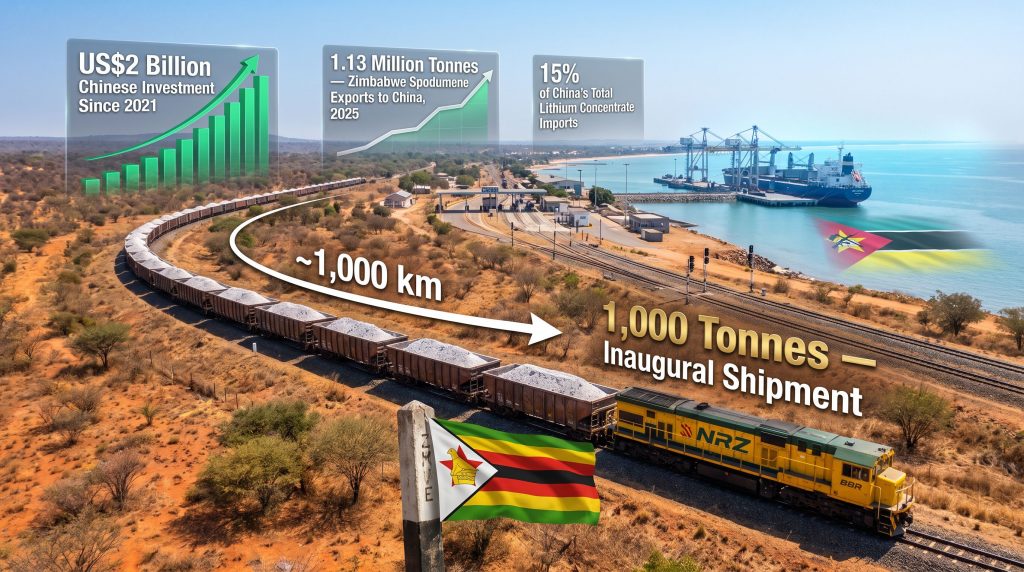
The scale of investment that followed geological discovery has been remarkable. Since 2021, Chinese mining companies have collectively directed approximately US$2 billion into Zimbabwe's lithium sector, transforming the country from a peripheral producer into one of China's most strategically important overseas suppliers of spodumene concentrate. By 2025, Zimbabwe exported roughly 1.13 million tonnes of spodumene concentrate to China, accounting for approximately 15% of China's total lithium concentrate imports during that year.
That 15% share is a figure worth pausing on. It represents a supply dependency large enough to give Zimbabwe meaningful leverage in the bilateral trade relationship, yet concentrated enough in a single buyer market to create vulnerability if Chinese demand patterns shift.
What Is the Gwanda-Maputo Rail Corridor and How Does It Work?
The newly commissioned export route links Tsingshan Holding Group's Gwanda Lithium Mine in southern Zimbabwe to the Port of Maputo in Mozambique across a total distance of approximately 1,000 kilometres. The corridor operates through a multi-party arrangement involving three distinct rail operators, each managing a defined geographic segment.
The Three-Segment Architecture
| Corridor Segment | Operator | Distance | Key Function |
|---|---|---|---|
| Gwanda to Beitbridge | Beitbridge Bulawayo Railway (BBR) | ~180 km | Mine-to-border southern leg |
| Beitbridge to Chicualacuala | National Railways of Zimbabwe (NRZ) | ~300 km | Internal Zimbabwe rail network |
| Chicualacuala to Port of Maputo | Mozambique Limpopo Railway | ~522 km | Cross-border to export terminal |
| Total Route | Multi-operator | ~1,000 km | Mine gate to vessel loading |
The inaugural shipment carried 1,000 tonnes of lithium concentrate through this entire chain. While modest relative to annual export volumes, this first export train established the operational proof of concept for a corridor that industry participants expect to scale considerably as lithium production continues expanding.
Step-by-Step: How a Shipment Moves Through the Corridor
-
Lithium concentrate is loaded at the Gwanda Lithium Mine, operated by Tsingshan Holding Group in Zimbabwe's southern mining belt
-
Cargo transfers onto BBR rail infrastructure, the Grindrod-backed private operator managing the approximately 180 km segment to Beitbridge
-
At Beitbridge, freight transitions onto the NRZ state network for the approximately 300 km internal segment toward the Mozambique border
-
The cargo crosses into Mozambique at the Chicualacuala border post, one of the key intermodal junctions in southern Africa's mineral export geography
-
Mozambique's Limpopo Railway carries the concentrate approximately 522 km southward to the Port of Maputo
-
At Maputo, the material is loaded onto bulk vessels bound for Chinese processing facilities
A notable geographic advantage underpins the corridor's commercial logic: a significant proportion of Zimbabwe's active lithium mining operations are naturally positioned along the country's west-to-southeast rail alignment. This means many producers can access the Gwanda-Maputo route without requiring costly new spur lines, substantially reducing the infrastructure investment threshold for broader uptake.
Why Road Freight Was Failing Zimbabwe's Lithium Sector
Prior to this corridor's activation, virtually all Zimbabwean lithium concentrate moved by truck. As production volumes scaled rapidly following the post-2021 investment surge, the limitations of road-dependent logistics became progressively more acute.
The compounding vulnerabilities of bulk mineral road freight include:
- Cost escalation at scale: Fuel exposure, vehicle maintenance, axle load limits, and driver availability all create cost floors that erode competitiveness as volumes grow
- Border crossing unpredictability: Road freight at the Beitbridge border crossing, one of southern Africa's busiest trade points, routinely encounters delays that introduce significant lead-time variability into supply chains
- Infrastructure degradation: Heavy lithium concentrate trucks accelerate road surface deterioration, creating a feedback loop where increased production leads to higher road maintenance costs and further congestion
- Safety and theft exposure: Long-haul road freight through multiple jurisdictions carries elevated cargo security risks compared to monitored rail movements
Rail offers miners materially lower cost per tonne-kilometre for bulk commodity movements, improved schedule reliability, reduced carbon emissions per unit of cargo, and significantly higher payload capacity without the road damage penalties that make trucking increasingly expensive at scale.
For Chinese buyers operating refinery schedules that depend on consistent feedstock supply, the reliability differential between road and rail is not a marginal consideration. It directly affects processing efficiency and procurement planning.
Reviving Zimbabwe's State Railway: The NRZ Partnership Model
The National Railways of Zimbabwe's role in this corridor carries significance beyond the immediate lithium shipment. NRZ has experienced one of the more dramatic declines of any state rail operator in the region, with annual freight volumes falling from approximately 12 million tonnes in the 1990s to just 2 million tonnes in 2025, a reduction exceeding 80% over three decades.
Rather than pursuing a purely sovereign-funded rehabilitation programme, NRZ has adopted a partnership-led turnaround strategy. The BBR-NRZ-Silvergill arrangement demonstrates how combining state rail infrastructure with private operational expertise and logistics coordination can restore freight capacity without requiring entirely new network construction.
This model has broader implications for African rail infrastructure development:
| Regional Corridor | Countries Involved | Partnership Structure | Primary Commodity |
|---|---|---|---|
| Gwanda-Maputo Corridor | Zimbabwe, Mozambique | Public rail + private operators | Lithium concentrate |
| Lobito Corridor | Angola, Zambia, DRC | Multi-government + private investment | Copper, cobalt |
| Northern Cape Rail | South Africa | State infrastructure + private operators | Manganese, iron ore |
The common thread across these initiatives is a recognition that mineral export competitiveness increasingly depends on logistics modernisation, and that blended public-private frameworks can mobilise capital and operational capacity that neither sector could achieve independently.
China's Dominant Position and the Supply Chain Dependency Question
Understanding the Gwanda-Maputo corridor requires understanding the upstream investment architecture that made it necessary. The key Chinese operators active in Zimbabwe's lithium sector include:
| Company | Primary Activity in Zimbabwe |
|---|---|
| Tsingshan Holding Group | Gwanda Lithium Mine operator and inaugural corridor user |
| Zhejiang Huayou Cobalt | Mining and processing investment |
| Sinomine Resource Group | Spodumene extraction operations |
| Sichuan Yahua Industrial Group | Downstream processing interest |
| Chengxin Lithium Group | Strategic raw material sourcing |
Collectively, these companies have directed the US$2 billion investment wave that has fundamentally restructured Zimbabwe's mining sector within half a decade. Their motivation is straightforward: China controls the dominant share of global lithium refining and battery cell manufacturing capacity, but is heavily import-dependent for raw lithium feedstock. Zimbabwe's high-grade pegmatite deposits and relatively concentrated mining geography make it an efficient sourcing location.
The rail corridor reduces the delivered cost of Zimbabwean spodumene to Chinese buyers, reinforcing the commercial logic of the existing supply relationship. However, a structural tension is emerging as Zimbabwe's beneficiation policy agenda develops. Indeed, shifts in the global lithium market are increasingly influencing how these bilateral arrangements are structured and renegotiated.
The next major ASX story will hit our subscribers first
The Export Ban and the Policy-Logistics Tension
In February 2026, Zimbabwe introduced a ban on exports of raw minerals and lithium concentrates, a policy instrument designed to incentivise in-country processing and capture greater value from the country's resource endowment. The timing creates a notable paradox: the Gwanda-Maputo rail corridor was purpose-built to export lithium concentrate, the exact product category now subject to restriction.
Reports indicated the ban extended to cargo already in transit at the time of its implementation, raising significant questions about regulatory certainty for operators who had committed capital to the new rail logistics arrangement.
The interaction between Zimbabwe's beneficiation mandate and its newly commissioned rail infrastructure represents one of the most consequential policy-logistics tensions in African critical minerals supply chains as of 2026. Infrastructure investment cycles operate over decades; policy environments can shift within months.
The near-term commercial utilisation of the corridor is therefore partially constrained, though several pathways exist for the infrastructure to retain strategic relevance:
- Lithium sulphate and other processed intermediates may fall outside the raw mineral export prohibition, redirecting the corridor's freight profile toward higher-value products
- The policy may incorporate exemptions or phased implementation timelines that preserve some concentrate export capacity during the transition to domestic processing
- The corridor's infrastructure value is permanent regardless of near-term freight profile, and positions Zimbabwe to export processed products at scale once beneficiation capacity is established
The Downstream Value Chain: Where Zimbabwe Wants to Be by 2030
Zimbabwe's beneficiation ambitions follow the logic of the battery materials value chain, where each processing stage represents a significant increase in export revenue per tonne:
Spodumene Ore > Lithium Concentrate > Lithium Sulphate > Lithium Hydroxide/Carbonate > Battery Cells
   Mining          Current Exports       2030 Target         End-Use Precursor          Final Product
Lithium sulphate is an intermediate chemical produced by converting spodumene concentrate through acid roasting and purification processes. It serves as the feedstock for manufacturing lithium hydroxide and lithium carbonate, the battery-grade materials that underpin electric vehicle cathode chemistry and grid-scale energy storage systems. Advances in lithium extraction technologies are consequently making these downstream processing steps more commercially accessible for emerging producers.
Industry projections suggest Zimbabwe could produce approximately 344,000 tonnes of lithium sulphate annually by 2030 if current investment trajectories in domestic processing capacity continue. Reaching that target would represent a fundamental transformation of Zimbabwe's position in the global battery supply chain, from raw material exporter to chemical precursor producer.
For Chinese buyers, this transition introduces friction. Chinese companies have historically structured their Zimbabwe investments to import unprocessed concentrates for domestic refining, capturing the value-adding margin onshore. A shift toward Zimbabwean lithium sulphate exports would transfer a portion of that processing margin to Zimbabwe, requiring renegotiation of the commercial structures that currently define the bilateral relationship.
Mozambique as a Regional Minerals Gateway
The Gwanda-Maputo corridor positions Mozambique's port infrastructure as a strategic asset for landlocked southern African mineral producers extending well beyond Zimbabwe. The Port of Maputo's natural deep-water characteristics and its geographic proximity to southern Africa's mineral belt make it a commercially logical export terminal for multiple commodity streams. In fact, Africa's transport costs for lithium are being structurally reduced by precisely these kinds of corridor investments.
Broader regional discussions have explored further rail network investment to support mineral export growth, including potential longer-term development of the Port of Techobanine as an additional deep-water export terminal on Mozambique's southern coast. If realised, Techobanine could provide additional throughput capacity and competitive pressure that benefits mineral exporters across the region.
The Limpopo Railway, forming the Mozambican segment of the Gwanda-Maputo corridor, sits at the centre of these regional ambitions. Its capacity utilisation and infrastructure condition will be a determinant of how much of southern Africa's mineral export growth flows through Mozambican ports rather than South African alternatives.
Key Takeaways for Industry Observers and Investors
The Gwanda-Maputo corridor's activation distils several important signals for those tracking African battery metals investment and mining infrastructure:
- Logistics capability is now a competitive differentiator at the same level as geological endowment. Producers with efficient export access will compound their cost advantages as volumes scale
- Public-private partnership structures are demonstrating commercial viability for African rail infrastructure revival, offering a template that could be replicated across other mineral corridors
- Zimbabwe's policy environment introduces material uncertainty that operators and investors must price into project assessments. The export ban and beneficiation mandate create regulatory risk alongside infrastructure opportunity
- China's supply chain dependency on Zimbabwe lithium rail exports through Mozambique is large enough to create mutual leverage, but concentrated enough in a single customer market to represent a structural vulnerability for Zimbabwean producers if demand patterns shift
- The corridor's long-term value proposition rests on processed product exports rather than concentrate movements, aligning its infrastructure utility with Zimbabwe's downstream ambitions regardless of near-term policy constraints
Disclaimer: This article contains forward-looking projections regarding lithium sulphate production targets, investment trajectories, and infrastructure development timelines. These projections are based on industry forecasts and publicly available data and should not be interpreted as investment advice. Actual outcomes may differ materially from projections due to policy changes, market conditions, regulatory developments, or operational factors. Readers should conduct independent due diligence before making investment decisions.
For ongoing analysis of African mining infrastructure, battery minerals investment, and critical minerals supply chain developments, the Mining Indaba content hub at miningindaba.com publishes market intelligence covering investment trends, logistics corridors, and industry developments across the continent.
Want to Stay Ahead of the Next Major Battery Minerals Discovery?
Discovery Alert's proprietary Discovery IQ model scans ASX announcements in real time, instantly identifying significant mineral discoveries across lithium and other battery metals before the broader market reacts — explore how historic discoveries have generated substantial returns or begin your 14-day free trial today to position yourself at the forefront of the next major find.