July 22, 2026
The Infrastructure Bet Most Commodity Analysts Missed
For most of the past decade, forecasting lithium demand meant forecasting electric vehicle adoption. Analysts built elaborate models around consumer sentiment, government subsidies, charging infrastructure rollouts, and automaker production targets. The implicit assumption was straightforward: lithium's fortune was tied to the car industry. Understanding lithium demand from AI data centers as an emerging force requires stepping back from that assumption entirely.
That assumption is now structurally incomplete.
A fundamentally different demand architecture is taking shape, one rooted not in consumer purchasing decisions but in the relentless, capital-intensive buildout of artificial intelligence infrastructure. Understanding this shift requires examining how the physical requirements of AI computing translate into commodity consumption at scale, particularly within the broader battery raw materials market.
When big ASX news breaks, our subscribers know first
Why Battery Storage Has Become the Defining Demand Variable for Lithium
Lithium posted a gain exceeding 22% in the first half of 2026, ranking as the top-performing commodity tracked across major indices during that period. Crucially, this rally is structurally distinct from the 2021–2022 price surge, which was driven almost entirely by EV production ambitions and speculative positioning around them.
The new demand anchor is stationary battery energy storage systems, commonly referred to as BESS. These are large-scale installations designed to stabilise electrical grids, buffer renewable energy intermittency, and provide backup power for critical infrastructure. Unlike vehicle batteries, which depend on consumer spending cycles and policy incentives, the battery storage-driven lithium demand from stationary storage is driven by capital expenditure programmes at technology companies and utilities, which tend to be far more durable and predictable.
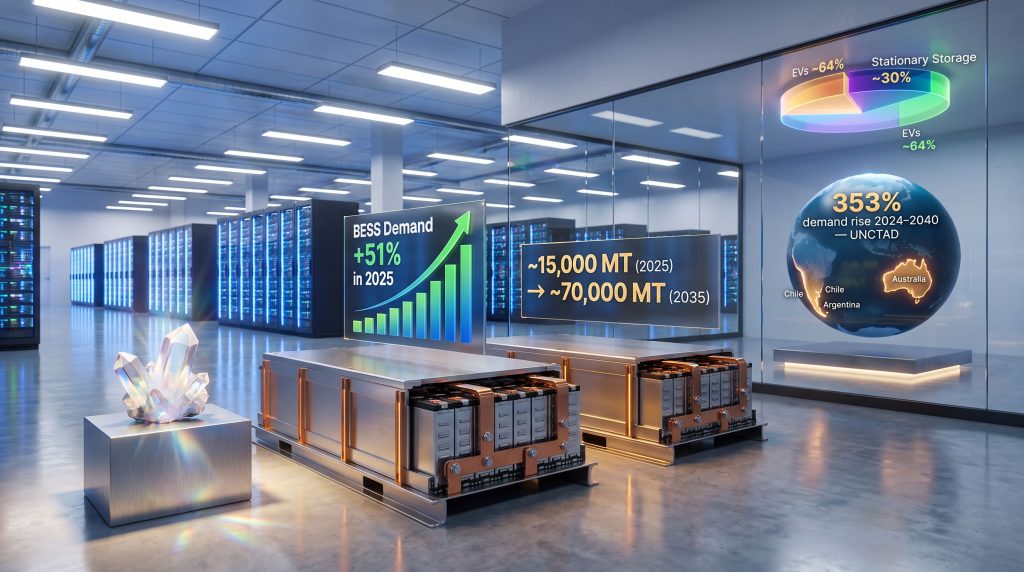
Demand for storage batteries surged 51% in 2025, approximately double the growth rate recorded for EV batteries over the same period. Despite this acceleration, EVs still represent roughly 75% of global battery demand, meaning stationary storage remains a growth-stage contributor rather than the dominant category. Its significance lies in its trajectory and structural permanence, not its current share.
Lithium Demand From AI Data Centers: The Indirect Mechanism Explained
The connection between artificial intelligence and lithium is one of the most misunderstood dynamics in commodity markets. AI systems do not chemically consume lithium. The relationship is infrastructural and indirect, mediated through the power requirements of data centres. As noted by industry analysts, lithium has become the unsung power source behind the AI boom.
AI data centres require uninterrupted, 24/7 power delivery. GPU-intensive computing workloads generate variable power demands, and AI model training in particular creates load profiles that are difficult to manage without dedicated storage infrastructure. This creates three distinct requirements for BESS installations:
- Backup power — protecting against grid outages that would interrupt compute workloads worth millions of dollars per hour.
- Grid stabilisation — absorbing fluctuations inherent in renewable energy inputs, which now supply a growing share of data centre power.
- Power smoothing — managing the variable load profiles created by large clusters of graphics processing units operating simultaneously.
Lithium iron phosphate, or LFP chemistry, has become the dominant technology for these applications. The table below illustrates why LFP has displaced alternatives in the stationary storage segment:
| Battery Chemistry | Cycle Life | Thermal Safety | Cost Profile | Primary Application |
|---|---|---|---|---|
| LFP (Lithium Iron Phosphate) | Very High | Excellent | Low | Stationary BESS, Data Centres |
| NMC (Nickel Manganese Cobalt) | Moderate | Moderate | Higher | EV Batteries |
| NCA (Nickel Cobalt Aluminium) | Moderate | Lower | High | Premium EVs |
| Lead-Acid | Low | Good | Very Low | Legacy UPS Systems |
LFP's thermal stability is particularly critical in data centre environments, where fire risk management is a primary engineering consideration. Its long cycle life, often exceeding 4,000 charge-discharge cycles, also reduces the total cost of ownership for operators running storage systems continuously over many years.
### Why Direct Lithium Extraction Matters Here
Furthermore, advances in direct lithium extraction technology are also influencing the supply side of the equation, potentially enabling faster production ramp-ups in response to structurally growing demand signals from stationary storage applications.
Quantifying the AI-Linked Lithium Demand Signal
Placing a precise number on lithium demand from AI data centers requires careful qualification, as this remains an evolving and contested area of analysis. Current industry research estimates AI data centre-related lithium demand at approximately 15,000 metric tonnes in 2025, with projections pointing toward 70,000 metric tonnes by 2035, representing roughly a fourfold increase over the decade.
The projected quadrupling of AI-linked lithium demand between 2025 and 2035 is meaningful in directional terms, but investors should note this remains a subordinate demand stream relative to EV consumption. Its investment significance derives from growth rate and structural durability, not current volume.
The United States alone presents a substantial demand picture. AI data centre power expansion in the country could translate into approximately 160 GWh of battery storage requirements, according to industry research, with LFP expected to maintain technology dominance in this segment for the foreseeable future. For a deeper look at how data centres impact battery demand, independent analysis from Benchmark Minerals provides additional context.
The broader storage market trajectory supports this directional view. BloombergNEF estimates global energy storage deployment could exceed 100 GW in 2026, with capacity potentially approaching 200 GW over the following decade. J.P. Morgan projects stationary storage will account for 30% of global lithium demand in 2026, rising to 36% by 2030.
| Forecasting Institution | Key Projection | Timeframe |
|---|---|---|
| J.P. Morgan | Storage = 30% of global lithium demand | 2026 |
| J.P. Morgan | Storage = 36% of global lithium demand | 2030 |
| Albemarle | Total demand doubles to ~3.7 million tonnes | By end of decade |
| UNCTAD | Lithium demand rises 353% | 2024–2040 |
| BloombergNEF | Global storage capacity exceeds 200 GW | Next decade |
| Industry Research | AI data centre lithium demand ~70,000 metric tonnes | 2035 |
The Hyperscaler Buildout: Who Is Actually Driving This Demand
The companies building AI infrastructure at scale are not making discretionary choices about capital expenditure. Major cloud and AI infrastructure operators including Amazon and Google are executing multi-year, multi-billion dollar construction programmes driven by AI model training requirements, inference workload capacity, and sovereign cloud mandates from governments seeking domestic data sovereignty.
Each new data centre facility requires dedicated BESS installations, creating a repeating demand cycle that is directly tied to capital expenditure programmes rather than consumer behaviour. This is a qualitatively different demand driver than the EV market, where purchase decisions can be deferred, cancelled, or shifted based on incentive structures and macroeconomic conditions.
The metals implications extend well beyond lithium. Bank of America estimates AI infrastructure requires 60 to 75 tonnes of metals per megawatt of capacity, predominantly in power and cooling systems. Wood Mackenzie adds a critical observation: once grid reinforcement and transmission infrastructure are included, total metals consumption runs three to four times what the data centre itself implies. Lead times for power equipment are now stretching three to five years, indicating supply chain stress across the entire AI infrastructure metals complex.
How the EV Slowdown Has Reshaped the Demand Composition
US EV sales fell more than 20% year-over-year in the second quarter of 2026, according to Cox Automotive data, with the expiration of federal EV tax credit incentives identified as the primary driver. This contraction has created a demand gap that stationary storage is partially, but not yet fully, compensating for.
The compositional shift in lithium demand is illustrated by comparing approximate demand mix estimates across time:
| Demand Category | ~2022 Share | ~2026 Projected Share |
|---|---|---|
| Electric Vehicles | ~85% | ~64% |
| Stationary Storage | ~8% | ~30% |
| Industrial and Other | ~7% | ~6% |
The partial decoupling of lithium demand from EV sales cycles is arguably the most consequential structural development in the lithium market since the original EV boom began. A demand base anchored in AI infrastructure and grid storage is less susceptible to consumer sentiment, policy shifts, and interest rate environments than vehicle purchase decisions.
However, this decoupling is not yet complete, and EV demand remains the dominant category. The directional shift nonetheless represents a fundamental rebalancing that analysts with EV-centric models may be slow to fully incorporate, particularly given ongoing lithium oversupply challenges that have suppressed prices in recent years.
The next major ASX story will hit our subscribers first
Supply Constraints That Amplify the Demand Signal
Demand projections only tell half the story. The supply side of the lithium equation contains structural constraints that could amplify price impacts if demand growth materialises as projected. In addition, the broader critical minerals demand picture reinforces the urgency of addressing these bottlenecks.
Key supply-side risk factors include:
- Geographic concentration — The majority of global lithium production originates from Australia, Chile, and Argentina, creating systemic dependence on a small number of producing nations.
- Export restrictions — Nearly 100 new critical mineral export controls have been introduced globally since 2020, compressing supply flexibility and increasing the risk of disruption.
- Mine development timelines — New lithium projects typically require 7 to 15 years from discovery to meaningful production, creating an inherent lag between demand signals and supply responses.
- Reduced investment appetite — The severe lithium price collapse between 2022 and 2024 reduced capital allocation to new supply development, potentially creating a supply gap in the latter part of this decade.
- Permitting complexity — Regulatory approval processes in major producing jurisdictions are lengthening, adding further delay to supply response timelines.
UNCTAD projects lithium demand will rise 353% between 2024 and 2040, a trajectory that implies substantial supply investment will be required to avoid structural deficits. Albemarle, the world's largest lithium producer, projects total global demand will approximately double to 3.7 million tonnes by the end of this decade.
A Balanced Assessment: The Bull Case and Its Limits
Investors evaluating lithium demand from AI data centers as an investment thesis should weigh the structural arguments against genuine counterpoints.
Arguments supporting a sustained demand impact:
- Storage demand is growing structurally, tied to long-term AI infrastructure capital expenditure that is largely insensitive to consumer sentiment.
- Supply concentration is intensifying, with resource nationalism accelerating across producing nations.
- The mine development lag means supply cannot respond quickly to demand signals, supporting price floors in deficit scenarios.
- Multiple institutional forecasters are converging on projections that imply structural rebalancing of the lithium demand mix.
Arguments for measured expectations:
- AI-linked demand, while fast-growing, starts from a small base relative to total lithium consumption.
- New supply projects are in development across Australia, Chile, Argentina, and Africa, and some will reach production before the end of the decade.
- Alternative battery chemistries, including sodium-ion, are advancing and could displace LFP in some stationary storage applications over time.
- Lithium price forecasting has a poor historical track record; the 2022 bubble and subsequent collapse illustrate the risk of extrapolating demand curves into multi-year projections.
- AI infrastructure buildout timelines could extend or be disrupted by capital constraints, technological shifts, or regulatory developments.
Frequently Asked Questions: Lithium and AI Data Centre Demand
Do AI data centres directly consume lithium?
No. The relationship is infrastructural. Data centres require BESS installations for backup power, grid stability, and power management, and these systems are predominantly built on lithium-based chemistry, specifically LFP.
How significant is AI-linked lithium demand today versus the EV market?
AI data centre-related demand is estimated at approximately 15,000 metric tonnes in 2025, compared to EVs representing roughly 75% of total global battery demand. The AI-linked figure is growing rapidly but remains comparatively small in absolute terms.
What makes LFP the preferred chemistry for data centre storage?
LFP offers excellent thermal safety, very high cycle life exceeding 4,000 cycles, and a declining cost profile. These characteristics make it the practical choice for large-scale stationary applications where safety, longevity, and total cost of ownership matter more than energy density.
What are the biggest risks to this thesis?
Key risks include new supply coming online faster than projected, alternative chemistries displacing LFP, AI buildout timelines extending, and the historical tendency for lithium demand forecasts to overshoot reality.
Disclaimer: This article is intended for informational purposes only and does not constitute investment advice. Commodity markets, including lithium, carry significant price volatility and risk. Forecasts referenced in this article represent the views of third-party institutions and may not be realised. Investors should conduct independent research and seek professional financial advice before making investment decisions.
Want to Position Yourself Ahead of the Next Major ASX Mineral Discovery?
Discovery Alert's proprietary Discovery IQ model delivers real-time alerts on significant ASX mineral discoveries — including lithium and other critical minerals driving the AI infrastructure buildout — turning complex data into actionable insights for both short-term traders and long-term investors. Explore historic examples of exceptional discovery returns and begin your 14-day free trial today to secure a market-leading edge.