July 22, 2026
When Industrial Policy Meets the Energy Transition: South Africa's Battery Value Chain Moment
The global race to control electric vehicle battery supply chains is no longer simply an environmental story. It is a contest for industrial relevance in the twenty-first century economy. Emerging economies that recognise this shift early and build the enabling infrastructure to participate meaningfully in battery value chains will gain lasting competitive advantages. Those that remain passive exporters of raw materials risk watching the most profitable segments of the clean energy transition consolidate elsewhere, leaving them structurally dependent on imported technologies they once had the minerals to produce.
South Africa finds itself at precisely this inflection point. The country possesses some of the world's most strategically important mineral endowments, an established automotive manufacturing base with deep OEM relationships, and engineering and research institutions capable of supporting advanced industrial development. What has historically been missing is the connective tissue: the quality infrastructure, skills pipelines, policy architecture, and investment facilitation mechanisms needed to convert raw mineral wealth into finished battery products and the industrial capability that surrounds them.
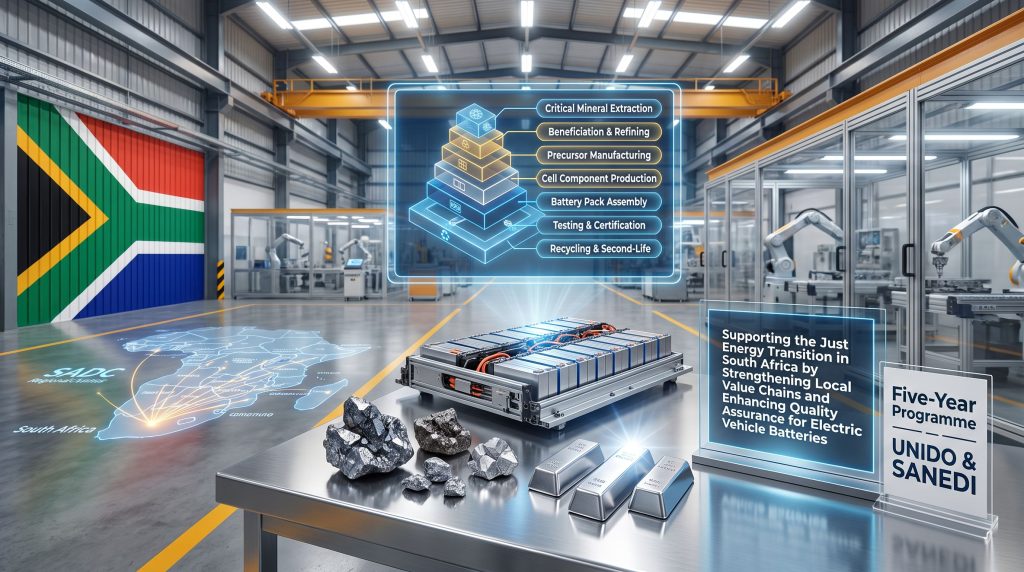
The South Africa electric vehicle battery value chain initiative, formally launched through the GEF-8 funded programme titled Supporting the Just Energy Transition in South Africa by Strengthening Local Value Chains and Enhancing Quality Assurance for Electric Vehicle Batteries, represents a structured attempt to build exactly that connective tissue.
When big ASX news breaks, our subscribers know first
Understanding the GEF-8 Programme: Scope, Partners, and Industrial Logic
The five-year initiative is being implemented by the United Nations Industrial Development Organization (UNIDO) in partnership with the South African National Energy Development Institute (SANEDI). Its operational mandate is deliberately broad, spanning battery testing and certification, workforce development, battery recycling and second-life applications, and investment facilitation tied to local manufacturing and beneficiation activity.
The multi-ministerial governance structure reflects the programme's cross-cutting ambitions:
| Governing Department | Primary Function Within the Initiative |
|---|---|
| Department of Trade, Industry and Competition (dtic) | Industrial policy alignment and manufacturing incentive frameworks |
| Department of Electricity and Energy | Energy transition integration and low-carbon mobility targets |
| Department of Transport | EV adoption policy and regulatory development |
| Department of Forestry, Fisheries and the Environment (DFFE) | GEF Operational Focal Point and climate commitment oversight |
SANEDI's role as the primary implementation hub is significant. The organisation's existing mandate in energy research and development gives it credibility across government, industry, and academic stakeholders, making it well-positioned to serve as the operational centre for a programme that must simultaneously navigate industrial policy, climate finance, and skills development terrain.
UNIDO's involvement is equally important to understand correctly. This is not a traditional climate grant focused narrowly on emissions reduction metrics. UNIDO's institutional mandate centres on industrial development, and its participation signals that the GEF-8 battery initiative is explicitly framed as an industrial upgrading programme that uses climate finance as a catalyst, rather than a climate programme that incidentally touches on industry.
UNIDO's position within this initiative reflects a broader institutional philosophy: that decarbonisation and industrial development are not competing priorities but mutually reinforcing pathways, provided the policy architecture is designed to capture both outcomes simultaneously.
Mapping South Africa's Battery Value Chain: Assets, Gaps, and Regional Opportunities
Understanding where South Africa currently sits within the global battery supply chain hierarchy requires mapping both its structural advantages and its capability deficits with precision.
The Critical Mineral Endowment: A Structural Advantage Waiting to Be Activated
South Africa's mineral base provides a genuine foundation for battery value chain participation. Furthermore, considering the critical minerals and energy security dimensions of this landscape makes it clear why the country's endowment is so strategically significant. Key assets include:
- Manganese reserves among the largest on the planet, with the IDC backing manganese sulphate processing capacity development that could feed directly into battery cathode material supply chains
- Platinum Group Metals (PGMs) with emerging applications in hydrogen fuel cell vehicles and battery catalyst chemistry, positioning South Africa across multiple clean mobility technology pathways simultaneously
- SADC regional proximity to lithium, cobalt, graphite, and copper deposits in neighbouring countries, creating a potential battery materials corridor that extends South Africa's effective mineral footprint considerably beyond its own borders
- An established industrial base in Gauteng and the Eastern Cape with automotive manufacturing infrastructure, logistics networks, and engineering services that could be adapted for battery-adjacent production
The manganese sulphate development angle is particularly worth understanding in depth. Battery-grade manganese sulphate is a precursor material for several lithium-ion cathode chemistries, including lithium manganese iron phosphate (LMFP), which is gaining traction globally as a cost-effective and thermally stable alternative to more cobalt-intensive chemistries. South Africa's manganese endowment, combined with developing processing capacity, positions the country as a potential upstream supplier to cell manufacturers worldwide, provided the downstream quality infrastructure exists to certify and validate that supply.
Where the Gaps Are: Capability Deficits the Initiative Must Close
Despite its mineral wealth, South Africa currently lacks several critical capabilities:
- Domestic battery testing laboratory infrastructure capable of meeting international certification benchmarks independently
- Regulatory frameworks for responsible end-of-life battery management and second-life repurposing
- A sufficiently deep skills pipeline in electrochemistry, battery management systems, and battery pack integration
- Investment facilitation mechanisms to connect local industrial capability with global battery supply chain procurement decisions
These gaps explain why the GEF-8 initiative is structured around four operational pillars rather than a single intervention.
The Four Operational Pillars: Building Capability Layer by Layer
Pillar 1: Quality Infrastructure and Certification
Battery testing and certification is often the least glamorous but most commercially critical component of any battery value chain strategy. Without the ability to independently test and certify batteries against international standards frameworks such as those established by the International Electrotechnical Commission (IEC) and the International Organization for Standardization (ISO), South African manufacturers face two compounding disadvantages: they must send products offshore for certification, adding cost and delay, and they cannot credibly validate the performance claims that global buyers require.
Building domestic testing laboratory capacity is therefore a prerequisite for everything else in the value chain. It enables local manufacturers to access export markets, it supports the development of procurement standards for EV adoption in South Africa itself, and it creates the institutional knowledge base needed to participate in international standards-setting processes.
Pillar 2: Workforce Development and Skills Pipeline
The skills required to design, manufacture, test, maintain, and recycle EV batteries are distinct from those that underpin conventional automotive manufacturing. The initiative's workforce development component targets:
- Technical and vocational training programmes across battery manufacturing and maintenance disciplines
- University and research institution partnerships for advanced battery science and electrochemistry capacity
- Integration of battery value chain competencies into existing automotive sector workforce development frameworks, leveraging the training infrastructure already built around South Africa's vehicle assembly operations
Pillar 3: Battery Recycling and Circular Economy Integration
The battery recycling process is increasingly recognised globally not merely as an environmental compliance requirement but as a strategic mineral recovery mechanism. End-of-life lithium-ion batteries contain recoverable quantities of lithium, cobalt, nickel, and manganese. Countries that build regulated, efficient recycling industries early will progressively reduce their dependence on primary mineral imports for battery production, creating a closed-loop domestic supply dynamic.
Second-life battery applications add another dimension. Battery packs that have degraded below the performance threshold required for vehicle use, typically around 70–80% of original capacity, retain sufficient energy storage capability for stationary applications such as grid-scale storage or commercial and industrial backup power. Developing the technical and regulatory frameworks to enable this second-life market extends the economic value of each battery unit and supports South Africa's broader grid resilience objectives.
Pillar 4: Investment Facilitation and Manufacturing Linkages
The fourth pillar addresses the commercial gap between capability and capital. Investment facilitation in this context means actively identifying and de-risking investment opportunities across the battery value chain, connecting South African industrial assets to global supply chain procurement criteria, and providing the technical and market intelligence that foreign and domestic investors need to commit capital to battery manufacturing projects. For context on the broader battery metals investment landscape, understanding global capital flows is essential to appreciating why this pillar is so critical.
Industrial Policy Architecture: Redesigning Incentives for Battery Value Chain Development
The dtic's EV White Paper provides the policy backbone against which the GEF-8 initiative operates. Proposed mechanisms under active consideration include:
| Policy Mechanism | Target Outcome | Current Status |
|---|---|---|
| Extended automotive incentives to battery materials | Stimulate local beneficiation of lithium, graphite, copper, and cobalt | Under active policy review |
| Temporary import duty relief on EV components | Reduce cost barriers for domestic EV assembly | Proposed in White Paper framework |
| SACU/SADC sourcing criteria for battery materials | Anchor regional supply chain integration | In consultation phase |
| Battery manufacturing investment facilitation | Attract cell and pack manufacturing FDI | IDC and dtic co-ordination ongoing |
A critical and underappreciated insight here is that the bottleneck for South Africa's battery value chain development is not mineral availability. The country has the raw material base. The bottleneck is incentive design: structuring fiscal and regulatory signals clearly enough, and credibly enough, to shift private sector investment decisions from raw mineral export toward downstream processing and manufacturing.
Indonesia's experience with its nickel processing export ban offers a relevant, if imperfect, analogy. By leveraging resource control to force downstream value addition, Indonesia catalysed significant investment in nickel processing and battery material production that would not have flowed under a raw export model. In addition, global cobalt production trends further illustrate how resource-rich nations are increasingly seeking to capture more of the downstream value.
The Just Transition Dimension: Beyond Carbon Accounting
The just energy transition framing embedded in the GEF-8 initiative is substantively important and not merely rhetorical. In the South African context, a just transition explicitly requires that the shift to clean technologies generates new economic opportunities, preserves and expands industrial employment, and ensures that communities and workers most exposed to fossil fuel dependency are not abandoned in the process.
The core argument is that decarbonisation pursued without an industrial development lens simply relocates economic harm rather than eliminating it. South Africa's participation in battery value chains must therefore be measured not only by emissions reductions but by job quality, wage levels, supply chain localisation ratios, and the breadth of communities connected to the new economy.
The next major ASX story will hit our subscribers first
How South Africa's Strategy Compares Globally
| Country/Region | Core Battery Strategy Focus | Key Competitive Advantage |
|---|---|---|
| European Union | Critical Raw Materials Act plus domestic gigafactory development | Regulatory standards-setting power and market scale |
| China | Vertically integrated supply chain from mining to cell manufacturing | Scale, cost efficiency, and technology leadership |
| United States | Inflation Reduction Act domestic content requirements | Market incentives and allied-nation sourcing rules |
| Indonesia | Nickel processing restrictions to force downstream value addition | Resource leverage and ASEAN market positioning |
| South Africa | GEF-8 quality infrastructure plus SADC mineral corridor development | Critical mineral endowment and established automotive base |
The risk of inaction is explicit and time-bound. Global battery supply chains are consolidating rapidly around countries that have already made credible commitments to quality infrastructure, skills, and incentive frameworks. The window during which South Africa can insert itself meaningfully into those supply chains as a producer rather than a raw material exporter is finite. The battery storage-driven lithium boom further underscores how rapidly demand dynamics are shifting, reinforcing the urgency of decisive policy action.
The Existing Automotive Sector: Platform or Liability?
Toyota's investment in a ninth-generation Hilux production line in South Africa illustrates both the strength and the complexity of the country's automotive inheritance. Established OEM relationships, skilled manufacturing workforces, and logistics infrastructure represent genuine assets for any EV battery strategy. However, Tier 1 and Tier 2 automotive suppliers built around internal combustion engine components face real supply chain reconfiguration risk as powertrain technology shifts.
Converting combustion engine manufacturing expertise into EV-adjacent capability is achievable but requires deliberate policy support, retraining investment, and time. The GEF-8 initiative's workforce development pillar is partly designed to manage this transition, ensuring that workers in conventional automotive manufacturing are not left structurally unemployed as the technology mix evolves. The new GEF-funded initiative has consequently attracted considerable attention from both domestic manufacturers and international supply chain observers.
Inception Phase: What Happens Before Full Operations Begin
The programme is currently in its inception phase. Key priorities during this stage include:
- Establishing the Project Management Unit at SANEDI
- Constituting a representative Project Steering Committee to provide strategic oversight and governance
- Conducting private sector engagement and comprehensive stakeholder mapping
- Reviewing and refining the project logical framework and workplan to eliminate duplication with existing initiatives
- Conducting a policy alignment audit against recent legislative and regulatory developments
Once the workplan has been finalised and formally endorsed by the Project Steering Committee, the South Africa electric vehicle battery value chain initiative will move into full operational mode. The Africa Electric Mobility Conference in Cape Town later in 2026 has been identified as a platform for showcasing the initiative and exchanging lessons with comparable programmes across the continent.
Frequently Asked Questions: South Africa EV Battery Value Chain Initiative
What is the GEF-8 EV battery project in South Africa?
It is a five-year internationally funded programme designed to strengthen South Africa's electric vehicle battery value chain through quality infrastructure development, workforce training, battery recycling frameworks, and investment facilitation, implemented by UNIDO in partnership with SANEDI.
Which government departments are involved in South Africa's EV battery strategy?
The initiative operates under the guidance of the Department of Trade, Industry and Competition, the Department of Electricity and Energy, and the Department of Transport, with the Department of Forestry, Fisheries and the Environment serving as the GEF Operational Focal Point.
What critical minerals does South Africa have for EV battery manufacturing?
South Africa holds significant manganese and platinum group metal reserves, while its SADC regional position provides proximity to lithium, cobalt, graphite, and copper deposits essential for battery cell manufacturing. Furthermore, the Africa EV battery value chain analysis by the African Development Bank reinforces how strategically positioned the region is to capitalise on these endowments.
Why does battery testing and certification matter so much for local manufacturers?
Without domestic testing laboratory capacity aligned to IEC and ISO standards, South African battery producers must use offshore certification processes, adding cost and delay that undermine their competitiveness in both export and domestic markets.
How does battery recycling strengthen South Africa's long-term energy security?
Regulated battery recycling recovers critical minerals domestically, progressively reducing reliance on primary mineral imports for battery production and building a circular economy capability that lowers the country's long-term supply chain vulnerability.
When will the GEF-8 initiative move beyond the inception phase?
Full operational activity is expected once the Project Steering Committee is constituted and the workplan is formally endorsed. The programme is currently completing its governance formation and stakeholder engagement activities.
Disclaimer: This article is intended for informational purposes only and does not constitute financial or investment advice. Readers should conduct their own due diligence before making any investment or business decisions related to the topics discussed. Programme timelines, policy outcomes, and investment facilitation results referenced in this article are subject to change and carry inherent uncertainty.
Want to Stay Ahead of the Next Major Mineral Discovery in the Battery Metals Space?
Discovery Alert's proprietary Discovery IQ model scans ASX announcements in real time, instantly identifying significant mineral discoveries across the 30+ commodities driving the clean energy transition — including the battery materials central to initiatives like South Africa's EV value chain programme. Explore how historic discoveries have generated substantial returns on Discovery Alert's dedicated discoveries page, and begin your 14-day free trial today to position yourself ahead of the broader market.