July 21, 2026
The Logistics Gap Holding Africa's Lithium Giant Back
Bulk mineral freight economics rarely attract headlines, but they quietly determine which mining jurisdictions thrive and which stagnate. A tonne of lithium concentrate sitting at a mine gate in southern Zimbabwe carries significant embedded value, yet the method by which that tonne reaches a deepwater port shapes the entire commercial proposition for the producer. For years, the Zimbabwe lithium export rail to Maputo port has been the missing piece in an otherwise compelling geological story — undermined not by grade or geology, but by the blunt inefficiency of road-based logistics.
That calculus is now shifting. The activation of a multi-operator freight rail corridor linking Zimbabwe's Gwanda mining district to the Port of Maputo in Mozambique represents more than an incremental operational improvement. It signals a structural rethinking of how southern Africa's most lithium-rich nation integrates with the global lithium market at a moment when the energy transition is reshaping commodity flows across the continent.
When big ASX news breaks, our subscribers know first
Why Road Haulage Has Been a Competitive Handicap
For a country exporting over one million tonnes of lithium-bearing spodumene concentrate annually, the choice of transport mode is not a minor operational footnote. It is a margin-defining variable that affects every producer in the country simultaneously.
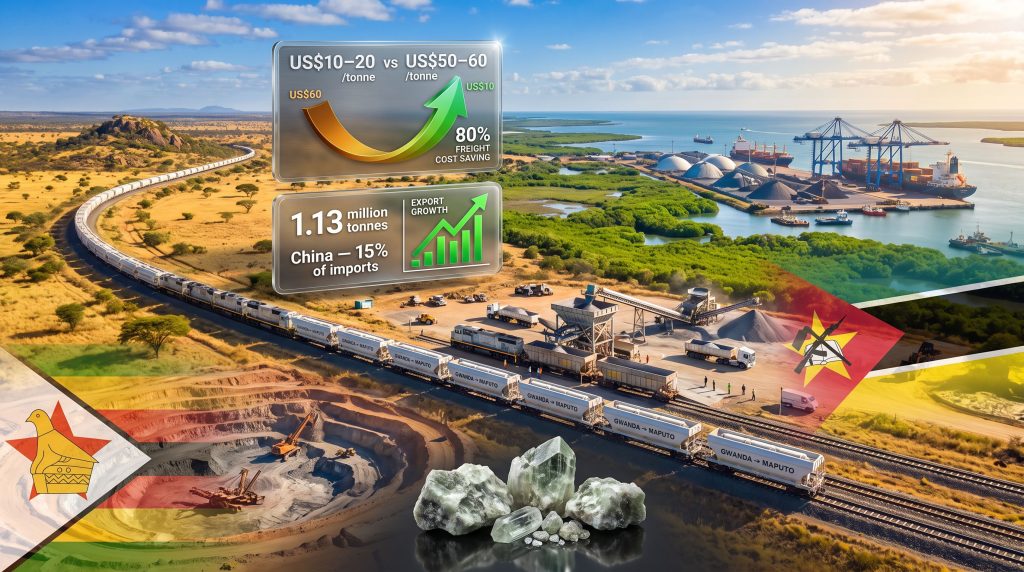
Road trucking of bulk mineral concentrate to port carries an estimated cost burden of US$50 to US$60 per tonne. Applied across Zimbabwe's 2025 export volume of 1.13 million tonnes of spodumene concentrate shipped primarily to China, that per-tonne cost translates into a sector-wide logistics bill running into the hundreds of millions of dollars annually. Furthermore, road haulage introduces compounding operational risks:
- Road degradation accelerates under the weight of heavy mineral freight vehicles, creating recurring infrastructure damage and transit unpredictability
- Driver shortages and fuel price volatility add cost uncertainty that rail does not carry at the same intensity
- Customs processing at land borders, particularly the busy Beitbridge crossing into South Africa, introduces delays that compound over a high-volume export season
- The cumulative effect suppresses the landed competitiveness of Zimbabwean spodumene relative to producers in Australia and Chile who benefit from well-developed port and rail infrastructure
Industry benchmarks suggest that rail transport of bulk mineral concentrates can reduce per-tonne freight costs to the US$10 to US$20 range. On a system-wide basis, the arithmetic is striking: a conservative saving of US$40 per tonne applied to Zimbabwe's annual spodumene export volume implies a potential sector-wide cost reduction exceeding US$45 million per year. For mining operations already navigating a lithium price cycle that has compressed margins across the industry, that differential is material.
The Three-Segment Corridor: Route Architecture and Operators
The newly operational Zimbabwe lithium export rail to Maputo port corridor spans approximately 1,000 kilometres across three distinct operating segments, each managed by a separate entity under a coordinated multi-party partnership.
| Segment | Route | Distance | Operator |
|---|---|---|---|
| Segment 1 | Gwanda to Beitbridge | ~180 km | Beitbridge Bulawayo Railway (BBR) |
| Segment 2 | Beitbridge to Chicualacuala | ~300 km | National Railways of Zimbabwe (NRZ) |
| Segment 3 | Chicualacuala to Maputo (Limpopo Line) | ~522 km | Mozambican rail network |
| Total | Gwanda to Port of Maputo | ~1,000 km | Multi-operator partnership |
The three entities anchoring this arrangement each bring distinct capabilities:
-
National Railways of Zimbabwe (NRZ): The state rail operator managing the central segment and coordinating cross-border logistics. The NRZ has faced severe structural challenges, with freight volumes collapsing from a peak of approximately 12 million tonnes annually in the 1990s to roughly 2 million tonnes in 2025, a decline exceeding 83% over three decades driven primarily by chronic underinvestment in rolling stock and track maintenance.
-
Beitbridge Bulawayo Railway (BBR): A subsidiary of South Africa's JSE-listed Grindrod, BBR operates the critical first leg connecting the Gwanda lithium district to the Beitbridge border crossing. The involvement of a private, commercially oriented rail operator at this stage of the corridor is significant: it introduces performance incentives and capital discipline that state-owned rail networks have historically struggled to maintain independently.
-
Silvergill: A Zimbabwean logistics firm providing operational coordination across the supply chain, bridging the gaps between rail segments and ensuring consignment continuity across multiple jurisdictions.
The inaugural consignment comprised 1,000 metric tonnes of lithium concentrate originating from the Gwanda Lithium Mine, operated by China's Tsingshan Holding Group. While modest relative to annual export volumes, this first shipment establishes proof-of-concept for a corridor that, if scaled efficiently, could fundamentally alter the economics of Zimbabwean lithium production. Understanding how lithium mining works in this context helps clarify why logistics infrastructure is so central to the sector's competitiveness.
The West Nicholson Transshipment Node: Infrastructure at the Mine Gate
What Makes the West Nicholson Siding So Important?
One infrastructure investment that has received comparatively little attention in coverage of the new corridor is the West Nicholson lithium transshipment rail siding, commissioned at a cost of US$1.5 million. This facility functions as a critical intermodal transfer point where concentrate arriving by mine-site truck is loaded onto rail wagons for the long-haul journey to Maputo.
The significance of this node is often underappreciated. In bulk mineral logistics, the efficiency of the load-out point determines the viability of the entire chain. A poorly designed or under-resourced transshipment facility creates bottlenecks that negate the cost advantages of rail over road. The West Nicholson siding represents a targeted investment in precisely this constraint, suggesting that the operators involved have thought carefully about the full chain rather than just the rail segments themselves.
The development of dedicated load-out infrastructure at West Nicholson signals that this corridor is being designed for operational scale, not merely symbolic first-shipment optics. Purpose-built transshipment capacity is what separates a functional rail export chain from a one-off logistics exercise.
Zimbabwe's Lithium Geology and Why the Rail Alignment Matters
A detail that illuminates the strategic logic of the Maputo corridor is the geographic relationship between Zimbabwe's lithium deposits and the rail route itself. Zimbabwe's principal lithium mineralisation occurs within a west-to-southeast trending geological corridor that aligns closely with the rail infrastructure now being activated.
This is not coincidental. Zimbabwe's lithium occurs predominantly as spodumene, a lithium aluminium inosilicate mineral found within lithium-caesium-tantalum (LCT) pegmatites. Understanding spodumene extraction at a technical level reveals why the geographic alignment of these pegmatite intrusions in the Gwanda, Bikita, and Kamativi areas is so commercially significant. The rail route from Gwanda through Beitbridge to Chicualacuala essentially follows the geological grain of the country's lithium endowment.
This alignment means that as additional mines in the corridor come into production, each new operation naturally sits closer to the established rail infrastructure, reducing the feeder-road distance that concentrate must travel before reaching a railhead. Consequently, the network effect of this geographic coherence compounds the cost benefits over time.
Chinese Capital, Captive Flows, and the Demand Base for Rail Investment
Understanding who owns Zimbabwe's lithium mines is essential to understanding why the Maputo rail corridor is commercially viable as an investment proposition. Since 2021, Chinese mining and processing companies have deployed approximately US$2 billion in capital across Zimbabwe's lithium sector, creating a concentration of ownership that few other African mining jurisdictions have experienced.
The dominant operators include:
- Zhejiang Huayou Cobalt
- Sinomine Resource Group
- Sichuan Yahua Industrial Group
- Chengxin Lithium
- Tsingshan Holding Group
This ownership structure creates what logistics analysts would describe as a captive freight base: the overwhelming majority of Zimbabwe's lithium output is destined for Chinese battery supply chains, and the producers themselves have strong commercial incentives to reduce the delivered cost of their concentrate. Zimbabwe's 2025 export data illustrates the scale of this dependency:
| Metric | Figure |
|---|---|
| Spodumene concentrate exported in 2025 | 1.13 million tonnes |
| Share of China's lithium concentrate imports | ~15% |
| Chinese capital invested since 2021 | ~US$2 billion |
| Primary beneficial destination | Chinese battery supply chains |
The next major ASX story will hit our subscribers first
Diversifying Away from South African Port Dependency
A less discussed but strategically important dimension of the Maputo corridor is what it represents for Zimbabwe's port diversification ambitions. Historically, an estimated 95% of Zimbabwe's total trade flows have passed through South African port infrastructure, primarily Durban and Richards Bay.
This concentration creates structural vulnerability. South African port performance has been inconsistent in recent years, with congestion and operational delays adding unpredictable costs and timeline uncertainty to mineral export schedules. These resource export challenges are not unique to Zimbabwe; however, the country's landlocked geography makes it particularly exposed to port system inefficiencies.
The Maputo corridor offers a geographically shorter and operationally independent alternative:
| Export Route | Estimated Cost/Tonne | Primary Risk | Port System |
|---|---|---|---|
| Road trucking to Durban or Richards Bay | US$50-60 | Congestion, road wear, fuel costs | South Africa |
| Rail to Maputo via new corridor | US$10-20 | Multi-operator coordination | Mozambique |
| Planned Techobanine seaport route | To be determined | Development timeline uncertainty | Mozambique (new facility) |
The Port of Maputo's rail connections have undergone meaningful expansion in recent years, positioning it as a competitive deep-water hub for southern African bulk commodities. Its proximity to Zimbabwe's southeastern mineralised corridor, combined with the now-operational rail link, makes it a structurally logical export gateway for lithium concentrate heading to Asian markets.
The 2027 Export Ban: A Policy Deadline That Changes the Infrastructure Calculus
Any analysis of Zimbabwe's lithium logistics must be read against a firm policy deadline that fundamentally alters what the country will be exporting within the next few years. Zimbabwe has enacted a ban on the export of raw and unprocessed lithium concentrates, with full implementation scheduled for January 2027.
This policy shift means the concentrate volumes currently moving through the Zimbabwe lithium export rail to Maputo port corridor will, within 18 months of the corridor's activation, need to be replaced by a different product stream. Rather than spodumene concentrate, Zimbabwe's export profile will transition toward lithium sulphate, a precursor chemical used in the production of battery-grade lithium compounds including lithium carbonate and lithium hydroxide. In addition, innovations such as direct lithium extraction are beginning to influence how producers think about downstream processing and the product forms they will ultimately export.
Producers operating in Zimbabwe are forecasting lithium sulphate exports of 344,000 tonnes by 2030, reflecting the intended transformation of the country's export value proposition.
Policy Risk Consideration: Infrastructure investors and logistics operators must evaluate whether handling systems designed for bulk spodumene concentrate will require modification to accommodate lithium sulphate, which carries different bulk density, moisture sensitivity, and packaging requirements. The January 2027 deadline creates a hard transition point that is closer than it may appear for operators currently commissioning concentrate-specific rail and port handling infrastructure.
The speculative dimension here is significant. If Zimbabwe's domestic processing capacity is commissioned ahead of the policy deadline, concentrate export volumes could taper earlier than 2027, potentially stranding rail capacity that was sized for concentrate throughput. Conversely, if processing plant construction faces delays, the ban's enforcement could be politically complicated, creating regulatory uncertainty that affects investment decisions across the sector.
The Techobanine Seaport: A Longer Strategic Horizon
The Maputo corridor should be understood not as a permanent endpoint but as an intermediate solution within a longer-horizon regional infrastructure strategy. In July 2024, Zimbabwe, Mozambique, and Botswana formalised a trilateral agreement to co-develop a regional rail corridor terminating at the planned Techobanine seaport on Mozambique's southern coastline.
Techobanine is envisioned as a purpose-built deepwater facility capable of handling large-volume bulk commodity shipments from the Zimbabwean and Botswanan interior. Botswana's inclusion is instructive: the corridor's strategic value extends beyond lithium alone, encompassing coal, diamonds, and other bulk commodities that both countries currently route through congested South African infrastructure.
The layered infrastructure picture emerging from this regional architecture includes:
- The NRZ-BBR-Silvergill Maputo corridor, now operationally active
- The West Nicholson transshipment siding, providing purpose-built mine-to-rail transfer capacity
- The planned Techobanine seaport, designed for higher-capacity, purpose-built bulk mineral export
- The trilateral rail corridor agreement connecting all three countries to the new port
Each layer builds on the previous, suggesting a coherent long-term infrastructure vision even if individual components carry execution risk. The Limpopo railway's historical role in regional connectivity further underscores why this corridor has long been considered a natural trade artery for southern African mineral producers.
Frequently Asked Questions
How long is the Zimbabwe lithium rail route to Maputo port?
The total corridor spans approximately 1,000 kilometres, comprising a 180 km first leg from Gwanda to Beitbridge, a 300 km central segment from Beitbridge to the Mozambican border at Chicualacuala, and a 522 km final leg along the Limpopo line into Maputo.
Who operates the corridor?
The route is managed under a three-party arrangement involving the National Railways of Zimbabwe, Beitbridge Bulawayo Railway (a Grindrod subsidiary), and Zimbabwean logistics firm Silvergill.
Why is rail transport more competitive than road haulage for lithium concentrate?
Rail freight for bulk mineral concentrate is estimated to cost US$10 to US$20 per tonne, compared to US$50 to US$60 per tonne by road. Across Zimbabwe's annual export volumes, this differential represents a substantial improvement in producer economics.
When does Zimbabwe's lithium concentrate export ban take effect?
The full prohibition on raw lithium concentrate exports is scheduled for January 2027, after which producers will need to export processed products such as lithium sulphate.
What is the Techobanine seaport?
Techobanine is a planned deepwater port in southern Mozambique included in a trilateral development agreement signed by Zimbabwe, Mozambique, and Botswana in July 2024. It is intended to serve as a purpose-built bulk commodity export hub for the region's mineral producers.
How much lithium concentrate did Zimbabwe export to China in 2025?
Zimbabwe exported approximately 1.13 million tonnes of lithium-bearing spodumene concentrate to China in 2025, representing around 15% of China's total lithium concentrate imports for that year.
This article is intended for informational purposes only and does not constitute financial or investment advice. Forecasts and cost estimates referenced throughout reflect industry benchmarks and publicly available data and are subject to change. Readers should conduct their own due diligence before making investment decisions related to any company or sector discussed.
Want to Catch the Next Major Lithium Discovery Before the Market Does?
Discovery Alert's proprietary Discovery IQ model delivers real-time alerts on significant ASX mineral discoveries — including lithium — instantly translating complex geological data into actionable investment insights for traders and long-term investors alike. Explore how historic discoveries have generated substantial returns on Discovery Alert's dedicated discoveries page, and begin your 14-day free trial today to position yourself ahead of the broader market.