July 21, 2026
Why Industrial Policy Maturity Triggers Tax Reform, Not Policy Retreat
When a government removes preferential treatment from an industry it once aggressively nurtured, the instinctive reaction from market participants is alarm. History, however, tells a more nuanced story. The withdrawal of fiscal support from maturing sectors has repeatedly preceded the most durable phases of industry consolidation, with stronger producers ultimately capturing larger market share from weaker, subsidy-dependent competitors. China's decision to end key tax breaks for lithium batteries and solar cells follows precisely this pattern, and understanding the mechanics behind the reform is essential for anyone with exposure to global clean energy supply chains.
When big ASX news breaks, our subscribers know first
The Fiscal Architecture That Built China's Clean Energy Dominance
To appreciate the scale of what is being dismantled, it helps to understand what was built. Since 2015, China's clean energy manufacturing sector operated under a dual-layered system of fiscal advantage that created compounding cost benefits for domestic producers.
The first layer was a domestic consumption tax exemption applied to lithium-ion batteries, solar photovoltaic cells, and other clean energy products. This removed a production-side cost burden that would otherwise have eroded manufacturer margins at the point of domestic sale.
The second layer was a VAT export rebate mechanism, which effectively reimbursed Chinese exporters a portion of the value-added tax embedded in their products at the point of international shipment. For both batteries and solar cells, this rebate rate stood at 9%, functioning as a direct price subsidy on every unit shipped overseas.
Together, these two instruments gave Chinese manufacturers a structural cost floor that competitors in other jurisdictions could not replicate through operational efficiency alone. The result was a decade of extraordinary capacity expansion, dramatic price declines in the global lithium market and solar module sectors, and China's ascent to dominance across virtually every node of the clean energy manufacturing value chain.
The compounding effect of domestic tax exemptions and export rebates was not simply additive. It created a self-reinforcing competitive advantage that suppressed the viability of competing manufacturing ecosystems worldwide, particularly across Southeast Asia, Europe, and North America.
How the New Consumption Tax Framework Is Structured
Phased Tax Implementation: Lithium-Ion Batteries
China's decision to introduce a staged consumption tax on lithium-ion batteries reflects a deliberate policy design. Rather than imposing costs abruptly, the phased structure allows manufacturers time to adjust pricing strategies, operational models, and supply contracts.
| Phase | Tax Rate | Effective Date | Products Covered |
|---|---|---|---|
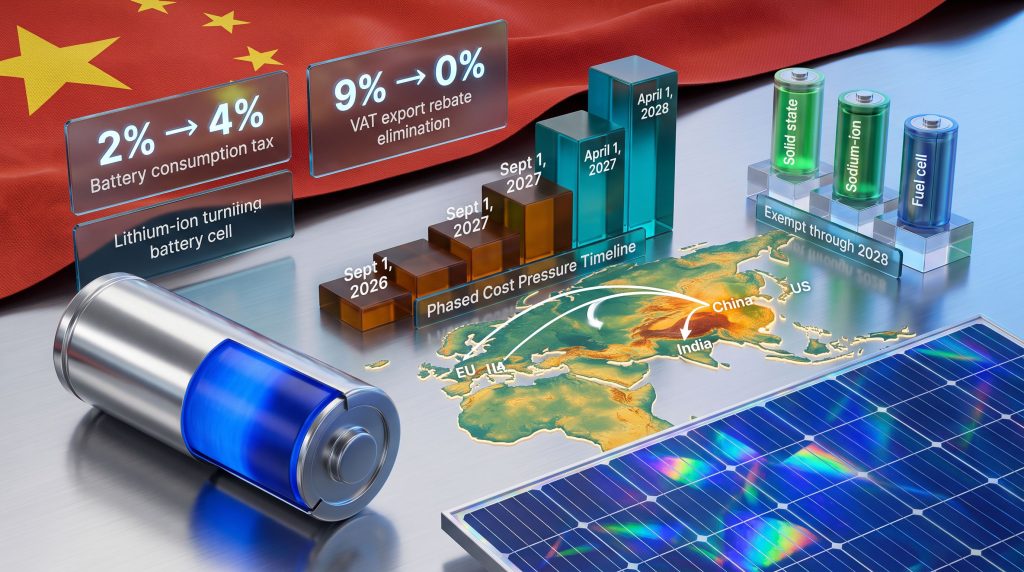
| Phase 1 | 2% consumption tax | September 1, 2026 | EV batteries, laptop batteries, smartphone batteries |
| Phase 2 | 4% consumption tax | September 1, 2027 | Same product categories |
Phased Tax Implementation: Solar Photovoltaic Cells
Solar PV manufacturers face a later consumption tax introduction, but they absorbed the VAT rebate shock first, creating an asymmetric pressure sequence across the two sectors.
| Phase | Tax Rate | Effective Date |
|---|---|---|
| Phase 1 | 2% consumption tax | April 1, 2027 |
| Phase 2 | 4% consumption tax | April 1, 2028 |
Regulatory Design Note: The phased rate structure, beginning at 2% before doubling to 4%, is a deliberate policy signal designed to give manufacturers adjustment time while establishing a clear cost trajectory for long-term planning.
Which Products Remain Exempt Through 2028?
Critically, the new consumption tax regime does not apply uniformly across the energy storage sector. Beijing has made deliberate carve-outs for technologies it considers strategically pre-commercial:
- Fuel cells retain their exempt status, consistent with China's parallel hydrogen economy development agenda.
- Sodium-ion batteries are excluded from the new tax to accelerate commercial adoption of a lithium-independent storage chemistry, reflecting Beijing's interest in reducing raw material concentration risk.
- Solid-state batteries are protected from the consumption tax framework to encourage continued R&D investment in next-generation energy density and safety improvements.
The logic is clear: exemptions are reserved for technologies not yet operating at commercial scale, where market development support still generates a genuine return on policy investment. The imposition of tax on lithium batteries and solar cells signals the opposite conclusion about those sectors' maturity.
What Is Happening to China's VAT Export Rebate System?
Solar Cells and PV Products: Full Rebate Cancellation
The export rebate removal for solar photovoltaic products is both immediate and total. Chinese solar exporters, who previously benefited from a 9% VAT rebate on overseas shipments, faced the complete elimination of that rebate from April 1, 2026. The effective rebate rate moved from 9% to zero in a single policy step, front-loading the cost pressure on solar module producers before the consumption tax even takes effect.
This sequencing matters. Solar manufacturers are absorbing the export cost shock before facing domestic consumption tax increases, which means the sector's international pricing competitiveness is being challenged in two separate waves, with the more disruptive one arriving first. Furthermore, the lithium carbonate dynamics across global supply chains add another layer of cost complexity for producers navigating these reforms.
Lithium-Ion Battery Exports: Staged Reduction to Zero
For batteries, Beijing chose a more graduated approach, likely reflecting the greater strategic sensitivity of the battery supply chain to global EV manufacturers who have built procurement models around Chinese cell pricing.
| Period | Export VAT Rebate Rate |
|---|---|
| Pre-reform | 9% |
| April 1 to December 31, 2026 | 6% (partial reduction) |
| From January 1, 2027 | 0% (full elimination) |
The transitional 6% rate through the end of 2026 provides a brief adjustment window. However, by January 2027, Chinese battery exporters will simultaneously face zero export rebates and the step-up to a 4% domestic consumption tax, creating the sharpest cost convergence point in the entire reform timeline.
A secondary effect worth monitoring is the pull-forward dynamic. Manufacturers and importers with advanced knowledge of the April 2026 rebate cut had strong financial incentives to accelerate export volumes into the first quarter of 2026, potentially inflating headline export figures before the reform took hold and distorting near-term demand signals.
What Are the Dual Policy Objectives Behind These Reforms?
Objective 1: Domestic Market Rationalisation and Capacity Discipline
China's solar and battery manufacturing sectors have expanded at a pace that substantially outstripped both domestic absorption capacity and total global demand. The structural oversupply problem has been well-documented across industry reporting, with China's solar giants warning of first-half losses in 2026 even before the new tax framework was finalised.
The consumption tax functions as a margin-compression instrument. For the weakest producers operating on the thinnest margins, a 2-to-4% additional cost burden accelerates the inevitable. The policy is effectively designed to hasten consolidation among mid-tier manufacturers, triggering plant closures, merger activity, and capacity rationalisation that Beijing has been unwilling to mandate directly through administrative production quotas.
Historically, this approach has precedent in China's steel sector, where China steel consolidation was driven through a combination of environmental regulations and fiscal adjustments, producing a prolonged but ultimately effective wave that reduced the number of operating steelmakers and improved average profitability among survivors.
Objective 2: Reducing Trade Friction Without Formal Concession
The geopolitical dimension of the export rebate cancellation is arguably more significant than the domestic market rationale. Sustained rebate-driven export pricing has generated a mounting wave of anti-dumping investigations, safeguard measures, and punitive tariff regimes across the EU, the United States, and India. Each retaliatory action ultimately restricts Chinese manufacturers' market access more severely than the subsidy benefited them.
By withdrawing export rebates unilaterally, Beijing achieves a reduction in trade friction without formally acknowledging that prior pricing practices were subsidy-dependent, preserving a useful diplomatic posture while achieving a practical outcome.
This calculation mirrors earlier adjustments China made in aluminium and primary steel exports, where targeted fiscal changes reduced the volume and velocity of trade remedy complaints from major trading partners without requiring bilateral negotiation or World Trade Organisation concessions.
How Will These Tax Changes Ripple Through Global Supply Chains?
Comparative Cost Impact Table
| Product Category | Domestic Tax Change | Export Rebate Change | Combined Cost Pressure |
|---|---|---|---|
| Lithium-ion batteries | +2% (2026) to +4% (2027) | -3% (2026) to -9% (2027) | Significant, staged |
| Solar PV cells | +2% (2027) to +4% (2028) | -9% (immediate, April 2026) | Export impact front-loaded |
| Solid-state batteries | No change (exempt to 2028) | Subject to rebate changes | Partial exposure |
| Sodium-ion batteries | No change (exempt to 2028) | Subject to rebate changes | Partial exposure |
Impact on Global Solar Module Pricing
In the near term, the full cancellation of solar export rebates from April 2026 creates upward pricing pressure on internationally traded solar modules. Chinese manufacturers face a binary choice: absorb the 9-percentage-point cost increase against already compressed margins, or pass costs downstream to project developers and EV manufacturers in their export markets.
For non-Chinese solar manufacturers in India, Southeast Asia, and the United States, this shift represents a meaningful competitive repricing. Manufacturing capacity that was previously uneconomic relative to Chinese-origin modules may become viable as the effective landed cost of Chinese products rises.
Impact on EV Battery Supply Chains
The battery supply chain transmission is more complex. Global EV original equipment manufacturers with long-term cell supply agreements from Chinese producers will face renegotiation pressure as the cost environment shifts. The key question is whether the tax burden is absorbed at the cell manufacturer level, shared across the value chain, or passed to vehicle assemblers and ultimately retail consumers.
Given that Chinese battery producers are already operating in a compressed margin environment driven by battery raw materials price volatility and intense domestic competition, the capacity to absorb additional cost without price transmission to customers is limited for all but the largest, most integrated producers.
The next major ASX story will hit our subscribers first
Which Technologies Benefit From China's Strategic Exemption Decisions?
Next-Generation Battery Chemistries as Policy Winners
The deliberate exemption of solid-state batteries, sodium-ion batteries, and fuel cells from the new consumption tax sends a clear directional signal about where Beijing intends to concentrate its next phase of industrial development support.
Solid-state batteries represent the most significant near-term commercial opportunity in advanced energy storage, offering substantially higher energy density and improved thermal safety compared to conventional lithium-ion formats. China's exemption preserves the investment incentive for R&D-intensive producers working toward commercial scale production.
Sodium-ion battery technology is particularly interesting from a strategic perspective. It addresses one of the core vulnerabilities of the current lithium-ion supply chain: geographic concentration of lithium resources and processing capacity. By keeping sodium-ion batteries exempt, China is explicitly hedging its own resource dependency while also developing a lower-cost chemistry that could serve price-sensitive applications. In addition, China battery recycling infrastructure investment is accelerating in parallel, further strengthening Beijing's long-term position in the energy storage value chain.
The Post-2028 Question
A reasonable projection, based on the precedent now being set with lithium-ion batteries, is that solid-state and sodium-ion batteries will face equivalent consumption tax treatment once they reach commercial manufacturing scale. The policy pattern is consistent: exempt during development, tax once mature. Investors in next-generation battery manufacturers should model this eventual transition into their long-horizon valuation frameworks.
How Should Investors Interpret This Policy Shift?
A Maturity Signal, Not an Abandonment
The most important interpretive mistake would be to read China's decision to end key tax breaks for lithium batteries and solar cells as Beijing stepping back from clean energy ambition. The sector-specific exemptions for emerging technologies confirm that incentive architecture remains intact for pre-commercial categories. What is being removed is the fiscal life support for industries that no longer require it to be globally competitive.
This mirrors the trajectory of China's wind power and utility-scale solar installation programmes, where feed-in tariff support was progressively withdrawn as those sectors reached grid parity and became self-sustaining on competitive economics alone.
Risk Recalibration for Clean Energy Supply Chain Investors
Investors with exposure to Chinese battery and solar manufacturers should consider the following in their forward earnings models:
- Companies with high export revenue concentration face the most immediate margin pressure from rebate elimination.
- Smaller, export-dependent producers with limited pricing power are most vulnerable to the margin squeeze created by the combined consumption tax and rebate removal timeline.
- Larger, vertically integrated manufacturers with domestic sales diversification and stronger balance sheets are best positioned to weather the transition and potentially accelerate market share gains as weaker competitors exit.
- Non-Chinese manufacturers in India, Southeast Asia, and the US gain relative cost competitiveness as Chinese export pricing rises, though their ability to capture redirected demand depends on available capacity and qualification timelines.
Disclaimer: This article contains analysis and forward-looking observations based on publicly available policy information. It does not constitute financial or investment advice. Readers should conduct independent due diligence before making investment decisions.
Frequently Asked Questions: China's Lithium Battery and Solar Cell Tax Reform
What is the new consumption tax rate for lithium-ion batteries in China?
A 2% consumption tax applies from September 1, 2026, rising to 4% from September 1, 2027. This ends an exemption in place since 2015.
When did China cancel VAT export rebates for solar cells?
Export VAT rebates for solar photovoltaic cells were fully eliminated from April 1, 2026, dropping the rebate rate from 9% to 0%.
Are all battery types subject to China's new consumption tax?
No. Fuel cells, sodium-ion batteries, and solid-state batteries are exempt from the new consumption tax through at least the end of 2028.
Why is China removing export rebates for clean energy products?
The policy raises the effective export cost of Chinese-manufactured solar and battery products, reducing international trade friction generated by prior subsidy-supported pricing.
What is the difference between the consumption tax change and the VAT rebate cancellation?
The consumption tax is a domestic levy on production, while the VAT export rebate cancellation removes a financial mechanism that reduced the effective cost of Chinese exports. They are separate policy instruments with different mechanisms and timelines.
Which products are most affected by these combined changes?
Lithium-ion batteries used in electric vehicles, laptops, and smartphones, along with standard solar photovoltaic cells, bear the full impact of both the consumption tax introduction and the export rebate removal.
Key Takeaways at a Glance
- Two distinct fiscal mechanisms are being unwound simultaneously: a domestic consumption tax exemption and a VAT export rebate, each operating on separate timelines with different sectoral impacts.
- Solar PV producers faced the export rebate shock first in April 2026, with consumption tax arriving later in April 2027, creating a two-wave pressure sequence.
- Lithium-ion battery manufacturers face their sharpest combined cost pressure point in early 2027, when the consumption tax steps to 4% and export rebates reach zero simultaneously.
- Solid-state batteries, sodium-ion batteries, and fuel cells retain their exempt status through at least 2028, confirming Beijing's continued strategic support for pre-commercial energy storage technologies.
- Global supply chain implications extend well beyond China, affecting EV manufacturers, solar project developers, and clean energy investors worldwide who have built procurement and financial models around Chinese-origin product pricing.
Want to Capitalise on the Next Major Mineral Discovery Before the Market Does?
Discovery Alert's proprietary Discovery IQ model delivers real-time alerts on significant ASX mineral discoveries — instantly turning complex market data into actionable investment insights for both short-term traders and long-term investors. As clean energy supply chains undergo structural repricing and the race for critical minerals intensifies, start your 14-day free trial today, or explore historic discoveries and their returns to understand just how transformative early positioning in major mineral finds can be.