July 21, 2026
Why India's Battery R&D Gap Is the Real Bottleneck in Its Energy Transition
Across the global energy storage industry, a well-documented pattern keeps repeating itself: nations that attempt to scale battery manufacturing without first developing indigenous materials science capabilities find themselves trapped in a cycle of technological dependency. They build factories, but fill them with imported cells. They install gigawatts of storage, but remain structurally vulnerable to upstream supply chain disruptions they cannot control. This is precisely the inflection point at which India now finds itself, and it is the backdrop against which the establishment of the Pace Digitek battery research centre in Pune carries meaningful significance.
India's energy storage ambitions are substantial. The country's renewable energy targets, electric vehicle adoption trajectories, and grid stabilisation requirements all point toward an enormous future demand for battery systems. Yet the critical missing layer has not been capital or policy intent. It has been the absence of credible, industry-embedded research infrastructure capable of developing next-generation battery chemistries from the ground up, using domestically sourced materials, validated against real-world Indian manufacturing conditions.
When big ASX news breaks, our subscribers know first
The Dependency Problem India Must Solve
To understand why the Pace-Lineage Research Centre matters, it helps to first understand what it is responding to. India currently imports the overwhelming majority of its battery-grade materials, including lithium carbonate, cobalt sulphate, nickel sulphate, and graphite, primarily from Chinese and South Korean supply chains. Even when battery packs are assembled domestically, the electrochemical core, including the cathode, anode, electrolyte, and separator, largely originates from foreign sources.
Furthermore, the broader battery raw materials market underscores just how exposed India remains to upstream pricing and geopolitical pressures. This dependency creates a structural vulnerability that operates on multiple dimensions:
- Geopolitical exposure: Disruptions to Chinese export flows of processed battery materials, whether through trade policy shifts or supply shocks, directly affect Indian battery manufacturers with no domestic alternative.
- Technology transfer limitations: Importing cells means importing someone else's intellectual property. Indian manufacturers assembling foreign-designed cells accumulate limited electrochemical knowledge that can be iterated upon or scaled independently.
- Cost structure fragility: Without domestic material production, Indian battery economics remain hostage to international commodity pricing, undermining the cost competitiveness that makes storage-integrated renewables economically viable at scale.
- PLI compliance pressure: India's Production Linked Incentive scheme for Advanced Chemistry Cells, which allocates ₹18,100 crore to incentivise domestic ACC manufacturing, embeds progressive localisation requirements. Meeting those thresholds demands genuine material-level R&D capability, not just assembly-line investment.
Establishing the Pace-Lineage Research Centre: Structure and Mandate
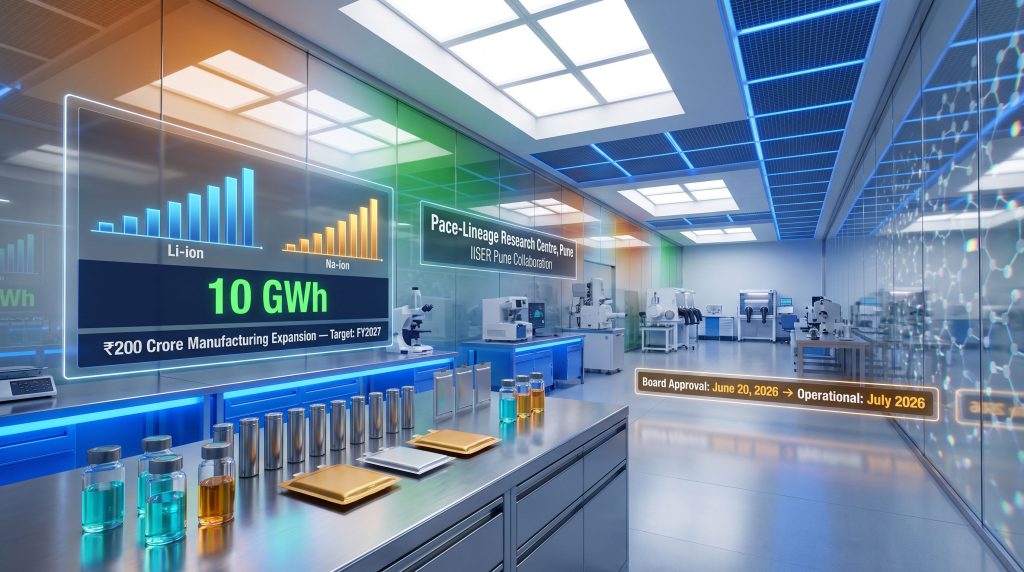
Against this backdrop, Lineage Power Private Limited, the energy storage subsidiary of Pace Digitek Ltd, received board approval on June 20, 2026 to formally establish a dedicated battery technology R&D facility in Pune, Maharashtra. The centre became operational shortly thereafter, with the public announcement confirmed on July 21, 2026.
Pune is not an incidental location. The city has developed into one of India's most concentrated hubs for advanced engineering, automotive research, and manufacturing. Its proximity to major academic institutions, a deep talent pool of materials scientists and electrochemists, and well-developed industrial infrastructure make it a logical home for this type of facility.
The Pace-Lineage Research Centre operates with a mandate that spans both fundamental research and applied development. Its core research areas include:
- Advanced Chemistry Cell development across lithium-ion (Li-ion) and sodium-ion (Na-ion) chemistries
- Material coating technologies for cathode and anode enhancement
- Electrolyte formulation and design, targeting improved ionic conductivity, thermal stability, and cycle life
- Material characterisation using structural and chemical analysis methodologies
- Electrochemical evaluation protocols for measuring cell performance, capacity retention, and degradation behaviour
- Systematic cell parameter optimisation, covering electrode thickness, porosity, and formation cycling protocols
- Domestic supplier qualification: a structured programme to evaluate Indian-sourced precursor materials against international performance benchmarks
That final point deserves particular emphasis. Embedding domestic raw material validation into the centre's core research function, rather than treating it as a secondary commercial activity, signals a deliberate commitment to building an integrated Indian battery supply chain from the materials layer upward. In addition, advances in direct lithium extraction could further accelerate India's ability to process its own lithium resources rather than relying on imported refined materials.
The IISER Pune Partnership: Where Fundamental Science Meets Engineering Reality
A research centre is only as capable as its scientific network. The collaboration between Lineage Power and the Indian Institute of Science Education and Research (IISER) Pune provides the Pace-Lineage Centre with access to institutional capabilities that would take years and substantial capital to replicate independently.
IISER Pune is recognised as one of India's foremost basic science institutions, with research programmes spanning materials chemistry, condensed matter physics, and electrochemistry. The partnership model creates complementary value across multiple dimensions that neither party could generate alone:
| Capability Dimension | Lineage Power | IISER Pune | Combined Output |
|---|---|---|---|
| Materials synthesis | Applied, product-focused | Exploratory, novel chemistries | Faster path from discovery to prototype |
| Characterisation tools | Commercial instruments | Research-grade advanced equipment | Deeper material understanding |
| Talent pipeline | Engineers and technicians | PhD researchers and postdoctoral scientists | Multidisciplinary innovation teams |
| IP and publication | Commercial confidentiality focus | Open science culture | Balanced IP framework |
| Funding access | Corporate R&D budget | Government research grants | Blended funding model |
This structure reflects a model increasingly recognised in advanced manufacturing economies as critical for compressing the technology development timeline. In Japan and South Korea, analogous partnerships between battery manufacturers and national universities during the 2000s and 2010s were instrumental in accelerating cathode material refinements that took Chinese competitors years longer to replicate independently.
Venugopal Rao Maddisetty, Chairman and Managing Director of Pace Digitek Ltd, has positioned the R&D centre not as a cost centre but as a capability multiplier, describing the intersection of scientific research and industry expertise as central to advancing battery materials and supporting indigenous technology development in India.
The Chemistry Strategy: Why Both Li-ion and Na-ion Research Makes Sense
One of the more technically significant decisions embedded in the Pace-Lineage Centre's design is the simultaneous pursuit of both lithium-ion and sodium-ion battery research. This is not resource inefficiency. It is a deliberate risk diversification strategy grounded in the distinct supply chain profiles of each chemistry.
| Parameter | Lithium-Ion (Li-ion) | Sodium-Ion (Na-ion) |
|---|---|---|
| Energy density | Higher (150-250 Wh/kg) | Lower (100-160 Wh/kg) |
| Raw material availability | Constrained (lithium, cobalt, nickel) | Abundant (sodium, manganese, iron) |
| Cost trajectory | Declining but geopolitically sensitive | Potentially lower at manufacturing scale |
| Cycle life | Mature, well-characterised | Improving rapidly |
| India supply chain alignment | Requires significant imports | Strong domestic material availability |
| Commercial maturity | Dominant globally | Emerging, with Chinese producers leading |
Sodium-ion chemistry holds particular strategic relevance for India because its primary input materials, principally sodium compounds, manganese, and iron, are available domestically in meaningful quantities. This creates a plausible pathway toward genuine supply chain independence for stationary storage applications where the lower energy density of Na-ion relative to Li-ion is an acceptable engineering trade-off.
However, lithium-ion development remains critical for higher-density applications. The spodumene-to-lithium salts processing pathway is one area where India could build greater self-sufficiency, particularly as global spodumene supply chains continue to evolve.
It is worth noting that sodium-ion battery research has historically been underweighted in industry R&D budgets relative to its strategic potential, in part because lithium-ion's commercial dominance has concentrated investment attention. The decision to pursue Na-ion research at an early stage, before commercial pressures force a chemistry commitment, reflects a forward-looking approach to technology optionality.
Connecting R&D to Manufacturing: The ₹200 Crore Scale-Up
The research centre does not exist in isolation from Pace Digitek's broader industrial strategy. The company has committed ₹200 crore (approximately ₹2 billion) to expand battery manufacturing capacity to 10 GWh, with commissioning targeted for FY2027.
This timeline creates a direct and urgent relationship between the R&D centre's outputs and the manufacturing operation's readiness. A 10 GWh production facility operating without domestically validated materials and cell designs would simply replicate import dependency at greater scale. The Pace Digitek battery research centre in Pune is positioned as the upstream enabler that prevents this outcome, by generating the material solutions, cell designs, and supplier qualifications needed to populate a genuinely indigenous production operation.
The next major ASX story will hit our subscribers first
What Makes This Model Structurally Distinctive
Several architectural features of the Pace-Lineage Centre differentiate it from more conventional industry R&D approaches:
- Subsidiary-level IP ownership: By housing the research centre within Lineage Power Private Limited rather than at the parent company level, the structure creates cleaner intellectual property ownership and sharper commercial accountability for research outputs.
- Dual chemistry mandate within one facility: Operating Li-ion and Na-ion research programmes in parallel generates cross-chemistry learnings, particularly in electrolyte systems and characterisation methodologies, that single-chemistry facilities cannot capture.
- Integrated supply chain development: Treating domestic supplier qualification as a primary research function rather than a procurement activity means the centre actively builds the Indian battery materials ecosystem rather than simply consuming it.
- Academic partnership at inception: Beginning the collaboration with IISER Pune from the centre's founding, rather than grafting it on after commercial priorities have already been set, gives fundamental science a structural seat at the research design table.
Key Facts at a Glance
| Attribute | Detail |
|---|---|
| Centre Name | Pace-Lineage Research Centre |
| Operating Entity | Lineage Power Private Limited (LPPL) |
| Parent Company | Pace Digitek Ltd |
| Location | Pune, Maharashtra, India |
| Board Approval Date | June 20, 2026 |
| Public Announcement | July 21, 2026 |
| Research Partner | IISER Pune |
| Battery Chemistries | Lithium-ion and Sodium-ion |
| Core Research Functions | Material coatings, electrolyte design, electrochemical evaluation, cell optimisation, domestic supplier qualification |
| Linked Manufacturing Investment | ₹200 crore for 10 GWh capacity expansion (target: FY2027) |
Frequently Asked Questions
What is the Pace-Lineage Research Centre?
It is a dedicated battery technology R&D facility established in Pune by Lineage Power Private Limited, a subsidiary of Pace Digitek Ltd, focused on advanced battery materials across lithium-ion and sodium-ion chemistries.
Who is the academic partner for this research initiative?
Lineage Power has entered into a formal research collaboration with the Indian Institute of Science Education and Research (IISER) Pune to jointly investigate advanced battery materials and electrochemical technologies.
Why is domestic supplier qualification part of the research mandate?
Qualifying Indian-sourced precursor materials against international benchmarks allows the centre to actively develop the domestic battery materials supply chain, reducing dependence on imported inputs across lithium, manganese, nickel, and sodium supply chains.
How does the centre connect to Pace Digitek's manufacturing plans?
It operates as the upstream R&D enabler for the company's ₹200 crore manufacturing expansion targeting 10 GWh of battery production capacity, with commissioning expected in FY2027.
When was the centre formally approved?
Pace Digitek's board sanctioned the initiative on June 20, 2026, with the public announcement made on July 21, 2026.
The Broader Significance for India's Energy Storage Trajectory
India's battery industry will not achieve genuine technological sovereignty through manufacturing scale alone. Gigafactory investment without upstream materials capability creates a sophisticated form of the same dependency problem it was meant to solve. The establishment of credible, industry-embedded research infrastructure capable of generating original intellectual property in battery materials is the foundational layer that makes everything else sustainable.
Consequently, the wider context matters here. India's lithium market is drawing growing international attention, and developments such as this R&D centre are part of a broader strategic repositioning. Similarly, innovations in Chinese battery recycling illustrate how upstream and downstream material flows are becoming increasingly interconnected globally, a dynamic that Indian manufacturers cannot afford to ignore.
The Pace Digitek battery research centre in Pune represents one concrete step in building that foundational layer. Whether it evolves into a reference institution for ACC technology development across South Asia will depend on the depth and consistency of research investment over the coming years, and on how effectively its findings translate into the manufacturing operation coming online in FY2027. Both questions remain open. However, the structural framework now exists to pursue answers.
This article contains forward-looking references to manufacturing timelines, research outcomes, and strategic objectives. Readers should note that actual outcomes may differ materially from current plans due to technical, regulatory, commercial, or macroeconomic factors. This content is informational only and does not constitute financial or investment advice.
Want to Stay Ahead of the Next Major Battery Minerals Discovery on the ASX?
Discovery Alert's proprietary Discovery IQ model delivers real-time alerts the moment significant mineral discoveries — including those critical to battery supply chains such as lithium, sodium, manganese, and nickel — are announced on the ASX, turning complex data into actionable investment insights. Explore historic discoveries and their remarkable returns on Discovery Alert's dedicated discoveries page, and begin your 14-day free trial today to position yourself ahead of the broader market.