July 20, 2026
The Hidden Bottleneck in America's Battery Ambitions: Why Processing Is the Real Prize
Securing lithium in the ground has never been the hardest part of building a sovereign battery supply chain. The genuinely difficult challenge, the one that separates resource-rich nations from truly self-sufficient ones, is what happens after extraction. Converting raw lithium-bearing material into battery-grade lithium carbonate requires a distinct set of engineering competencies that most mining-focused developers simply do not possess. For brine-based projects in particular, that downstream conversion challenge is compounded by brine chemistry that varies dramatically from one lake or aquifer to the next, rendering generic processing solutions inadequate.
This is the industrial reality that the Great Salt Lake lithium project JordProxa technology partnership is designed to confront directly. Rather than treating extraction and conversion as a single engineering problem, Lilac Solutions and JordProxa have structured their collaboration as two specialist disciplines working in sequence, each accountable for its own performance outcomes. The result is an architecture that addresses one of the most persistent technical risks in brine lithium development: the assumption that a system optimised for extraction will naturally produce feed material that any downstream process can handle.
When big ASX news breaks, our subscribers know first
Why Great Salt Lake Brine Demands a Purpose-Built Processing Solution
Not all lithium brines are created equal, and the differences matter enormously at the processing stage. The lithium concentration in Great Salt Lake brine sits at approximately 70 milligrams per litre, which is exceptionally dilute by global brine standards. For context, the Chile lithium brine benchmark, the Salar de Atacama, contains lithium concentrations exceeding 1,500 milligrams per litre in some zones. That is a difference of more than twenty-fold, and it has direct implications for extraction efficiency, energy consumption, and the chemical composition of the recovered intermediate material.
Great Salt Lake brine is also characterised by high sulphate content, which creates purification challenges that standard processing chemistry is not equipped to resolve. High sulphate concentrations in the feed stream can interfere with carbonation reactions, complicate crystallisation, and introduce impurities that push the final product outside battery-grade specifications. This is why JordProxa's selection was preceded by an extended validation phase rather than a desktop engineering study.
The Chemistry of Brine-to-Carbonate Conversion: What Makes It So Technically Demanding?
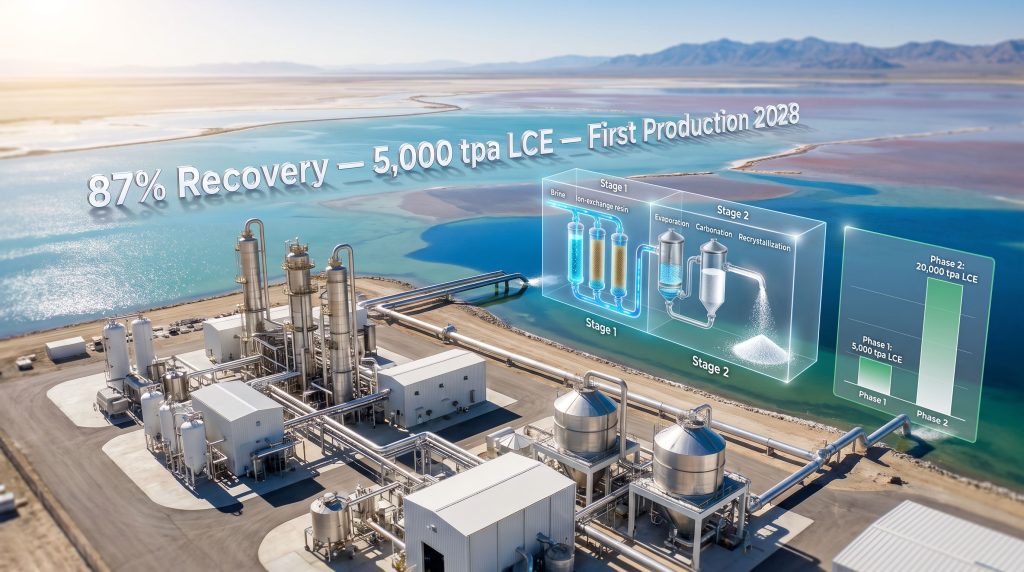
The conversion of lithium sulphate eluate into battery-grade lithium carbonate involves several sequential unit operations, each of which must be engineered around the specific composition of the feed stream. Furthermore, lithium brine extraction at this scale demands processing systems calibrated to the precise chemical matrix of the source material:
- Evaporation concentrates the dilute lithium sulphate solution to a workable feed grade, consuming significant energy and requiring materials that resist the corrosive chemistry of the brine.
- Carbonation introduces carbonate ions to precipitate lithium carbonate from solution, a reaction whose efficiency depends heavily on temperature, pH, and the concentration of competing ions.
- Dissolution and recrystallisation refines the precipitated material through multiple stages to reach the purity thresholds demanded by battery manufacturers, typically above 99.5% Li₂CO₃.
- Advanced water treatment manages the sulphate-laden process streams that are generated throughout, preventing waste volumes from becoming an environmental or regulatory liability.
Each of these steps introduces failure points if the underlying process design is not calibrated to the actual brine chemistry being processed. This is precisely why JordProxa completed its FEL-3 phase testing using eluate produced from actual Great Salt Lake brine rather than a synthetic laboratory proxy.
How JordProxa Technology Was Validated Before Commercial Award
In project development terminology, Front-End Loading (FEL) phases represent structured decision gates that progressively reduce technical and financial uncertainty before capital is committed. FEL-1 and FEL-2 establish conceptual and pre-feasibility frameworks, while FEL-3 is the final major technical gate before a Final Investment Decision (FID). Completing FEL-3 with real brine eluate, rather than simulated feed, is an unusually rigorous standard and one that significantly narrows the gap between projected and actual plant performance.
"FEL-3 completion on actual project brine, rather than synthetic feed, represents the highest level of pre-commercial process validation achievable before construction begins. It eliminates the most common source of cost and schedule overruns in lithium processing projects: the discovery that laboratory results do not translate to real brine chemistry."
According to reporting from NA Clean Energy, JordProxa's FEL-3 work confirmed that battery-grade lithium carbonate could be produced from Great Salt Lake brine using its evaporation, carbonation, and recrystallisation package, with contractual performance guarantees attached to the commercial award. This structure transfers a meaningful portion of technical execution risk from Lilac Solutions to JordProxa, a feature that institutional lenders and project finance providers typically regard as a significant de-risking signal.
The 2025 Pilot Plant: Seven Months of Proof on Real Brine
Lilac Solutions operated a pilot plant on Great Salt Lake throughout 2025, generating the performance dataset that underpins the project's commercial advancement. The results were independently verified by a third-party analyst, confirming both extraction performance and compliance with the project's non-consumptive process requirements.
Pilot Plant Performance Summary
| Metric | Verified Result |
|---|---|
| Pilot operation duration | 7 months (2025) |
| Average lithium recovery rate | 87% |
| Feed brine lithium concentration | 70 mg/L |
| Brine return method | Equivalent volume returned to lake |
| Environmental classification | Non-consumptive, non-contaminating |
| Verification standard | Independent third-party analysis |
An 87% average lithium recovery rate from 70 mg/L brine is a commercially significant result. At that concentration, achieving high recovery requires the ion-exchange system to operate with exceptional selectivity, capturing lithium while rejecting the far more abundant sodium, magnesium, potassium, and sulphate ions present in the brine matrix. The fifth-generation nature of Lilac's ion-exchange technology reflects nearly a decade of iterative development since the company's founding in 2016.
Project Scale, Timeline, and What Phase 2 Could Mean for U.S. Supply
The Great Salt Lake lithium project's Phase 1 commercial facility is designed around the following parameters:
- Location: Box Elder County, Utah
- Physical footprint: Approximately 20 acres
- Annual production target: 5,000 metric tons of battery-grade lithium carbonate
- Planned first production: 2028
- Processing pathway: Lilac fifth-generation DLE feeding JordProxa downstream conversion
Phase 2 would expand total annual capacity to the equivalent of 20,000 metric tons of lithium carbonate, a four-fold increase that would make the project a genuinely material contributor to U.S. domestic supply. To contextualise that figure, the lithium carbonate market in the United States is projected to grow substantially through the late 2020s as domestic gigafactory capacity continues to expand, and current domestic processing capacity remains severely constrained relative to projected demand.
Scenario Analysis: FID Timing and Supply Chain Impact
| Development Scenario | Phase 1 Output | Phase 2 Potential | Supply Chain Outcome |
|---|---|---|---|
| FID achieved, construction on schedule | 5,000 tpa LCE by 2028 | 20,000 tpa LCE | Meaningful domestic supply by 2029-2030 |
| FID delayed 12 months | 5,000 tpa LCE by 2029 | Phased accordingly | Modest delay to domestic integration |
| Phase 2 accelerated post-Phase 1 | 5,000 tpa LCE (2028) | 20,000 tpa LCE by 2031 | Strong U.S. brine lithium anchor established |
Note: These scenarios are illustrative projections based on publicly available development timelines. Final Investment Decision outcomes depend on capital markets conditions, permitting progression, and technical execution. Nothing in this analysis constitutes investment advice.
Direct Lithium Extraction and the Non-Consumptive Water Return Model
One of the most persistent criticisms levelled at conventional brine lithium production is its environmental footprint. Large evaporation pond operations in South America's Lithium Triangle have faced sustained scrutiny over their impact on fragile desert ecosystems and indigenous water rights. Great Salt Lake, itself a lake that has experienced significant level decline over recent decades, is an environmentally sensitive context that demands a fundamentally different operational approach.
Direct lithium extraction technology addresses this concern through a closed-loop brine return design. Brine is pumped from the lake, passed through the ion-exchange system to strip dissolved lithium, and then returned to the lake in an equivalent volume. No net water is removed from the system, and the return brine is confirmed non-contaminating. This stands in stark contrast to conventional evaporation pond operations, where brine is spread across pond fields and allowed to concentrate over months or years, with the water component lost to evaporation.
Environmental Comparison: DLE Versus Conventional Methods
| Environmental Dimension | Evaporation Pond Brine | Hard-Rock Mining | DLE (Great Salt Lake Model) |
|---|---|---|---|
| Water consumption | Very high | Moderate to high | Near-zero net consumption |
| Land disturbance | Extensive pond fields | Significant open pit | 20-acre facility footprint |
| Lake or ecosystem impact | Level drawdown risk | Not applicable | Designed to be neutral |
| Chemical processing intensity | Moderate | High (calcination) | Targeted, brine-specific |
| Carbon intensity | Moderate | High | Lower (no calcination required) |
The absence of a calcination step is worth noting specifically. Hard-rock lithium processing typically requires roasting spodumene ore at temperatures around 1,000 degrees Celsius to convert it from alpha to beta phase before acid leaching, a highly energy-intensive step that elevates the carbon footprint of hard-rock lithium carbonate relative to well-designed brine operations.
The next major ASX story will hit our subscribers first
JordProxa's Specialist Position in the Battery Metals Processing Landscape
JordProxa operates from a headquarters in Sydney, Australia, but its project portfolio spans Australia, Europe, South America, and North America. The company's core differentiation from general engineering, procurement, and construction contractors lies in the specificity of its technical mandate: it does not adapt processing technology from adjacent industries and apply it to lithium. Its systems are designed from first principles around the chemistry of battery metals and critical minerals supply chains.
How JordProxa Compares to General EPC Contractors
| Capability Dimension | General EPC Contractor | JordProxa Specialist Approach |
|---|---|---|
| Technology origin | Adapted from adjacent industries | Purpose-built for battery metals |
| Brine chemistry expertise | Generalised | Tailored to specific brine composition |
| Performance guarantees | Typically excluded from scope | Contractually embedded |
| Pre-commercial validation | Rare | FEL-3 testing on actual project brine |
| Product output capability | Lithium carbonate only | Li₂CO₃, LiOH, MnSO₄, NiSO₄, CoSO₄ |
| Service scope | Design and build | Lab testing through operational support |
The multi-product output capability is a lesser-appreciated aspect of JordProxa's positioning. While the Great Salt Lake lithium project JordProxa technology partnership targets lithium carbonate specifically for Phase 1, the ability to produce lithium hydroxide, manganese sulphate, nickel sulphate, and cobalt sulphate from the same processing platform means the technology is applicable across a wide range of battery cathode chemistry supply chains. As the industry continues to debate the relative merits of lithium iron phosphate versus nickel-manganese-cobalt cathode chemistries, a processing partner with multi-product flexibility holds structural optionality that single-product specialists do not.
What Contractor Consolidation Signals About Final Investment Decision Readiness
The decision to award major contractor positions before reaching a Final Investment Decision is not standard practice in the mining and minerals processing sector. Many project developers defer contractor selection until after FID to preserve negotiating leverage and avoid committing to scope before capital is secured. Lilac Solutions has taken the opposite approach, however, deliberately consolidating its major contractor positions in advance.
This strategy carries a clear logic: lenders and equity investors in project finance structures are more willing to commit capital when execution risk has been distributed to contractually accountable specialists. A project where the extraction technology supplier, the downstream conversion technology supplier, and other key contractors have all confirmed scope and attached performance guarantees presents a materially different risk profile to a capital provider than one where contractor selection remains open.
As noted in coverage from Mining Magazine, Lilac has indicated the project is positioned to be among the first U.S. lithium brine operations to reach a Final Investment Decision, a claim that the contractor consolidation strategy actively supports. Whether that timeline materialises will depend on capital markets conditions and permitting progression, but the technical foundation being constructed is deliberately sequenced to support that ambition.
Frequently Asked Questions: Great Salt Lake Lithium Project and JordProxa Technology
What is JordProxa's specific role in the Great Salt Lake project?
JordProxa has been contracted to supply the complete downstream conversion technology and equipment package for Phase 1, transforming lithium sulphate solution from Lilac's DLE system into battery-grade lithium carbonate through evaporation, carbonation, and multi-stage recrystallisation, with contractual performance guarantees attached.
Why does 70 mg/L brine concentration matter so much technically?
At 70 milligrams of lithium per litre, the brine is highly dilute relative to world-class brine operations. Achieving commercial recovery rates from such low-grade feed requires an extraction system with exceptional selectivity and an energy-efficient design. The 87% average recovery demonstrated during the 2025 pilot confirms that Lilac's fifth-generation ion-exchange technology meets this threshold on actual Great Salt Lake brine.
How does direct lithium extraction differ from conventional brine processing?
Conventional brine lithium production spreads brine across vast evaporation ponds, allowing concentration to occur naturally over one to two years before chemical processing begins. DLE bypasses this step entirely, using selective separation technology to recover lithium continuously from pumped brine. The process is faster, requires far less land, and in the Great Salt Lake model, returns brine to the lake in equivalent volume rather than consuming it through evaporation.
What production volumes are targeted across both project phases?
Phase 1 targets 5,000 metric tons of battery-grade lithium carbonate per year, with first production planned for 2028. Phase 2 expansion would consequently increase total annual capacity to the equivalent of 20,000 metric tons of lithium carbonate, representing a four-fold scale-up from the initial facility.
When is a Final Investment Decision expected?
Lilac Solutions has indicated the Great Salt Lake lithium project JordProxa technology partnership is positioned to be among the first U.S. lithium brine operations to reach a Final Investment Decision, with contractor consolidation milestones aligned to support a 2026 target timeframe. This remains subject to capital markets conditions and regulatory progression.
Disclaimer: This article contains forward-looking statements and scenario projections based on publicly available information. It does not constitute financial or investment advice. Readers should conduct their own due diligence before making any investment decisions.
Want to Stay Ahead of the Next Major Mineral Discovery?
Discovery Alert's proprietary Discovery IQ model scans ASX announcements in real time, instantly identifying high-potential opportunities across lithium and other critical minerals — turning complex data into clear, actionable insights for investors at every level. Explore how historic discoveries have generated substantial returns on Discovery Alert's dedicated discoveries page, and begin your 14-day free trial today to position yourself ahead of the broader market.