July 21, 2026
The Structural Flaw at the Heart of Geothermal Energy's Commercialisation Problem
Every energy technology eventually confronts the same test: can it generate returns that justify its cost of capital? For geothermal energy, that test has historically produced an uncomfortable answer. Despite offering baseload renewable electricity with a minimal surface footprint and near-zero fuel costs, geothermal projects have struggled to attract the volume of private investment their wind and solar counterparts command. The reason is not technical failure. It is an economics problem rooted in the nature of deep drilling.
Combining geothermal power with minerals is now widely regarded as key to viability for projects that would otherwise fail to clear the investment threshold on electricity revenue alone. Understanding why requires unpacking both the cost structure of geothermal development and the largely overlooked chemistry of the fluids that make it work. Furthermore, the critical minerals demand driving this conversation has never been greater, adding urgency to finding workable commercial solutions.
When big ASX news breaks, our subscribers know first
Why Geothermal Energy Struggles to Stand Alone as a Power Asset
Geothermal power's fundamental challenge is front-loaded capital intensity. Unlike solar or wind installations, where costs scale incrementally with capacity, geothermal projects require deep exploratory drilling before a single kilowatt-hour is generated. Drilling a single geothermal well to commercially viable depths can cost anywhere from USD 5 million to over USD 15 million, and multiple wells are typically required to sustain reservoir flow rates sufficient for power generation.
Once operational, geothermal plants offer highly competitive levelised costs of electricity. However, the path to operations is expensive and uncertain, and electricity prices in liberalised markets are rarely high enough to justify that upfront outlay on their own. This creates a structural mismatch between the risk profile investors take on and the revenue stream available to compensate them.
The consequence is that geothermal has remained a niche within the broader renewables sector, concentrated in countries where geological conditions are unusually favourable and where state support or regulated tariffs underwrite the economics. Expanding the technology beyond those conditions requires a fundamentally different financial architecture. In addition, the broader energy transition mining agenda is placing increasing pressure on developers to find models that work without indefinite subsidy.
What Geothermal Brines Actually Contain and Why It Matters
The core insight driving the co-production model is geological rather than financial. Geothermal power generation works by circulating superheated fluid, called brine, through underground reservoirs. This brine is not pure water. As it moves through rock formations at depth, it dissolves minerals from the surrounding geology, producing a complex chemical solution that, when brought to surface, carries measurable concentrations of commercially valuable elements.
The composition of geothermal brine varies significantly by location and geological setting, but in high-value fields it can contain lithium, zinc, manganese, silica, boron, strontium, and in some cases, trace concentrations of rare earth elements.
The critical point that is often overlooked outside specialist circles is that these minerals are already being brought to surface as part of normal power generation operations. The brine must be pumped, processed, and reinjected regardless of whether mineral extraction occurs. Co-production does not add an entirely new industrial process — it inserts a recovery step into an existing fluid handling system, which fundamentally changes the economics of doing so. Research published by the Pacific Northwest National Laboratory confirms that this pairing represents one of the most promising pathways in low-impact mineral recovery.
The Scale-Forming Problem That Became an Opportunity
An important operational nuance rarely discussed in mainstream coverage is that many of the minerals dissolved in geothermal brines actively cause infrastructure problems. Silica, calcium carbonate, and other scale-forming compounds precipitate out of solution as brine cools and depressurises, clogging pipes, heat exchangers, and injection wells. This scaling problem has historically represented a significant operational and maintenance cost.
The co-production model reframes this liability. By extracting scale-forming minerals before reinjection, operators simultaneously generate a saleable product and reduce long-term maintenance expenditure. In effect, solving an engineering problem becomes a revenue event. This dual benefit is one of the most compelling and underappreciated aspects of the geothermal-minerals integration thesis.
The Revenue Stack: How Mineral Co-Production Changes Project Economics
The financial logic of combining geothermal power with minerals rests on the concept of a layered revenue stack, where each additional commodity recovered adds incremental value without proportionate increases in operating cost.
| Revenue Driver | Economic Impact |
|---|---|
| Electricity generation | Base revenue stream; often insufficient alone to justify capital outlay |
| Lithium extraction | Highest-value mineral co-product; pilot projects confirm technical feasibility |
| Zinc and manganese recovery | Secondary revenue contributors with established industrial demand |
| Silica, boron, strontium | Niche markets; additive incremental value |
| Operational cost savings from scale removal | Reduces maintenance expenditure while generating saleable product |
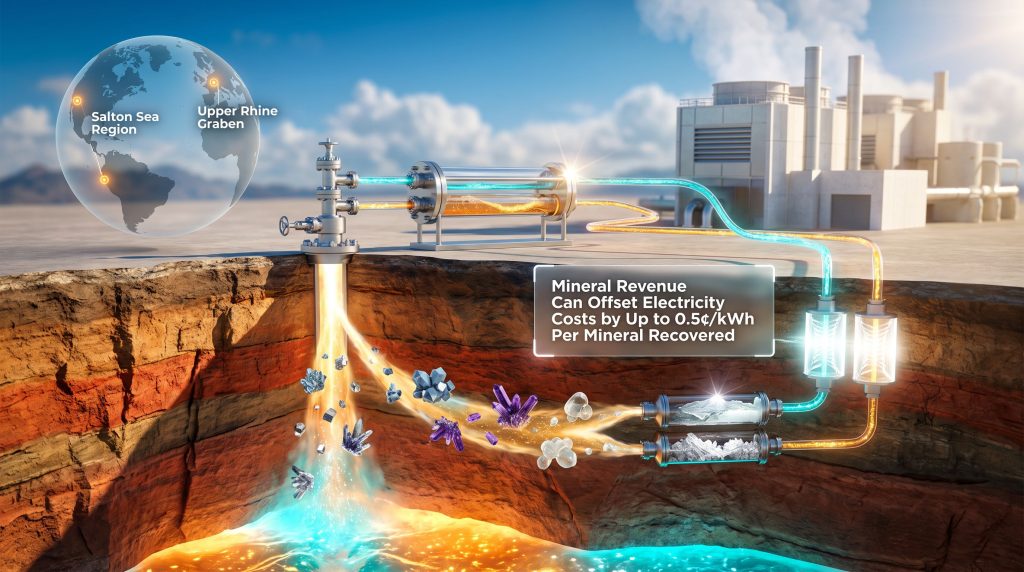
Industry analysis suggests that each additional mineral stream recovered from geothermal brine can reduce the effective cost of electricity generation by approximately 0.5 cents per kilowatt-hour. While that figure may appear modest in isolation, when stacked across multiple minerals it can materially shift the project's breakeven point and, in high-grade brine scenarios, push mineral revenue above power revenue as the primary economic driver.
This tipping point scenario is not speculative in all cases. At the Salton Sea geothermal field in California, brine lithium concentrations have been estimated at levels sufficient to make lithium recovery the dominant value contributor to project economics. Some projections suggest the field could eventually supply a meaningful share of North American battery-grade lithium demand. These figures remain subject to commercial-scale confirmation, and investors should treat projections with appropriate caution until full production data is available. Furthermore, the surge in battery storage demand underpins why these projections attract serious attention from capital markets.
Direct Lithium Extraction: The Technology That Makes Co-Production Practical
The feasibility of inline mineral recovery at geothermal sites has been significantly advanced by the maturation of Direct Lithium Extraction (DLE) technology. Unlike conventional lithium production from evaporation ponds, which requires large land areas and months-long processing cycles, direct lithium extraction selectively isolates lithium from brine solutions using sorbent or membrane-based systems that operate continuously and at relatively compact scale.
DLE is particularly well-suited to geothermal co-production for three reasons:
- Geothermal operations already circulate brine continuously, providing a steady feedstock without additional pumping infrastructure.
- DLE systems can be configured as inline processing modules, meaning they integrate into existing fluid handling systems without requiring standalone plant construction.
- The technology returns processed brine to the reinjection stream with minimal volume loss, preserving reservoir integrity, which is essential for long-term power generation sustainability.
The compatibility between DLE and geothermal infrastructure is not accidental. It reflects a convergence of two technologies that were developed in parallel but are now finding significant synergy in dual-commodity project designs.
Where Co-Production Is Already Operating and What the Data Shows
Global Hotspots for Dual-Potential Geothermal Resources
| Location | Key Mineral Target | Development Stage |
|---|---|---|
| Salton Sea, California, USA | Lithium | Pilot-to-commercial transition |
| Smackover Formation, Arkansas, USA | Lithium | Active pilot projects |
| Upper Rhine Graben, Europe | Lithium | Early-stage commercial development |
| Iceland and high-enthalpy fields globally | Multiple minerals | Feasibility and research phase |
The Salton Sea region in Southern California represents the most advanced example of geothermal-lithium co-production globally. Multiple operators have demonstrated lithium brine extraction from existing geothermal brine circuits, with at least two projects progressing from bench-scale testing toward commercial facility construction as of 2025. The U.S. Department of Energy has invested in dual-potential site identification research, supporting early-stage feasibility work, though this reflects broad programmatic funding rather than project-specific backing.
In Europe, the Upper Rhine Graben, which extends through France, Germany, and Switzerland, has emerged as the most geologically prospective region for geothermal-lithium development. The Graben's deep sedimentary brines carry lithium concentrations that several development companies have assessed as potentially economic. The region also benefits from existing geothermal power infrastructure that could serve as a foundation for co-production operations.
A critical geological reality constraining this model globally is that sites combining sufficient heat flow for power generation with economically meaningful mineral concentrations in brine are genuinely uncommon. First-mover operators who identify and secure these dual-potential sites hold a structural advantage that is difficult to replicate.
The Technical Constraints Investors and Developers Must Understand
Viability Assessment by Development Stage
| Maturity Level | Current Status |
|---|---|
| Technical feasibility | Confirmed at pilot scale in California and Arkansas |
| Economic viability (lithium) | Emerging – dependent on brine grade, DLE costs, and lithium price |
| Economic viability (REEs) | Not yet achieved – further R&D required before commercial relevance |
| Commercial-scale deployment | In transition – leading projects moving from pilot to production phase |
Several technical constraints define the boundaries of where co-production is genuinely viable versus where it remains aspirational:
- Brine lithium concentration thresholds: Most economic models for geothermal lithium recovery require brine grades above approximately 100–150 mg/L lithium. Fields below this threshold may not justify DLE capital expenditure, regardless of favourable power economics.
- Reinjection compatibility: Extracting minerals from brine changes its chemistry. Operators must ensure that processed brine remains chemically compatible with reservoir rock to avoid permeability damage that could impair long-term fluid circulation.
- Rare earth element (REE) caution: While REEs are technically detectable in some geothermal brines, their concentrations are generally far below economically recoverable thresholds. Any investor proposition that places significant weight on REE co-production from geothermal brines warrants careful scrutiny.
- Market access for secondary minerals: Zinc, manganese, and specialty minerals like boron and strontium each require established offtake pathways. Revenue projections for secondary minerals should be stress-tested against realistic market access scenarios rather than spot price assumptions.
The next major ASX story will hit our subscribers first
How Co-Production Compares to Conventional Mining on Environmental Metrics
One of the structurally differentiated attributes of geothermal mineral co-production is its environmental profile relative to conventional hard-rock or brine mining. The comparison across several dimensions is instructive:
- Land disturbance: Geothermal co-production uses a closed-loop fluid system operating through a small surface footprint, in contrast to open-cut mining operations that can disturb thousands of hectares.
- Water consumption: Unlike evaporation pond-based lithium production, which consumes large volumes of water in arid environments, DLE-based geothermal co-production recirculates brine with minimal net water loss.
- Energy source for extraction: The processing energy required for mineral recovery at geothermal sites is partly supplied by the geothermal resource itself, creating a renewable-powered extraction model that is intrinsically cleaner than fossil fuel-dependent mining operations.
- Tailings and waste: Closed-loop brine reinjection eliminates the surface tailings storage that represents one of the most significant environmental liability areas in conventional mining.
These characteristics position geothermal mineral co-production as a lower-impact pathway to critical mineral supply. However, individual site assessments remain essential and environmental performance varies by project design and geology. The IEA's analysis of mineral requirements for clean energy transitions underscores how significant the supply challenge remains across all extraction pathways.
The Strategic Outlook: A Convergence of Energy and Minerals Policy
The broader significance of combining geothermal power with minerals as key to viability extends beyond individual project economics. It reflects a structural convergence between two policy priorities that have historically been managed separately: renewable energy deployment and critical mineral supply security.
Western governments are increasingly focused on developing domestic sources of battery-critical minerals, particularly lithium, to reduce dependence on supply chains concentrated in a small number of countries. Geothermal co-production offers a pathway to domestic lithium production that leverages existing or planned renewable energy infrastructure, consequently aligning both objectives simultaneously.
This convergence does not guarantee project success or regulatory support for any specific development. Geology remains the primary viability determinant, and projects in unfavourable brine chemistry environments will not benefit from favourable policy settings alone. However, it does mean that the investment and development environment for well-positioned geothermal co-production projects is structurally more supportive than at any previous point in the technology's history.
The longer-term scenario worth tracking is whether geothermal brines could become a meaningful contributor to battery-grade lithium supply at a global scale. Current pilot data supports technical feasibility at individual sites, but the aggregate supply potential depends on how many dual-potential sites can be identified, developed, and brought to commercial production within the timeframes relevant to EV battery manufacturing growth. That question remains open, and the answer will be determined as much by geology as by policy or technology.
This article is intended for informational purposes only and does not constitute financial or investment advice. Forward-looking statements, projections, and commercial feasibility assessments discussed herein involve inherent uncertainty and should not be relied upon as guarantees of future outcomes. Readers considering investment decisions in the geothermal or critical minerals sectors should seek independent professional advice.
Want to Stay Ahead of the Next Major Critical Minerals Discovery?
Discovery Alert's proprietary Discovery IQ model scans ASX announcements in real time, instantly identifying significant mineral discoveries — including the critical minerals driving the geothermal co-production revolution — and translating complex data into actionable investment insights. Explore how historic discoveries have delivered extraordinary returns and begin your 14-day free trial today to position yourself ahead of the broader market.