August 6, 2026
The Energy Storage Revolution Quietly Reshaping China's Battery Industry
Global battery markets have long been defined by a single narrative: electric vehicle adoption drives demand, and demand drives production. For much of the past decade, this logic held reasonably well. But a structural shift is now underway that challenges this framing entirely. China battery production surges on energy storage demand and exports have become the defining headline of 2026, as the fastest-growing segment is no longer EVs but stationary energy storage, redrawing the boundaries of what the world's dominant battery manufacturing ecosystem produces, for whom, and where it ends up.
Understanding this shift requires looking beyond headline EV sales figures toward the deeper mechanics of how grid infrastructure, renewable energy integration, and cross-border supply chains are reshaping battery storage expansion. The numbers from the first half of 2026 tell a story that goes far beyond any single technology or market.
When big ASX news breaks, our subscribers know first
Production Growth That Outpaces Its Own Domestic Market
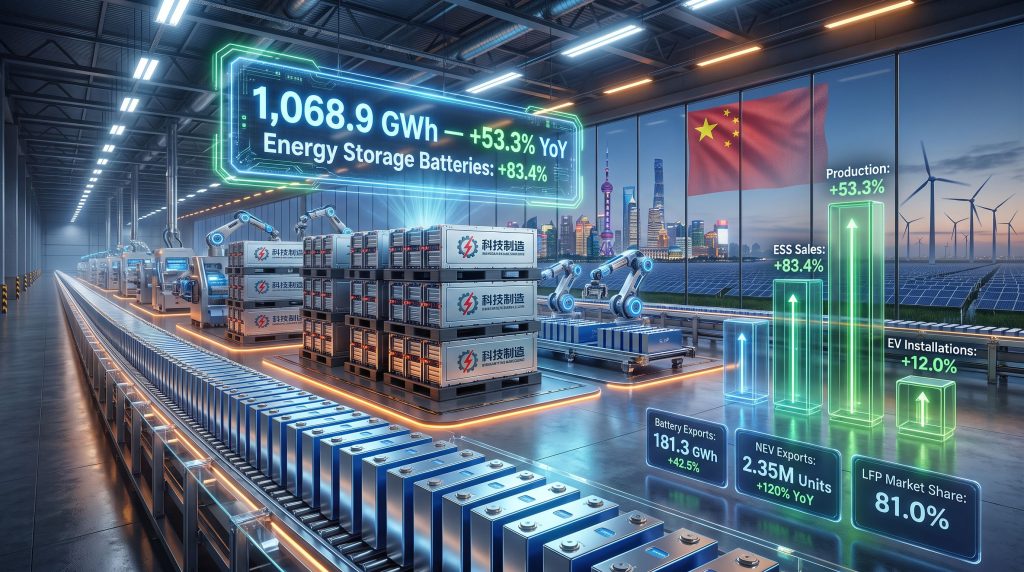
China battery production surges on energy storage demand and exports have become impossible to ignore when examining the magnitude of divergence between output and domestic consumption. According to data released by the China Automotive Battery Innovation Alliance (CABIA), combined production of power and energy storage batteries reached 1,068.9 GWh across January to June 2026, representing a 53.3% year-on-year increase.
Set that figure alongside domestic power battery installations, which grew at just 12.0% year on year to 335.6 GWh, and the gap becomes clear. Production expanded at more than four times the pace of domestic EV battery uptake. The straightforward interpretation is that China's battery factories are producing at a rate that the domestic vehicle market alone cannot absorb.
This is not a sign of overshooting demand blindly. It reflects a deliberate and structurally sound repositioning of Chinese battery output toward two growth engines that now rival, and in some metrics exceed, the EV market in terms of incremental volume: grid-scale energy storage and overseas exports. Furthermore, the battery raw materials market is feeling the upstream effects of this extraordinary pace of expansion.
When battery production grows more than four times faster than domestic EV installations, it confirms that the EV market is no longer the sole, or even primary, engine of Chinese battery sector expansion. Energy storage and export demand have become co-equal growth pillars.
Energy Storage: The Fastest-Growing Segment in the Battery Supply Chain
The most striking data point from the first half of 2026 is not total production volume. It is the pace of energy storage battery sales growth, which reached 83.4% year on year to hit 318.1 GWh, making it comfortably the fastest-expanding application category within China's entire battery ecosystem.
The broader sales picture provides useful context:
| Segment | H1 2026 Sales (GWh) | Year-on-Year Growth |
|---|---|---|
| Total battery sales | 979.4 GWh | +48.6% |
| Power batteries | 661.3 GWh | +36.2% |
| Energy storage batteries | 318.1 GWh | +83.4% |
Energy storage batteries now account for 32.5% of total battery sales in China, a structural reweighting that would have seemed improbable just a few years ago. Monthly data reinforces the sustained nature of this trend. April 2026 saw combined output reach 183.9 GWh, up 55.6% year on year, followed by 191.7 GWh in May 2026, up 55.2% year on year. January through May 2026 saw energy storage battery sales surge 87.7% year on year.
What Is Driving Grid-Scale Storage Demand?
Several converging forces are accelerating battery energy storage system (BESS) deployment both within China and internationally:
- Renewable energy infrastructure buildout, particularly solar and wind, is generating structural demand for grid-balancing storage as intermittency management becomes a core operational requirement for power networks.
- Electricity market reforms within China are gradually improving the commercial viability of utility-scale BESS projects, making them more attractive to large project developers and grid operators.
- Global data centre expansion is emerging as an increasingly significant demand vector. Hyperscale operators require both uninterruptible power supplies and load-management capabilities that stationary battery systems can provide.
- Overseas energy storage order pipelines remain substantial. Chinese energy storage manufacturers recorded approximately 366 GWh in new overseas orders in 2025, with that momentum carrying into 2026.
On the pricing side, Fastmarkets' first assessment for the LFP prismatic cell, 314Ah, ex-works domestic China, placed the market at 0.35 to 0.40 yuan ($0.05 to $0.06) per watt-hour as of late June 2026. Firm procurement timelines tied to Q3 and Q4 project delivery schedules have supported price stability in the BESS cell market, with some buyers entering procurement cycles earlier than typical seasonal patterns.
Battery Exports: A Structural Pillar, Not a Secondary Channel
Export markets have evolved from an overflow valve for excess domestic capacity into a genuine structural demand pillar for Chinese battery manufacturers. The China battery recycling outlook also forms an increasingly relevant part of this global picture, as exported batteries will eventually require end-of-life processing. The H1 2026 data illustrates the export picture clearly:
| Export Category | H1 2026 Volume (GWh) | Year-on-Year Growth | Share of Total Sales |
|---|---|---|---|
| Combined battery exports | 181.3 GWh | +42.5% | 18.5% |
| Power battery exports | 122.7 GWh | +50.3% | — |
| Energy storage battery exports | 58.6 GWh | +28.5% | — |
In Q1 2026 alone, China exported 84.1 GWh of combined power and storage batteries, up 36.7% year on year, with stationary storage exports reaching 27.3 GWh, up 15.0%. China's broader lithium battery export value rose approximately 37.6% in H1 2026, building on total export revenues estimated at approximately $60 to $66 billion in 2025, establishing batteries as one of the country's most commercially significant clean-technology export categories. According to recent ESS export data, these figures reflect a sustained and accelerating trend rather than a short-term anomaly.
The NEV Export Multiplier Effect
A dimension that often receives insufficient analytical attention is the compounding relationship between vehicle exports and battery export volumes. According to the China Association of Automobile Manufacturers (CAAM), Chinese automakers exported 5.10 million vehicles in H1 2026, up 65.3% year on year. New energy vehicle exports more than doubled, reaching 2.35 million units, up 120% year on year, accounting for 46% of all Chinese vehicle exports.
Each exported NEV carries an embedded battery pack. Consequently, every percentage point gain in China's NEV export share translates directly into an equivalent uplift in battery export volumes, creating a compounding demand effect for domestic cell manufacturers. Key destination markets include:
- Europe, which remains the largest destination, though tariff developments are prompting some procurement strategy reassessment among buyers.
- Southeast Asia, which is emerging as a high-growth market underpinned by expanding EV adoption incentives and grid storage infrastructure investment.
- The Middle East and Latin America, where Chinese manufacturers are actively expanding their commercial footprint as newer but potentially high-volume frontiers.
Intensifying domestic price competition within China is, furthermore, accelerating manufacturers' international expansion strategies, as overseas markets offer margin-preservation opportunities that the crowded domestic landscape increasingly cannot.
LFP Chemistry: Consolidating Structural Dominance
Within the domestic Chinese battery market, the competition between lithium iron phosphate (LFP) and nickel-cobalt-manganese (NCM) chemistries has effectively reached a conclusion in all but the premium EV segment. H1 2026 data confirms LFP's commanding position:
| Chemistry | H1 2026 Installations (GWh) | Market Share | Year-on-Year Growth |
|---|---|---|---|
| LFP (Lithium Iron Phosphate) | 272.0 GWh | 81.0% | +11.5% |
| NCM (Nickel-Cobalt-Manganese) | 63.4 GWh | 18.9% | +14.2% |
The directional signal from June 2026 monthly data is particularly telling. LFP installations rose 9.2% month on month, while NCM installations contracted 5.5% month on month, reinforcing a trend that shows no signs of reversing at the aggregate market level.
Why LFP Has Won the Energy Storage Segment
LFP chemistry offers a superior cycle life, often 3,000 to 6,000 or more charge cycles, compared with NCM chemistries. This makes it the economically rational choice for grid-scale storage systems that require daily charge-discharge cycling over multi-decade project lifespans.
Several structural advantages compound LFP's position in the ESS segment specifically:
- No cobalt dependency and lower nickel content translate into structurally lower raw material costs and reduced exposure to supply chain risk from politically sensitive mining jurisdictions.
- Thermal stability advantages reduce fire risk in large-format stationary installations, a factor that carries regulatory and insurance implications for utility-scale project developers.
- Vertical integration across the lithium supply chain has enabled Chinese manufacturers to drive LFP cell costs to levels that make NCM uncompetitive for the vast majority of storage applications.
NCM retains commercial relevance in premium EV segments where energy density per kilogram justifies the cost premium. However, its share of total installations continues to narrow as LFP cell performance and cost trajectories improve.
Upstream Implications: What This Means for Lithium Raw Material Demand
Production growth exceeding 53% year on year generates a proportionally substantial pull-through on lithium chemical inputs. Battery cell manufacturing consumes two primary lithium compounds: lithium carbonate, which is the dominant precursor for LFP cathode material, and lithium hydroxide, used predominantly in higher-nickel NCM cathode formulations. In addition, lithium carbonate demand dynamics are increasingly being shaped by the extraordinary pace of energy storage deployment globally.
The structural shift toward LFP dominance carries a specific implication for lithium market chemistry: it favours lithium carbonate demand over lithium hydroxide demand. As ESS applications, which overwhelmingly use LFP cells, continue to capture a larger share of total battery output, the relative demand balance between these two lithium products is gradually shifting.
High operating rates among Chinese battery cell manufacturers have maintained firm procurement activity for lithium raw materials even during periods of commodity price softness, providing demand-side support that pure price signals alone might not reflect.
The Overcapacity Tension: A Critical Risk Variable
A structural tension running through the entire analysis is the gap between installed production capacity and actual demand absorption. Industry observers have noted that China's battery manufacturing capacity is expanding faster than domestic demand alone can consume. The broader critical minerals demand picture, however, suggests that global appetite for battery inputs remains structurally robust across multiple end markets.
Disclaimer: The following scenario analysis involves forward-looking assumptions and should not be treated as a forecast. Actual outcomes will depend on geopolitical, regulatory, and market variables that are inherently uncertain.
Scenario: Export Market Constraint
- Trigger: Expanded tariff barriers in Europe or the United States materially limit Chinese battery export access.
- Likely response: Accelerated domestic price competition, further margin compression at the cell level, and potential consolidation among smaller manufacturers.
- Upstream impact: Weaker battery cell procurement flows through to reduced demand for lithium, cobalt, and manganese, placing downward pressure on raw material prices.
This means export market access and energy storage project pipelines are not optional growth levers for the Chinese battery industry. They are structural necessities for maintaining utilisation rates and financial viability across the supply chain.
The next major ASX story will hit our subscribers first
H1 2026 in Context: A Growth Trajectory at Scale
| Period | Key Metric | Growth Rate |
|---|---|---|
| H1 2026 | Combined production: 1,068.9 GWh | +53.3% YoY |
| May 2026 | Monthly output: 191.7 GWh | +55.2% YoY |
| April 2026 | Monthly output: 183.9 GWh | +55.6% YoY |
| Q1 2026 | Battery exports: 84.1 GWh | +36.7% YoY |
| H1 2026 | ESS battery sales: 318.1 GWh | +83.4% YoY |
The consistency of 50%-plus year-on-year production growth across multiple consecutive months rules out the possibility that this represents a short-term inventory build. It reflects sustained structural expansion of both output capacity and end-market demand, driven by forces that extend well beyond China's domestic EV market. The IEA's commentary on global battery market growth reinforces the view that supply risks are rising in parallel with demand, making market structure increasingly important to monitor.
Energy storage battery sales growth of 83.4% in H1 2026 is the primary statistical engine behind aggregate production expansion. Its durability depends on the continued deployment of grid infrastructure and renewable energy integration projects globally. That pipeline, based on current commitments across major energy markets, remains deep.
China battery production surges on energy storage demand and exports represent more than a short-term growth story. For participants across the battery supply chain, from raw material producers to cell manufacturers and project developers, the message from H1 2026 is consistent: the industry's centre of gravity has shifted. Energy storage and exports are no longer secondary beneficiaries of China's battery manufacturing scale. They are the industry's defining growth story.
Want to Track the Next Major Mineral Discovery Powering the Energy Storage Revolution?
As battery production and energy storage demand reshape global commodity markets, Discovery Alert's proprietary Discovery IQ model delivers real-time ASX mineral discovery alerts — instantly identifying actionable opportunities in the lithium, cobalt, and critical minerals driving this structural shift. Explore historic discoveries and their returns or start your 14-day free trial today to position yourself ahead of the market.