August 5, 2026
The Structural Fault Lines Beneath Europe's Lithium Processing Dream
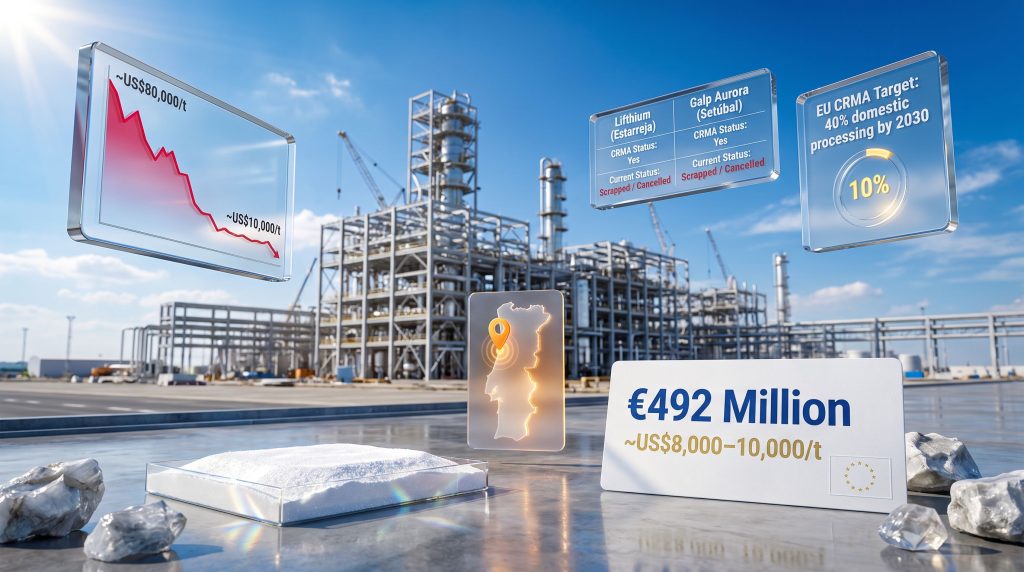
Processing raw lithium into battery-grade lithium hydroxide sounds straightforward on paper. In practice, it demands a precise convergence of economics, logistics, offtake security, and long-run price assumptions that rarely align simultaneously. When lithium carbonate equivalent prices were trading above US$80,000 per tonne in late 2022, the investment case for European refinery capacity seemed almost self-evident. Fast forward to 2025 and, as lithium carbonate supply-demand dynamics have shifted dramatically, that same commodity trades in the US$8,000 to US$10,000 per tonne range. The cancellation of the Lifthium Portugal lithium refinery scrapped ambitions is not simply a corporate retreat. It is a diagnostic signal about the fragility of Europe's critical mineral processing architecture.
When big ASX news breaks, our subscribers know first
A €492 Million Bet on European Battery Sovereignty
Lifthium Energy, operating as a subsidiary of Portuguese industrial conglomerate Grupo José de Mello, had positioned its Estarreja facility as a cornerstone of European battery supply chain independence. The planned investment totalled €492 million, placing it among the largest proposed lithium hydroxide processing investments in Southern Europe. Estarreja itself is not an arbitrary location. The site sits within an established Portuguese industrial corridor with existing chemical processing infrastructure, which theoretically reduces some of the greenfield buildout risk that typically burdens refinery developments in undeveloped zones.
The intended output was battery-grade lithium hydroxide, a chemically refined form of lithium suited to high-nickel cathode chemistries increasingly favoured by European electric vehicle manufacturers seeking longer range and higher energy density. This product specification placed Lifthium squarely in competition with Chinese refiners who dominate global hydroxide conversion capacity.
Critically, the project carried designation under the EU Critical Raw Materials Act, a regulatory framework introduced to accelerate permitting and improve financing access for strategically important mineral supply projects across the bloc.
The EU Critical Raw Materials Act targets processing at least 40% of the EU's annual consumption of strategic raw materials domestically by 2030. CRMA designation offers permitting acceleration and access to EU financing instruments, but it provides no price floor, no guaranteed offtake, and no equity financing protection. The Lifthium cancellation crystallises that distinction with uncomfortable clarity.
Decoding the Phrase "Adverse Market Conditions"
When mining and processing companies cite market conditions as grounds for project cancellation, the language is deliberately broad. Unpacking what that phrase actually contains in Lifthium's case requires understanding three compounding structural forces.
1. The Lithium Price Collapse
The decline from peak lithium carbonate equivalent prices of roughly US$80,000 per tonne in late 2022 to sub-US$10,000 per tonne by 2024 and 2025 is one of the most severe commodity corrections in recent memory. The ongoing lithium market downturn has not merely compressed margins for projects like Lifthium's — it has rendered them economically uninvestable under conventional financing terms.
2. Chinese Hydroxide Oversupply
China's dominance in lithium chemical conversion is not incidental. Chinese refiners benefit from integrated supply chains linking spodumene imports from Australia and brine operations in South America directly into large-scale conversion facilities operating at economies of scale that European single-site projects cannot match. Chinese hydroxide exports have consequently intensified competition in European spot markets, squeezing the margin assumptions upon which projects like Lifthium's feasibility studies were built.
3. European EV Demand Softness
The anticipated surge in European EV adoption that underpinned regional hydroxide demand forecasts has proven more incentive-dependent and politically sensitive than originally modelled. Growth rates in Germany, France, and the United Kingdom have slowed materially from the trajectories projected during the 2021 to 2022 planning cycle, reducing the urgency of securing new regional processing capacity in the near term.
| Metric | 2022 Peak Environment | 2025-2026 Reality |
|---|---|---|
| Lithium carbonate equivalent price | ~US$80,000/t | ~US$8,000-10,000/t |
| European EV sales growth | Strong double-digit | Slowing; incentive-dependent |
| Chinese hydroxide competition | Moderate | Intense oversupply |
| Refinery project IRR assumptions | Highly favourable | Significantly compressed |
| CRMA financing availability | Emerging | Available but insufficient alone |
Portugal's Dual Cancellations: A Pattern, Not an Anomaly
The Lifthium Portugal lithium refinery scrapped outcome does not stand in isolation. Portugal has now experienced the collapse of two separately structured, CRMA-designated lithium hydroxide refinery projects within a compressed timeframe, and the comparison between them reveals important nuances.
Galp's Aurora refinery, planned for Setúbal on Portugal's western coast, was cancelled after Northvolt's financial collapse removed the anchor offtake partner that had underwritten the project's commercial logic. Without a replacement offtake counterparty willing to commit to long-term volume at commercially viable pricing, Galp could not sustain the project's financing structure.
| Factor | Lifthium (Estarreja) | Galp Aurora (Setúbal) |
|---|---|---|
| Parent entity | Grupo José de Mello | Galp Energia |
| Stated cancellation reason | Adverse market conditions | Loss of anchor partner (Northvolt) |
| CRMA status | Yes | Yes |
| Planned output | Lithium hydroxide for EVs | Lithium hydroxide for EVs |
| Status as of mid-2026 | Scrapped | Cancelled |
While the proximate causes differ, the underlying vulnerability is identical: both projects were structurally exposed to the absence of commercial fundamentals that CRMA designation alone cannot supply. Northvolt's bankruptcy, itself a cautionary tale about the difficulty of scaling battery cell manufacturing in a high-cost European environment, triggered Galp's collapse. Lifthium's undoing came from the broader commodity price environment eroding project economics directly.
Portugal's upstream lithium resource base, which includes some of Europe's largest identified spodumene deposits, creates genuine raw material potential. However, the critical and frequently misunderstood distinction in critical mineral investment is the gap between upstream extraction economics and downstream chemical conversion economics. These are separate industries with different capital structures, different skill requirements, and different competitive dynamics. A country rich in lithium ore is not automatically positioned to be competitive in lithium hydroxide refining. Furthermore, innovations in direct lithium extraction technology may eventually alter these dynamics, though commercial viability at European scale remains some years away.
What CRMA Can and Cannot Do
The EU Critical Raw Materials Act was conceived in a policy environment shaped by acute supply chain anxieties following the post-pandemic commodity surge and Europe's experience of energy dependency. Its core mechanics include accelerated permitting pathways, strategic project designation, and improved access to EU-level financing instruments such as those administered through the European Investment Bank. European critical raw materials funding has, in practice, proven meaningful in some contexts, though insufficient in isolation against severe price headwinds.
What the CRMA framework lacks, and what the Lifthium situation exposes with precision, is any mechanism for managing commodity price risk at the project level. The US Inflation Reduction Act, by contrast, incorporates direct production tax credits that provide a degree of revenue floor protection for qualifying mineral processors. This means US-based processing projects can maintain economic viability through price downturns that would otherwise render them uncommercial. European policy has not yet incorporated equivalent instruments.
The absence of contracts-for-difference mechanisms or minimum revenue guarantees for CRMA-designated processing projects represents a structural policy gap that multiple European refinery cancellations are now exposing simultaneously. Policy frameworks designed during a commodity supercycle need recalibration for the commodity downcycle that followed.
An additional layer of complexity surrounds the Reed Advanced Materials and Lifthium joint evaluation process that broke down in 2024. Both parties ceased discussions over licensing and commercial evaluation terms before reaching a workable arrangement, indicating that commercial fragility was present at an early stage, well before the formal cancellation announcement.
It is also worth noting that in January 2026, Lifthium was reported to have secured a US$210 million grant for its refinery project, underscoring that institutional support was available and active. The fact that even this level of grant financing proved insufficient to sustain the project against deteriorating market economics is a striking indicator of how dramatically the commercial environment had shifted.
Three Scenarios for European Lithium Processing Through 2030
The dual Portuguese cancellations force a reckoning with how Europe's critical minerals supply chain will actually be served through the end of this decade. Three plausible trajectories emerge from the current landscape.
Scenario A: Deepening Chinese Dependency
If European domestic processing capacity fails to materialise at scale, battery manufacturers and automotive OEMs will increasingly source refined lithium from Chinese converters. This delivers near-term cost advantages given Chinese overcapacity and aggressive export pricing, but it recreates precisely the supply chain dependency that CRMA policy was designed to prevent. Regulatory risk under potential future EU import restriction frameworks compounds this vulnerability.
Scenario B: Rationalised European Processing Post-2026
A smaller number of better-capitalised refinery projects survive the current downturn by securing binding offtake agreements, deploying multi-party financing structures, and modelling project economics on conservative long-run lithium price assumptions rather than cyclical peaks. Joint venture structures between European energy companies, mining groups, and automotive manufacturers may replace the single-developer model that characterised first-generation CRMA projects. This pathway is viable but requires institutional patience and revised policy support mechanisms.
Scenario C: Geopolitical Reorientation to Allied Suppliers
European battery manufacturers pivot toward processed lithium sourced from Australia, Canada, and Chile under bilateral trade agreements consistent with broader allied-nation supply chain strategies. This approach sacrifices the EU's domestic processing ambitions but maintains supply chain resilience outside Chinese influence, consistent with friend-shoring frameworks gaining traction in Western industrial policy.
The next major ASX story will hit our subscribers first
Conditions Required for the Estarreja Project to Return
Project cancellations in capital-intensive mineral processing are not always permanent. The conditions under which the Lifthium Estarreja refinery could be reconsidered are identifiable, even if their timing is uncertain.
- Sustained lithium hydroxide price recovery: A durable return to pricing above US$15,000 to US$18,000 per tonne would materially restore project IRR assumptions and potentially reopen financing discussions.
- Binding long-term offtake agreements: A committed multi-year supply agreement with a European automotive manufacturer or battery cell producer would provide the revenue certainty that market-price exposure currently cannot.
- Restructured public co-investment: Greater equity participation from EU financing institutions, combined with possible contracts-for-difference mechanisms protecting against price downside, could reduce the risk burden on the private sector developer.
- Accelerated EV policy mandates: Firmer EU timelines for internal combustion engine phase-outs and enhanced purchase incentive programmes would strengthen long-run hydroxide demand projections and improve offtake partner confidence.
As of mid-2026, no timeline for project reactivation has been announced by Grupo José de Mello or Lifthium Energy.
The Rationalisation Argument: Why Fewer Projects May Produce Better Outcomes
There is a counterintuitive case to be made that the wave of European refinery cancellations, while painful for individual projects and for near-term CRMA credibility, may ultimately produce a healthier processing landscape. The projects that survive the current environment will, almost by definition, be those with stronger commercial foundations: secured offtake, realistic price modelling, diversified financing, and integrated supply chain logic.
The first generation of CRMA-backed refinery announcements was largely a product of a commodity supercycle that inflated both the ambition and the assumed economics of greenfield processing investment. A rationalised second generation, forged in a lower-price environment with binding commercial commitments as prerequisites, may prove more durable. Industry analysts tracking these developments have noted similar patterns across battery materials investment cycles in recent years.
The Lifthium Portugal lithium refinery scrapped outcome, alongside Galp's Aurora cancellation, does not necessarily represent the failure of European critical mineral ambition. It may instead represent the clearing of projects whose economics were always dependent on conditions that could not be sustained, making room for a more commercially grounded generation of processing investment to emerge when market and policy conditions align more durably.
For broader context on European critical mineral strategy and lithium market dynamics, industry reporting from Mining Magazine's processing and ESG coverage is available at miningmagazine.com.
Want To Position Yourself Ahead of the Next Major Mineral Discovery?
Discovery Alert's proprietary Discovery IQ model delivers real-time alerts on significant ASX mineral discoveries, transforming complex mineral data into actionable investment insights for both short-term traders and long-term investors — explore historic discoveries and their exceptional returns, then begin your 14-day free trial at Discovery Alert to secure your market-leading advantage.