August 4, 2026
The Hidden Cost of Going Green: When Clean Energy Demand Meets Agricultural Reality
Every major energy transition in history has produced winners and losers at the local level, even when the global rationale is compelling. The shift from coal to renewables is no different. While the macro-level case for lithium extraction is built on critical minerals and energy transition science, energy security, and industrial policy, the communities living closest to active mining zones experience something far more immediate: dust clouds, cracked walls, demolished homes, and the slow erosion of livelihoods that took generations to build. South Africa lithium mining farmers opposition is fast becoming the focal point of this tension along the southeast coast, where the promise of a green economy is colliding head-on with one of the country's most productive agricultural corridors.
When big ASX news breaks, our subscribers know first
Understanding the Scale: How Much Land Is Actually Under Pressure?
The public debate around South Africa lithium mining farmers opposition often focuses on individual stories of displacement. However, the geographic scope of what is unfolding along the KwaZulu-Natal south coast reframes the issue entirely.
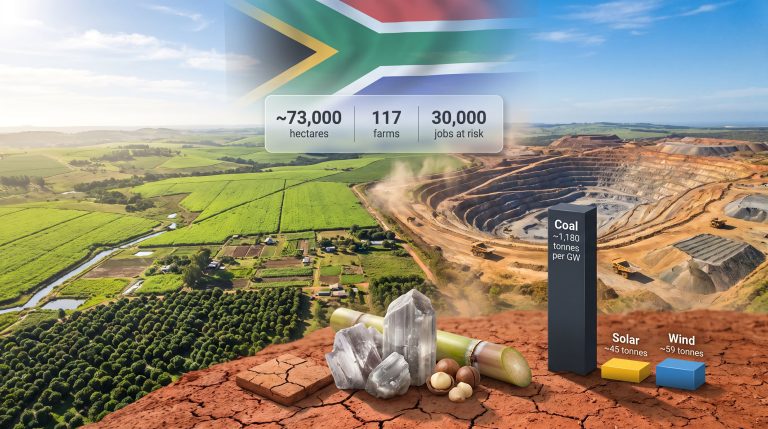
Data from South Africa's mineral resources department reveals that active lithium prospecting licences collectively cover approximately 73,000 hectares, an area broadly comparable to the footprint of Pretoria. That figure alone demands attention. But it is the composition of that land, not just its size, that makes the situation particularly complex.
| Metric | Figure |
|---|---|
| Total area under lithium prospecting licences | ~73,000 hectares (282 sq miles) |
| Number of farms affected | 117 farms |
| Prospecting licences granted since 2023 | More than a dozen |
| Existing mine pit footprint | ~150 hectares |
| Existing mine waste dump area | ~180 hectares |
| Proposed expansion area | ~6,000 hectares |
The 117 farms sitting within these prospecting boundaries are not marginal or unproductive. They form the backbone of a regional sugar economy in which approximately 2,000 small-scale growers and 600 commercial operators supply a single sugar mill processing 2 million metric tonnes of cane annually. Layered on top of this is macadamia horticulture, coastal tourism infrastructure, and the ecosystem of services and labour that sustains rural communities across the region.
KwaZulu-Natal represents the largest of South Africa's three identified lithium prospecting zones, making it both the most economically significant and the most politically charged battleground.
The Agricultural Economy at Risk: More Than a Numbers Game
What South Africa's Lithium Rush Threatens to Displace
Framing this conflict purely in terms of land area misses the economic interdependency that makes agricultural disruption so consequential. Sugar cane farming in KwaZulu-Natal is not a standalone industry. It connects directly to:
- Processing infrastructure employing hundreds of mill workers
- Transport and logistics networks serving both small-scale and commercial growers
- Local retail and service economies dependent on farm income
- Downstream food manufacturing and export supply chains
- Tourism and hospitality businesses tied to coastal land quality
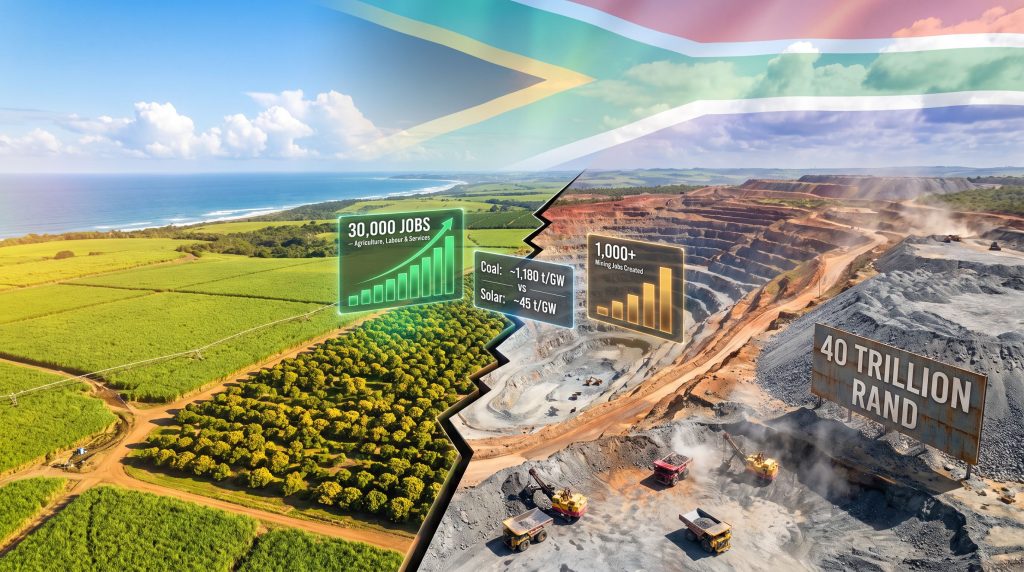
The South Coast Guardians Association (SCGA) has estimated that full conversion of current prospecting licences into operational mining licences could place as many as 30,000 jobs at risk across farming, labouring, and services sectors. That figure encompasses direct agricultural employment and the indirect economic activity it generates, making it a materially different calculation than the mining sector's reported job creation of over 1,000 positions at the existing operation.
"The employment comparison between mining and farming is not simply a matter of counting heads. Mining jobs tend to be capital-intensive, concentrated in specific extraction phases, and relatively limited in number relative to land consumed. Agricultural employment, by contrast, is distributed broadly across communities, generates multigenerational economic participation, and sustains downstream industries in food processing, logistics, and retail that aggregate employment data often undercount."
Furthermore, a comprehensive net employment impact analysis for the KwaZulu-Natal lithium corridor, accounting for both direct and indirect job flows, has not been publicly released, leaving communities and policymakers without a rigorous basis for comparison. Critical minerals demand projections at the global level rarely account for this kind of localised economic disruption.
Community Voices: Displacement Beyond Property Loss
The Human Reality Behind the Licence Maps
The conflict is not abstract for the residents of Magog, a hillside village in KwaZulu-Natal that sits within the country's primary lithium prospecting zone. The lived experience of people in this community illustrates something that environmental impact statements rarely capture: the difference between economic displacement and cultural rupture.
Residents of the village describe a range of physical and social impacts from existing mining activity nearby, as reported by Inside Climate News:
- Structural damage to homes attributed to blasting vibrations from adjacent operations
- Persistent dust clouds from excavation affecting air quality and health
- Visible degradation of tree cover and vegetation in proximity to active pits
- Disruption to graves and culturally meaningful sites within the village boundary
- Noise and activity incompatible with the agricultural calendar and quality of life
Several homes in Magog have already been demolished to accommodate mine expansion, with additional structures dismantled. Residents describe relocation offers as providing access to land that is remote, less fertile, and poorly suited to the subsistence farming and garden cultivation that defines daily life in the community. For families with decades of connection to specific plots, the prospect of inheritance, cultural continuity, and agricultural practice being severed in a single generation represents something that monetary compensation does not adequately address.
The Relocation Dispute: A Study in Competing Claims
| Perspective | Position |
|---|---|
| SA Lithium (company) | Reports 150 farmers voluntarily relocated; states relocated families are materially better off |
| Affected residents | Describe replacement land as remote, infertile, and unsuitable for farming practices |
| Independent observers | Note that voluntary consent is difficult to assess when the alternative is living adjacent to active blasting |
This tension points to a broader governance gap. What constitutes genuine, freely given consent in a context where industrial activity has already made continued residence difficult? The answer requires regulatory frameworks more sophisticated than a simple voluntary/involuntary binary.
The Green Energy Paradox: Less Mining, But in New Places
Reassessing the Material Intensity Argument
One of the most frequently cited justifications for lithium extraction is that clean energy infrastructure requires dramatically less raw material than the fossil fuel systems it displaces. The empirical basis for this claim is solid. A 2024 Breakthrough Institute research paper found that coal extraction in South Africa averages approximately 1,180 tonnes of material per gigawatt of generating capacity, compared with roughly 59 tonnes per gigawatt for wind and 45 tonnes per gigawatt for solar, including the minerals required for battery storage in a standard installation.
| Energy Source | Material Extracted (tonnes per GW) |
|---|---|
| Coal (South Africa's primary source) | ~1,180 tonnes |
| Wind energy (including battery storage) | ~59 tonnes |
| Solar energy (including battery storage) | ~45 tonnes |
Source: Breakthrough Institute, 2024
On a per-gigawatt basis, clean energy's material footprint is roughly 20 to 26 times smaller than coal's. This is a significant and legitimate finding. However, the argument has a structural blind spot that policymakers and investors rarely address openly.
Coal extraction in South Africa is geographically concentrated in established mining regions, principally Mpumalanga and the Witwatersrand basin, where regulatory frameworks, community expectations, and economic structures have evolved over more than a century of industrial activity. Lithium extraction, by contrast, is opening entirely new geographic frontiers, in many cases agricultural zones and coastal landscapes where communities have no historical experience with open-pit mining.
The aggregate material efficiency of clean energy is real. But efficiency at a national or global scale does not automatically protect the specific communities bearing the localised cost of extraction. This gap between macro-level justification and micro-level impact is where South Africa's policy framework is currently most exposed.
"South Africa is not navigating this tension in isolation. Lithium and critical mineral projects have triggered sustained community resistance in Portugal, legal challenges from indigenous landowners and agricultural communities in the United States, and documented land degradation from rock waste management in both Australia and China. The pattern is consistent: the global benefits of the energy transition are diffuse, while its material costs are intensely localised."
Regulatory Architecture: Where the Framework Falls Short
Key Gaps in South Africa's Mining Licence Process
The opposition to lithium expansion in KwaZulu-Natal is not simply emotional resistance to change. A substantial portion of the legal and community objections are rooted in specific regulatory concerns that deserve close examination. In addition, technologies such as direct lithium extraction offer promising alternatives that could reduce surface disturbance, yet these remain largely absent from current licence conditions.
1. Consultation adequacy
Affected communities and advocacy groups have raised formal objections arguing that the prospecting licence approvals did not involve genuine prior, informed consultation with the farming and residential communities most directly affected. This is a procedurally significant claim under South African mining law.
2. Cumulative impact assessment
More than a dozen prospecting licences have been granted across a single coastal region since 2023. Opposition groups argue that each licence has been assessed individually rather than as part of an interconnected system, leaving the combined environmental and social footprint of the lithium corridor unanalysed as a whole.
3. Water management accountability
Farmers' submissions warn that expanded open-pit mining could permanently degrade both water and soil quality across the region. The mining company disputes this, stating that mine water is fully contained within dams used for processing or dust suppression. Independent verification of these claims remains publicly unavailable.
4. Post-mining rehabilitation obligations
Questions remain about what enforceable commitments exist for land restoration following the conclusion of mining operations. Considerations of natural capital in mining suggest that current rehabilitation bonding requirements may be insufficient to restore land to full agricultural productivity.
5. Government responsiveness
South Africa's mineral resources department did not respond to media requests for comment on the community concerns raised in the KwaZulu-Natal corridor. This silence has reinforced opposition groups' argument that the regulatory system lacks adequate accountability mechanisms.
The next major ASX story will hit our subscribers first
The National Economic Framing vs. Local Economic Reality
President Ramaphosa's Critical Minerals Vision
South Africa's national government has articulated an ambitious rationale for accelerating critical mineral development. President Cyril Ramaphosa, addressing parliament in February, described the country's critical mineral reserves as worth approximately 40 trillion rand (roughly USD $2.39 trillion), characterising the sector as a sunrise industry with the potential to generate widespread employment and rebuild South Africa's industrial base.
This framing reflects a genuine strategic calculation. South Africa holds some of the world's most significant reserves not just of lithium, but of manganese, platinum group metals, vanadium, and chrome, all of which are central to clean energy infrastructure globally. However, as Global Witness has documented, the national-level opportunity represented by mineral wealth does not automatically translate into locally shared prosperity. The communities of KwaZulu-Natal's south coast are experiencing the downside of extraction without a structured mechanism for economic participation in its upside.
A Pathway Forward: Governance Reforms That Could Change the Outcome
Six Structural Interventions Worth Considering
The conflict between South Africa lithium mining farmers opposition is not inherently unresolvable. Nations including Canada and parts of Scandinavia have navigated comparable tensions by treating community consent and environmental protection as preconditions for the social licence to operate, rather than as regulatory obstacles to be managed. Furthermore, robust mine reclamation frameworks have proven essential in ensuring degraded land is genuinely restored. Several structural reforms could shift South Africa's trajectory:
- Corridor-level cumulative impact assessment requiring holistic environmental and social evaluation of all prospecting licences within a defined geographic zone before any individual application advances to mining status
- Legally enforceable free, prior, and informed consent (FPIC) standards for all communities in agricultural zones affected by mineral prospecting, consistent with internationally recognised human rights frameworks
- Independent relocation verification assessing agricultural suitability, cultural continuity, and livelihood replacement rather than relying solely on property value equivalence
- Protected agricultural zone designation preventing conversion of high-productivity farmland to mining use without explicit parliamentary approval and demonstrated public interest justification
- Community benefit-sharing mechanisms directing a defined royalty percentage to affected farming communities, creating economic participation in the lithium value chain rather than pure displacement
- Pre-licence rehabilitation bonding requiring mining companies to post independently verified financial bonds sufficient to fully restore land to agricultural productivity before any mining licence is granted
The Larger Question South Africa Must Answer
South Africa's lithium ambitions sit at the intersection of three structural forces that do not naturally align: global clean energy demand creating genuine economic opportunity, domestic inequality making the promise of mining-led job creation politically powerful, and rural community rights representing the lived reality of people whose livelihoods are most directly at risk from the pace of extraction.
The resolution of this conflict will not be determined by geology, commodity prices, or climate policy alone. It will be shaped by whether South Africa's governance architecture proves capable of distributing both the benefits and the burdens of the energy transition more equitably than resource booms historically have. The farming communities of KwaZulu-Natal are, in this sense, a test case not just for South Africa, but for every mineral-rich developing nation navigating the same paradox.
"The energy transition's legitimacy depends not only on what it builds globally, but on what it avoids destroying locally. Communities that have sustained productive agricultural economies for generations deserve more than displacement in exchange for the promise of a greener future they may never materially share in."
This article is strictly for informational purposes only. It does not constitute financial, investment, or legal advice. Figures relating to job estimates, land areas, and economic projections reflect publicly available data and community submissions as reported; actual outcomes may vary materially. Readers should seek independent professional advice before making any decisions based on information contained herein.
Want to Track the Next Major Critical Mineral Discovery Before the Market Does?
Discovery Alert's proprietary Discovery IQ model scans ASX announcements in real time, translating complex mineral data across more than 30 commodities into clear, actionable insights — so subscribers can identify significant opportunities the moment they emerge. Explore historic discoveries and their market returns to understand what early positioning in major mineral finds has delivered, then start your 14-day free trial to gain a market-leading edge.