August 4, 2026
Hard-Rock Lithium's Next Chapter: Why Permitting Milestones Shape Project Economics Before a Single Tonne Is Mined
In the global battery materials supply chain, the distance between a drilled resource and a producing mine is rarely measured in kilometres. It is measured in regulatory hurdles, native title negotiations, environmental assessments, and capital allocation decisions. For hard-rock lithium projects in Western Australia, this permitting journey has historically separated projects that reach production from those that stall indefinitely in the development pipeline. The Global Lithium Manna project approval of its Mining Development and Closure Proposal (MDCP) in August 2026 is a concrete illustration of how methodically clearing these hurdles can transform a development-stage asset into one standing at the threshold of construction.
When big ASX news breaks, our subscribers know first
What Makes the Manna Lithium Project Strategically Distinct
Located approximately 100 to 110 kilometres east of Kalgoorlie-Boulder in Western Australia's Eastern Goldfields region, the Manna project sits within one of the most mineralised and infrastructure-connected hard-rock lithium corridors on the planet. The Eastern Goldfields has long been associated with gold production, but over the past decade its lithium endowment has drawn sustained exploration interest as battery demand accelerated globally.
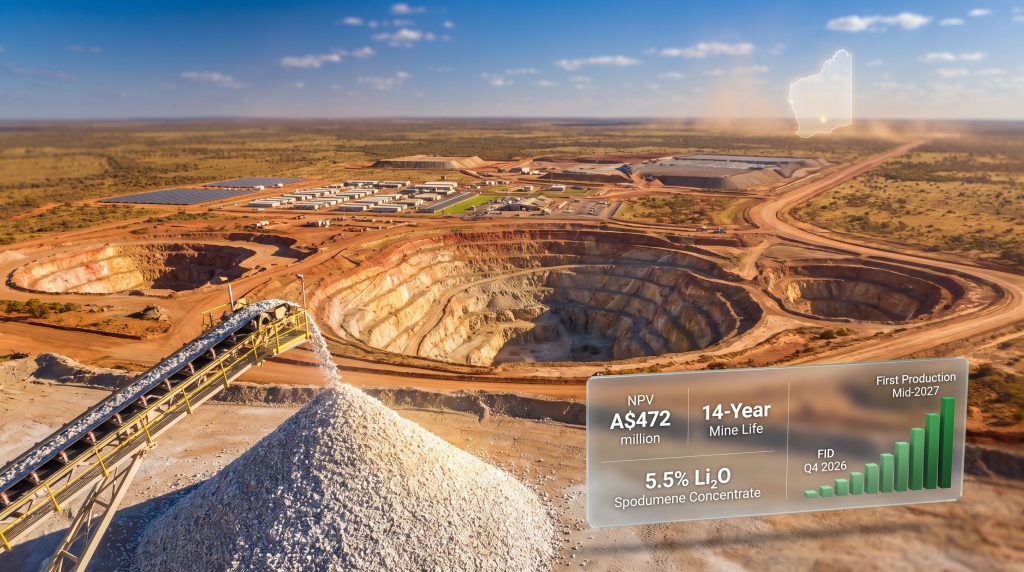
Manna's definitive feasibility study outlines a project with a 14-year mine life and a net present value of A$472 million, figures that position it as a commercially material development within the broader Western Australian lithium pipeline. The deposit is spodumene-dominant, meaning the lithium mineralisation is hosted within spodumene crystals rather than in brine-based systems. This geological characteristic is fundamental to how the project's economics are structured, what processing infrastructure is required, and how concentrate quality is defined.
Spodumene as a Mineral: Why Grade Matters Enormously
Spodumene is a lithium aluminium inosilicate mineral that forms within lithium-caesium-tantalum (LCT) pegmatite intrusions. Understanding spodumene extraction basics is essential here, as ore is crushed, milled, and processed through dense media separation and flotation circuits to produce a concentrated product. The industry benchmark for marketable spodumene concentrate sits at 6% lithium oxide (Li₂O), though commercially viable contracts have historically been struck across a range from roughly 5.0% to 6.5% Li₂O.
Manna is targeting a concentrate grade of 5.5% Li₂O, which sits within the commercially acceptable band but marginally below the premium 6% benchmark. This grade positioning is worth examining from an investor perspective:
- Concentrate at 5.5% Li₂O will typically attract a modest discount relative to 6% material in spot or term offtake negotiations
- However, the discount is not linear; downstream converters in China and South Korea have demonstrated willingness to blend grades to optimise their refinery feed
- Higher throughput volumes can offset per-unit grade discounts when project economics are modelled at scale
- The 5.5% target reflects the natural mineralogy of the deposit rather than a processing shortcut
Downstream, spodumene concentrate is fed into rotary kilns for decrepitation and acid roasting, ultimately producing either lithium hydroxide monohydrate or lithium carbonate. Furthermore, the lithium carbonate market for these two primary battery-grade lithium chemicals continues to evolve as cathode active material manufacturing scales globally.
Understanding the MDCP: A Regulatory Instrument That Is Frequently Misunderstood
The Mining Development and Closure Proposal is not the same instrument as a mining lease, nor is it equivalent to an environmental impact assessment, though all three are required in sequence for a Western Australian project to proceed. The MDCP is the operational planning document that sits beneath the mining lease, detailing precisely how the mine will be constructed, operated, and eventually rehabilitated.
Approval from the Western Australia Department of Mines, Petroleum and Exploration (DMPE) authorises the company to commence early works and critical infrastructure establishment at the mine site. For Manna, the approved MDCP covers the following infrastructure scope:
| Infrastructure Component | Detail |
|---|---|
| Open pit configuration | One main pit plus two satellite pits |
| Waste management | Waste rock dumps and dry stack tailings facilities |
| Ore handling | Surface ore stockpile areas |
| Accommodation | On-site workers' village |
| Water supply | Dedicated bore field |
| Land management | Topsoil stockpile and rehabilitation areas |
One aspect of the MDCP that is not widely understood outside of Western Australian mining circles is the dry stack tailings component. Unlike conventional tailings storage facilities that impound fine material in a wet slurry behind an embankment, dry stack tailings involve mechanically dewatering processed material and stacking it in a compacted, stable landform. For hard-rock lithium projects operating in water-stressed environments like the Eastern Goldfields, dry stack is increasingly the preferred methodology, reducing both water consumption and long-term environmental liability.
Critical distinction: MDCP approval does not constitute a Final Investment Decision. It removes a foundational regulatory barrier, enabling early-stage construction activities to proceed while the FID process, including financing confirmation and offtake finalisation, is completed separately.
The Regulatory Journey to MDCP Approval: A Chronological View
The path to MDCP approval for Manna was not a single administrative event but a sequenced series of interlocking approvals, each of which was a prerequisite for the next. Understanding this sequence illuminates why project timelines in Western Australia can extend across multiple years even when the underlying geology is well-defined.
- August 2025: The Western Australian Minister for Mines, Petroleum and Exploration grants a 21-year mining lease for the Manna project, providing the foundational tenure required for all subsequent approvals.
- 2025: Execution of a Native Title Mining Agreement with the Kakarra Part B Native Title Group, resolving one of the most historically complex approval layers for projects in this region.
- April 2026: Lodgement of a Native Vegetation Clearing Permit application and formal submission of the MDCP to the DMPE.
- August 2026: MDCP approval granted, enabling early works mobilisation and infrastructure construction to commence.
Native Title: The Approval Layer That Determines Everything Downstream
The Native Title Act 1993 creates a legally mandated process through which mining companies must negotiate with registered native title holders or claimants before certain tenement activities can proceed. In practice, this means that the mining lease application and the native title process run concurrently, but the mining lease cannot be formally granted until the native title pathway has been resolved.
For Manna, the execution of a Native Title Mining Agreement with the Kakarra Part B Native Title Group was the critical enabler for the August 2025 mining lease. Several comparable Western Australian lithium projects have experienced delays of 12 to 36 months at this stage, making early and constructive engagement with native title parties a material project risk management consideration rather than merely a compliance formality.
From MDCP Approval to First Production: The Compressed Timeline
The project's development schedule, as it currently stands, represents an ambitious but structured progression from regulatory clearance to commercial production:
| Milestone | Target Timing |
|---|---|
| MDCP Approval | August 2026 |
| Final Investment Decision (FID) | Q4 2026 |
| First Direct Shipping Ore (DSO) | Q2 2027 |
| First Spodumene Concentrate Production | Mid-2027 |
| Spodumene Concentrate Grade Target | 5.5% Li₂O |
| Projected Mine Life | 14 years |
| Project NPV (DFS) | A$472 million |
Direct Shipping Ore: Revenue Generation Before the Concentrator Is Ready
A less widely understood aspect of hard-rock lithium project sequencing is the role of Direct Shipping Ore (DSO) as a transitional revenue mechanism. DSO refers to ore that is extracted, crushed to a coarse fraction, and shipped to downstream processors without undergoing the full dense media separation and flotation treatment that produces standard spodumene concentrate.
DSO commands a significantly lower price per tonne than processed concentrate and is only commercially viable above certain minimum lithium grades in the run-of-mine ore. Its primary value in a project development context is early cash flow generation that can partially offset construction costs and demonstrate operational capability to financiers before the concentrator circuit reaches nameplate capacity.
Manna's schedule targets first DSO in Q2 2027, with the concentrator producing 5.5% Li₂O spodumene concentrate from mid-2027, suggesting a relatively short DSO-only window of perhaps one to two quarters.
What Still Needs to Be Resolved Before FID?
The Global Lithium Manna project approval is a material de-risking event; however, several conditions must be met before the company can formally declare a Final Investment Decision:
- Confirmation of project financing arrangements, whether through debt, equity, or offtake-linked prepayment structures
- Finalisation of binding offtake agreements with lithium chemical converters for spodumene concentrate
- Completion of any outstanding conditions associated with the Native Vegetation Clearing Permit
- Board-level capital allocation approval following a review of prevailing lithium market conditions
Investor consideration: In the current lithium market environment, where spot prices for spodumene concentrate have experienced significant volatility since 2023 peaks, the bankability of a project at FID is as much a function of offtake contract structure as it is of resource quality or permitting status. Fixed-price or floor-price offtake arrangements can materially improve debt financing terms by reducing revenue uncertainty.
Manna Within Australia's Structural Role in Global Lithium Supply
Australia has consistently held the position of the world's largest lithium producer by volume, with Western Australia generating the overwhelming majority of national output. The state's dominance is built on a combination of high-grade spodumene deposits, established export infrastructure, and a regulatory framework that, while rigorous, has demonstrated the capacity to process major mining proposals within commercially viable timeframes.
In addition, the differences between hard-rock vs brine extraction pathways are relevant here, as the primary market for Western Australian spodumene concentrate remains lithium chemical conversion capacity in China. South Korean battery manufacturers and their associated supply chains represent a secondary but growing offtake market. This concentration of downstream processing capacity in Northeast Asia creates a structural dependency that some producers have sought to diversify through agreements with emerging converters in Europe and North America.
Consequently, for a project like Manna, the timing relative to forecast lithium demand recovery is a key variable. Analysts tracking electric vehicle adoption curves and battery manufacturing capacity expansions have generally projected a tightening of spodumene supply balances in the 2027 to 2029 window, though these forecasts carry material uncertainty given the pace of lithium price normalisation following the 2022 to 2023 price spike.
The next major ASX story will hit our subscribers first
Key Risk Factors Investors Should Assess
Regulatory and Environmental Risks
- The Native Vegetation Clearing Permit application, lodged in April 2026, remains subject to conditions that could affect early works timelines
- Environmental offset requirements in the Eastern Goldfields have become more stringent in recent approval cycles, adding potential cost and schedule uncertainty
- Stakeholder engagement obligations under the Native Title Mining Agreement require ongoing compliance throughout the project lifecycle
Market and Financial Risks
- Spodumene concentrate prices have demonstrated high volatility; a sustained period of low prices between now and FID could alter project financing terms or delay the FID decision itself
- Capital cost inflation in the Western Australian mining construction sector has been a persistent feature since 2021, and the Kalgoorlie-Boulder region faces specific labour and equipment availability constraints
- The various lithium extraction methods being adopted globally are also reshaping offtake market dynamics as downstream converters adjust procurement strategies in response to battery chemistry shifts
Operational Risks
- The transition from DSO operations to full concentrator production involves commissioning risk that is common across hard-rock lithium projects
- Dry stack tailings management at scale introduces operational considerations that differ materially from conventional tailings facilities
- Water management in the semi-arid Eastern Goldfields requires careful bore field yield planning to sustain processing operations across the projected 14-year mine life
Disclaimer: This article contains forward-looking statements and projections based on publicly available information and DFS outputs. Actual outcomes may differ materially from those described. This content is informational only and does not constitute financial advice. Investors should conduct their own due diligence before making investment decisions.
Frequently Asked Questions: Global Lithium Manna Project Approval
What Has Been Approved for the Manna Lithium Project?
The Western Australia Department of Mines, Petroleum and Exploration approved the Mining Development and Closure Proposal for the Manna project in August 2026, authorising early works and critical infrastructure construction at the mine site. The robust DFS results underpinning this milestone confirm the project's commercial viability ahead of FID.
Where Is the Manna Lithium Project Located?
The Manna project is situated approximately 100 to 110 kilometres east of Kalgoorlie-Boulder in Western Australia's Eastern Goldfields region.
When Is the Final Investment Decision Expected?
Global Lithium Resources has targeted the December quarter of 2026 for its FID on the Manna project.
When Will the Project Produce Its First Lithium?
First direct shipping ore is targeted for Q2 2027, with first spodumene concentrate production at 5.5% Li₂O anticipated in mid-2027.
What Is the Economic Value of the Manna Project?
The DFS indicates a net present value of A$472 million across a 14-year mine life, making it a commercially significant asset within Australia's hard-rock lithium pipeline.
What Is an MDCP and Why Does It Matter?
A Mining Development and Closure Proposal is a formal planning document required under Western Australian mining legislation that details how a mine will be developed, operated, and rehabilitated. Approval is a prerequisite for commencing construction activities and is a key milestone in the project's path to FID.
Has Native Title Been Resolved for Manna?
Yes. A Native Title Mining Agreement was executed with the Kakarra Part B Native Title Group, which was a prerequisite for the 21-year mining lease granted in August 2025. The Global Lithium Manna project approval of the MDCP confirms that all foundational regulatory and native title requirements have been satisfied ahead of the anticipated FID.
Want to Track the Next Major ASX Lithium Discovery Before the Market Moves?
Discovery Alert's proprietary Discovery IQ model scans ASX announcements in real time, instantly identifying significant mineral discoveries — including hard-rock lithium projects — and delivering actionable alerts before the broader market has time to react. Explore how major discoveries have historically generated substantial returns on the Discovery Alert discoveries page, and begin your 14-day free trial today to position yourself ahead of the next breakthrough.