August 4, 2026
India's Battery Supply Chain Is Being Rebuilt From the Ground Up
The global energy transition has exposed a fundamental tension in industrial policy: the nations most eager to decarbonise their economies are often the least equipped to manufacture the core technology that makes decarbonisation possible. Battery cells sit at the heart of this paradox. For India, a country racing to electrify its transport network and integrate hundreds of gigawatts of renewable energy into its grid, the absence of domestic cell manufacturing capacity around Tata Agratas LFP battery cells in India is not merely an inconvenience. It is a structural vulnerability with compounding consequences.
The decision by Tata Group's battery manufacturing arm, Agratas Energy Storage Solutions, to build its own lithium iron phosphate cell technology from scratch rather than license it from an external partner marks a pivotal moment in India's industrial history. Understanding why that pivot became necessary, and what it means for the country's long-term energy ambitions, requires looking beyond the company's immediate production timelines.
When big ASX news breaks, our subscribers know first
The Technology Lockout That Changed Everything
For years, the assumed pathway for emerging-market battery manufacturers was straightforward: identify a proven cell chemistry, license the manufacturing know-how from an established producer, build a factory, and scale. This model worked for other industries across Asia. In battery manufacturing, however, it has effectively collapsed for Indian companies.
Beijing has progressively tightened restrictions on the export of critical battery manufacturing knowledge, including the process parameters, electrode formulations, and equipment specifications that underpin commercial-scale LFP cell production. The consequence for Indian firms is stark. Industry players including Reliance Industries and JSW Group have encountered serious difficulties in accessing the technology required to produce cells domestically, with existing or prospective licensing arrangements running into regulatory and commercial barriers.
For Agratas, the assessment reached by company leadership was equally unambiguous. The probability of securing a workable technology licensing agreement with a Chinese LFP cell manufacturer had effectively fallen to near zero. This was not a temporary negotiating impasse. It reflected a deliberate and durable shift in Chinese industrial policy toward treating battery manufacturing expertise as a strategic export-controlled asset.
"The forced pivot away from Chinese licensing is not a detour on India's battery manufacturing roadmap. It is a permanent rerouting that demands a fundamentally different development model."
The contrast with Agratas' NMC cell development track is instructive. For nickel manganese cobalt chemistry, the company successfully secured a licensing arrangement with Automotive Energy Supply Corp. (AESC), a unit of Hong Kong-based Envision Energy International. That agreement gave Agratas access to mature, proven NMC manufacturing processes, allowing it to bypass years of early-stage development and target commercial production at its Sanand facility by early 2027. No equivalent pathway exists for LFP. Every step of the manufacturing process must be developed, validated, and optimised internally.
What Makes LFP the Right Chemistry for India's Market
The decision to prioritise LFP chemistry for indigenous development is not arbitrary. It reflects a clear-eyed read of where Indian battery demand is actually concentrated and where it is headed. Furthermore, the global lithium market dynamics of 2025 make this strategic focus particularly timely.
LFP vs. NMC: A Practical Comparison for Indian Conditions
| Attribute | LFP (Lithium Iron Phosphate) | NMC (Nickel Manganese Cobalt) |
|---|---|---|
| Raw Material Cost | Lower, no cobalt or nickel | Higher, cobalt and nickel intensive |
| Energy Density | Moderate | Higher |
| Thermal Stability | Superior, lower fire risk | Moderate |
| Cycle Life | 3,000 to 5,000+ cycles | Shorter by comparison |
| Best Application | Mass-market EVs, grid storage | Premium EVs, high-range applications |
| Price Sensitivity Fit | Strong for Indian market | Better suited to premium segments |
India's EV market is overwhelmingly concentrated in price-sensitive segments. The vast majority of electric vehicles sold domestically fall below the ₹15 lakh price threshold, where cell cost per kilowatt-hour is the single most consequential factor in product viability. LFP chemistry, with its elimination of expensive cobalt and nickel from the cathode formulation, delivers a structural cost advantage precisely where Indian consumers need it most.
Beyond automotive applications, LFP's superior thermal stability and cycle longevity make it the dominant global choice for grid-scale Battery Energy Storage Systems (BESS). As India pursues its target of 500 GW of non-fossil fuel electricity capacity by 2030, the need for large-scale storage to manage solar and wind intermittency is escalating rapidly. The critical minerals demand surge driven by the energy transition is accelerating this requirement further. Grid-scale BESS deployments globally rely overwhelmingly on LFP chemistry for these reasons.
LMFP: The Next-Generation Chemistry Already in Agratas' Sights
Standard LFP is not the only chemistry under investigation at Agratas. The company's R&D program also encompasses Lithium Manganese Iron Phosphate, or LMFP, a chemistry that is less widely understood outside specialist battery circles but represents a meaningful technical step forward.
LMFP retains the core safety and cost advantages of the iron-phosphate chemical family while delivering materially higher energy density through the partial substitution of manganese for iron in the cathode. This addresses the primary competitive disadvantage of conventional LFP relative to NMC, without reintroducing the cost and supply chain risks associated with cobalt or nickel. For Agratas, an LMFP capability would position its proprietary cell technology ahead of current-generation Chinese LFP benchmarks on energy density, a potentially significant competitive differentiator if achieved.
Inside the Sanand Gigafactory: India's Most Consequential Industrial Project
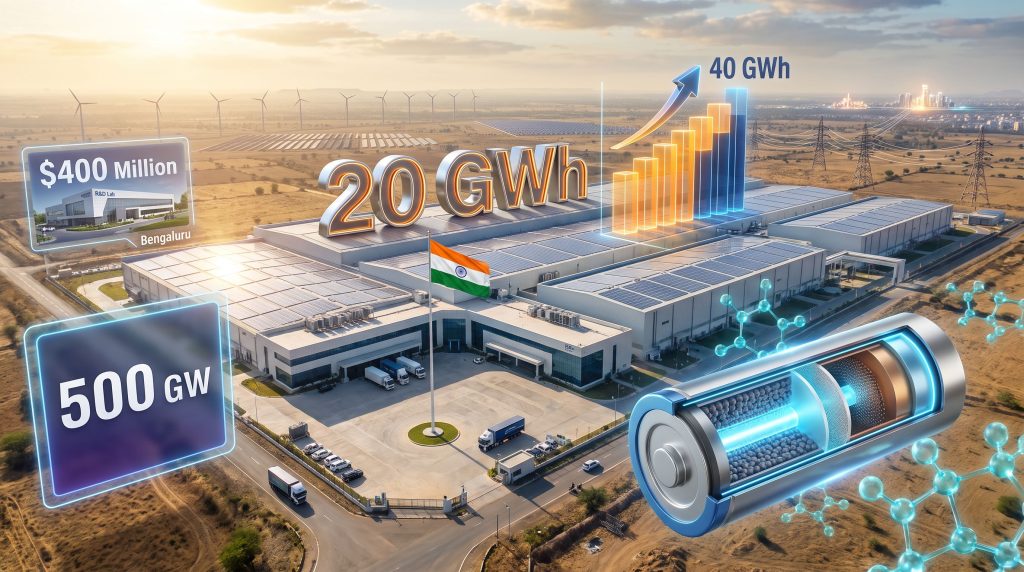
The Agratas manufacturing facility at Sanand in Gujarat is the physical embodiment of India's domestic battery ambitions. The site's scale and dual-chemistry strategy reflect a long-term investment thesis rather than a near-term production play.
Sanand Facility: Key Parameters
| Parameter | Detail |
|---|---|
| Location | Sanand, Gujarat, India |
| Phase 1 Target Capacity | 20 GWh |
| Potential Phase 2 Expansion | Up to 40 GWh |
| Cell Chemistries Planned | LFP and NMC |
| NMC Commercial Production Target | Early 2027 |
| LFP Development Stage | Pilot line under validation |
| Primary Domestic Offtake | Tata Motors EV portfolio |
The LFP pilot production line at Sanand is where Agratas' indigenous technology development is being tested in real manufacturing conditions. A cross-functional engineering team comprising Indian, South Korean, and Chinese technical specialists is responsible for refining process parameters and validating initial cell batches before any commercial scale-up can proceed.
This pilot-to-commercial transition is a technically demanding phase that is frequently underestimated by outside observers. Achieving consistent cell performance at pilot scale is one challenge. Translating that consistency into high-yield commercial production — where incremental improvements in electrode coating uniformity, electrolyte filling precision, and formation cycling protocols directly determine unit economics — is a substantially more complex undertaking.
The inclusion of South Korean engineers is particularly noteworthy. South Korea's battery manufacturing sector, anchored by companies like LG Energy Solution, Samsung SDI, and SK On, has developed deep process expertise across multiple chemistries over decades. Embedding that institutional knowledge within an Indian manufacturing environment represents a deliberate strategy to compress the learning curve that purely domestic development would require.
The $400 Million Bengaluru R&D Bet
Manufacturing capability alone does not secure long-term competitiveness in battery technology. Agratas and the Tata Group clearly understand this, which explains the scale of the commitment to the Bengaluru research and development centre.
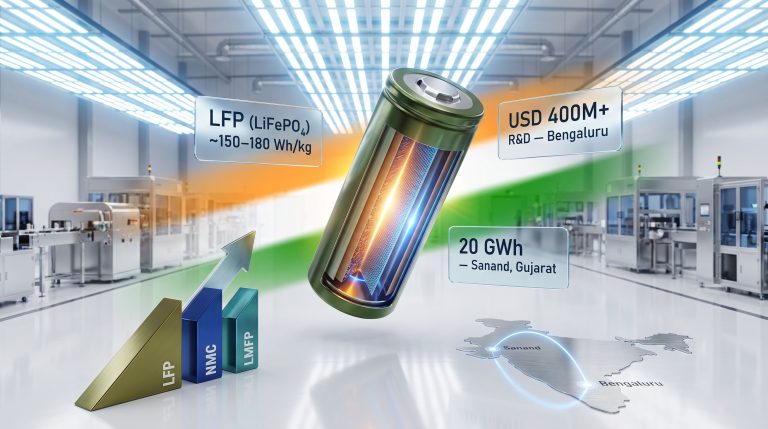
Agratas is investing more than $400 million in the Bengaluru facility, with a focus specifically on LFP and LMFP battery chemistries. The size of this investment is significant in the context of global battery R&D spending. It signals that LFP is being treated as a long-duration competitive platform, not a transitional chemistry to be abandoned as energy densities improve.
Historically, India has been a consumer of battery intellectual property rather than a creator of it. Every commercial cell deployed in an Indian EV or grid storage system has originated from IP owned by Chinese, Japanese, or Korean manufacturers. A successful Agratas R&D program would fundamentally alter this dynamic, creating the first domestically owned, commercially viable battery cell IP in Indian history.
The multi-nationality of the engineering team at both Sanand and Bengaluru reflects a sophisticated talent strategy. Rather than attempting to build capability exclusively from the Indian talent pool, Agratas is synthesising global battery manufacturing expertise within an Indian institutional framework, with the explicit goal of internalising that knowledge and generating proprietary innovations over time.
India's Position in the Global LFP Manufacturing Landscape
To understand what Agratas is attempting, it helps to situate India within the broader global LFP production ecosystem. In addition, India's strategy for securing lithium supply plays a crucial role in supporting this ambition, as outlined in India's approach to lithium sourcing.
| Country/Region | Key LFP Cell Producers | Approximate Installed Capacity | Technology Ownership |
|---|---|---|---|
| China | CATL, BYD, CALB, Gotion | 1,000+ GWh | Proprietary and licensed |
| United States | Multiple via IRA incentives | 50 to 100 GWh (growing) | Licensed and emerging proprietary |
| Europe | Northvolt, ACC, others | 30 to 50 GWh (growing) | Licensed and proprietary |
| India | Agratas, Sanand (pre-commercial) | 20 GWh Phase 1 target | Proprietary (in development) |
China controls an estimated 70 to 80 percent of global LFP cell production capacity. This concentration creates supply chain risk for every country that depends on Chinese cell imports, and it is precisely the vulnerability that India's domestic manufacturing push is designed to reduce. The opportunity for India extends beyond import substitution. As Western nations and their allies actively seek to diversify battery supply chains away from Chinese dominance, a commercially competitive Indian LFP producer could position itself as a credible alternative supply node for Southeast Asian and Global South markets.
The next major ASX story will hit our subscribers first
Grid-Scale Storage: The Market That Could Justify 40 GWh
The dual-market demand base available to Agratas' LFP line — spanning both automotive and grid-scale storage — is what makes the economics of full-scale Sanand expansion potentially viable. The battery storage expansion boom currently reshaping global energy markets is directly relevant to this opportunity.
India's grid-scale BESS market is at an early but accelerating stage of development. The country's commitment to 500 GW of non-fossil fuel electricity capacity by 2030 implies an enormous requirement for storage capacity to manage the intermittency of solar and wind generation at scale. Current domestic BESS deployment is a fraction of what the 2030 target will ultimately require.
For Indian utilities and independent power producers, sourcing LFP cells domestically rather than importing them from China would reduce exposure to currency risk, logistics disruption, and geopolitical leverage. A commercially operational Agratas LFP line at Sanand would be the first time that sourcing option has been available at meaningful scale.
"India's grid-scale storage market is projected to be among the fastest-growing in the Asia-Pacific region through 2030. Domestic LFP production at Sanand could make Agratas a critical infrastructure supplier, not simply a component manufacturer."
The Tata Group's Vertically Integrated Battery Vision
Agratas does not operate in isolation. It functions as the cell manufacturing backbone of a broader Tata Group battery value chain that connects vehicle production, energy storage deployment, and potentially raw materials sourcing. The evolving battery raw materials market landscape in 2025 is shaping the commercial context in which these decisions are being made.
The Sanand facility's NMC cells are designated for Tata Motors' domestic passenger EV portfolio. Meanwhile, the Somerset, UK facility is on a parallel production track, with commercial output targeted for approximately mid-2027. The Somerset plant's primary customer is Jaguar Land Rover, whose premium vehicle positioning aligns naturally with NMC's higher energy density profile. The upcoming Range Rover Electric is among the initial models expected to be supplied.
This dual-geography, dual-chemistry architecture reflects a deliberate market segmentation strategy. India serves as the production hub for volume, cost-optimised LFP chemistry targeting mass-market EVs and grid storage. The UK facility focuses on premium NMC cells for high-end vehicle applications. Each site's chemistry focus is matched to its primary customer's requirements.
Risks That Could Slow the LFP Development Timeline
Intellectual honesty requires acknowledging the execution challenges embedded in Agratas' indigenous LFP development strategy.
- Technology development risk: Building LFP manufacturing capability without a licensing partner introduces genuine uncertainty around process yield, cell consistency, and cost competitiveness. These parameters must be achieved through internal development rather than proven technology transfer.
- Timeline pressure: India's EV market is growing rapidly. Every quarter of delay in LFP cell availability represents lost positioning as imported cells continue to dominate domestic supply chains.
- Capital intensity: The combined investment in the Bengaluru R&D centre and Sanand gigafactory construction represents a substantial capital commitment that requires sustained Tata Group financial backing through an extended pre-revenue development period.
- Competitive benchmarking: Chinese LFP producers have decades of accumulated manufacturing experience and economies of scale that new entrants must overcome. Agratas' cells must ultimately compete on cost and performance against producers operating at ten to fifty times the initial Sanand capacity.
- Engineering team complexity: The presence of Chinese engineers in the LFP process development team introduces potential operational sensitivity given the broader India-China technology and trade relationship.
Milestone Scenarios: What Success Looks Like
| Milestone | Target Timeline | Strategic Significance |
|---|---|---|
| LFP pilot line validation complete | 2026 to 2027 | Confirms process viability for commercial scale-up |
| NMC commercial production begins, Sanand | Early 2027 | First domestic cell revenue and supply chain proof point |
| LFP commercial production begins, Sanand | 2027 to 2028 estimated | Enables mass-market EV and grid-storage supply |
| Bengaluru R&D centre fully operational | 2026 to 2027 | Generates proprietary IP for next-generation chemistries |
| Sanand Phase 2 expansion to 40 GWh | Post-2028 | Positions India as a meaningful global LFP supply node |
Three Structural Shifts Underway in India's Battery Economy
Agratas' LFP program is not simply a corporate strategy. It is a leading indicator of deeper structural changes in how India participates in the global energy transition economy.
1. From import dependency to domestic production. If Agratas achieves commercial LFP cell production at Sanand, India will transition from being a cell-importing nation to a cell-producing one. That shift has profound implications for trade balances, energy security, and industrial employment.
2. From technology licensing to proprietary IP. The forced departure from the Chinese licensing model is accelerating India's development of indigenous battery technology. The Bengaluru R&D investment is the institutional foundation of that transition.
3. From vehicle-centric to grid-integrated battery strategy. By targeting both EV and grid-scale storage markets simultaneously, Agratas is positioning itself as an infrastructure-level supplier. That dual-market approach reduces single-sector demand risk and creates a more resilient commercial foundation for the long-term capital investment required.
The success or failure of Tata Agratas LFP battery cells in India will serve as a bellwether not only for the Tata Group's industrial ambitions but for India's broader credibility as a participant in the global battery supply chain realignment. The stakes extend well beyond a single gigafactory in Gujarat.
Disclaimer: This article contains forward-looking statements, projections, and timeline estimates based on publicly available information as of mid-2026. These projections involve inherent uncertainties and should not be interpreted as investment advice. Readers should conduct independent research and consult qualified financial advisers before making investment decisions.
Want to Track the Next Major Battery Minerals Discovery Before the Market Does?
Discovery Alert's proprietary Discovery IQ model delivers real-time alerts on significant ASX mineral discoveries — including the lithium, iron, phosphate, and critical minerals driving India's battery supply chain revolution — transforming complex data into actionable insights for investors at every level. Explore historic discoveries and their extraordinary returns on Discovery Alert's dedicated discoveries page, then begin your 14-day free trial to position yourself ahead of the market.