August 3, 2026
Why Spodumene Offtake Agreements Have Become the Cornerstone of Lithium Project Finance
The lithium supply chain is undergoing a structural transformation that few outside the battery materials sector fully appreciate. Unlike base metals with centuries of established trading infrastructure, the hard-rock lithium market is still maturing its commercial frameworks. Developers moving from exploration to production face a fundamental challenge: lenders and equity investors want proof of revenue before committing capital, yet revenue cannot materialise until capital has been committed. Binding offtake agreements, particularly those bundled with prepayment facilities from commodity trading houses, have emerged as the most effective mechanism for breaking this deadlock.
The Rock Tech Georgia Lake supply deal, executed between Rock Tech Lithium Inc. and Switzerland-based trader Transamine SA, represents precisely this model in action. Understanding why this structure matters requires looking beyond the headline numbers and into the mechanics of how lithium projects get built in the current environment.
When big ASX news breaks, our subscribers know first
Spodumene Concentrate: The Intermediate Product Driving Hard-Rock Lithium Economics
Most coverage of lithium markets focuses on battery-grade lithium hydroxide or lithium carbonate, the refined chemicals that cathode manufacturers actually purchase. Far less attention is paid to spodumene concentrate, the upstream intermediate that makes those chemicals possible. Furthermore, understanding spodumene extraction and its role in the value chain is essential context for evaluating any hard-rock lithium project.
Spodumene is a lithium-bearing pyroxene mineral found in granitic pegmatite formations. When mined and processed through crushing, dense media separation, and flotation, it produces a concentrate typically grading around 6% lithium oxide (Li₂O) by weight. This benchmark grade is the commercial standard that converters globally price their feedstock procurement around, and material deviating significantly below this threshold attracts meaningful discounts.
The supply chain sequence from hard-rock lithium to battery cell follows a defined pathway:
- Mining and concentration at the spodumene mine (e.g., Georgia Lake)
- Calcination and conversion at a chemical refinery (e.g., Rock Tech's proposed Red Rock converter)
- Cathode active material production incorporating lithium hydroxide or lithium carbonate
- Cell manufacturing assembling the final battery chemistry
Each step adds value but also adds capital intensity and technical complexity. Developers who can control multiple steps in this chain capture more margin but require substantially larger balance sheets. This is precisely why the commercial architecture around the Rock Tech Georgia Lake supply deal is designed with optionality built in: it secures a revenue pathway for concentrate while not foreclosing the higher-margin processing route.
A detail that is often overlooked in spodumene project analysis is the significance of concentrate moisture content. Pricing is typically denominated in dry metric tonnes, meaning producers absorb the cost of any excess moisture in their shipments. The Rock Tech-Transamine agreement specifying volumes in dry metric tonnes is consistent with industry practice but reflects a technical discipline that has real financial consequences at scale.
Georgia Lake and the Thunder Bay Mining District: More Than Geographic Context
Situated approximately 60 kilometres north of Nipigon in Ontario's Thunder Bay Mining District, the Georgia Lake project occupies territory that is gaining increasing attention as one of Canada's most prospective hard-rock lithium corridors. The Thunder Bay Mining District has historically been associated with gold, silver, and base metal production, but its pegmatite geology hosts lithium-bearing spodumene occurrences that have moved from geological curiosity to strategic asset class over the past decade.
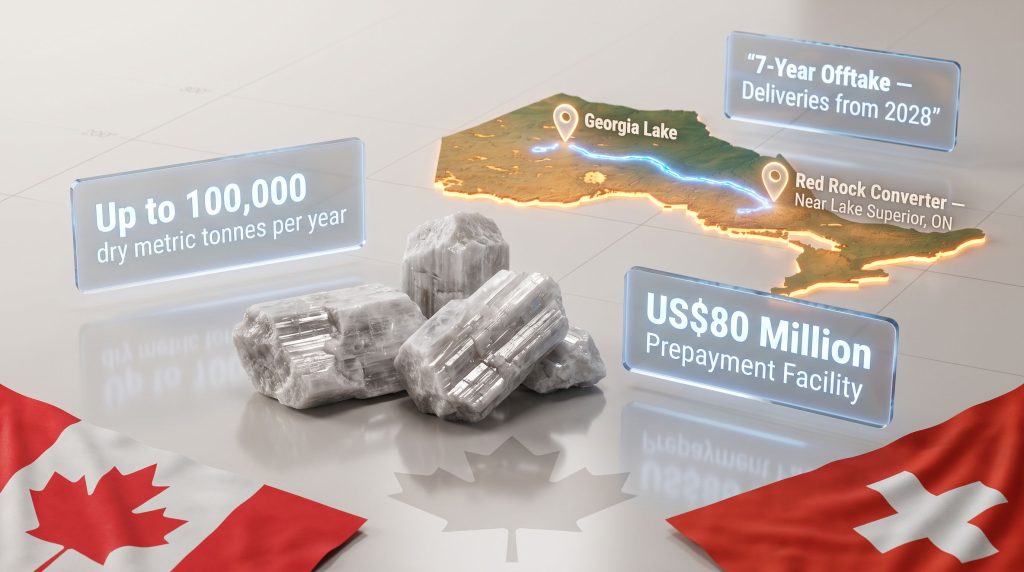
Georgia Lake is wholly owned by Rock Tech Lithium and is being advanced as the upstream feed source for the company's integrated Ontario supply chain. The proposed Red Rock lithium converter, located near Lake Superior, is designed to accept Georgia Lake spodumene concentrate and convert it into battery-grade lithium chemicals at a planned capacity of up to 32,000 metric tonnes per year of lithium carbonate equivalent (LCE). The dynamics of the lithium carbonate market are, consequently, central to understanding the commercial logic of this integrated model.
| Asset | Location | Role | Planned Output |
|---|---|---|---|
| Georgia Lake Mine | ~60 km north of Nipigon, ON | Spodumene concentrate production | Up to 100,000 t/yr concentrate |
| Red Rock Converter | Near Lake Superior, ON | Lithium chemical refining | Up to 32,000 t/yr LCE |
The geographic proximity of these two facilities within Ontario is not incidental. Shipping spodumene concentrate from mine to converter within a single provincial jurisdiction reduces logistics costs, simplifies customs and trade compliance, and creates a more defensible supply chain against the kinds of geopolitical disruptions that have repeatedly affected lithium chemical flows from offshore sources.
A less commonly understood aspect of the mine-to-converter model is the alpha spodumene to beta spodumene conversion step. Naturally mined spodumene exists in the alpha crystalline form, which is chemically unreactive with sulfuric acid. Converters must first roast the concentrate at temperatures exceeding 1,000 degrees Celsius to convert it to the beta form before acid leaching can extract the lithium. This calcination step is energy-intensive and represents a significant portion of converter operating costs, which is why geographic proximity to affordable, reliable energy infrastructure matters as much as proximity to the ore source. The broader process of spodumene-to-lithium conversion involves considerable technical and economic complexity that underpins the investment case for integrated projects.
Dissecting the Rock Tech Georgia Lake Supply Deal: Commercial Terms and Financial Structure
The Rock Tech Georgia Lake supply deal is structured as a binding seven-year offtake agreement with Transamine SA, a Switzerland-headquartered trading house with specialisation in nonferrous raw materials including lithium. According to reporting from Metal Tech News, the commercial terms reflect a carefully negotiated balance between Rock Tech's need for revenue certainty and Transamine's need for volume reliability.
Core Offtake Terms at a Glance
- Agreement type: Binding offtake
- Offtake purchaser: Transamine SA
- Commodity: Spodumene concentrate from Georgia Lake
- Initial term: 7 years, with first delivery targeted in 2028
- Extension provisions: Annual mutual-agreement renewals for up to 5 additional years
- Year 1 delivery volume: 50,000 dry metric tonnes
- Years 2 onwards: 100,000 dry metric tonnes per year (±10% tolerance in Rock Tech's favour)
- Volume finalisation: Confirmed after completion of the Georgia Lake definitive feasibility study (DFS)
The ±10% volume tolerance in Rock Tech's favour is a commercially meaningful provision. In early-stage mining production, throughput rarely meets nameplate capacity immediately. Having the flexibility to deliver 90,000 dry metric tonnes in a given year without triggering contract penalties provides a production ramp buffer that reduces offtake risk considerably.
How the US$80 Million Prepayment Facility Works
Alongside the offtake itself, Transamine has committed to a framework for providing up to US$80 million in pre-production development capital. This type of structure, often called a prepayment or streaming advance in the mining finance industry, is increasingly preferred by project developers because it avoids the equity dilution that comes with issuing new shares.
The repayment mechanism operates as follows:
- Transamine advances funds prior to first production, subject to conditions being met
- Once deliveries begin, the value of concentrate shipments is applied against the outstanding advance balance for a 24-month period
- Any remaining balance after the 24-month set-off window is settled in cash
- Interest accrues quarterly at a rate of 3-month CME Term SOFR plus 2.95%
| Prepayment Parameter | Detail |
|---|---|
| Maximum facility size | US$80 million |
| Repayment mechanism | Set-off against concentrate deliveries |
| Set-off window | 24 months from first delivery |
| Interest rate | 3-month CME Term SOFR + 2.95% |
| Interest accrual frequency | Quarterly |
CME Term SOFR (Secured Overnight Financing Rate) replaced LIBOR as the reference benchmark for US dollar lending following the global transition away from interbank offered rates. Using a floating rate benchmark means the effective cost of this facility will move with broader credit market conditions, a factor Rock Tech's treasury team will need to model carefully across different interest rate scenarios.
Conditions Precedent to Prepayment Drawdown
The US$80 million facility is conditional, not automatic. Before Transamine is obligated to advance funds, Rock Tech must satisfy several requirements:
- Secure full investor commitments for Georgia Lake's total development capital requirement
- Obtain all necessary permits and regulatory approvals across Ontario and federal jurisdictions
- Pass Transamine's comprehensive legal, financial, and technical due diligence review
- Provide acceptable concentrate test results and confirmed product specifications
These conditions function as a mutual quality gate. From Transamine's perspective, they ensure the trading house does not commit capital to a project that cannot reach production. From Rock Tech's perspective, meeting these conditions signals project readiness to the broader financing community, creating a positive signalling effect that can accelerate other capital commitments.
Offtake as a Financing Catalyst: Understanding the Project Finance Logic
To appreciate why the Rock Tech Georgia Lake supply deal carries strategic weight beyond its commercial terms, it helps to understand how project finance actually works for critical minerals developers. Understanding how lithium mining works across different extraction models provides useful grounding for this analysis.
In hard-rock lithium project finance, lenders typically require offtake coverage of at least 60-70% of projected revenue before advancing senior debt. A binding agreement with a creditworthy counterparty is not just commercially useful; it is often a structural prerequisite for accessing the debt markets at all.
The prepayment facility from Transamine fits within a broader capital stack that typically includes equity, project debt, and potentially government loan programmes. The non-dilutive nature of prepayment financing is particularly valuable in the current lithium market environment, where equity valuations for pre-production developers remain compressed relative to the capital intensity of their projects.
Comparing the main financing pathways available to spodumene developers illustrates why this structure is gaining traction:
| Financing Approach | Capital Dilution | Revenue Certainty | Margin Impact |
|---|---|---|---|
| Pure equity raise | High | None | Neutral |
| Royalty streaming | Low to moderate | Moderate | Permanent margin reduction |
| Offtake + prepayment (Rock Tech model) | None (debt-like) | High | Temporary, repaid via deliveries |
| Government loan programs | None | Partial | Dependent on terms |
The offtake-plus-prepayment model effectively converts future production into present-day capital without permanently ceding a share of revenue, making it the most capital-efficient structure for a company that retains optionality on domestic processing through the Red Rock converter.
Milestones Between Now and First Delivery in 2028
The 2028 targeted delivery date implies an execution timeline that, while achievable, leaves limited margin for delay. The critical path includes:
- Completion of the Georgia Lake definitive feasibility study (DFS), which will confirm mineable reserves, capital cost estimates, and production schedules with the level of precision required by project financiers
- Finalisation of volume and delivery schedules with Transamine following DFS outcomes
- Permitting and regulatory approvals under Ontario provincial and Canadian federal environmental and mining frameworks
- Securing full development financing commitments from the capital markets, satisfying the prepayment facility's first condition precedent
- Passing Transamine's multi-discipline due diligence process, including legal structure, financial model validation, and technical review of the mine plan
Each of these milestones is sequentially dependent in part on the others. The DFS informs the capital cost, which informs the financing quantum, which informs the permit applications, which gate the prepayment drawdown. This interdependency means that progress on any single workstream accelerates the overall timeline, while delays in any one area have compounding effects.
The next major ASX story will hit our subscribers first
Ontario's Position in North American Lithium Supply Chain Development
The broader context for the Rock Tech Georgia Lake supply deal sits within Canada's evolving role as a critical minerals supplier to North American battery manufacturing. Canada's Critical Minerals Strategy identifies lithium as a priority commodity, and Ontario's geology, infrastructure, and established mining regulatory framework position it as one of the more credible jurisdictions for battery supply chain integration in the Western Hemisphere.
The significance of domestic mine-to-converter capability within a single jurisdiction extends beyond corporate strategy. North American battery cell manufacturers, facing pressure to localise their supply chains under the provisions of the US Inflation Reduction Act, are actively seeking sources of battery-grade lithium chemicals that do not pass through non-allied processing jurisdictions. A converter situated in Ontario, fed by a mine also in Ontario, offers a supply chain provenance that is increasingly commercially valuable to downstream purchasers.
In addition, innovations such as direct lithium extraction are reshaping how the industry thinks about processing efficiency, further underscoring why jurisdictional integration and technological flexibility are both valued by offtake partners and financiers alike.
What is less widely understood is that the converter stage, not the mining stage, is currently the most significant bottleneck in Western lithium supply chains. Global conversion capacity remains heavily concentrated in China, which processes an estimated 60-70% of the world's spodumene concentrate into battery chemicals. Every tonne of conversion capacity built in North America reduces this structural vulnerability, giving projects like Red Rock a strategic rationale that extends well beyond their direct economics.
Key Takeaways for Investors and Industry Observers
The Rock Tech Georgia Lake supply deal, when assessed across its commercial, financial, and strategic dimensions, delivers several insights relevant to both the company's development trajectory and the broader lithium sector. Mining.com's coverage of the agreement highlights the scale of the commitment and its significance within the wider North American critical minerals landscape.
- Binding offtake with a reputable trading house materially de-risks the Georgia Lake project's revenue pathway ahead of the DFS, strengthening its position in project finance discussions
- The US$80 million prepayment facility represents a non-dilutive capital pathway that complements rather than competes with equity and debt financing
- Volume ramp from 50,000 to 100,000 dry metric tonnes reflects realistic production risk management, providing Rock Tech with operational flexibility in the critical first year of delivery
- The ±10% volume tolerance in Rock Tech's favour is a commercially protective mechanism that reduces penalty exposure during production ramp-up
- Preservation of the Red Rock processing option means the company retains the ability to capture higher-margin chemistry conversion as that facility advances, rather than being locked into concentrate sales indefinitely
- Ontario's integrated jurisdiction advantage creates supply chain provenance value for downstream North American battery manufacturers seeking to qualify non-Chinese lithium chemical sources
This article is informational in nature and does not constitute financial advice. Statements regarding project timelines, production targets, and financing outcomes involve forward-looking assumptions subject to material risks and uncertainties. Readers should conduct independent due diligence before making any investment decisions.
Ready to Identify the Next Major Critical Minerals Discovery Before the Broader Market?
Discovery Alert's proprietary Discovery IQ model delivers real-time alerts on significant ASX mineral discoveries — instantly transforming complex data across 30-plus commodities into clear, actionable insights for both traders and long-term investors. Explore historic discoveries and their exceptional market returns, then begin your 14-day free trial at Discovery Alert to position yourself ahead of the market.