July 31, 2026
Why the World's Most Complex Lithium Project Needed a Specific Kind of Board Member
The global critical minerals industry is undergoing a quiet but profound transformation. Projects that once attracted capital on the strength of their geological potential alone are now being evaluated through an entirely different lens. Investors, institutional funders, and offtake partners increasingly want to know who is sitting in the boardroom before they commit. Amanda Lacaze Vulcan Energy board member — this single phrase encapsulates a shift in how the sector thinks about governance.
In a sector where the distance between a feasibility study and a functioning production facility is measured not just in capital but in political relationships, regulatory navigation, and operational credibility, board composition has become a strategic asset in its own right.
This shift helps explain why the appointment of Amanda Lacaze as a non-executive director of Vulcan Energy Resources carries weight that extends well beyond a routine governance announcement. For a company attempting to build what could become Europe's first integrated, low-carbon lithium supply chain, the question of who provides strategic oversight at the board level is inseparable from the question of whether the project succeeds at all.
When big ASX news breaks, our subscribers know first
Board Composition as Competitive Advantage in Critical Minerals
The Shift From Technical Credibility to Strategic Governance
Junior and mid-tier critical minerals companies have historically recruited directors with technical backgrounds: geologists, mine engineers, and metallurgists who could validate the science underpinning a project. That model has not disappeared, but it has been supplemented by a newer imperative.
As critical minerals projects mature from exploration assets into construction-stage developments, the governance demands shift dramatically. The questions that matter most at this stage are not about what is in the ground but about how capital is allocated, how stakeholder relationships are managed, and whether the board can credibly communicate a project's strategic value to European industrial partners, institutional lenders, and policymakers simultaneously.
In the critical minerals sector, a single board appointment can signal a company's transition from speculative developer to credible industrial-scale producer, particularly when the appointee carries institutional weight across government, industry, and capital markets.
The qualities that investors and industry analysts now scrutinise in a critical minerals board appointment include:
- Demonstrated ability to scale production from early-stage development to global supply volumes
- Established networks spanning government regulators, multilateral institutions, and strategic industrial partners
- Cross-sector credibility that bridges the worlds of mining, energy technology, and policy advocacy
- A track record of operating in politically sensitive supply chain environments where geopolitical alignment matters as much as unit economics
Vulcan Energy's decision to recruit Amanda Lacaze reflects all four of these criteria with unusual precision.
Amanda Lacaze: A Career Built on Supply Chain Transformation
Twelve Years That Redefined Australian Rare Earths
Before her tenure at Lynas Rare Earths, Amanda Lacaze had built a career in corporate leadership across telecommunications and consumer industries. Her transition into the resources sector was, at the time, unconventional. What followed over the next twelve years was one of the most consequential leadership narratives in the modern history of Australian mining.
When Lacaze assumed the chief executive role at Lynas, the company was navigating severe financial distress, political controversy around its Malaysian processing operations, and deep scepticism from institutional investors. The challenge she faced was not merely operational. It was reputational, regulatory, and geopolitical simultaneously.
By the time she departed, Lynas had been transformed into a globally recognised supplier of separated rare earth materials, operating the only significant rare earths processing capacity outside of China at industrial scale. The company's assets, including the Mount Weld mine in Western Australia and the processing facility in Malaysia, had become strategically important to defence supply chains in the United States, Japan, and Europe. Furthermore, her work fundamentally shaped how Western governments think about rare earth supply chains and strategic resource sovereignty.
Key milestones from her leadership period include:
- Navigating complex permitting and community relations challenges associated with the Lynas Advanced Materials Plant in Kuantan, Malaysia
- Overseeing significant expansions of separated rare earth production capacity
- Positioning Lynas as a preferred supplier within Western government strategic stockpiling and supply diversification frameworks
- Establishing the company as a counterweight to Chinese dominance of global rare earth processing
Her Current Governance Footprint
Since leaving the Lynas chief executive role, Lacaze has moved into board-level governance positions, a trajectory consistent with senior executives who shift from operational leadership to strategic oversight. Her appointment as Chair of the Minerals Council of Australia in May 2026 placed her at the apex of Australian mining industry policy advocacy, a role that gives her direct influence over the regulatory and trade policy dialogue shaping Australia's export ambitions in critical minerals.
Her membership of Chief Executive Women extends her platform beyond the resources sector into the broader leadership conversation, reinforcing her cross-sector profile.
Her post-Lynas positioning reflects a deliberate pivot toward board-level strategic influence across multiple critical minerals verticals, with Vulcan Energy representing what she assessed as the most technologically compelling opportunity available to her.
After evaluating multiple board opportunities following her Lynas departure, Lacaze identified Vulcan as standing apart from the field, specifically because of its integrated technological approach combining lithium extraction and geothermal energy production from a single subsurface resource. That assessment, from someone with her level of industry exposure, carries significant signal value.
The Lionheart Project: What Makes It Structurally Different
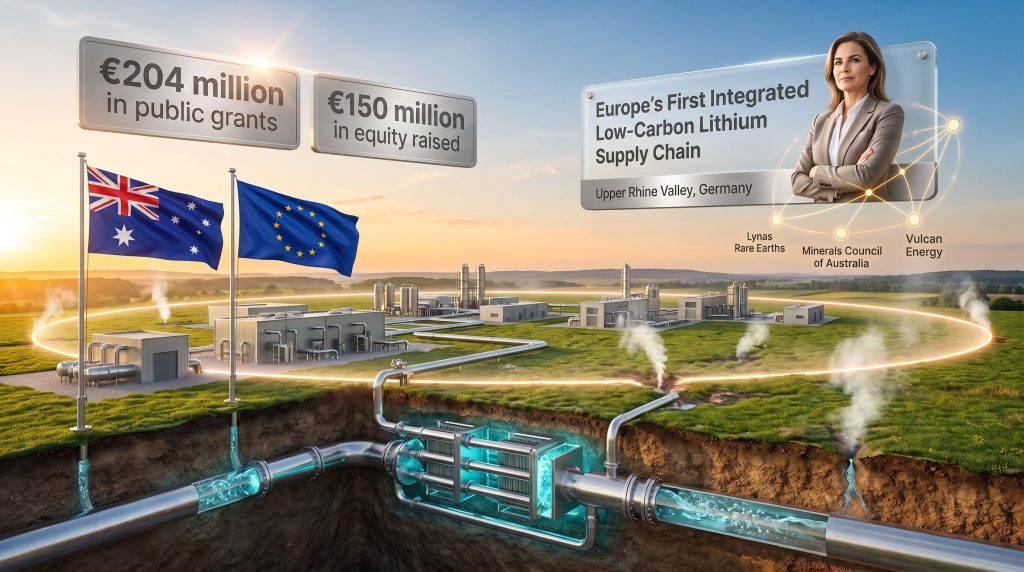
Europe's First Integrated Low-Carbon Lithium Supply Chain
To understand why this appointment matters strategically, it is necessary to understand what the Lionheart project is actually attempting to do, and why its complexity demands a specific quality of board oversight. In addition, the project's positioning speaks directly to the broader challenge of Europe's critical minerals supply chain and European battery manufacturing sovereignty.
| Project Attribute | Detail |
|---|---|
| Location | Upper Rhine Valley, Germany |
| Project Type | Integrated lithium and geothermal energy production |
| Supply Chain Scope | Extraction to refining within a 100km radius |
| Extraction Technology | Proprietary Direct Lithium Extraction (DLE) powered by geothermal energy |
| Public Grant Funding | Nearly €204 million (~A$332.4 million) |
| Equity Raised | €150 million (~A$244.5 million) |
| Strategic Positioning | Positioned as Europe's first integrated, low-carbon lithium supply chain |
The Lionheart project is not a conventional lithium mine. Understanding what makes it different requires a brief explanation of the technology at its core.
Direct Lithium Extraction: The Technology Behind the Ambition
Direct lithium extraction is a processing methodology that selectively removes lithium ions from lithium-bearing fluids, typically geothermal brines or oilfield produced water, without the need for conventional evaporation ponds or hard rock blasting. Traditional lithium production from brines, as practised in South America's Lithium Triangle, requires brine to be pumped into large evaporation ponds and left to concentrate over periods of twelve to eighteen months before further processing. DLE eliminates this step entirely.
Vulcan's model introduces a further layer of integration that has no direct precedent at commercial scale: the geothermal brine that carries the lithium also carries significant thermal energy. By extracting heat from the brine to generate renewable electricity, and then recovering the lithium from the same fluid before reinjecting the cooled, delithiated brine back into the subsurface, the project theoretically produces two outputs — lithium chemicals and geothermal energy — from a single resource and a single production well network.
The implications for carbon intensity are substantial. Unlike hard rock spodumene mining, which requires energy-intensive crushing, flotation, and high-temperature calcination before lithium can be recovered, the Vulcan model draws its processing energy from the same geothermal resource it is mining. This positions Lionheart lithium hydroxide as among the lowest carbon-intensity battery-grade lithium available globally, a distinction that matters enormously to European automotive manufacturers navigating increasingly stringent Scope 3 emissions accountability.
Why the 100km Integrated Supply Chain Radius Is Strategically Significant
The concentration of extraction, processing, and refining operations within a 100-kilometre radius is not simply a logistical convenience. It is a structural response to one of the most persistent vulnerabilities in European battery supply chains: the disconnect between raw material sources and processing capacity.
Most lithium consumed by European battery manufacturers today travels from mines in Australia or South America to processing facilities in China before arriving in Europe as battery-grade lithium hydroxide or carbonate. Every link in that chain represents a geopolitical risk point. The Lionheart model, if it reaches commercial production, would collapse that chain into a single geographic footprint on European soil.
Three Strategic Scenarios Unlocked by the Lacaze Appointment
Scenario 1: Reinforcing European Institutional Confidence
The Lionheart project has already secured close to €204 million in public grant funding and €150 million in equity, demonstrating that European public institutions and private capital markets have already made meaningful commitments. The next phase of capital requirements, associated with full construction and commissioning, will demand an even higher level of institutional confidence.
European funders, development banks, and strategic industrial partners evaluating further commitments to Lionheart will inevitably scrutinise the governance quality of the entity they are entrusting with that capital. A board member who successfully navigated the political, regulatory, and financial complexity of building a non-Chinese critical minerals supply chain at Lynas provides a credibility bridge that is difficult to replicate through any other means.
Scenario 2: Accelerating the Western Supply Chain Narrative
The geopolitical framing of the critical minerals transition has shifted decisively in recent years. Europe's dependence on Chinese-controlled lithium processing has moved from a theoretical vulnerability to a policy priority. The EU Critical Raw Materials Act, which came into force in 2024, established binding domestic production and supply diversification benchmarks for strategic raw materials including lithium. Consequently, the critical raw materials transition has become one of the defining industrial policy challenges of this decade.
Amanda Lacaze Vulcan Energy board member — this combination matters precisely because her background at Lynas maps directly onto this strategic context. Lynas built its competitive position precisely by offering Western governments and industrial buyers an alternative to Chinese rare earths processing. The institutional relationships, policy credibility, and operational knowledge she accumulated in doing so are directly transferable to the lithium supply chain challenge Vulcan is attempting to solve.
Her simultaneous role as Chair of the Minerals Council of Australia creates an additional dimension. Australia and the European Union have been deepening their critical minerals partnership through bilateral frameworks, and a board member who sits at the peak of Australian mining industry advocacy is well positioned to strengthen those government-to-government and industry-to-industry connections.
Scenario 3: Navigating the Construction Phase's Governance Demands
The transition from development to construction is widely understood within the resources industry as the highest-risk capital deployment phase a project will encounter. It is the moment when engineering assumptions meet physical reality, when procurement schedules meet global supply chain constraints, and when project budgets face their most sustained pressure.
For Lionheart, these standard construction-phase risks are compounded by the genuinely novel nature of the technology being deployed. No project has previously brought DLE-powered-by-geothermal to commercial scale in a European regulatory environment. There is no direct precedent to draw on for stakeholder management, permitting sequencing, or operational troubleshooting.
This is precisely where experienced non-executive directors earn their place. Board members who have managed the intersection of novel technology deployment, complex regulatory environments, and large-scale capital allocation provide the strategic oversight layer that translates management ambition into disciplined execution.
What This Appointment Reveals About the Broader Sector
A Pattern of Experienced Operators Moving Into Governance Roles
The appointment of Amanda Lacaze Vulcan Energy board member is not an isolated event. Across the critical minerals sector globally, there is a discernible pattern of senior executives transitioning from operational leadership into non-executive governance positions at projects approaching or entering construction. This pattern reflects the maturation of the sector itself.
The exploration and development boom in critical minerals that followed the electric vehicle demand surge of the early 2020s produced a large cohort of projects that are now approaching the point of capital commitment and physical construction. The governance demands at this stage are fundamentally different from those of the preceding exploration phase, and experienced operators who understand both the technical complexity and the stakeholder management requirements of industrial-scale delivery are in high demand.
The Dual-Channel Influence of Policy-Adjacent Board Members
One less commonly appreciated dimension of appointments like this is the dual-channel influence they create. A board member who simultaneously holds a significant industry advocacy role — such as the Minerals Council of Australia chairmanship — operates in two distinct influence environments at once: the corporate governance environment of the company they serve, and the policy advocacy environment of the industry body they lead.
This dual positioning can, in principle, allow strategic insights flowing from board-level project experience to inform broader industry policy positions, and vice versa. For a project as structurally novel as Lionheart, having a board member who can credibly engage with both European industrial policymakers and Australian government stakeholders simultaneously represents a form of strategic leverage that goes well beyond conventional directorship. Furthermore, this dynamic is deeply relevant to the broader challenge of the energy transition in mining and decarbonising critical mineral supply chains globally.
The next major ASX story will hit our subscribers first
Frequently Asked Questions
Who is Amanda Lacaze?
Amanda Lacaze is one of Australia's most prominent resources sector executives, recognised primarily for leading Lynas Rare Earths over a twelve-year period during which the company evolved from a financially distressed emerging producer into a globally significant supplier of rare earth materials. She currently serves as Chair of the Minerals Council of Australia, a position she assumed in May 2026, and holds membership of Chief Executive Women.
What is Vulcan Energy's Lionheart project?
The Lionheart project is Vulcan Energy's flagship development, located in Germany's Upper Rhine Valley. It aims to become Europe's first integrated, low-carbon lithium supply chain by combining proprietary Direct Lithium Extraction technology with geothermal energy production. The project has secured approximately €204 million in public grant funding and €150 million in equity.
What is Direct Lithium Extraction and why does it matter?
Direct Lithium Extraction is a processing method that selectively recovers lithium from geothermal brines or other lithium-bearing fluids without the large evaporation ponds associated with conventional brine processing. When integrated with geothermal energy production, as in Vulcan's model, it can dramatically reduce the carbon footprint of lithium production compared to both brine evaporation and hard rock spodumene mining methods.
Why does the Lionheart project matter to Europe's EV supply chain?
Europe faces a structural deficit in domestically produced battery-grade lithium. Lionheart, if it reaches commercial production, would represent the first lithium supply chain vertically integrated on European soil, reducing dependence on lithium processed in China and providing European battery manufacturers and automotive OEMs with a low-carbon, geopolitically secure source of supply.
What role does Amanda Lacaze now hold at the Minerals Council of Australia?
Amanda Lacaze became Chair of the Minerals Council of Australia in May 2026, making her the peak body's most senior industry representative in policy advocacy, government engagement, and trade dialogue affecting Australia's mining and resources sector.
Key Takeaways for Investors and Industry Observers
- Governance quality is now a project valuation input: In the critical minerals sector, institutional funders and offtake partners increasingly treat board composition as a material factor in assessing project credibility and risk.
- Supply chain credibility is portable: Executives who have built Western-aligned critical minerals supply chains carry transferable institutional knowledge and relationships that can be redeployed across different commodities and geographies.
- The construction phase is a governance inflection point: The Lionheart project's transition from development into active construction marks the period of highest capital risk, making the addition of experienced board oversight particularly well-timed.
- DLE and geothermal integration represent unprecedented operational territory: The combination of novel extraction technology and renewable energy co-production demands board members capable of navigating challenges that have no direct industry precedent.
- Australian expertise is becoming a structural input into European industrial strategy: The people-to-people and institution-to-institution connections between Australian critical minerals leadership and European industrial demand are deepening, with appointments like this reinforcing that trend.
Readers seeking broader context on Australia's critical minerals sector and its evolving role in global supply chains can explore ongoing industry reporting at Australian Mining, which provides regular coverage of project developments, industry leadership, and critical minerals market dynamics.
Disclaimer: This article contains forward-looking analysis and scenario projections regarding the Lionheart project and critical minerals markets. These projections involve assumptions and uncertainties and should not be construed as financial advice. Readers should conduct their own independent research before making any investment decisions.
Want to Stay Ahead of the Next Major Critical Minerals Discovery?
Discovery Alert's proprietary Discovery IQ model scans ASX announcements in real time, instantly identifying significant mineral discoveries across lithium, rare earths, and more than 30 other commodities — transforming complex data into clear, actionable opportunities for both short-term traders and long-term investors. Explore historic discoveries and their remarkable returns, then begin your 14-day free trial at Discovery Alert to position yourself ahead of the broader market.