July 31, 2026
The Battery Manufacturing Race Is Reshaping Africa's Economic Future
For most of the past century, the global industrial economy followed a predictable pattern: resource-rich developing nations supplied the raw materials, while wealthier industrial economies captured the manufacturing value. That arrangement is now under significant pressure, and nowhere is the disruption more visible than in Africa's critical minerals sector. As the energy transition minerals accelerate global demand for battery technologies, the continent that holds a disproportionate share of the world's key mineral inputs is beginning to ask a more commercially sophisticated question: why export the ingredients when you could manufacture the product?
The approval by the African Development Bank (AfDB) of a €100 million loan to Gotion Power Morocco to develop Africa's first integrated lithium iron phosphate (LFP) Morocco battery gigafactory is one of the most concrete answers yet to that question. This is not simply a manufacturing investment. It is a signal that the structural conditions for value-adding industrialisation on the continent are finally converging.
When big ASX news breaks, our subscribers know first
Morocco's Industrial Positioning: Why This Location Was No Accident
A Decade of Automotive Infrastructure Building the Foundation
Morocco's selection as the site for Africa's inaugural LFP battery gigafactory reflects decades of deliberate industrial policy rather than opportunistic timing. The country has spent more than a decade establishing itself as one of Africa's leading automotive manufacturing centres, building out competitive industrial zones, logistics corridors, and an increasingly sophisticated network of component suppliers.
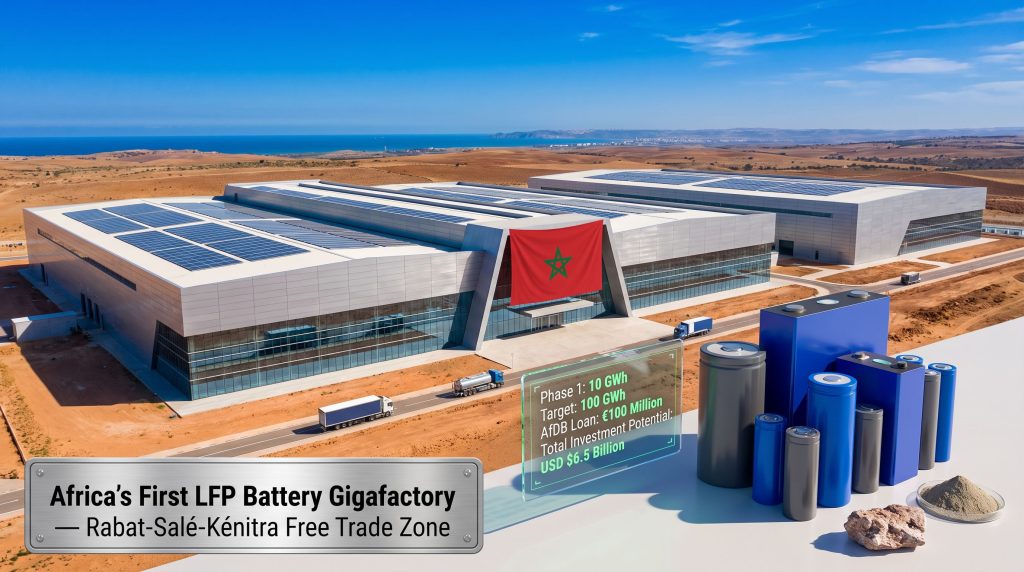
The Rabat-Salé-Kénitra Free Trade Zone, where the Gotion Power Morocco facility will be developed, exemplifies this long-term approach. It functions as a purpose-designed environment for advanced manufacturing, offering infrastructure, incentive structures, and logistical connectivity that reduce friction for capital-intensive industrial projects. For a gigafactory requiring precision supply chains and reliable energy inputs, this kind of ecosystem maturity matters considerably.
Geographic Proximity to Europe as a Structural Advantage
Morocco's geography is not incidental to this investment thesis. Positioned as a natural bridge between African mineral supply and European demand, the country offers something that few emerging market manufacturing locations can: genuine logistical proximity to the world's most aggressive EV adoption market.
European automakers are under mounting pressure to shorten and diversify battery supply chains. Regulatory requirements including the EU's Battery Regulation, which introduces progressive local content and supply chain due diligence obligations, are creating structural incentives for sourcing battery cells from geographically closer, lower-risk manufacturing partners. A Moroccan LFP facility shipping to European EV assembly plants represents a fundamentally different supply chain risk profile compared to equivalent facilities in East Asia.
The majority of initial output from the Morocco battery gigafactory is consequently expected to target European markets, reflecting this commercial logic.
Morocco's Expanding EV Supply Chain Ecosystem
The gigafactory does not exist in isolation. Companies including Hailiang and Shinzoom are reported to be planning copper and anode material facilities near Tangier, which would meaningfully broaden Morocco's battery materials manufacturing cluster. This trajectory reflects an ambition that extends well beyond a single factory: the development of an end-to-end battery supply chain anchored in North Africa, capable of serving European and eventually African EV markets from a regionally integrated industrial base.
The African Continental Free Trade Area (AfCFTA) provides a complementary framework for cross-border material flows and manufacturing integration, though the practical depth of that integration will depend on continued investment in transport infrastructure and regulatory harmonisation across member states.
What Is the Morocco Battery Gigafactory and How Large Will It Be?
Project Snapshot: Key Metrics at a Glance
| Metric | Detail |
|---|---|
| Developer | Gotion Power Morocco (subsidiary of Gotion High-Tech) |
| Location | Rabat-Salé-Kénitra Free Trade Zone, Morocco |
| Battery Chemistry | Lithium Iron Phosphate (LFP) |
| Phase 1 Annual Capacity | 10 GWh |
| Long-Term Capacity Target | 100 GWh |
| AfDB Loan Approved | €100 million (~USD $110 million) |
| Additional Finance to be Mobilised | Up to €141 million from development partners |
| Total Potential Investment (Moroccan Government Estimate) | Up to USD $6.5 billion |
| Initial Project Cost | Approximately USD $1.3 billion |
| Production Start Target | Q3 2026 |
| Primary Output Markets | Europe |
What Products Will the Facility Manufacture?
One of the most commercially significant aspects of this project is its vertical integration. Rather than focusing on a single stage of the battery manufacturing process, the Gotion Power Morocco facility will produce battery cathodes, anodes, cells, and complete battery packs within a single integrated facility.
This matters for several reasons:
- Cost efficiency: Integrated production eliminates inter-facility transportation and handling costs, compressing the overall cost per kilowatt-hour of manufactured capacity.
- Quality control: Processing materials through to finished packs within one facility enables tighter tolerances and more consistent electrochemical performance.
- Bargaining position: A fully integrated African manufacturer can offer European buyers a single-source supply relationship, reducing procurement complexity significantly.
LFP chemistry specifically uses lithium, iron, and phosphate to construct the cathode material. Compared to chemistries incorporating nickel, cobalt, or manganese, LFP offers superior thermal stability, a longer operational cycle life, and substantially lower material costs. The trade-off is a lower energy density relative to nickel-rich cathode chemistries, which is why LFP is particularly well-suited to commercial vehicle applications, stationary energy storage, and mass-market passenger EVs where packaging space is less constrained.
How Does 10 GWh Compare Globally?
To contextualise Phase 1 output: 10 GWh of annual battery production capacity is roughly equivalent to supplying battery packs for approximately 150,000 to 200,000 electric passenger vehicles per year, depending on pack size. While this is modest by the standards of China's largest gigafactories, which operate at 100 GWh or more, it represents a historically unprecedented threshold for African manufacturing.
The scaling pathway from 10 GWh to 100 GWh, if realised, would position Morocco among the genuinely significant global battery manufacturing geographies. That trajectory is contingent on sustained demand, continued financing, and supply chain development, and investors should treat long-range capacity targets as indicative rather than confirmed.
How Is the Morocco Gigafactory Being Financed?
The African Development Bank's Role in De-Risking the Investment
The AfDB's decision to anchor the financing with a €100 million loan to Gotion Power Morocco is strategically significant beyond the quantum of capital involved. Multilateral development bank participation in a project of this nature performs a function that commercial lenders cannot easily replicate: it signals institutional credibility and substantially reduces the perceived risk premium for subsequent private investors.
The AfDB has additionally stated its intention to mobilise up to €141 million in co-financing from development finance partners, creating a layered capital structure that blends concessional and commercial funding. Furthermore, Morocco's partnership with China's Gotion High-Tech brings one of the world's most experienced LFP manufacturers directly into the project's technology and operational framework.
The Blended Finance Model: Combining Public and Private Capital
Blended finance is an increasingly established mechanism for catalysing private capital in emerging market industrial projects. The core principle is straightforward: development finance institutions (DFIs) deploy concessional lending or equity at terms that commercial lenders would not independently offer, thereby reducing the overall cost of capital to a level at which private co-investors can participate profitably.
For technology-intensive manufacturing projects in frontier markets, where perceived execution risk and currency risk can make conventional project finance unworkable, blended finance structures are often the difference between a viable investment and an uninvestable opportunity. The Morocco battery gigafactory financing structure is a working example of this model applied at meaningful industrial scale.
Key Insight: The combination of AfDB anchor lending and anticipated co-financing from development partners creates a layered capital structure that substantially reduces the risk threshold for private investors. This model is increasingly applied to industrial-scale clean energy projects across emerging economies, and its success here could serve as a replicable template for future African manufacturing investments.
Total Investment Potential: Understanding the $6.5 Billion Figure
Moroccan government projections place total investment potential at up to USD $6.5 billion across all development phases. This figure reflects the cumulative capital requirements of scaling from 10 GWh to 100 GWh of annual production capacity, incorporating upstream materials processing, infrastructure expansion, and workforce development.
It is important to distinguish between committed financing at this stage, which covers the initial project cost of approximately USD $1.3 billion, and the broader long-term investment projection, which is contingent on market conditions, offtake agreements, and continued development finance availability across multiple future phases.
Why Is LFP Battery Chemistry Central to This Project?
LFP vs. Other Battery Chemistries: A Comparative Overview
| Chemistry | Key Advantage | Key Limitation | Primary Application |
|---|---|---|---|
| LFP (Lithium Iron Phosphate) | Low cost, high safety, long cycle life | Lower energy density | Commercial EVs, energy storage |
| NMC (Nickel Manganese Cobalt) | Higher energy density | Higher cost, thermal risk | Passenger EVs, premium applications |
| NCA (Nickel Cobalt Aluminium) | High performance | Complex supply chain | High-performance EVs |
| Solid-State (emerging) | Superior energy density | Early-stage commercialisation | Future EV and grid applications |
Why LFP Aligns With Africa's Mineral Resource Base
This is perhaps the most underappreciated dimension of the Morocco battery gigafactory story. Morocco is not only a geographically convenient manufacturing location. It is one of the world's dominant phosphate producers, holding an estimated 70% of global phosphate reserves according to the US Geological Survey. Phosphate is a primary feedstock for the iron phosphate cathode material used in LFP battery chemistry.
The strategic coherence of building LFP manufacturing capacity in a country with this scale of phosphate resource is considerable. It creates the possibility of a genuinely domestic upstream-to-downstream supply chain, where Moroccan phosphate is processed into battery-grade lithium iron phosphate and then incorporated into cells manufactured within the same national industrial ecosystem. Few countries globally can claim this degree of natural supply chain alignment for any single battery chemistry.
Global Demand Drivers for LFP Batteries Through 2030
Several structural forces are converging to strengthen demand for LFP production capacity over the coming decade. The global lithium market is likewise shifting in ways that reinforce this trajectory, with demand projections underpinned by accelerating electrification commitments across major economies. These forces include:
- Accelerating EV adoption across European markets, driven partly by tightening emissions regulations and OEM electrification commitments.
- Growing preference among commercial fleet operators and mass-market automakers for LFP chemistry due to its cost and longevity advantages.
- Rapid expansion of grid-scale battery storage expansion, for which LFP's long cycle life and thermal safety characteristics are particularly well-matched.
- EU Battery Regulation provisions requiring progressive increases in recycled content and supply chain transparency, which may favour geographically proximate manufacturers who can demonstrate traceability more readily.
How Does This Project Fit Into Africa's Broader Value Chain Ambitions?
The Historical Problem: Minerals Exported, Value Created Elsewhere
Africa supplies a substantial proportion of the minerals underpinning the global energy transition. Cobalt, manganese, graphite, phosphate, and lithium are all present in significant quantities across the continent. Yet the economic value generated through refining, cell manufacturing, and EV assembly has overwhelmingly been captured in China, Europe, South Korea, and Japan.
This structural disconnect between mineral endowment and industrial value creation represents one of the most persistent economic challenges facing resource-dependent African economies. When a tonne of cobalt leaves the Democratic Republic of Congo as ore and returns to the continent as a battery module in an imported electric vehicle, the value added in between has been created, taxed, and employed elsewhere.
The Policy Shift Driving Beneficiation Across the Continent
Governments across Africa are increasingly responding to this dynamic through export restrictions on raw materials, mandatory beneficiation requirements, and industrial policy frameworks designed to incentivise downstream processing. These are not isolated policy experiments. They reflect a continental-scale recognition that raw material export dependency has limits as a development strategy.
The critical minerals demand narrative is further reinforcing this policy momentum, as governments recognise that securing manufacturing capacity alongside resource extraction is essential to long-term economic competitiveness. The AfCFTA provides a broader enabling architecture for cross-border battery value chains, theoretically allowing minerals from one African country to be refined in another and assembled into finished products in a third, with preferential trade terms applying throughout.
Morocco as a Proof-of-Concept for the Wider African Industrial Transition
What the Gotion Power Morocco gigafactory demonstrates is that integrated battery manufacturing is commercially and technically achievable on the African continent at meaningful scale. That proof-of-concept function may ultimately be as valuable as the facility's direct economic output.
If the project achieves its Phase 1 targets on schedule, it becomes a reference case that development finance institutions, private investors, and manufacturing partners can point to when evaluating the next generation of African battery and clean technology manufacturing proposals. The replicability of this model in other mineral-rich African economies, including the DRC for cobalt, Zimbabwe for lithium, and South Africa for manganese, is a question that will become increasingly pressing as the global competition for battery supply chain security intensifies.
The next major ASX story will hit our subscribers first
What Role Does Technology Transfer Play in This Investment?
The Gotion High-Tech Partnership: Technology Meets Industrial Infrastructure
Gotion High-Tech brings substantial global battery manufacturing expertise to this partnership. The distinction between importing finished battery products and building domestic manufacturing competence through technology transfer is commercially significant: the former generates short-term supply security, while the latter builds long-term industrial capability and employment.
The partnership structure enables knowledge transfer alongside capital deployment, which is increasingly recognised as a prerequisite for sustainable industrial development rather than a desirable add-on. Development finance institutions including the AfDB are progressively structuring their lending conditions to incentivise genuine technology sharing and local content requirements rather than simply funding construction of facilities that remain dependent on foreign expertise indefinitely.
Skills Development and Employment Generation
Battery manufacturing is a skills-intensive industry. Beyond direct employment within the facility, a project of this scale generates demand for engineers, logistics specialists, quality technicians, maintenance professionals, and supply chain managers across the surrounding ecosystem. These employment multiplier effects extend well beyond the factory gate and represent a meaningful contribution to Morocco's human capital development.
The long-term significance of establishing this competency on the continent extends beyond Morocco. Engineers and manufacturing specialists trained within the gigafactory ecosystem become mobile assets who can contribute to the development of the next generation of African clean technology facilities. In addition, Morocco's role in the battery raw materials market is likely to deepen further as domestic processing capabilities mature alongside manufacturing capacity.
Frequently Asked Questions: Morocco Battery Gigafactory
What is the Morocco battery gigafactory?
Africa's first integrated lithium iron phosphate (LFP) battery manufacturing facility, developed by Gotion Power Morocco in the Rabat-Salé-Kénitra Free Trade Zone. The plant will produce cathodes, anodes, battery cells, and complete battery packs within a single integrated facility, with an initial annual capacity of 10 GWh and long-term expansion plans targeting 100 GWh. According to the African Leadership Magazine, this facility marks a pivotal moment in Africa's role within the global clean energy supply chain.
Who is funding the Morocco gigafactory?
The African Development Bank approved a €100 million loan to support the project, with plans to mobilise up to an additional €141 million from development finance partners. Total investment across all phases could reach up to USD $6.5 billion according to Moroccan government projections, with the initial project cost estimated at approximately USD $1.3 billion.
Why was Morocco chosen for Africa's first battery gigafactory?
Morocco offers a combination of established automotive manufacturing infrastructure, competitive free trade zones, strategic proximity to European EV markets, and globally dominant phosphate reserves that create natural supply chain alignment with LFP battery chemistry. These factors collectively make it the most commercially and logistically viable location for large-scale battery manufacturing on the continent at this stage of market development.
When will the Morocco gigafactory begin production?
Initial production was targeted to commence in Q3 2026, with Phase 1 delivering approximately 10 GWh of annual battery production capacity.
What is LFP battery chemistry and why does it matter?
Lithium iron phosphate (LFP) is a battery chemistry valued for its cost efficiency, thermal stability, and long operational cycle life. It is increasingly favoured for commercial electric vehicles, mass-market passenger EVs, and grid-scale energy storage. Morocco's substantial phosphate resources create a natural feedstock alignment with LFP manufacturing that few countries globally can replicate for this chemistry.
How does this project connect to Africa's critical minerals strategy?
The gigafactory represents a concrete step toward capturing more economic value from Africa's mineral resources by converting raw material extraction into finished industrial products. Rather than exporting phosphate for processing elsewhere, Morocco is positioning itself to manufacture battery components that feed directly into global EV and energy storage supply chains.
Key Takeaways: What the Morocco Gigafactory Signals for African Industry
From Raw Material Exporter to Clean Technology Manufacturer
The fundamental shift this project represents is one of economic model rather than simply industrial scale. Africa's competitive position in the energy transition will ultimately be determined not by how much mineral material it can extract and export, but by how much of the downstream manufacturing value chain it can credibly host.
The Morocco battery gigafactory does not resolve that challenge on its own. However, it demonstrates that the commercial, financial, and technical conditions for this transition are achievable, and that the right combination of industrial infrastructure, development finance, and manufacturing partnership can deliver outcomes that were widely considered aspirational just a few years ago.
The Partnership Template: Finance, Technology, and Industrial Policy in Alignment
The convergence of AfDB development financing, Gotion High-Tech's manufacturing technology platform, and Morocco's established industrial policy framework created an investment structure that no single party could have assembled independently. This alignment of finance, technology, and policy is increasingly recognised as the necessary precondition for delivering capital-intensive clean technology manufacturing in emerging markets.
The broader applicability of this template to other African nations pursuing industrial diversification is significant. Nations with mineral endowments but less developed industrial infrastructure can potentially replicate the model by prioritising free zone development, logistics investment, and active engagement with development finance institutions before approaching technology partners.
What Comes Next: Scaling the Model Across the Continent
The conditions required to replicate Morocco's approach in other mineral-rich African economies include:
- Mature industrial zone infrastructure capable of supporting advanced manufacturing.
- Reliable energy supply at competitive cost, including increasingly from renewable sources.
- Development finance institution engagement to anchor the capital structure and crowd in private investment.
- Technology partnership arrangements that include genuine knowledge transfer and local content obligations.
- Regional trade frameworks that enable cross-border supply chain integration at scale.
Strategic Perspective: As the global race for battery supply chain security intensifies, Africa's competitive advantage may increasingly derive not from the volume of minerals it extracts, but from the sophistication of what it manufactures from them. The Morocco battery gigafactory is the first substantive proof point for that thesis.
Readers interested in the broader context of African mining investment and industrial development can explore additional perspectives and analysis through the Mining Indaba Content Hub, which covers emerging trends across Africa's resource and clean energy sectors.
This article contains forward-looking statements and projections, including capacity targets and investment figures, that are subject to material risks and uncertainties. Readers should not interpret any content herein as financial advice. Independent due diligence is recommended before making investment decisions related to any companies or projects mentioned.
Want to Track the ASX Opportunities Emerging From the Battery Materials Boom?
As Africa's critical minerals sector reshapes global battery supply chains, the demand for lithium, phosphate, and related commodities is creating significant opportunities on the ASX — and Discovery Alert's proprietary Discovery IQ model delivers real-time alerts the moment significant mineral discoveries are announced, ensuring subscribers can act ahead of the broader market. Explore historic discoveries and their remarkable returns on Discovery Alert's dedicated discoveries page, and begin your 14-day free trial today to position yourself at the forefront of the next major find.