July 31, 2026
The Quiet Revolution Reshaping Africa's Battery Mineral Landscape
For decades, Africa's role in global commodity markets followed a familiar and frustrating pattern: extract raw materials, ship them abroad, and watch other nations capture the majority of the value. That dynamic is now being actively dismantled in one of the continent's most lithium-rich nations. The structural forces driving this change reflect a convergence of surging global battery demand, tightening supply chains, and the growing leverage that resource-holding nations can exercise when timing and geology align in their favour.
Zimbabwe sits at the centre of this shift. Its hard-rock lithium deposits, long underutilised relative to their scale, are now generating export revenues that would have seemed implausible just two years ago. Understanding why those numbers have moved so dramatically requires looking beyond the headline figures and into the mechanics of how lithium is priced, processed, and politically managed.
When big ASX news breaks, our subscribers know first
Zimbabwe Lithium Exports Up 230%: Unpacking What the Numbers Actually Mean
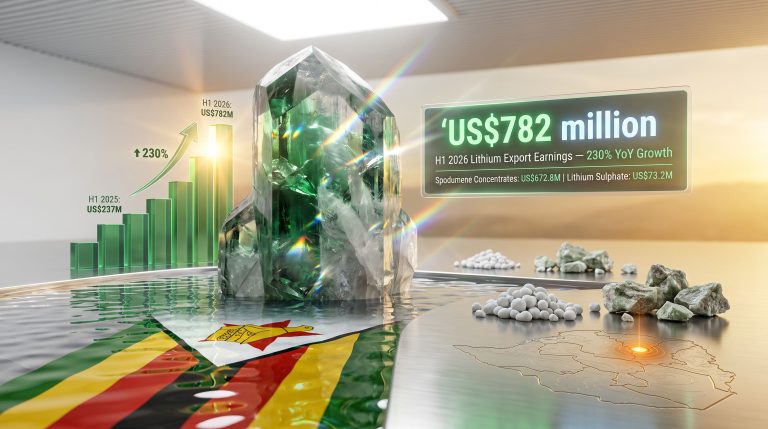
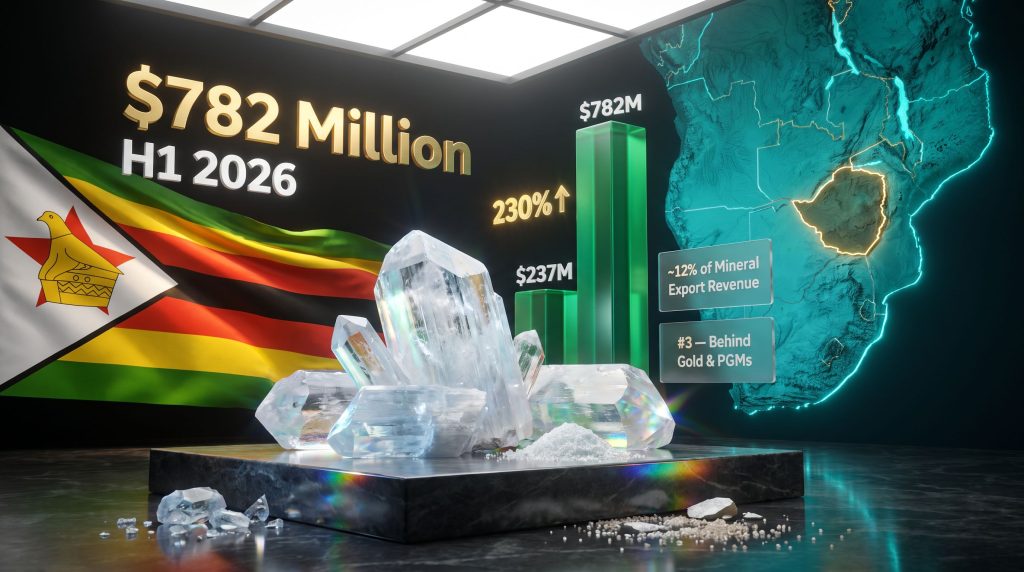
Zimbabwe's Finance Minister Mthuli Ncube confirmed during the country's half-year budget review that lithium export revenue reached $782 million in the first six months of 2026, compared to $237 million during the same period in 2025. That represents a year-on-year increase of approximately 230%, or roughly $545 million in additional revenue generated within a single comparable period.
These figures place lithium as the third-largest contributor to Zimbabwe's mineral export earnings, accounting for approximately 12% of total mineral export revenue in H1 2026, behind only gold and platinum group metals (PGMs). For context, Q1 2026 alone generated $178.64 million in lithium export value, more than double the $84.19 million recorded in Q1 2025, according to data from mining.com and the Minerals Marketing Corporation of Zimbabwe (MMCZ).
Critically, this 230% surge is a revenue metric, not a volume metric. Actual lithium production is forecast to come in at 2.14 million metric tons for full-year 2026, slightly below the 2.2 million metric tons produced in 2025. The leap in revenue is being driven by a different set of forces entirely.
Three primary drivers explain the divergence between flat-to-declining production volumes and sharply higher export revenues:
- Global lithium price recovery in the comparison period, which amplified the per-tonne value of exports
- A deliberate shift toward higher-value processed products, particularly lithium sulphate, which commands meaningfully higher prices than raw spodumene concentrate
- Policy-driven export restructuring, including a temporary suspension of concentrate exports in February 2026, which redirected and delayed material flows, creating a pipeline effect that influenced H1 revenue timing
Lithium's Rapid Ascent in Zimbabwe's Export Hierarchy
The speed with which lithium has climbed Zimbabwe's commodity rankings is remarkable. Consider that hard-rock lithium mining in Zimbabwe at industrial scale is largely a post-2020 development, yet the mineral now generates revenues comparable to sectors with decades of established infrastructure. Furthermore, the global lithium market has increasingly recognised Zimbabwe as a significant emerging supplier within this competitive landscape.
| Mineral | Estimated Share of H1 2026 Mineral Export Revenue | Export Rank |
|---|---|---|
| Gold | Highest share | #1 |
| Platinum Group Metals | Second highest | #2 |
| Lithium | ~12% | #3 |
| All other minerals | Remainder | #4+ |
At its current growth trajectory, lithium's share of Zimbabwe's export revenue mix could challenge PGM revenues by 2027 as domestic processing capacity scales and more tonnes move through higher-value product streams. However, commodity price volatility means this projection carries inherent uncertainty and should be treated as directional rather than definitive.
The Spodumene-to-Sulphate Transition: Why Processing Stage Matters More Than Volume
One of the least understood aspects of Zimbabwe's export revenue surge is the role that product grade plays in determining export value. Raw spodumene concentrate, the most basic lithium product exported from hard-rock mines, typically trades at a significant discount to downstream processed forms. In addition, spodumene extraction methods continue to evolve, further influencing how much value each tonne of ore can ultimately yield.
Lithium sulphate represents the next step up the value chain. It is an intermediate compound produced by reacting spodumene concentrate with sulphuric acid, and it serves as a feedstock for the production of battery-grade lithium hydroxide or lithium carbonate. The commissioning of Zimbabwe's first lithium sulphate production plant in April 2026 is therefore not merely an industrial milestone; it is the mechanism through which Zimbabwe begins extracting a materially greater revenue share per tonne of lithium mined.
The distinction between exporting raw concentrate at, say, $800 per tonne versus exporting lithium sulphate at multiples of that price illustrates why Zimbabwe's revenue can grow even as production volumes remain flat or decline slightly.
This product mix shift also has implications for how Zimbabwe's lithium sector is perceived by investors and trading partners. Nations that process domestically are viewed as more strategically valuable within global battery supply chains, attracting longer-term offtake agreements and potentially higher-quality counterparties.
The Spodumene Advantage: Geological Characteristics That Matter
Zimbabwe's lithium deposits are predominantly hard-rock pegmatite formations, mineralogically similar to the world-class spodumene deposits found in Western Australia's Pilbara and Goldfields regions. This geological similarity is significant for several reasons:
- Hard-rock spodumene deposits typically offer more predictable lithium grades than brine-based deposits, which can exhibit significant variability
- Pegmatite-hosted lithium allows for faster production ramp-ups compared to brine evaporation operations, which can take 12 to 18 months to achieve steady-state output
- The Bikita and Goromonzi regions, which host Zimbabwe's primary lithium mineralisation, are among the oldest known lithium pegmatite fields in Africa, suggesting geological continuity and resource depth that exploration drilling has only partially defined
- Unlike many African hard-rock deposits, Zimbabwe's pegmatites have demonstrated commercially viable grades that attracted major Chinese capital without requiring extensive resource definition work
Resource Nationalism in Practice: The January 2027 Export Ban
Zimbabwe's government has announced a full prohibition on raw lithium concentrate exports, effective January 2027. This policy follows a well-established global playbook. Indonesia's ban on nickel ore exports, introduced in stages between 2014 and 2020, transformed that country from a raw ore exporter into a significant nickel processing hub, dramatically increasing fiscal revenues and domestic employment, though not without creating short-term supply disruptions for global markets.
The parallel with Zimbabwe is instructive but imperfect. Indonesia had substantial domestic industrial capacity and a large manufacturing base to absorb nickel processing investment. Zimbabwe's processing infrastructure is nascent, and the timeline pressure on Chinese operators is considerably more compressed.
The January 2027 ban is designed to achieve several objectives simultaneously:
- Compel Chinese mining operators to invest in domestic processing facilities rather than exporting raw feedstock to Chinese refineries
- Increase per-tonne fiscal receipts for the Zimbabwean government through higher-value export streams
- Create local employment in technical and semi-technical processing roles
- Reduce Zimbabwe's economic exposure to the raw concentrate price, which sits at the most volatile and lowest-margin point of the lithium value chain
Whether Chinese operators will accelerate local processing investment or seek alternative lithium supply sources ahead of the deadline remains one of the most consequential uncertainties facing Zimbabwe's lithium sector. A detailed examination of the export restriction's impact reveals how significantly this policy has already begun reshaping trade flows and operator behaviour.
The February 2026 Export Suspension: A Signal Worth Examining
Before the permanent ban takes effect, Zimbabwe's government took a more immediate step in February 2026, temporarily suspending all lithium concentrate exports due to documented revenue leakages and alleged malpractice by certain exporters. This episode reveals a governance dimension that is critical for assessing Zimbabwe's lithium sector risks.
The suspension created a disconnect visible in the production and export data. Zimbabwe's state minerals export agency recorded 1.13 million tons of lithium exported in 2025, against reported production of 2.2 million tons for the same year. That gap of roughly 1.07 million tons suggests substantial stockpile accumulation at mine sites, likely a product of both the export suspension and pre-existing logistical and regulatory frictions.
This stockpile dynamic may be a partial but underappreciated contributor to the strong H1 2026 revenue figures, as deferred material from the suspension period entered the export pipeline once the halt was lifted.
Chinese Dominance in Zimbabwe's Lithium Sector: Strategic Dependency and Its Tensions
Five major Chinese firms currently control the overwhelming majority of Zimbabwe's lithium mining and early-stage processing:
| Company | Primary Role in Zimbabwe |
|---|---|
| Zhejiang Huayou Cobalt | Mining and processing operations |
| Sinomine Resource Group | Mining operations |
| Chengxin Lithium Group | Mining and processing |
| Sichuan Yahua Industrial Group | Lithium production |
| Tsingshan Holding Group | Lithium and broader metals processing |
This concentration reflects China's broader strategy of securing upstream critical mineral supply to feed its dominant position in battery cell manufacturing. Chinese firms collectively account for the vast majority of global lithium-ion battery cell production, making upstream supply security a genuine strategic priority rather than purely a commercial one.
For Zimbabwe, this creates a double-edged dynamic. Chinese capital has funded the rapid development of lithium mining infrastructure that the country could not have built independently at this pace. However, the concentration of ownership means that the Zimbabwean government's ability to enforce processing mandates depends almost entirely on the compliance behaviour of a small group of foreign-controlled entities.
Western nations, including those within the EU, the United States, Japan, and South Korea, have demonstrated growing interest in Zimbabwean lithium as part of broader supply chain diversification strategies. Consequently, battery metals investment interest from non-Chinese sources has grown materially, though whether this translates into actionable capital flows capable of reducing Chinese dominance remains speculative at this stage.
The next major ASX story will hit our subscribers first
Fiscal Implications and Economic Risks: A Balanced Assessment
At $782 million in half-year export revenue, lithium is now a material contributor to Zimbabwe's foreign currency earnings, a significant consideration for a country that has historically faced severe foreign exchange constraints. Sustained growth in lithium revenues would support improved reserve positions, reduced current account pressures, and potentially greater fiscal space for infrastructure investment.
However, several structural risks warrant close monitoring:
- Lithium price cyclicality: The Zimbabwe lithium exports up 230% figure is partly a function of price recovery from the sharp downturn seen in 2023 and 2024. A return to depressed lithium prices would compress revenues rapidly, since Zimbabwe's export volumes are not growing proportionally to offset price weakness
- Operator compliance uncertainty: Whether the five dominant Chinese firms will commit to building domestic processing capacity before January 2027 or attempt to renegotiate the deadline is unresolved
- Governance and leakage risks: The February 2026 export suspension demonstrated that revenue collection and export monitoring systems have meaningful weaknesses that could undermine the fiscal benefit of production growth
- Infrastructure constraints: Zimbabwe's processing ambitions require significant investment in power supply, water infrastructure, and skilled labour, areas where the country faces well-documented constraints
Furthermore, developments in the lithium carbonate market will continue to influence Zimbabwe's downstream ambitions, as the viability of further value-adding steps depends heavily on end-product pricing dynamics.
Zimbabwe's Global Positioning: Where It Sits in the Lithium Production Hierarchy
| Country | Resource Type | Global Production Rank | Processing Status |
|---|---|---|---|
| Australia | Hard rock (spodumene) | #1 | Significant refining offshore |
| Chile | Brine (Atacama) | #2 | Domestic processing growing |
| China | Mixed (brine and hard rock) | #3 | Dominant downstream processor |
| Argentina | Brine | #4 | Expanding processing capacity |
| Zimbabwe | Hard rock (spodumene) | Emerging top-10 | Nascent, actively scaling |
Zimbabwe's geological profile positions it as a potential swing supplier in a global lithium market that most analysts expect to remain structurally tight through the late 2020s, as electric vehicle adoption continues to accelerate demand faster than new supply can be brought online. The country's hard-rock deposit characteristics offer ramp-up speed and grade predictability that brine-dependent producers cannot always match.
The Value-Addition Roadmap: Four Phases of Zimbabwe's Lithium Ambition
Zimbabwe's transition from raw material exporter to processing hub is best understood as a staged progression rather than a single policy event. Moreover, innovations in direct lithium extraction technology may yet influence how efficiently future processing stages can be deployed across the country's deposit base.
- Phase 1 (Pre-2026): Raw spodumene concentrate exported with minimal domestic transformation, generating low revenue per tonne and limited fiscal benefit relative to the resource value extracted
- Phase 2 (2026): Commissioning of the first lithium sulphate plant shifts the export mix toward higher-value intermediate products, visibly reflected in H1 2026 revenue figures and underpinning the Zimbabwe lithium exports up 230% story
- Phase 3 (January 2027): Full ban on concentrate exports enforced, requiring all operators to demonstrate domestic processing capability as a condition of export rights
- Phase 4 (2027 to 2030): Anticipated development of battery-grade lithium hydroxide and lithium carbonate capacity, moving Zimbabwe further up the value chain toward materials directly usable in battery cell manufacturing
Each phase carries execution risk. Phase 3's success depends heavily on whether Chinese operators accelerate infrastructure investment or resist compliance. Phase 4 requires foreign exchange, skilled labour, energy reliability, and export market relationships that do not yet exist at scale in Zimbabwe.
The ambition is clear. The execution pathway remains the defining uncertainty for investors and policymakers watching Zimbabwe's lithium sector develop through the remainder of this decade.
Disclaimer: This article contains forward-looking statements, projections, and analytical commentary based on publicly available data and reported figures. It does not constitute financial or investment advice. Lithium markets are subject to significant price volatility, and outcomes for individual projects or national export revenues may differ materially from those described. Readers should conduct independent research before making investment decisions.
Want to Capitalise on the Next Major Battery Mineral Discovery Before the Market Does?
Discovery Alert's proprietary Discovery IQ model scans ASX announcements in real time, instantly identifying significant mineral discoveries — including battery metals like lithium — and delivering actionable insights to subscribers ahead of the broader market. Explore historic discovery returns on Discovery Alert's dedicated discoveries page and begin your 14-day free trial to position yourself at the forefront of the next major find.