July 31, 2026
The Price-Mix Revolution Reshaping Africa's Battery Mineral Landscape
When a country's export revenue from a single commodity triples in twelve months while physical shipment volumes barely move, something structurally significant is occurring beneath the surface. This is not the familiar story of a commodity boom driven by a surge in dig-and-ship activity. Zimbabwe half-year lithium exports up 230% is a story about where value is captured in the supply chain, who controls that capture, and how policy intervention can rapidly alter both answers.
When big ASX news breaks, our subscribers know first
Understanding What Zimbabwe Half-Year Lithium Exports Up 230% Actually Means
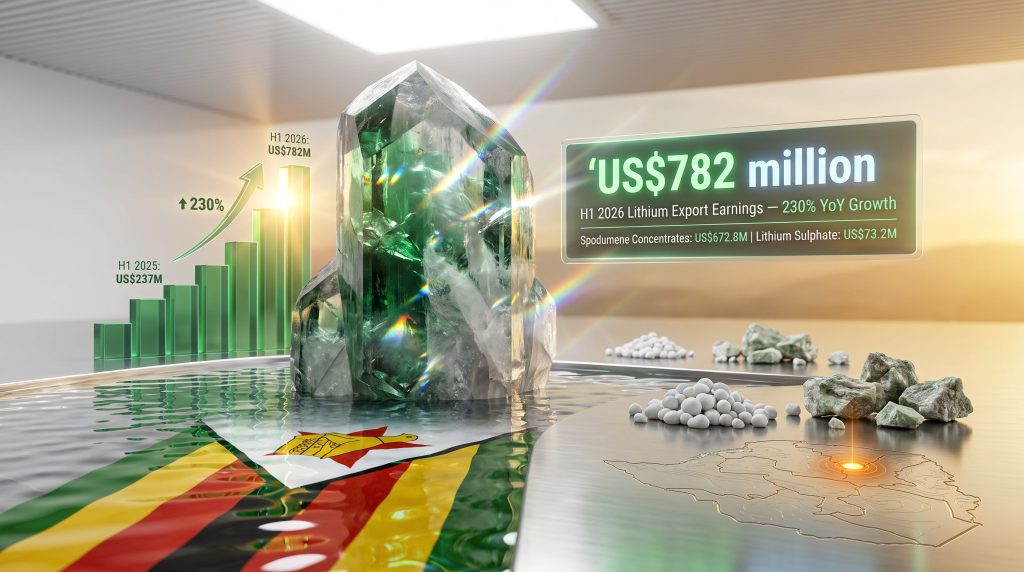
The headline figure demands careful unpacking before any strategic conclusions can be drawn. Zimbabwe's lithium export earnings reached US$782 million in H1 2026, compared to US$237 million during the equivalent period in 2025. That is a 230% year-on-year increase in revenue. However, the physical export volume picture tells an entirely different story.
In Q1 2026, Zimbabwe shipped approximately 240,826 tonnes of lithium products, compared to 224,610 tonnes in Q1 2025. That is a volume increase of roughly 7%. The divergence between a 230% revenue jump and a 7% volume increase is not a data anomaly. It is the analytical core of everything happening in Zimbabwe's lithium economy right now.
"When export revenue grows at 230% while physical volumes rise by only around 7%, the underlying driver is a structural shift in product grade and pricing power, not simply more tonnes leaving the country."
The breakdown across product categories makes this even clearer:
| Product Type | H1 2026 Revenue | Share of Total |
|---|---|---|
| Spodumene Concentrates | US$672.8 million | ~85.9% |
| Lithium Sulphate | US$73.2 million | ~9.3% |
| Other Lithium Products | ~US$36 million | ~4.8% |
| Total | ~US$782 million | 100% |
Lithium has now established itself as the third-largest mineral export earner in Zimbabwe, accounting for approximately 12% of total mineral export revenue in H1 2026, behind only gold and platinum group metals (PGMs). Finance Minister Mthuli Ncube confirmed these figures in late July 2026, framing them as evidence of the sector's growing economic significance.
Three Converging Forces Behind the Revenue Acceleration
Global Lithium Price Recovery After the 2023–2024 Correction
The lithium market downturn between late 2023 and mid-2024 saw spodumene concentrate prices fall dramatically from their 2022 peaks. The recovery that began in late 2025 and extended into 2026 substantially amplified the revenue impact of even modest volume increases. This price recovery was underpinned by structural demand continuity from the battery electric vehicle supply chain, which never fundamentally weakened despite the pricing volatility at the commodity level.
A critical but underappreciated dynamic here is the difference between spot price and contract price exposure. Chinese operators in Zimbabwe, being vertically integrated from mine to cathode in many cases, have complex internal transfer pricing arrangements that do not always map directly onto publicly reported export values. Consequently, the reported US$782 million figure likely reflects a blend of spot-referenced and contract-referenced transactions, and the true realised margin per tonne may differ from what headline revenue numbers suggest.
The Commissioning of Zimbabwe's First Lithium Sulphate Plant
April 2026 marked a genuinely significant milestone in Zimbabwe's industrial development. The commissioning of the country's first domestic lithium sulphate production facility introduced a higher-value product into the export mix almost immediately. Lithium sulphate commands a meaningfully higher per-tonne price than raw spodumene concentrate, and its contribution of US$73.2 million in H1 2026 represents an entirely new revenue stream that did not exist in the same period the prior year.
Understanding the spodumene-to-lithium salts conversion process is essential here. Spodumene concentrate is the standard export product from hard-rock lithium mines, with its lithium oxide (Li₂O) content typically ranging from 5.5% to 7.0% depending on the ore body and processing efficiency. Lithium sulphate, by contrast, is a water-soluble inorganic salt produced by reacting spodumene with sulphuric acid, occupying an intermediate position in the battery materials value chain between raw concentrate and battery-grade lithium hydroxide or carbonate.
"The shift from concentrate to sulphate is not merely a processing upgrade. It repositions Zimbabwe within the global lithium value chain, capturing a larger share of the margin between mine-gate and battery cathode production."
Export Restrictions Concentrating Value Into Compliant Shipments
In February 2026, Zimbabwe temporarily suspended lithium concentrate exports, citing revenue leakage and malpractice by certain operators. While disruptive in the short term, this intervention had an unintended structural benefit: it concentrated subsequent export activity into higher-value, more rigorously documented shipments. Operators who could demonstrate compliance, and who had progressed further along the processing curve, were permitted to resume activity first.
The more consequential policy event, however, lies ahead. Zimbabwe has announced a complete ban on raw lithium concentrate exports from January 2027, following the model established by Indonesia's nickel ore export ban in 2020. This single policy decision is compressing an enormous investment decision into an extremely narrow window for every Chinese operator currently extracting lithium in Zimbabwe.
The Five Firms Controlling Zimbabwe's Lithium Economy
Zimbabwe's lithium sector is structurally unlike most African mining industries in one specific respect: its operator base is almost entirely composed of Chinese capital, whether state-affiliated or private.
| Company | Role in Zimbabwe |
|---|---|
| Zhejiang Huayou Cobalt | Mining and processing, Arcadia mine operator |
| Sinomine Resource Group | Lithium extraction operations |
| Chengxin Lithium Group | Production and export activities |
| Sichuan Yahua Industrial | Lithium processing operations |
| Tsingshan Holding Group | Diversified metals including lithium operations |
The Arcadia deposit, operated by Huayou Cobalt and brought into production in 2023, is the anchor asset in Zimbabwe's hard-rock lithium landscape. The pegmatite formations hosting Arcadia and adjacent deposits are geologically similar to those found in Western Australia's Pilbara region, featuring relatively coarse-grained spodumene crystals that respond well to conventional dense media separation (DMS) processing.
This geological characteristic is relevant because it makes processing upgrades more technically straightforward than they would be in fine-grained or chemically complex lithium systems. Furthermore, the concentration of Chinese capital raises substantive questions about technology transfer, local employment depth, and the proportion of value that actually remains within Zimbabwe's economy rather than being repatriated through dividends, management fees, and intra-group supply contracts.
The Stockpile Question: One Million Tonnes of Unexported Lithium
One of the less-discussed aspects of Zimbabwe's lithium situation is the implied divergence between production and export volumes. Zimbabwe's Ministry of Finance projected 2.14 million metric tonnes of lithium production for 2026, marginally below the 2.2 million tonnes produced in 2025. The state minerals export agency confirmed that 1.13 million tonnes were exported in 2025.
The arithmetic creates an uncomfortable question:
- 2025 production: ~2.2 million tonnes
- 2025 confirmed exports: ~1.13 million tonnes
- Implied gap: ~1.07 million tonnes
"The divergence between production and export figures suggests either measurement inconsistencies, significant inventory build-up at mine sites, or processing losses, each with distinct policy and financial implications."
In addition, prolonged storage of spodumene concentrate carries genuine quality risks. Spodumene is relatively chemically stable, but exposure to moisture and atmospheric conditions over extended periods can affect surface chemistry in ways that marginally reduce recoveries in downstream sulphuric acid conversion processes. For operators holding large surface stockpiles in Zimbabwe's subtropical climate, this is a non-trivial operational consideration.
Three Scenarios for the Post-2027 Supply Chain
The January 2027 concentrate export ban creates a branching set of outcomes that investors and supply chain participants should be actively modelling:
- Accelerated Processing Build-Out: Chinese firms rapidly commission lithium sulphate and hydroxide conversion plants inside Zimbabwe before the deadline, maintaining market control while complying with the new regulatory framework. This is the most capital-intensive but strategically coherent response.
- Partial Supply Disruption: Insufficient processing capacity is commissioned by January 2027, creating a temporary supply gap in global spodumene markets. This scenario would likely push spodumene concentrate prices higher, benefiting producers elsewhere, particularly in Australia.
- Regulatory Negotiation and Timeline Modification: Zimbabwe modifies or delays the ban under diplomatic pressure from China, which is the primary destination for virtually all of Zimbabwe's lithium output. Given the degree of Chinese capital exposure in the sector, this scenario cannot be dismissed.
The next major ASX story will hit our subscribers first
From Sulphate to Hydroxide: The Ultimate Value-Chain Prize
Lithium sulphate is an intermediate product, not an endpoint. The next stage in Zimbabwe's processing ambition is lithium hydroxide monohydrate (LHM), the battery-grade material used directly in the production of cathode active materials for nickel-manganese-cobalt (NMC) and nickel-cobalt-aluminium (NCA) battery chemistries. Various lithium processing technologies are being assessed globally to achieve this transition more efficiently.
The economics of this upgrade are substantial:
- Spodumene concentrate (6% Li₂O): roughly US$800–1,200 per tonne at recent market prices
- Lithium sulphate: intermediate pricing, capturing partial processing margin
- Lithium hydroxide monohydrate: historically trades at a 3x to 5x premium over spodumene concentrate on a per-lithium-unit basis
Achieving domestic LHM production would fundamentally reposition Zimbabwe from a raw material exporter into a genuine battery supply chain participant. The technical barriers are significant, as LHM production requires precise pH control, high-purity reagents, and sophisticated crystallisation processes, but they are not insurmountable given sufficient capital investment.
How Zimbabwe's Growth Compares Globally
Context matters when interpreting the 230% figure. Australia, the world's largest lithium producer, saw export revenue growth in the range of 15–25% in the same period, reflecting price recovery rather than any structural transformation of its product mix. The Chile lithium strategy produced only modest export revenue growth, as the government's nationalisation framework for its major producers created regulatory uncertainty and constrained investment decisions.
Furthermore, the Argentina lithium market experienced comparable price tailwinds but without the same processing-mix transformation that has defined Zimbabwe's trajectory. Zimbabwe's 230% growth rate is therefore genuinely exceptional in relative terms, driven by the convergence of three forces simultaneously: price recovery, product-mix upgrading through the new sulphate plant, and policy-driven export concentration.
According to recent export data, no other lithium-producing jurisdiction experienced all three of these dynamics in the same window, underscoring just how structurally distinctive Zimbabwe's situation has become.
Risk Matrix: What Could Derail the Growth Story
| Risk Category | Specific Risk | Severity | Time Horizon |
|---|---|---|---|
| Policy Execution | January 2027 ban creates processing capacity shortfall | High | 6–18 months |
| Market Dependency | Single-buyer concentration (China as primary destination) | High | Ongoing |
| Price Volatility | Lithium price cycles could compress revenue despite volume growth | Medium | 12–36 months |
| Governance | Export leakage recurrence as seen in February 2026 suspension | Medium | Near-term |
| Infrastructure | Processing plant commissioning delays | Medium | 6–24 months |
| Geopolitical | Western sanctions risk or investment access barriers | Low-Medium | Long-term |
Western battery supply chain developers across the EU, United States, Japan, and South Korea are increasingly assessing Zimbabwe as a potential complementary source to Australian and Chilean lithium. However, the near-complete dominance of Chinese operators creates genuine barriers for non-Chinese capital seeking to access or certify the supply chain for Western battery manufacturing purposes. This structural friction is unlikely to resolve quickly.
Key Milestones to Monitor Through 2027
- Q3–Q4 2026: Ramp-up of lithium sulphate plant output and monitoring of its growing revenue contribution relative to raw concentrate
- Q4 2026: Government signals regarding January 2027 ban enforcement readiness and any timeline adjustments
- January 2027: Enforcement of the raw concentrate export ban, the single most consequential near-term policy event for Zimbabwe's lithium sector
- 2027–2028: Expected commissioning of additional processing facilities by Chinese operators; potential entry of non-Chinese capital if the investment and governance environment improves sufficiently
Disclaimer: This article is for informational purposes only and does not constitute financial or investment advice. Forecasts, projections, and scenario analyses represent analytical frameworks rather than guaranteed outcomes. Readers should conduct independent due diligence before making any investment decisions related to lithium markets, Zimbabwe's mining sector, or related securities.
Want to Capitalise on the Next Major Battery Mineral Discovery Before the Broader Market?
Discovery Alert's proprietary Discovery IQ model delivers real-time alerts on significant ASX mineral discoveries across lithium and more than 30 other commodities, instantly converting complex geological data into actionable investment insights — start your 14-day free trial at Discovery Alert today, or explore how historic mineral discoveries have generated substantial returns to understand the full magnitude of what early positioning can mean for a portfolio.