July 30, 2026
The Structural Crisis Reshaping How the World Sources Battery Materials
Every major industrial transition in history has eventually confronted a resource bottleneck. The shift from coal to oil created one. The semiconductor revolution created another. The battery economy is now facing its own, and unlike previous transitions, this one is unfolding against a backdrop of intensifying environmental scrutiny, geopolitical fragmentation, and a global race to control critical mineral supply chains before demand outpaces available supply.
Lithium sits at the centre of this bottleneck. It is the irreplaceable electrochemical foundation of lithium-ion battery technology, and there is currently no commercially viable alternative at scale. However, the dominant methods used to extract it are coming under growing pressure from regulators, local communities, and investors who increasingly price environmental, social, and governance risk into long-term valuations.
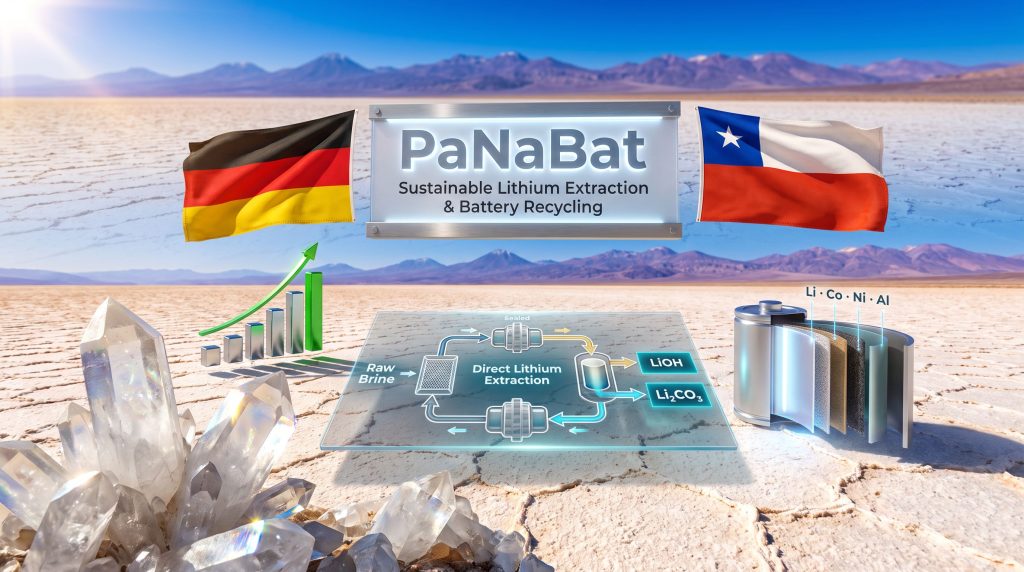
The German-Chilean PaNaBat lithium extraction and battery recycling platform represents one of the more architecturally sophisticated responses to this challenge to emerge in recent years. Rather than pursuing a single technological fix, it attempts something more ambitious: building a durable bilateral infrastructure for sustainable sourcing, processing, and circular recovery of battery materials across two continents.
When big ASX news breaks, our subscribers know first
Why the Lithium Triangle Is Both the Solution and the Problem
Geography and Concentration Risk
More than half of the world's known lithium reserves are concentrated within a single geographic zone spanning parts of Chile, Bolivia, and Argentina, a region referred to in the industry as the Lithium Triangle. Chile's lithium resources, particularly within the Atacama Salt Flat (Salar de Atacama), include some of the world's highest-grade brine deposits, where lithium concentrations can reach levels that make extraction economically compelling by global standards.
This geographic concentration creates a structural supply risk that battery manufacturers in Europe and East Asia cannot easily hedge. When a single region accounts for the majority of global reserves, any disruption, whether regulatory, environmental, or geopolitical, propagates rapidly through downstream supply chains.
The Environmental Fault Line in Conventional Extraction
The dominant extraction method in the Atacama relies on pumping lithium-rich brine to the surface and allowing it to evaporate in large, shallow pond systems over periods that can extend to 12 to 18 months. The chemistry is relatively straightforward: as water evaporates under intense solar radiation, lithium concentrations increase until the solution can be processed into lithium carbonate or lithium hydroxide.
The problem is hydrological. The Atacama is one of the driest places on Earth, and its underground water systems are fragile, interconnected, and slow to recharge. Research has raised concerns that large-scale lithium brine extraction disrupts aquifer pressure gradients, potentially drawing down freshwater sources that indigenous Atacameño communities and local agricultural operations depend on. These communities have increasingly pursued legal and regulatory challenges against mining operations, adding social licence risk to the environmental equation.
Large-scale brine evaporation in the Atacama can consume substantial volumes of water in an ecosystem where annual rainfall in some zones measures less than 15 millimetres, making water governance one of the most contested dimensions of lithium production in South America.
It is within this contested landscape that innovations like direct lithium extraction (DLE) have moved from academic interest to urgent industrial priority.
Understanding Direct Lithium Extraction: The Technology PaNaBat Is Built Around
How DLE Works and Why It Matters
Direct lithium extraction DLE technology is a collective term for a range of technologies that selectively extract lithium ions from brine solutions without relying on solar evaporation. The core mechanism involves passing brine through a selective sorbent, membrane, or ion exchange material that preferentially captures lithium while allowing other dissolved minerals to pass through.
The operational advantages over conventional evaporation ponds are significant:
- Water consumption is substantially reduced because brine can be processed and reinjected rather than evaporated to dryness
- Recovery rates from DLE processes can reach 70 to 90 percent of available lithium, compared to 40 to 60 percent typical of evaporation pond methods
- Processing timelines compress from months to hours or days, improving capital efficiency and reducing inventory cycle times
- Land footprint is dramatically smaller, reducing surface disturbance in sensitive ecosystems
- Lithium grade consistency from DLE outputs tends to be higher, producing feedstock that requires less downstream purification before battery-grade specification can be met
The trade-off is technical complexity and capital cost at the front end. DLE systems require more sophisticated engineering, higher reagent inputs, and more intensive process monitoring than passive evaporation infrastructure. This is precisely why research partnerships between institutions with deep process chemistry expertise, like the Fraunhofer network, and those with on-the-ground brine chemistry knowledge, like Chile's Universidad Católica del Norte, are strategically valuable.
Closed-Loop Evaporation as a Bridge Technology
For operations where full DLE implementation is not immediately feasible, closed-loop evaporation offers a transitional improvement. In this model, process water is captured and recycled within the extraction system rather than discharged or lost to atmospheric evaporation. The approach does not eliminate water consumption but substantially reduces the net draw on local hydrological systems.
PaNaBat is investigating closed-loop evaporation as a complementary pathway, particularly for contexts where brine chemistry or infrastructure constraints make immediate DLE deployment impractical. The ability to adapt process designs to local geological and hydrological conditions, rather than applying a standardised global template, is one of the platform's defining research principles.
The PaNaBat Platform: Architecture, Funding, and Institutional Partners
What PaNaBat Is Designed to Do
Launched in February 2026 with an initial operating phase running through January 2029, PaNaBat functions simultaneously as a research collaboration, a pilot project incubator, and an industry-research interface. Its €450,000 funding base comes from the German Federal Ministry of Research, Technology, and Space, with overall project coordination led by the Fraunhofer Institute for Silicate Research (ISC).
| Parameter | Detail |
|---|---|
| Launch Date | February 2026 |
| Project End | January 2029 |
| Total Funding | €450,000 |
| Funding Source | German Federal Ministry of Research, Technology, and Space |
| Lead Coordinator | Fraunhofer ISC (Silicate Research) |
| Geographic Scope | Germany and Chile |
The platform's founding institutional consortium reflects a deliberate balance between European process engineering expertise and Chilean raw material knowledge:
| Institution | Country | Role |
|---|---|---|
| Fraunhofer ISC (Silicate Research) | Germany | Project coordination; materials research |
| Fraunhofer IST (Thin Film and Surface Technology) | Germany | Surface and materials technology |
| Fraunhofer ISE (Solar Energy Systems) | Germany | Energy integration in extraction and processing |
| Universidad Católica del Norte, Lithium I+D+i Center | Chile | Lithium extraction R&D; primary Chilean research partner |
| Fraunhofer Chile | Chile | In-country operational coordination |
The Industry Advisory Board: Why SME Inclusion Matters
A structurally distinctive feature of PaNaBat is its industry advisory board, which draws participation primarily from small and medium-sized enterprises (SMEs) in both Germany and Chile. This weighting is deliberate. In many research platforms, industry advisory functions are dominated by large corporations whose procurement timelines and risk tolerances differ substantially from the SME sector.
By centring SME participation, PaNaBat builds in a practical commercialisation pressure that keeps research outcomes oriented toward technologies that can be adopted at mid-scale industrial operations, not just by vertically integrated mining majors. Furthermore, this also widens the potential addressable market for intellectual property and process innovations developed within the platform.
Battery Recycling: Where Circular Economy Theory Meets Electrochemistry
Functional Recovery vs. Elemental Extraction
One of the more technically nuanced aspects of PaNaBat's recycling mandate is its emphasis on functional material recovery rather than simple elemental extraction. This distinction carries real commercial weight.
Conventional battery recycling typically breaks end-of-life cells down to their base chemical constituents through pyrometallurgical (high-temperature smelting) or hydrometallurgical (acid leaching) processes. While effective at recovering metals, these methods destroy the crystalline structures and chemical configurations that give battery materials their electrochemical performance characteristics.
Functional recovery, by contrast, aims to preserve these structures so that materials, particularly cathode active materials like lithium nickel manganese cobalt oxide (NMC) compounds, can be reintroduced into battery production with minimal additional processing. The economic implication is significant: functionally recovered cathode material commands substantially higher value per kilogram than the equivalent mass of refined nickel, cobalt, or lithium carbonate. Recent battery recycling breakthroughs have further demonstrated the commercial potential of this approach.
Target Materials and Technology Priorities
PaNaBat's recycling research targets four primary battery materials:
- Lithium (recovered for reuse in new cell production or as process chemical feedstock)
- Cobalt (high-value, ethically sensitive supply chain with significant circular economy incentive)
- Nickel (increasingly dominant in high-energy-density NMC and NCA cathode chemistries)
- Aluminium (used in current collectors and cell casings; high recycling value and established processing infrastructure)
The core technology development priorities within the recycling mandate include:
- Automated battery disassembly systems that reduce manual labour exposure to hazardous materials in end-of-life cells
- Advanced sorting technologies capable of distinguishing between battery chemistries at industrial throughput scales
- Hydrometallurgical and direct recycling process optimisation for closed-loop material cycles
- Carbon footprint reduction across the full recycling value chain
The LiOH and Li₂CO₃ Connection
A strategically important dimension of PaNaBat's work is the potential linkage between its upstream extraction research and downstream recycling chemistry. If DLE and closed-loop extraction methods can produce battery-grade lithium hydroxide (LiOH) or lithium carbonate (Li₂CO₃) with a demonstrably lower environmental burden than conventional pond evaporation, these compounds can serve dual purposes: feeding directly into new cell production and providing the chemical feedstock for recycling reintegration processes.
This creates a theoretical end-to-end circular pathway — from Atacama brine to European battery cell to recycling facility and back into production — that would substantially reduce the total lifecycle environmental impact of lithium used in European battery manufacturing. Indeed, understanding the broader battery raw materials market helps contextualise why this circular chemistry pathway carries such strategic weight.
Integrated Computational Life Cycle Engineering: Sustainability as a Design Input
Why Front-Loading Environmental Analysis Changes Everything
Traditional industrial development sequences tend to address environmental performance as a retrospective exercise: processes are designed for efficiency and cost, then assessed for environmental impact after the engineering decisions have been locked in. Remediation at that stage is expensive, often incomplete, and sometimes structurally impossible without redesigning systems from scratch.
PaNaBat embeds Life Cycle Analysis (LCA) and Life Cycle Engineering (LCE) into the research and development workflow from the earliest design stages through the Integrated Computational Life Cycle Engineering (ICLCE) framework. This approach enables research teams to model the environmental trade-offs of competing process configurations before any capital commitment is made, compressing the timeline between laboratory innovation and industrially deployable sustainable solutions.
When environmental optimisation is treated as a design input rather than a compliance output, the resulting processes are structurally more sustainable, not just incrementally improved versions of environmentally problematic predecessors.
For a platform operating across both extraction and recycling, where the environmental stakes are high and the regulatory landscape is tightening, ICLCE provides a defensible, data-driven foundation for both process validation and regulatory engagement.
The next major ASX story will hit our subscribers first
Strategic Implications for European Supply Chain Resilience
Reducing Structural Vulnerability in Battery Manufacturing
European battery manufacturers currently face a compounding vulnerability: geographic concentration of lithium supply, processing capacity heavily weighted toward Asia, and tightening ESG disclosure requirements that are beginning to price non-compliant supply chains out of institutional investment portfolios.
PaNaBat contributes to addressing this vulnerability through several mechanisms:
| Strategic Dimension | PaNaBat Contribution |
|---|---|
| Supply Diversification | Direct bilateral Chile-to-Europe lithium pathway |
| Technology Sovereignty | Jointly developed DLE and recycling intellectual property |
| ESG Compliance | LCA-integrated process development from inception |
| SME Inclusion | Advisory board weighted toward mid-scale industrial applicability |
| Circular Economy Depth | Functional material recovery targeting battery-grade reuse |
Chile's Industrial Transition: From Raw Material Exporter to Value-Added Partner
For Chile, participation in the German-Chilean PaNaBat lithium extraction and battery recycling platform represents an opportunity to begin transitioning its economic relationship with lithium from that of a raw material exporter toward a more value-added role in the global battery supply chain. Chilean institutions gain access to advanced German process technologies in materials science, surface engineering, and recycling chemistry. Moreover, Chilean SMEs gain exposure to international markets and partnership networks that would otherwise be inaccessible.
This dynamic reflects a broader pattern in critical mineral geopolitics: resource-holding nations are increasingly seeking to capture more of the value chain rather than simply selling unprocessed or minimally processed commodities to industrial nations. The ICCT's analysis of expanding Chile's lithium value chain provides further context for understanding why this bilateral model is gaining traction.
How PaNaBat Fits Within the Broader German-Chilean Research Ecosystem
PaNaBat does not operate in isolation. It forms part of a wider constellation of German-Chilean bilateral research initiatives targeting next-generation lithium sourcing:
| Initiative | Focus Area | Approach |
|---|---|---|
| PaNaBat | Extraction and recycling networking platform | DLE, closed-loop evaporation, ICLCE |
| BRIDGE | Fluid reservoir exploitation for critical minerals | Virtual institute; geoscientific evaluation |
| BrineMine | Geothermal brine lithium extraction | Membrane-based selective extraction |
What distinguishes PaNaBat within this ecosystem is its platform architecture. Unlike single-technology research projects, PaNaBat is designed to onboard additional partners and pilot projects over time, functioning as an expandable infrastructure rather than a fixed research programme with a defined end state.
Key Takeaways for Industry Observers and Investors
Disclaimer: The following observations reflect analytical perspectives on industry trends and do not constitute financial advice. Readers should conduct independent due diligence before making any investment decisions.
Several dimensions of PaNaBat's design merit attention from those tracking critical mineral supply chains and battery technology investment:
- The platform's emphasis on functional material recovery in recycling signals a maturing understanding within the research community that circular economy value is maximised by preserving material performance, not just recovering elemental mass
- The integration of ICLCE from the design stage sets a methodological precedent that regulators and institutional investors are increasingly likely to require of new extraction and processing projects
- PaNaBat's bilateral structure positions it to benefit from the growing policy emphasis on supply chain diversification in European battery manufacturing, without being dependent on any single regulatory outcome
- The SME-weighted advisory board creates a commercialisation orientation that increases the probability of research outcomes translating into deployable industrial processes within the project's timeframe
- The potential for DLE-produced LiOH and Li₂CO₃ to serve both upstream battery production and downstream recycling reintegration represents a circular chemistry opportunity that the broader industry has not yet fully mapped
As the global battery supply chain undergoes structural reorganisation through the late 2020s, the German-Chilean PaNaBat lithium extraction and battery recycling platform, combining technological innovation, bilateral institutional depth, and embedded environmental accountability, is likely to occupy an increasingly important role in shaping how sustainably sourced lithium reaches European battery cells.
Want to Stay Ahead of the Next Major Battery Materials Discovery?
Discovery Alert's proprietary Discovery IQ model scans ASX announcements in real time, delivering instant alerts on significant mineral discoveries — including the critical battery materials reshaping global supply chains — so subscribers can act on actionable opportunities before the broader market responds. Explore historic discoveries and their returns or start your 14-day free trial today to gain a market-leading edge.