July 29, 2026
The Hidden Economics of Restarting a Mothballed Lithium Plant
Across the global lithium supply chain, few decisions carry as much forward-looking significance as the choice to restart a mothballed processing facility. Unlike greenfield construction or brownfield expansion, a care-and-maintenance restart is a precision instrument — one that signals a producer's view on where the cycle is heading rather than where it currently sits. The economics of that timing decision are rarely straightforward, and the operational complexity of reactivating a dormant circuit adds layers of execution risk that pure production guidance numbers rarely capture.
Pilbara Minerals (ASX: PLS) has made exactly this kind of calculated move with its Ngungaju processing plant at the Pilgangoora lithium operation in Western Australia. The July 2026 restart of Ngungaju, combined with FY27 spodumene output guidance of 1.03 to 1.1 million tonnes, positions PLS to potentially set a new annual production record while simultaneously testing the market's capacity to absorb incremental hard-rock concentrate supply. For investors and industry watchers tracking the PLS Ngungaju ramp up spodumene output trajectory, understanding the mechanics behind this decision is essential.
When big ASX news breaks, our subscribers know first
What Ngungaju Actually Is and Why It Matters
The Pilgangoora operation is not a single-circuit processing site. It hosts two distinct processing plants: the larger Pilgan circuit, which forms the operational backbone of the asset, and the Ngungaju plant, a secondary facility with a nameplate capacity of approximately 180,000 to 200,000 tonnes per annum of spodumene concentrate.
Ngungaju was originally developed and commissioned through 2022, undergoing a period of throughput optimisation before reaching its design capacity. Importantly, the two circuits process ore through different flowsheets, meaning their operational characteristics, reagent consumption profiles, and recovery rates are not identical. This distinction matters when modelling the incremental contribution Ngungaju can realistically deliver during a ramp-up phase, particularly in the September quarter of 2026, which will also include planned maintenance windows across the broader site.
The plant was placed into care and maintenance in late 2024 as spodumene extraction economics deteriorated alongside a prolonged decline in prices from their 2022 peak levels. At reduced price realisations, the marginal economics of running a second processing circuit deteriorated to the point where the fixed cost burden outweighed the incremental revenue. Care and maintenance is not a passive state: it requires ongoing expenditure to preserve equipment integrity, retain critical personnel, and maintain the optionality to restart. That PLS continued this expenditure through 2024 and 2025 suggests a deliberate decision to protect the restart pathway rather than permanently decommission the asset.
FY27 Guidance in Context: What the Numbers Actually Represent
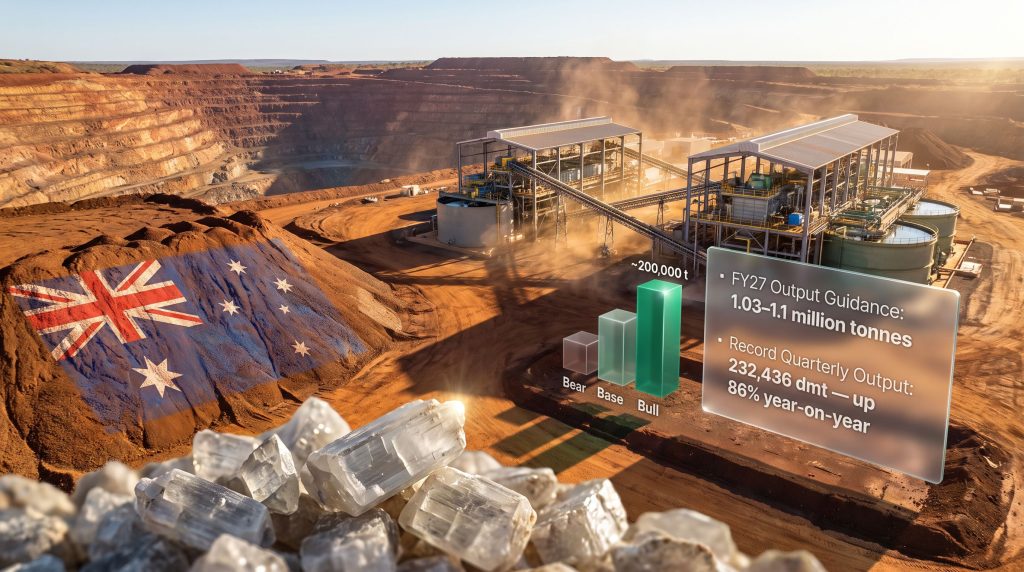
The FY27 production guidance range of 1.03 to 1.1 million tonnes of spodumene concentrate is best understood against the operational baseline Pilgangoora has already demonstrated. A recent quarterly output figure of 232,436 dry metric tonnes, representing an 86% year-on-year increase, illustrates the step-change in throughput capacity the site has achieved with dual-circuit operations approaching full utilisation.
The table below outlines the key metrics associated with the Ngungaju restart and FY27 guidance framework:
| Metric | Detail |
|---|---|
| FY27 Spodumene Output Guidance | 1.03 to 1.1 million tonnes |
| Ngungaju Nameplate Capacity | ~180,000 to 200,000 tpa |
| Record Quarterly Output | 232,436 dmt (up 86% year-on-year) |
| Ngungaju Care and Maintenance Entry | Late 2024 |
| Ngungaju Production Resumption | July 2026 |
| Steady-State Target Timeline | September Quarter 2026 |
What the guidance range communicates is a credible floor and a realistic upside scenario rather than a single-point forecast. The floor of 1.03 million tonnes assumes Ngungaju achieves a partial ramp in the first half of FY27 before reaching steady state. The top end of 1.1 million tonnes requires full dual-circuit utilisation across the majority of the financial year with limited unplanned downtime. Planned maintenance during the September quarter introduces genuine variability into how that ramp trajectory unfolds.
Scenario Modelling: Three Outcomes for Ngungaju in FY27
| Scenario | Core Assumption | Implied Ngungaju Output | Impact on Group Total |
|---|---|---|---|
| Bear Case | Delayed ramp, softening prices force curtailment | ~120,000 t | Below guidance floor |
| Base Case | Steady-state achieved by Q2 FY27 | ~180,000 t | Guidance midpoint |
| Bull Case | Full capacity, strong offtake, minimal downtime | ~200,000 t | Top end of guidance |
The Fixed Cost Absorption Argument: Why Dual-Circuit Operations Change the Unit Economics
One of the least discussed but most consequential aspects of the Ngungaju restart is its effect on Pilgangoora's unit cost structure. Hard-rock lithium operations carry a substantial fixed cost base: labour rosters, reagent supply contracts, power agreements, port logistics, and site administration costs do not scale linearly with production volume.
When Ngungaju was idled, those fixed costs were absorbed across the output of the Pilgan circuit alone, effectively inflating the cash cost per tonne of spodumene concentrate. Reactivating Ngungaju distributes the same fixed cost envelope across a materially larger volume base, compressing unit costs even if the variable cost per tonne of the secondary circuit is modestly higher due to its different processing characteristics.
Operating two processing circuits simultaneously allows fixed site costs, including labour, power, and infrastructure, to be spread across a materially larger volume base. At full dual-circuit utilisation, this dynamic can compress cash costs per tonne of spodumene concentrate, improving margin resilience even in a subdued price environment.
This is a particularly important dynamic in a market where spodumene prices have not fully recovered to their 2022 highs. Margin preservation through volume-driven cost dilution is one mechanism available to producers without requiring a price catalyst, and it is a meaningful component of the internal case for Ngungaju's restart timing.
The Relationship Between Recovery Rates and Circuit Blending
A technical nuance worth understanding is that spodumene recovery rates — the proportion of contained lithium oxide extracted from ore as sellable concentrate — vary by ore type, feed grade, and processing flowsheet. Ngungaju processes ore through a different configuration to the Pilgan plant, and the two circuits are fed from the same orebody but can be directed toward ore domains with differing lithological characteristics.
Pilgangoora hosts a pegmatite-hosted lithium deposit. Pegmatite mineralisation at Pilgangoora includes both spodumene-bearing and lepidolite-bearing zones. Spodumene, the dominant lithium mineral across the project, typically grades at levels that support commercially attractive concentrate production, but lithological variability across the orebody means that feed blend management is a continuous operational task rather than a one-time design parameter. During a ramp-up phase, optimising the feed blend to Ngungaju whilst maintaining Pilgan circuit performance is a genuine technical challenge that operating teams must navigate.
Timing the Restart: Reading the Lithium Price Signal
Spodumene prices experienced a sustained correction from the extraordinary highs of 2022, when concentrate traded above USD $8,000 per tonne on a CIF China basis, falling to levels that rendered high-cost and marginal operations uneconomic by late 2023 and through 2024. The lithium market downturn during this period placed considerable pressure on producers with higher operating costs. By mid-2026, pricing has moved off its trough but remains well below peak levels — a market environment that raises legitimate questions about the wisdom of adding supply.
The counterintuitive logic of the Ngungaju restart is that PLS is not betting on a price spike. Instead, the company appears to be positioning for a volume-driven margin recovery, using fixed cost absorption and operating leverage to generate acceptable returns at mid-cycle prices. This is a structurally different strategy to waiting for a price recovery before restarting, and it carries its own risk profile.
The risk of adding supply into a market where downstream conversion capacity in China is also ramping — and where lithium carbonate supply inventories remain elevated in certain segments — is real. Additional Australian spodumene concentrate entering the market competes at the spot level with output from other hard-rock producers, and price discovery for concentrate is closely linked to the economics of Chinese conversion facilities.
Spodumene concentrate produced at Pilgangoora is a key upstream feedstock for lithium hydroxide and lithium carbonate conversion facilities, predominantly located in China. A sustained increase in hard-rock concentrate supply from Australia has historically exerted pricing pressure at the spodumene spot level whilst supporting downstream chemical producers' input cost structures.
How Contracting Strategy Shapes the Risk Profile
PLS operates with a mix of long-term offtake arrangements and spot market exposure. The proportion of Ngungaju's incremental output that is covered by contracted offtake versus sold into the spot market is a critical variable that shapes the revenue certainty of the restart. Contracted volumes provide price floor protection, while spot-exposed tonnes carry the full benefit of any price upside but also the full downside risk of market softness.
Understanding this contract coverage ratio is one of the key monitoring signals investors should track through the ramp-up period, alongside quarterly production reports, realised price disclosures, and cash cost per tonne metrics.
What the 86% Year-on-Year Output Surge Reveals About Pilgangoora's Operational Maturity
The 86% year-on-year increase in quarterly output to 232,436 dmt is not simply a reflection of Ngungaju coming back online. It reflects the cumulative benefit of years of operational learning across Pilgangoora, including improvements in ore characterisation, mill throughput optimisation, reagent circuit tuning, and logistics coordination between the mine, the processing plants, and the Port Hedland export pathway.
Hard-rock lithium processing is operationally complex. Dense media separation circuits, froth flotation, and thermal processing stages each require continuous calibration to maintain recovery rates as ore characteristics shift across mining fronts. The fact that Pilgangoora has achieved record quarterly output demonstrates that the Pilgan circuit has reached a level of operational maturity that provides a stable platform from which Ngungaju can be reintegrated.
This operational maturity is also relevant to how quickly Ngungaju can reach steady state. A site with strong process knowledge, experienced personnel, and refined ore blending protocols is better positioned to ramp a secondary circuit efficiently than a site still working through first-principles process optimisation. Furthermore, innovations in direct lithium extraction technology across the broader industry continue to inform best practices that hard-rock operators increasingly draw upon.
The next major ASX story will hit our subscribers first
Key Risks Investors Should Monitor Through the Ramp-Up Period
No restart of this scale is without execution risk. The following are the primary variables that could cause FY27 output to track below or above the guidance range:
- Lithium price sensitivity: If spodumene prices deteriorate further from mid-2026 levels, the marginal economics of dual-circuit operation could shift, raising the possibility of a second care-and-maintenance decision for Ngungaju before the end of FY27.
- Planned maintenance timing: Scheduled shutdowns during the September quarter introduce volume variability that is difficult to offset without full ramp-up momentum across both circuits simultaneously.
- Recovery rate performance: During a ramp-up phase, recovery rates typically run below steady-state targets as the circuit is commissioned and the feed blend is optimised. Lower recoveries translate directly to lower concentrate output per tonne of ore processed.
- Offtake market depth: If downstream conversion economics in China deteriorate, demand for spot spodumene could soften, affecting PLS's ability to place incremental Ngungaju tonnes at acceptable prices.
- Operational execution: The 2022 commissioning and optimisation phase for Ngungaju demonstrated that achieving nameplate capacity takes time. Investors should not assume the nameplate figure is achievable from day one of restart operations.
Frequently Asked Questions: PLS Ngungaju Ramp-Up and FY27 Output
What is Ngungaju's role within the broader Pilgangoora operation?
Ngungaju is a secondary spodumene processing circuit at Pilgangoora, distinct from the primary Pilgan plant. It adds approximately 180,000 to 200,000 tonnes per annum of nameplate spodumene concentrate capacity, enabling PLS to target output volumes materially above what the Pilgan circuit alone can deliver.
When is Ngungaju expected to reach steady-state production?
PLS has indicated a target of reaching steady-state operations during the September quarter of 2026, though planned maintenance windows during that period introduce some timing variability into the ramp trajectory.
How much incremental spodumene does the restart add?
At full steady-state utilisation, Ngungaju adds roughly 180,000 to 200,000 dry metric tonnes per annum to group output. In FY27, the actual incremental contribution will depend on how quickly the circuit ramps from July 2026 through to full capacity.
What risks could derail the ramp-up?
Price weakness, recovery rate underperformance during commissioning, maintenance scheduling impacts, and offtake market depth are the primary risk factors. A sustained deterioration in spodumene prices remains the single largest external variable. The global lithium market dynamics, particularly shifts in demand from battery manufacturers, also warrant close monitoring. Indeed, the global lithium market in 2025 illustrated how rapidly sentiment and pricing can shift in response to macroeconomic and geopolitical forces.
How does PLS's FY27 guidance compare to peers?
At 1.03 to 1.1 million tonnes of spodumene concentrate, PLS's FY27 guidance positions it among the highest-volume hard-rock lithium producers globally, alongside peers such as Greenbushes (operated by Talison, jointly owned by Albemarle and Tianqi/IGO). Most other standalone Australian spodumene operations target significantly lower annual volumes.
FY27 as a Defining Test for PLS's Dual-Circuit Strategy
The PLS Ngungaju ramp up spodumene output story is ultimately about whether a mid-cycle volume expansion strategy can deliver acceptable returns without a price catalyst. If spodumene prices stabilise or recover modestly through FY27, the fixed cost absorption benefit of dual-circuit operations will be clearly visible in PLS's cash cost disclosures and margin metrics. If prices soften further, however, the same operational leverage works in reverse.
What the restart unambiguously communicates is that PLS's management team has made a considered assessment that the downside risk of restarting Ngungaju is acceptable relative to the upside of positioning the company at maximum volume output as the lithium cycle matures. That is a strategic signal worth taking seriously, even if the quarterly execution data will ultimately determine whether the timing proves prescient or premature.
This article is intended for informational purposes only and does not constitute financial advice. Readers should conduct their own due diligence and consult a qualified financial adviser before making investment decisions. Forward-looking statements and production guidance figures are subject to material risks, uncertainties, and assumptions that may cause actual outcomes to differ from those anticipated.
For ongoing coverage of Australian mining operations and sector developments, visit australianminingreview.com.au.
Want to Stay Ahead of the Next Major ASX Mineral Discovery?
Discovery Alert's proprietary Discovery IQ model delivers real-time alerts on significant ASX mineral discoveries, transforming complex geological and market data into actionable investment insights — explore the historic returns major discoveries have generated to understand the opportunity, then begin your 14-day free trial at Discovery Alert to position yourself ahead of the broader market.