July 31, 2026
When Production Records Mean More Than Headline Numbers
In commodity markets shaped by price volatility, geopolitical supply risk, and the accelerating energy transition, operational consistency is a form of currency that rarely appears on a balance sheet. For hard-rock lithium producers in Western Australia, the ability to sustain throughput, manage costs, and grow output simultaneously represents something far more valuable than a single strong quarter. It signals that an asset has crossed from development-stage potential into genuine industrial maturity.
That distinction matters enormously as the global battery supply chain continues its structural expansion. Against this backdrop, the PLS Pilgangoora record lithium production and sales result for FY26 deserves analysis that goes well beyond the headline tonnage figures.
When big ASX news breaks, our subscribers know first
FY26 by the Numbers: A Systematic Outperformance
Breaking Down the Production and Sales Data
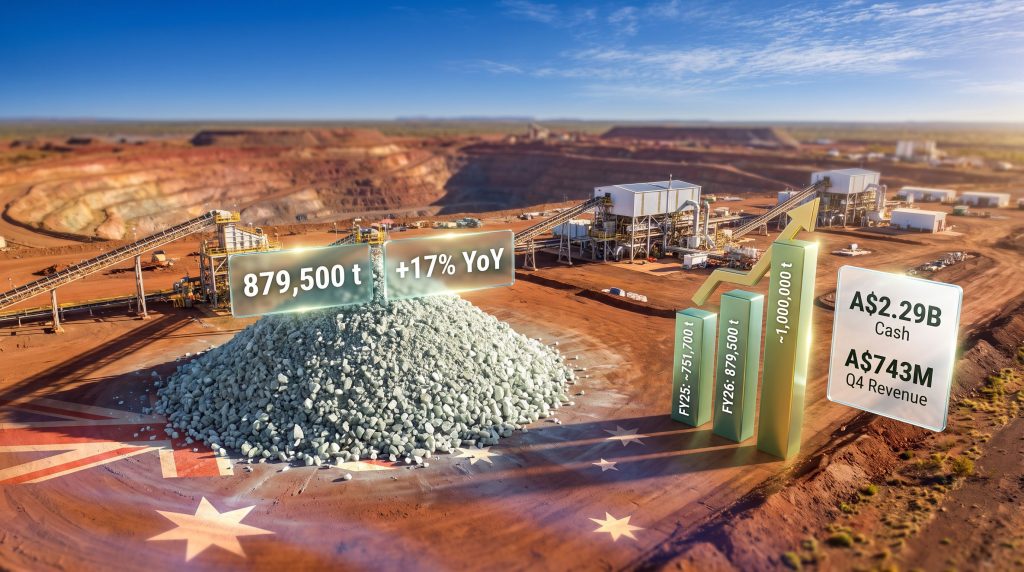
The full-year result from Pilgangoora reflects something rarely achieved in hard-rock mining: consistent quarterly throughput compounding into an annual record that exceeds guidance by a meaningful margin. Pilbara Minerals produced 879,500 tonnes of spodumene concentrate across FY26, a 17% increase on the prior year and approximately 10,000 tonnes above the company's own full-year production guidance.
Annual sales volumes reached 891,600 tonnes, also up 17% year-on-year and notably exceeding production by roughly 12,100 tonnes. This inventory drawdown dynamic is a subtle but important indicator of underlying demand strength from offtake customers.
| Metric | FY25 | FY26 | YoY Change |
|---|---|---|---|
| Annual Spodumene Production | ~751,700 t | 879,500 t | +17% |
| Annual Sales Volume | ~762,000 t | 891,600 t | +17% |
| June Quarter Production | — | 214,300 t | Quarterly record |
| June Quarter Sales | — | 249,900 t | Quarterly record |
| Average Realised Lithium Price | — | US$2,107/t | +13% QoQ |
| June Quarter Revenue | — | A$743 million | +31% QoQ |
| Cash Balance (30 June) | ~A$1.46B | A$2.29 billion | +57% QoQ |
| Net Cash Position | — | A$1.34 billion | — |
| Unit Operating Cost | — | A$616/t | Within guidance |
| Operating Cash Margin (Q4) | — | A$579 million | +26% QoQ |
The March Quarter's Role in Setting Up the Record
Full-year records are rarely built in a single quarter. The March quarter contributed 232,436 tonnes of production and 195,691 tonnes in shipments, establishing the operational momentum that carried into the June quarter result. This sequential throughput consistency is what differentiates a genuinely mature asset from one that delivers isolated strong periods.
The June quarter then provided the capstone: 214,300 tonnes produced and 249,900 tonnes shipped, driving revenue to A$743 million on the strength of both volume and a 13% quarter-on-quarter improvement in the average realised spodumene price to US$2,107 per tonne.
When volume growth and price recovery occur simultaneously in a commodity cycle, the revenue impact is multiplicative rather than additive. This combination is structurally rare and explains the 31% quarter-on-quarter revenue surge at Pilgangoora during the June period.
Understanding Spodumene Concentrate: What the Product Actually Is
For investors and observers less familiar with lithium's upstream supply chain, spodumene concentrate occupies a specific and critical position in the battery materials value chain. Understanding spodumene extraction basics helps clarify why Pilgangoora's output figures carry such strategic weight. Spodumene is a lithium-bearing pyroxene mineral found in granitic pegmatite rock formations. When mined and processed, it produces a concentrate typically graded at 5.5% to 6% lithium oxide (Li₂O), referred to in the industry as SC5.5 or SC6.
This concentrate is not a battery-ready product. The journey from spodumene to lithium salts involves a multi-stage roasting and leaching process at conversion facilities, predominantly in China, to produce either lithium hydroxide monohydrate or lithium carbonate. These refined chemicals are then incorporated into cathode active materials for lithium-ion batteries used in electric vehicles and grid-scale energy storage systems.
A critical but often overlooked aspect of this supply chain is that the conversion ratio from spodumene concentrate to lithium carbonate equivalent (LCE) is approximately 7.5 to 1 by mass. This means that roughly 7.5 tonnes of SC6 concentrate yields approximately 1 tonne of lithium carbonate equivalent. This conversion ratio is central to understanding how upstream spodumene prices relate to downstream lithium chemical prices, and why the two markets can move independently of one another.
How Costs Were Managed Alongside the Production Beat
The A$616/t Unit Cost in Context
Achieving guidance on both production volumes and operating costs in the same year is operationally significant. The two objectives can work against each other: pushing for higher throughput often involves trade-offs in maintenance scheduling, reagent consumption, and processing plant availability. The fact that Pilgangoora achieved all three metrics simultaneously, producing above guidance while holding costs within target, reflects genuine operational discipline.
Unit operating costs of A$616 per tonne of spodumene concentrate incorporated the dual headwinds of elevated diesel prices and expenditure associated with restarting the Ngungaju processing plant. In hard-rock lithium mining, diesel is one of the most significant variable cost inputs, powering the heavy mobile equipment used in open-pit extraction as well as on-site power generation. Diesel price trajectories in the Pilbara are subject to both global oil market dynamics and the logistical cost of transporting fuel to remote Western Australian operations.
A less commonly understood dynamic in hard-rock lithium processing is the role of ore blending strategies in managing unit costs and concentrate quality. At Pilgangoora, the ore body contains zones of varying lithium grade and mineralogical complexity. Effective blending of higher-grade and lower-grade ore zones through the processing plant allows operators to maintain a consistent concentrate grade for customers while optimising processing efficiency and reagent consumption. This blending capability, developed over years of operational experience, contributes meaningfully to cost stability.
Comparing Cost Structures Across Producer Types
| Producer Type | Typical Unit Cost Range | Key Cost Drivers |
|---|---|---|
| Hard-rock spodumene (WA) | A$500–A$750/t SC6 | Diesel, reagents, labour, processing |
| South American brine | US$3,000–US$6,000/t LCE | Evaporation ponds, water management, altitude |
| Integrated refinery (China) | Variable | Feedstock acquisition, conversion chemistry |
Note: Direct cost comparisons between producer types are not straightforward because they produce different product forms. Spodumene concentrate requires downstream conversion, while brine producers typically sell lithium carbonate directly. Adjusting for conversion costs narrows the gap but hard-rock operations in WA remain highly competitive at scale.
Understanding how lithium mining works across different extraction methods also helps contextualise why hard-rock operations in Western Australia maintain such a competitive cost position at scale. Furthermore, in commodity mining, fixed costs are diluted across a larger output base as production volumes increase. This operational leverage effect means that throughput growth at Pilgangoora naturally applies downward pressure on unit costs over time, even when variable cost inputs are rising.
The Cash Position: Strategic Optionality at A$2.29 Billion
From A$1.46 Billion to A$2.29 Billion in a Single Quarter
A 57% single-quarter increase in cash balance to A$2.29 billion is an exceptional result for a pure-play lithium producer. Net cash of A$1.34 billion at 30 June 2026 positions Pilbara Minerals among the most financially resilient companies in the global spodumene sector.
The operating cash margin expansion of 26% to A$579 million in the June quarter confirms that revenue growth is flowing efficiently to cash generation rather than being absorbed by cost escalation. This is the hallmark of operational leverage working in the company's favour: when price and volume improve together while costs remain controlled, margins expand disproportionately.
For investors, a strong balance sheet in a cyclical commodity business serves several functions:
- It provides downside protection during price troughs, eliminating the risk of forced asset sales or dilutive capital raises at the bottom of the cycle
- It funds growth capital without requiring equity dilution or taking on debt at disadvantageous rates
- It creates strategic flexibility to pursue acquisitions, joint ventures, or downstream investments when opportunities arise
- It shifts the risk-reward profile of pre-final investment decision (pre-FID) spending, allowing feasibility work to proceed from a position of strength rather than financial constraint
Growth Capital Deployment: Three Concurrent Initiatives
The P2000 Project: Doubling Capacity at Pilgangoora
The most significant capital allocation decision embedded in the FY26 result is the approval of approximately A$175 million in pre-FID expenditure for the P2000 project, committed during June 2026. P2000 represents a proposed expansion of Pilgangoora's nameplate processing capacity toward approximately 2 million tonnes per annum of spodumene concentrate, effectively doubling current throughput capacity.
Pre-FID spending at this scale funds detailed engineering, environmental baseline studies, infrastructure planning, and the feasibility work required to support a full investment decision. The quantum of pre-FID expenditure relative to typical project development budgets in the WA mining sector suggests that P2000 is a substantial infrastructure undertaking rather than an incremental modification to existing plant.
A critical but underappreciated aspect of large-scale capacity expansions in hard-rock lithium mining is the interplay between ore reserve adequacy and processing capacity. There is little commercial merit in commissioning a 2 million tonne per annum processing facility unless the underlying ore reserve can sustain that throughput rate over a project life that justifies the capital investment. This is precisely why the Colina project sits alongside P2000 in the development pipeline.
The Colina Project: Securing the Reserve Life Foundation
The Colina project targets the extension of Pilgangoora's ore reserve life through the development of additional mineralised material within or adjacent to the existing mine footprint. Feasibility studies for Colina are progressing in parallel with P2000, which is not coincidental. The two projects are strategically interdependent: Colina provides the geological foundation of sufficient ore reserves to justify the processing capacity expansion that P2000 represents.
From a geological standpoint, Pilgangoora sits within one of the most lithium-endowed pegmatite fields in the world. The Pilbara region of Western Australia hosts a cluster of lithium-caesium-tantalum (LCT) pegmatites formed through the differentiation of granitic magmas approximately 2.5 billion years ago during the Archean era. These ancient geological formations tend to produce consistent, well-defined ore bodies that are amenable to conventional open-pit mining and dense media separation processing, which underpins the operational reliability that Pilgangoora has demonstrated. For further context, Australian Mining reports on PLS posting record output and the strategic importance of the Colina expansion within the broader operation.
Ngungaju Restart: Near-Term Throughput Augmentation
The Ngungaju processing plant is a secondary facility at Pilgangoora that was previously placed on care and maintenance during the lithium price downturn. Its restart adds incremental processing capacity to the existing operation and is expected to contribute meaningfully to FY27 production volumes.
The Ngungaju restart introduced short-term cost headwinds during FY26 as recommissioning expenditure was absorbed. However, once fully operational, the additional throughput capacity it provides will dilute fixed costs across a larger output base, supporting unit cost improvement over time. This pattern, where restart costs temporarily inflate unit costs before throughput benefits flow through, is a well-established dynamic in mining operations and should be evaluated over a 12-to-18-month horizon rather than a single quarter.
The simultaneous pursuit of near-term throughput optimisation through the Ngungaju restart and long-term capacity growth through P2000 and Colina reflects a capital allocation framework designed to compound production growth across multiple time horizons without concentrating all optionality in a single initiative.
The next major ASX story will hit our subscribers first
FY27 Scenario Analysis: Three Pathways Forward
| Scenario | Production Assumption | Price Assumption | Implication |
|---|---|---|---|
| Bear Case | ~880,000 t (flat YoY) | US$1,800/t | Margin compression, capital conservation mode, P2000 FID delayed |
| Base Case | ~950,000–1,000,000 t | US$2,100–US$2,300/t | Continued cash accumulation, P2000 FID proceeds as planned |
| Bull Case | >1,000,000 t | >US$2,500/t | Accelerated FID timeline, potential consideration of capital return |
Disclaimer: The above scenarios are illustrative modelling frameworks based on publicly available operational data and commodity price ranges. They do not constitute financial advice or a forecast. Actual outcomes will depend on numerous factors including commodity price movements, operational performance, and capital allocation decisions made by management.
Key Variables That Will Determine FY27 Outcomes
Several operational and market variables will shape whether FY27 guidance is met, exceeded, or missed:
- Ngungaju ramp-up trajectory: The speed at which the secondary plant reaches steady-state throughput will directly influence the first half of FY27 production volumes
- Ore grade continuity: Pilgangoora's mine plan relies on maintaining blended feed grades through the processing plant; any unexpected geological variability can affect recovery rates and concentrate quality
- Diesel and reagent costs: Input cost inflation in the Pilbara remains a structural risk given the region's logistical remoteness and labour market tightness
- Spodumene price recovery sustainability: The 13% quarter-on-quarter price improvement to US$2,107/t is encouraging but the durability of this recovery depends on downstream demand from Chinese conversion facilities and global EV production rates
- Capital expenditure efficiency: The ability to deploy P2000 pre-FID spending on schedule without cost overruns will influence investor confidence in the broader expansion thesis
What the US$2,107/t Price Recovery Signal Means for the Market
The 2023–2024 lithium price correction was one of the most severe in the commodity's recent history, with spodumene concentrate prices falling from highs exceeding US$8,000 per tonne to lows below US$1,000 per tonne in some markets. The partial recovery evidenced in the June 2026 quarter result, where the average realised price reached US$2,107/t, suggests a stabilisation phase rather than a full cyclical recovery.
Several structural demand forces underpin the improved pricing environment:
- EV penetration growth: Global electric vehicle sales continue to expand, with China, Europe, and increasingly the United States driving battery material demand higher on an annualised basis
- Grid-scale storage deployment: Stationary energy storage installations, particularly lithium iron phosphate battery systems, are growing rapidly and consuming increasing volumes of lithium chemicals independent of the EV cycle
- Supply discipline from marginal producers: Higher-cost spodumene operations and brine projects that were pushed into care and maintenance during the price trough have been slow to restart, tightening near-term supply
- Chinese conversion capacity utilisation: The operating rates of Chinese lithium hydroxide and carbonate conversion facilities directly influence spot demand for spodumene feedstock, and improving utilisation supports upstream price recovery
Pilgangoora's Role in Australia's Battery Materials Positioning
Australia produces the majority of the world's hard-rock spodumene concentrate, and Pilgangoora is one of the largest single operations within that supply base. The concentration of global hard-rock lithium supply in Western Australia creates both a strategic advantage and a supply chain concentration risk for the industries that depend on it.
For battery manufacturers and automakers seeking to diversify away from lithium sources perceived as geopolitically sensitive, Australian spodumene from operations like Pilgangoora offers a combination of scale, geological endowment, and established logistics infrastructure that is difficult to replicate elsewhere in the near term. In addition, technologies such as direct lithium extraction are beginning to complement conventional hard-rock supply, though hard-rock operations remain the dominant upstream source globally.
The longer-term question for Australian lithium producers is whether the economics of domestic lithium chemical conversion will eventually justify investment in onshore refining capacity. Converting spodumene concentrate into battery-grade lithium hydroxide within Australia would capture significantly more value per tonne of ore mined. However, this requires substantial capital investment, access to competitively priced energy, and proximity to downstream manufacturing demand. Australia's lithium industry innovations in policy and technology are actively shaping this discussion, though no project-specific outcomes have been confirmed for Pilgangoora in this regard.
Furthermore, the PLS Pilgangoora record lithium production and sales performance reinforces the case that Australian hard-rock operations are well-positioned to serve as a cornerstone of the global battery supply chain for decades ahead. The Pilgangoora operation overview published by Pilbara Minerals provides additional detail on the site's infrastructure, processing capacity, and long-term development strategy for those seeking deeper operational context.
Frequently Asked Questions
What was PLS's total spodumene concentrate production in FY26?
Pilbara Minerals produced 879,500 tonnes of spodumene concentrate at the Pilgangoora operation in FY26, representing a 17% increase on the prior year and exceeding the company's full-year production guidance by approximately 10,000 tonnes. The PLS Pilgangoora record lithium production and sales result was underpinned by consistent quarterly throughput across all four quarters of the financial year.
How much revenue did PLS generate in the June 2026 quarter?
The June 2026 quarter generated A$743 million in revenue, driven by a combination of a quarterly sales record of 249,900 tonnes and a 13% quarter-on-quarter improvement in the average realised lithium price to US$2,107 per tonne.
What is the P2000 project and what does it involve?
P2000 is a proposed expansion of Pilgangoora's processing capacity targeting approximately 2 million tonnes per annum of spodumene concentrate output. Pilbara Minerals approved approximately A$175 million in pre-FID expenditure during June 2026, with a feasibility study ongoing to support a full investment decision.
Why was the Ngungaju plant restarted and what are the cost implications?
The Ngungaju plant is a secondary processing facility at Pilgangoora that was previously placed on care and maintenance. Its restart adds incremental throughput capacity to the operation. Short-term restart costs contributed to the unit operating cost of A$616 per tonne in FY26, but the medium-term expectation is that the additional throughput will dilute fixed costs and support improved unit economics.
What does spodumene concentrate actually mean in the context of battery production?
Spodumene concentrate, typically graded at 5.5–6% Li₂O, is an intermediate product derived from hard-rock lithium mining. It is not battery-ready but serves as feedstock for conversion facilities, predominantly in China, that transform it into lithium hydroxide or lithium carbonate for use in battery cathode materials. The conversion ratio is approximately 7.5 tonnes of SC6 per tonne of lithium carbonate equivalent.
How does PLS's balance sheet compare to peers?
With A$2.29 billion in cash and net cash of A$1.34 billion at 30 June 2026, Pilbara Minerals holds one of the strongest balance sheets among ASX-listed pure-play lithium producers. Consequently, the PLS Pilgangoora record lithium production and sales momentum, combined with this financial position, provides substantial flexibility for growth investment and resilience against commodity price volatility. The FY25 full-year results presentation from Pilbara Minerals also offers useful context for understanding the year-on-year progression in operational and financial performance.
This article is intended for informational purposes only and does not constitute financial advice. Readers should conduct their own research and consult a licensed financial adviser before making any investment decisions. Past operational performance does not guarantee future results.
Want to Catch the Next Major ASX Mineral Discovery Before the Market Does?
Discovery Alert's proprietary Discovery IQ model delivers real-time alerts on significant ASX mineral discoveries — transforming complex geological and market data into clear, actionable insights for both short-term traders and long-term investors. Explore historic discoveries and the exceptional returns they generated, then begin your 14-day free trial at Discovery Alert to position yourself ahead of the market.