August 4, 2026
The Battery Technology Race That China's Export Controls Just Transformed
When a major industrial power begins restricting the outflow of manufacturing knowledge rather than just physical goods, it signals something more consequential than a trade dispute. It signals a deliberate attempt to control the commanding heights of a future industry. That is precisely what Beijing has done with lithium iron phosphate battery technology, and the reverberations are now reshaping how India's largest industrial groups approach energy storage at a foundational level.
The decision by Tata Group's battery manufacturing arm, Agratas Energy Storage Solutions, to develop Agratas in-house LFP battery technology rather than continue pursuing Chinese licensing agreements is not merely a corporate strategy pivot. It represents an acknowledgment that the global battery supply chain has fractured along geopolitical lines, and that survival in the next decade of electrification requires ownership of core intellectual property, not just access to it.
When big ASX news breaks, our subscribers know first
How Beijing Weaponised Battery Manufacturing Knowledge
China's commercial dominance in lithium iron phosphate chemistry was built over roughly two decades of state-coordinated industrial policy, manufacturing scale, and accumulated process knowledge. By the time Western and Asian rivals recognised LFP's cost and safety advantages, Chinese manufacturers including CATL and BYD had already built manufacturing ecosystems that were extraordinarily difficult to replicate from the outside.
What changed in recent years was not China's manufacturing lead, but its willingness to share the underlying knowledge that created it. Beijing progressively tightened restrictions on the export of battery manufacturing equipment, cell design blueprints, and process-level know-how. These controls effectively transformed LFP technology from a commercially licensable asset into a strategically protected one.
The impact on Indian industrial groups was direct and severe. Executives at Agratas concluded that the likelihood of successfully completing a licensing agreement with a Chinese LFP cell manufacturer had effectively reached zero as restrictions intensified, according to people familiar with the matter as reported by Bloomberg. This assessment was not unique to Tata Group. Both Reliance Industries and JSW Group encountered the same structural wall when their own licensing discussions with Chinese cell manufacturers stalled or collapsed entirely.
Furthermore, shifts in the global lithium market have added further pressure on Indian manufacturers to secure independent access to both raw materials and the technologies required to process them effectively.
The systemic blockage of technology transfer from China to India is not a negotiating impasse that can be resolved with better deal terms. It is a deliberate policy outcome, and India's industrial sector is only beginning to internalise what that means for long-term battery supply chain architecture.
Understanding LFP Chemistry and Why It Matters for India
The Electrochemical Case for Lithium Iron Phosphate
LFP cells use an iron-phosphate cathode structure that is inherently more thermally stable than cobalt-based or nickel-rich alternatives. This stability translates directly into safety advantages in high-temperature operating environments, making LFP particularly well suited for markets like India where ambient temperatures regularly stress battery management systems.
The performance characteristics of competing battery chemistries reveal important trade-offs:
| Battery Chemistry | Energy Density | Thermal Stability | Cost Profile | Primary Application |
|---|---|---|---|---|
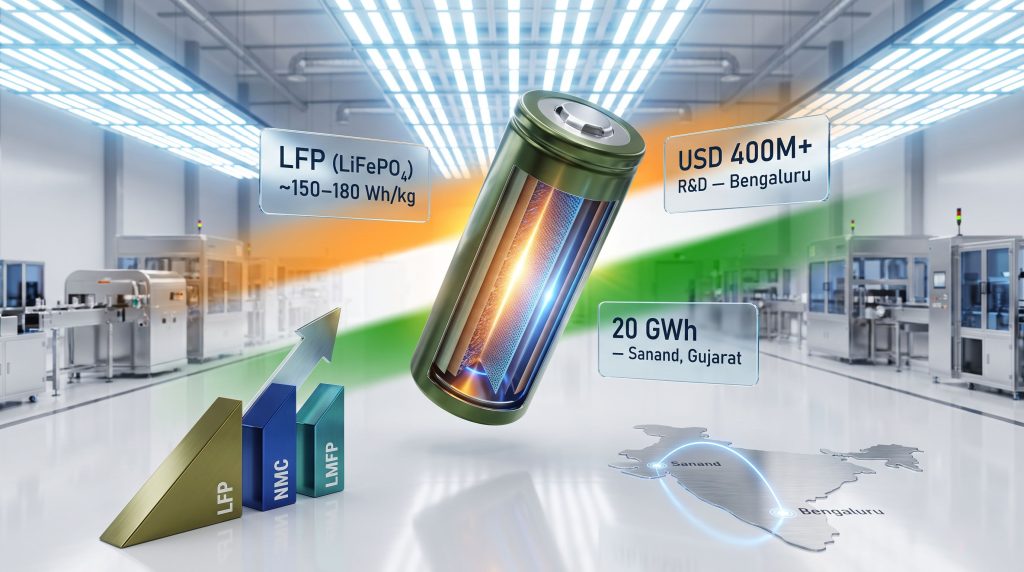
| LFP (LiFePO₄) | Lower (~150-180 Wh/kg) | High | Lower cost | Mass-market EVs, stationary storage |
| NMC (Nickel Manganese Cobalt) | Higher (~200-300 Wh/kg) | Moderate | Higher cost | Premium EVs, long-range applications |
| LMFP (Lithium Manganese Iron Phosphate) | Moderate-High | High | Moderate | Next-generation EVs, emerging applications |
LFP's lower energy density is a real constraint in passenger vehicle applications where driving range is a primary purchasing consideration. However, in grid-scale battery energy storage systems, that trade-off largely disappears. What matters in stationary storage is cost per kilowatt-hour over the operational lifetime of the asset, and LFP's superior cycle life, which can exceed 3,000 to 4,000 charge-discharge cycles under commercial operating conditions, gives it a compelling total cost of ownership advantage over NMC alternatives.
For India's rapidly expanding renewable energy sector, where grid-scale BESS procurement is accelerating alongside solar and wind capacity additions, LFP is not just a reasonable choice. It is the commercially logical one. In addition, advances in direct lithium extraction technology are beginning to improve the economics of lithium supply chains that feed directly into LFP cell production.
LMFP: The Chemistry Waiting in the Wings
A less widely understood dimension of Agratas' technology roadmap is its parallel investment in lithium manganese iron phosphate, or LMFP. This emerging chemistry sits between standard LFP and NMC in terms of energy density, offering meaningful improvements over conventional LFP while retaining the thermal stability and cost profile that make iron-phosphate cathodes attractive.
LMFP achieves higher energy density primarily by incorporating manganese into the cathode lattice, which raises the cell's operating voltage. The technical challenge is that manganese dissolution at elevated temperatures has historically limited cycle life, but advances in cathode coating technology and electrolyte formulation are progressively addressing this limitation. Agratas' USD 400 million-plus R&D investment in Bengaluru includes dedicated LMFP development work, positioning the company to potentially commercialise an upgraded chemistry that could serve as a bridge between current LFP capabilities and eventual solid-state battery platforms.
Agratas' Dual-Chemistry Architecture: Strategy in Practice
The Sanand Facility as India's Battery Manufacturing Anchor
The Sanand, Gujarat facility occupies a strategically significant position within India's emerging EV industrial corridor. Gujarat has become a focal point for EV-related manufacturing investment due to its port access, established automotive supply chain infrastructure, and proximity to key raw material logistics routes.
At Sanand, Agratas is building a facility designed to house both NMC and LFP cell production under one roof, with a planned capacity of approximately 20 GWh. This scale would position it among India's largest battery manufacturing installations once fully operational.
The pilot production line currently being established at Sanand serves a critical de-risking function. Rather than committing to commercial-scale LFP production before the technology has been validated in an Indian manufacturing context, Agratas is using the pilot line to:
- Produce initial batches of proprietary LFP cells
- Refine the manufacturing process based on observed performance data
- Validate cell chemistry against target specifications
- Generate the intellectual property documentation that forms the foundation of a defensible patent portfolio
- Train the engineering workforce that will eventually operate commercial-scale equipment
The engineering team assembled for this validation phase is notably multinational. Indian, South Korean, and Chinese specialists are collaborating on process optimisation, reflecting the reality that battery manufacturing expertise is globally distributed even when formal technology licensing has been foreclosed.
NMC Through the AESC Partnership
While LFP development proceeds through internal engineering effort, Agratas' NMC programme is advancing via a technology licensing agreement with Automotive Energy Supply Corp., known as AESC, a subsidiary of Hong Kong-headquartered Envision Energy International. This partnership provides Agratas with access to an established NMC cell platform without requiring the years of foundational R&D that LFP demands under the in-house model.
The commercial production timelines reflect this head start:
- Early 2027: NMC cell production commences at the Sanand facility in India
- Mid-2027: The Somerset, England plant begins NMC cell output
- Initial supply commitment: Both facilities will direct NMC cell production toward Jaguar Land Rover's forthcoming Range Rover Electric SUV
The AESC partnership is sometimes described as a Japanese technology arrangement, but it is worth noting the corporate structure precisely. AESC was originally a joint venture between Nissan, NEC, and NEC Energy Devices before being acquired by Envision Energy, which is headquartered in Hong Kong and has significant Chinese operational roots. This ownership context adds a layer of strategic nuance to Agratas' technology sourcing picture.
How the Two Chemistries Serve Different Markets
| Strategic Dimension | LFP (In-House) | NMC (AESC Partnership) |
|---|---|---|
| Technology Source | Proprietary / Indigenous | Licensed (AESC/Envision) |
| Primary Market | Mass-market EVs, grid-scale BESS | Premium EVs (JLR/Range Rover Electric) |
| Cost Profile | Lower | Higher |
| Development Stage | Pilot validation phase | Commercial production by early 2027 |
| IP Ownership | Full (long-term) | Licensed |
| Cycle Life Advantage | High | Moderate |
The R&D Infrastructure Behind the Long Game
A USD 400 Million Bet on Proprietary Battery Science
The scale of Agratas' commitment to the Bengaluru R&D centre warrants careful consideration. An investment exceeding USD 400 million in a dedicated battery research facility is a significant capital allocation by any global standard, and it signals that Tata Group views proprietary battery IP as a long-duration strategic asset rather than a near-term commercial necessity.
The Bengaluru centre's focus areas encompass LFP cell chemistry optimisation, LMFP development, and advanced manufacturing process research. Critically, this is not a product engineering centre focused on integrating purchased cells into battery modules. It is a materials science and electrochemistry research operation aimed at generating foundational IP that can underpin decades of manufacturing advantage.
One less commonly appreciated aspect of building battery technology from the ground up is the compounding nature of the intellectual property that results. Every process improvement, cathode formulation refinement, and electrolyte optimisation generates patentable knowledge. Over time, a company that owns its cell chemistry possesses not just a manufacturing capability, but a portfolio of defensible IP that competitors must design around or license. This is precisely the position that CATL and BYD built for themselves within China over the past two decades, and it is the position Agratas is attempting to establish for India. Consequently, the broader landscape for battery raw materials sourcing will play a critical role in determining whether Agratas can sustain its manufacturing ambitions over the long term.
The Technology Validation Feedback Loop
The relationship between the Sanand pilot line and the Bengaluru R&D centre is designed as a continuous feedback system. Cell batches produced at Sanand generate performance and failure data that inform cathode formulation and process adjustments at Bengaluru. Refined specifications then flow back to the pilot line for validation. This iterative loop is how battery manufacturers develop genuine manufacturing expertise, as distinct from simply executing a licensed process provided by a third party.
Technology Development Timeline:
- Current: Pilot LFP cell production at Sanand, validation phase underway
- Ongoing: LMFP and advanced LFP R&D at Bengaluru (USD 400M+ investment)
- Early 2027: Commercial NMC production begins at Sanand (AESC technology)
- Mid-2027: Somerset, England NMC plant commences production
- Long-term: Proprietary LFP commercial production following successful validation
India's Battery Sovereignty Imperative
The Competitive Landscape Among Indian Battery Developers
Agratas' position within India's emerging battery manufacturing sector becomes clearer when viewed against the broader competitive environment:
| Company | Technology Approach | Chemistry Focus | Key Challenge |
|---|---|---|---|
| Agratas (Tata Group) | In-house LFP + NMC via AESC | LFP, NMC, LMFP | Higher upfront cost, longer development timeline |
| Reliance Industries | Licensing (stalled) | LFP | Chinese licensing access effectively blocked |
| JSW Group | Licensing (stalled) | LFP | Chinese licensing access effectively blocked |
The competitive divergence here is significant. While Reliance and JSW remain in a holding pattern, unable to access the Chinese LFP technology they sought, Agratas has committed to building the capability internally. In the near term, this means higher capital expenditure and extended timelines. Over a five-to-ten-year horizon, it could mean Agratas possesses fully owned Agratas in-house LFP battery technology while competitors are still searching for viable technology access routes.
Execution Risks That Cannot Be Overlooked
Building proprietary LFP technology without the benefit of an established Chinese process blueprint carries genuine execution risk. The engineering challenges are substantial:
- Cathode synthesis at scale requires precise control of particle size distribution, morphology, and carbon coating uniformity that typically takes years of process refinement to master
- Electrolyte formulation must be optimised specifically for the cell design and target operating conditions rather than adapted from a licensed specification
- Formation cycling protocols, the initial charge-discharge sequences that determine a cell's long-term performance characteristics, are among the most commercially sensitive aspects of cell manufacturing and are rarely transferred in licensing agreements even when they do proceed
- Quality control at production scale requires statistical process control capabilities that are built through operational experience, not documentation
Chinese manufacturers have accumulated this knowledge over production runs measured in billions of cells. Agratas is starting from a fundamentally different position, and the timeline to genuine manufacturing competitiveness should be measured in years rather than months. However, developments in Chinese battery recycling breakthroughs and parallel advances in South Korea battery expansion demonstrate that competing manufacturing ecosystems are rapidly maturing, which adds further urgency to India's indigenous battery development ambitions. Furthermore, Agratas has partnered with the Faraday Institution on talent development, a strategic move that underscores its commitment to building deep scientific expertise rather than simply executing licensed processes. Investors and analysts evaluating the Agratas in-house LFP battery technology programme should apply realistic timeframes to their assessments.
Disclaimer: This article contains forward-looking assessments regarding technology development timelines and competitive positioning. Such projections involve inherent uncertainty and should not be interpreted as financial advice. Readers should conduct independent research before drawing investment conclusions.
The next major ASX story will hit our subscribers first
Frequently Asked Questions: Agratas In-House LFP Battery Technology
What is Agratas Energy Storage Solutions?
Agratas Energy Storage Solutions is the dedicated battery manufacturing division of Tata Group, established to develop and produce battery cells for electric vehicles and stationary energy storage across Indian and international markets.
Why is Agratas developing LFP technology internally rather than through a licensing deal?
Beijing's progressive tightening of controls on battery manufacturing technology exports has made it effectively impossible for Indian companies to secure meaningful licensing agreements with Chinese LFP cell producers. Agratas determined that the probability of obtaining such an agreement had reached near zero, making proprietary development the only viable long-term pathway.
What distinguishes LFP from NMC battery chemistry?
LFP offers lower cost per kilowatt-hour, superior thermal stability, and significantly longer cycle life, making it well suited to mass-market EVs and grid-scale energy storage. NMC delivers higher energy density, enabling greater driving range, and is preferred for premium vehicle platforms where performance justifies the additional cost.
When will Agratas begin commercial-scale battery cell production?
Commercial NMC cell production is targeted to begin at Sanand in early 2027, with the Somerset, England facility commencing output around mid-2027. Commercial LFP production timelines will depend on the outcomes of the current pilot validation phase at Sanand. The multi-billion pound battery facility being developed in Somerset represents a major milestone in Agratas' international manufacturing strategy.
What is LMFP and why is it part of the Agratas research programme?
Lithium manganese iron phosphate is an advanced cathode chemistry that improves on standard LFP's energy density by incorporating manganese into the cathode structure. It represents a next-generation option that could eventually serve applications currently dominated by NMC while retaining LFP's cost and safety advantages. Agratas is investing in LMFP development through its Bengaluru R&D centre as part of its longer-term technology roadmap.
How large is the planned Sanand battery manufacturing facility?
The Sanand facility has a planned production capacity of approximately 20 GWh, which would position it among the largest battery manufacturing installations in India upon reaching full operational scale.
For ongoing coverage of India's evolving battery manufacturing sector and related energy storage developments, ET EnergyWorld at energy.economictimes.indiatimes.com provides detailed reporting on industry trends and company-level developments across India's energy transition.
Want to Invest in the Companies Supplying the Materials Powering India's Battery Revolution?
Discovery Alert's proprietary Discovery IQ model delivers real-time alerts on significant ASX mineral discoveries — including the lithium, manganese, and iron ore plays central to the LFP and LMFP supply chains reshaping global battery manufacturing — ensuring subscribers can identify actionable opportunities well ahead of the broader market. Explore historic discoveries and their market returns to understand the scale of opportunity, then begin a 14-day free trial to position yourself at the forefront of the energy storage materials sector.