August 4, 2026
The Green Energy Paradox: When Clean Power Creates Localised Sacrifice Zones
The logic of the global energy transition rests on a seductive arithmetic: replace fossil fuels with renewables, extract less material from the earth, and reduce the cumulative damage humanity inflicts on ecosystems. Measured at the macro level, this calculation holds. However, zoom into the specific geographies where lithium, manganese, and rare earth deposits are concentrated, and the picture becomes considerably more complicated. South Africa lithium mining farmers opposition is, consequently, one of the most vivid illustrations of this unresolved tension anywhere in the world.
In those places, the transition is not abstract. It is an excavator on a hillside. It is cracked walls in a family home. It is a question no national energy strategy has cleanly answered: who bears the localised cost of a globally distributed benefit?
South Africa's KwaZulu-Natal south coast sits at the heart of this conflict, where critical minerals energy transition pressures are colliding directly with active farming communities and established rural livelihoods.
When big ASX news breaks, our subscribers know first
South Africa's R40 Trillion Minerals Moment and Where the Deposits Actually Are
South Africa's government has articulated an ambitious vision for the country's critical minerals endowment. President Cyril Ramaphosa characterised the sector as a sunrise industry during a February address to Parliament, citing estimates that place the total value of the country's untapped critical mineral reserves at R40 trillion. The framing positions South Africa not merely as a commodity exporter but as a sovereign participant in the global battery supply chain, with lithium as one of the centrepiece assets.
The geological reality, however, is geographically inconvenient. KwaZulu-Natal's south coast, one of the country's three principal lithium hotspots, is not idle land awaiting industrial purpose. It is an active, multi-generational agricultural corridor where sugarcane cultivation, macadamia farming, small-scale subsistence agriculture, and coastal tourism operate in close proximity.
The uncomfortable truth of South Africa's lithium story is that the deposits are not located beneath marginal land. They sit beneath productive food systems, established rural communities, and coastlines that support livelihoods built across generations.
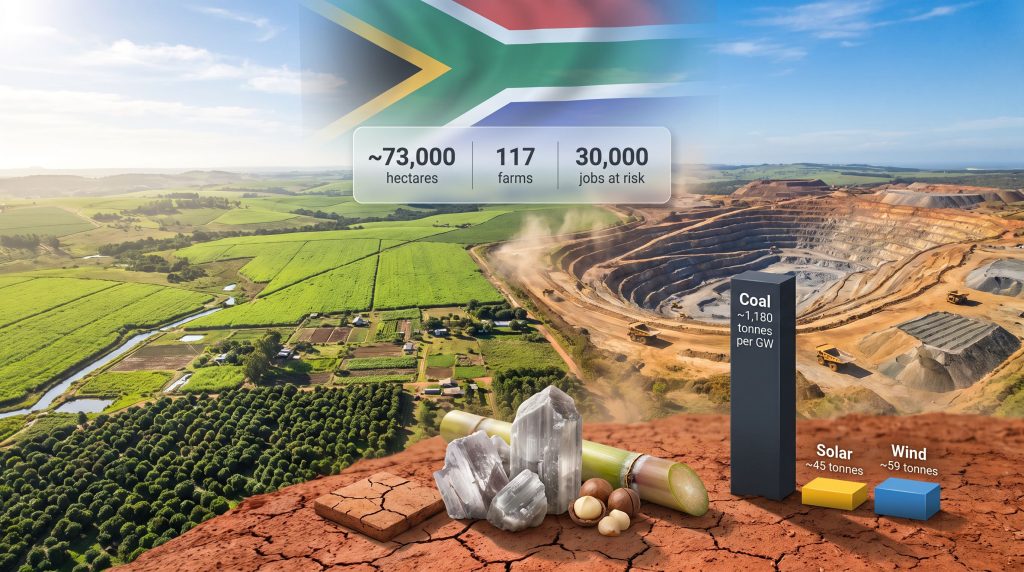
Data reviewed by Reuters from South Africa's Department of Mineral Resources reveals that prospecting licences have already been granted over approximately 73,000 hectares in the region, an area marginally larger than the city of Pretoria. Those licences span 117 farms, encompassing beaches and coastal zones alongside the agricultural land that defines the region's economic character.
What 73,000 Hectares of Prospecting Actually Means on the Ground
To understand the scale of community anxiety, it is worth distinguishing between the existing mine's operational footprint and the total area under prospecting rights.
| Land Area Component | Reported Figure |
|---|---|
| Active open-pit mining area | 150 hectares |
| Waste dump footprint | 180 hectares |
| Combined existing operational area | ~330 hectares |
| Proposed expansion area | 6,000+ hectares |
| Total area under prospecting licences | ~73,000 hectares |
| Number of farms affected | 117 |
The gap between the existing operational footprint and the prospecting envelope is enormous. The existing mine occupies roughly 330 hectares of combined pits and waste dumps. The prospecting licences, if fully converted to mining rights, would cover land two hundred times larger. This disproportion is central to why farming communities are alarmed well beyond the immediate vicinity of current operations.
The agricultural productivity at stake across this corridor is significant:
- Annual sugarcane output from the broader region reaches approximately 1 million tonnes
- The regional sugar mill processes harvests from roughly 2,000 small-scale growers and 600 commercial producers
- Macadamia nut cultivation represents a secondary but commercially meaningful land use across the same zone
- Tourism and coastal recreation economies operate alongside and are partly dependent on the agricultural character of the landscape
Furthermore, the critical minerals demand surge globally means pressure on regions like KwaZulu-Natal is only likely to intensify in the years ahead.
Displacement, Dust, and Damaged Homes: The Human Dimension
Abstract land-use statistics acquire a different weight when examined at the household level. In the hillside village of Magog in KwaZulu-Natal, residents have documented structural cracking in their homes, attributing the damage to blasting vibrations from adjacent mining operations. Dust generation from open-pit excavation has prompted repeated medical visits among community members dealing with respiratory complaints.
Seven homes in the village were visibly dismantled during field reporting conducted in 2026. Community members described watching a neighbour's dwelling reduced to rubble as mine expansion progressed. Between 142 and 153 households in Magog are projected for relocation under current expansion proposals.
The mining operator, SA Lithium, characterises its relocation programme as entirely voluntary, stating that all 150 farming households relocated to date have experienced improved living conditions as a result of the move. Company Director Ian Harbottle has publicly maintained that relocated residents are, without exception, materially better off than before. He has also stated that no mine water enters any river system, with all process water directed into on-site dams for recycling and dust control purposes.
Community members, however, tell a markedly different story. Residents describe relocation sites as remote, with soils less suitable for subsistence cultivation than the land they were asked to leave. Lithium mining in South Africa has drawn widespread eco-concerns from farmers, and for farming households whose livelihoods, cultural continuity, and inheritance structures are bound to specific parcels of land, the economic calculus of relocation cannot be reduced to infrastructure quality alone.
For multi-generational farming communities, ancestral land is not interchangeable with alternative land of nominally equivalent value. The severance represents a loss of food sovereignty, cultural inheritance, and community cohesion that no compensation framework has yet meaningfully addressed.
The South Coast Guardians Association and the Organised Opposition
Resistance to lithium prospecting and expansion has coalesced around the South Coast Guardians Association (SCGA), which has emerged as the primary coordinating body for objections across the region. The SCGA's General Manager has publicly characterised the potential conversion of all current prospecting licences into full mining rights as catastrophic for the region's social and economic fabric.
The association estimates that 30,000 jobs across farming, agricultural labour, service industries, and tourism are at risk if the prospecting footprint is fully activated. This figure encompasses not only direct agricultural employment but the cascading economic dependencies that sustain rural communities in the corridor, including shops, transport providers, and community service organisations whose customer base is the farming economy.
The coalition of objectors is broad:
- Small-scale sugarcane farmers with multi-generational ties to their land
- Commercial agricultural producers operating at larger scales
- Tourism and hospitality operators dependent on the region's coastal and agricultural character
- Environmental advocacy organisations focused on water quality, soil integrity, and biodiversity
- Legal advocates challenging the procedural legitimacy of licence approvals
One formal submission from affected farmers warned that mine expansion across the proposed 6,000-plus hectare footprint could permanently degrade water quality, soil quality, and undermine the long-term viability of farming across the region. SA Lithium disputes this characterisation, citing what it describes as extensive anti-pollution work and above-compliance environmental standards.
The R345,000 Appeal Fee: Administrative Justice or Access Barrier?
Among the procedural grievances raised by community groups, one issue has attracted particular criticism from civil society and legal advocates. Affected community members seeking to formally challenge mining expansion decisions through the administrative appeals process encountered a required fee of R345,000.
For small-scale farmers and community organisations operating on subsistence or cooperative margins, this threshold is not a procedural inconvenience. It is an effective exclusion from the formal objection process altogether.
A fee structure that costs more than most small-scale farmers earn in several years cannot function as a genuine mechanism for community participation. It functions, in practice, as a barrier to the constitutional right of administrative justice.
South Africa's constitutional framework guarantees access to just administrative action. Critics argue the fee structure directly contradicts this guarantee in the context of mining licence disputes. AgriSA and broader agricultural sector bodies have raised formal concerns that weak consultation safeguards, combined with prohibitive appeal costs, are eroding the protections that rural property rights and food security depend upon.
Parliament has conducted oversight visits and formal investigations in response to community complaints. The Department of Mineral Resources has, however, faced criticism for inadequate responsiveness, with media requests for comment reportedly going unanswered in multiple instances.
The next major ASX story will hit our subscribers first
Is Lithium Mining Actually Green? The Material Intensity Debate
The environmental case for critical minerals extraction rests on comparative material intensity. A 2024 analysis from the Breakthrough Institute provides a useful quantitative framework:
| Energy Source | Material Extracted Per Gigawatt (tonnes) |
|---|---|
| Coal (South Africa's primary generation source) | ~1,180 tonnes |
| Wind energy (including battery storage) | ~59 tonnes |
| Solar energy (including battery storage) | ~45 tonnes |
On a per-gigawatt basis, renewable energy systems are dramatically less material-intensive than the coal infrastructure they displace. Coal extraction requires roughly twenty times more material per unit of energy output than wind, and more than twenty-five times more than solar with storage. By this metric, the energy transition does represent a genuine reduction in the aggregate burden placed on the earth's crust.
However, this macro-level efficiency argument does not resolve the local-level impact question. The critical distinction lies in geographic concentration. Coal extraction is dispersed across many sites and has historically shaped mining communities over long timescales. Lithium and critical mineral deposits are geographically concentrated, meaning their extraction impacts fall intensely on specific communities and ecosystems, regardless of their aggregate efficiency advantage.
Global precedents from Portugal's lithium belt, Nevada's Thacker Pass, Chile's Atacama salt flats, and mining regions in Australia and China all demonstrate recurring patterns: rock waste accumulation degrades surrounding land quality, water quality risks are persistent and difficult to contain, and communities adjacent to open-pit operations bear disproportionate environmental health burdens. In addition, natural capital in mining contexts is increasingly recognised as a critical factor that extraction plans must account for rather than externalise.
The aggregate efficiency of clean energy systems does not automatically translate into acceptable localised outcomes for the communities living above the deposits.
The Food System at Stake: Why This Agricultural Corridor Is Not Marginal Land
One of the most consequential analytical errors in debates about resource extraction is the implicit assumption that land being considered for mining is economically marginal. In KwaZulu-Natal's south coast, this assumption is flatly incorrect.
The agricultural corridor under prospecting pressure supports a complex agro-industrial ecosystem:
- A regional sugar mill with a processing capacity measured in millions of metric tonnes annually
- A grower base of approximately 2,000 small-scale producers whose livelihoods are structurally dependent on the continued operation of that mill
- 600 commercial producers contributing to sugar export revenues
- Macadamia orchards representing high-value horticultural production
- Subsistence farming communities whose food security is directly tied to land access
The small-scale farming base in particular represents a social and economic structure that cannot be rapidly reconstituted once land is converted to open-pit operations. These grower communities took generations to establish, are embedded in specific land parcels, and depend on accumulated agricultural knowledge, water access, and market relationships that cannot be replicated on alternative sites.
If the prospecting footprint is converted to mining rights in its entirety, the regional sugar industry would lose a substantial portion of its smallholder grower base. That loss would cascade through the mill's processing economics, the service economy dependent on farming incomes, and the broader rural employment base the sector supports.
Three Scenarios for Resolution and Their Investment Implications
The conflict around South Africa lithium mining farmers opposition is unlikely to resolve quickly. Three plausible trajectories exist:
| Scenario | Description | Likely Outcome |
|---|---|---|
| Regulatory Reform | Government revises consultation requirements and reduces appeal fee thresholds | Slower mining approvals; stronger procedural protections for communities |
| Negotiated Benefit-Sharing | Mining operators and government establish binding compensation and community partnership frameworks | Partial community acceptance; enhanced monitoring requirements |
| Judicial Intervention | Community and farmer coalitions successfully challenge licences through constitutional litigation | Licence suspensions or revocations; precedent-setting case law affecting the sector nationally |
Each scenario carries significant implications for the pace and economics of South Africa's critical minerals development programme. Furthermore, insights from Ghana's lithium project suggest that benefit-sharing frameworks, when designed with genuine community input, can meaningfully reduce opposition and improve long-term project viability across the African continent.
For international battery manufacturers and EV supply chain investors applying increasingly rigorous ESG due diligence frameworks, the social licence conditions under which South African lithium is extracted will materially affect procurement and investment decisions. A mining sector characterised by sustained community opposition, documented displacement grievances, and procedural legitimacy questions creates reputational exposure at precisely the moment when responsible sourcing standards are becoming a commercial prerequisite.
The Policy Coherence Gap at the Heart of South Africa's Minerals Strategy
South Africa's critical minerals strategy is coherent at the level of macroeconomic ambition. The R40 trillion figure, the sunrise industry framing, and the positioning of the country as a future battery supply chain participant all reflect a credible reading of global energy transition dynamics. The mining sustainability transformation challenge, however, demands more than macroeconomic vision alone.
What the strategy currently lacks is an integrated framework for navigating the intersection of extraction ambition with:
- Agricultural land protection and food system continuity
- Community tenure rights and constitutionally guaranteed administrative justice
- Environmental safeguards calibrated to the specific ecological sensitivities of active farming and coastal zones
- Procedural fairness mechanisms that are genuinely accessible to small-scale farmers and rural communities
Without this framework, South Africa risks a pattern familiar from other resource-rich nations: national economic benefit accruing to urban industrial interests and export revenues while localised social and environmental costs fall on rural communities with limited political voice and restricted access to legal remedy.
The KwaZulu-Natal south coast conflict is, in this sense, an early warning signal. How South Africa responds to it will determine not only the fate of specific farming communities but the long-term credibility of the country's critical minerals programme. In global markets where responsible sourcing is rapidly becoming non-negotiable, the approach taken to renewable energy in mining and extraction governance alike will shape investor confidence for decades to come.
Frequently Asked Questions: South Africa Lithium Mining and Farmer Opposition
How large is the lithium prospecting footprint in KwaZulu-Natal?
Approximately 73,000 hectares, covering 117 farms across the south coast region and extending to coastal zones. This area is slightly larger than the city of Pretoria.
How many jobs does the SCGA say are at risk?
The South Coast Guardians Association estimates up to 30,000 jobs in farming, agricultural labour, services, and tourism could be affected if all current prospecting licences are converted to full mining rights.
What is the R345,000 appeal fee controversy?
This is the administrative cost required to formally challenge a mining licence decision. Critics argue it effectively prevents small-scale farmers and community organisations from accessing their legal rights to object, raising constitutional questions about access to administrative justice.
How does lithium mining compare to coal in environmental terms?
On a per-gigawatt basis, solar and wind systems with storage require dramatically less material extraction than coal. However, South Africa lithium mining's geographic concentration means its localised impacts on specific communities can be severe, even if the aggregate environmental footprint is smaller than fossil fuel systems.
Has South Africa's government responded to community concerns?
Parliament has conducted oversight visits. The Department of Mineral Resources has, however, faced criticism for insufficient responsiveness to community complaints and media enquiries.
Want to Invest in the Critical Minerals Driving the Global Energy Transition?
Discovery Alert's proprietary Discovery IQ model delivers real-time alerts the moment significant ASX mineral discoveries are announced, turning complex data across 30-plus commodities into clear, actionable opportunities — explore historic discoveries and the returns they generated, then begin your 14-day free trial at Discovery Alert to position yourself ahead of the broader market.