August 5, 2026
The Structural Case for Europe's First Integrated Lithium Producer
The global battery supply chain did not emerge from careful planning. It evolved through decades of cost arbitrage, geographic accident, and incremental industrial development concentrated in East Asia. Today, as European automakers accelerate their transition to electric mobility, the structural consequence of that historical drift has become impossible to ignore: a continent that manufactures millions of vehicles annually controls almost none of the raw material inputs that will define its industrial future.
This is the context in which the Vulcan Energy Europe lithium project, formally known as the Lionheart Project, demands serious attention. Not as a speculative mining venture, but as a calculated response to one of the most consequential supply chain vulnerabilities in modern European industry.
When big ASX news breaks, our subscribers know first
What the Lionheart Project Actually Is
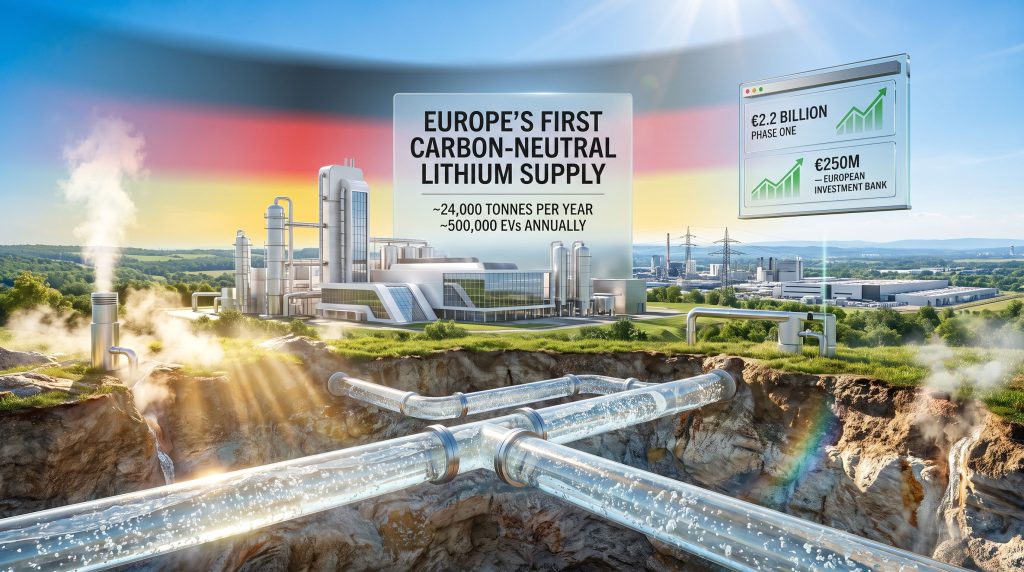
Lionheart is not a conventional mining operation, and understanding why matters for anyone trying to assess its real significance. The project is designed around a dual-output model: extracting battery-grade lithium hydroxide monohydrate (LHM) from naturally occurring geothermal brines in Germany's Upper Rhine Valley while simultaneously generating renewable electricity and heat from the same underground resource.
The central lithium chemical plant is sited at Frankfurt-Höchst, an established industrial precinct in southwest Germany, with construction activity progressing through 2026 following the execution of the site lease. The Phase One production targets are substantial.
| Output Category | Phase One Target |
|---|---|
| Lithium Hydroxide Monohydrate (LHM) | ~24,000 tonnes per year |
| EV Batteries Supported (annually) | ~500,000 vehicles |
| Renewable Electricity Generated | ~275 GWh per year |
| Renewable Heat Delivered | ~560 GWh per year |
What separates Lionheart from the broader universe of lithium development projects is the integration of energy production into the same resource loop. The geothermal heat that enables lithium extraction also powers the processing operation, eliminating fossil fuel inputs from the production equation entirely. That is the foundation of the project's net carbon-neutral production claim.
Key Insight: Lionheart functions as a dual-commodity infrastructure asset. The geothermal brine beneath the Upper Rhine Valley is simultaneously a lithium deposit and a renewable energy source, a combination with no direct precedent among conventional lithium projects globally.
How Geothermal Brine Lithium Extraction Works
The Upper Rhine Valley sits atop an extraordinarily well-characterised geothermal system. Hot, mineral-laden brines circulate through deep geological formations at elevated temperatures, and operators in the region have understood for decades that these fluids carry dissolved lithium. What was missing until recently was both the technical framework and the commercial incentive to extract that lithium economically.
The extraction process works through a series of steps that differ fundamentally from conventional hard-rock or evaporation brine mining. Lithium brine extraction of this kind represents a genuinely distinct production pathway:
-
Geothermal fluid is drawn to the surface through production wells at elevated temperatures, typically between 120°C and 180°C depending on depth and geological conditions.
-
Lithium is selectively separated from the brine using direct lithium extraction (DLE) technology, a sorbent or membrane-based process that targets lithium ions specifically without the need for large evaporation ponds.
-
The cooled brine is re-injected into the subsurface after lithium removal, maintaining pressure in the reservoir and eliminating significant surface water consumption.
-
The heat energy from the geothermal fluid is captured and used to power the lithium chemical processing operation, as well as supplying renewable heat and electricity to nearby consumers.
This closed-loop design produces a fundamentally different environmental profile compared to the two production methods that currently dominate global lithium supply.
| Production Method | Carbon Footprint | Water Intensity | Location |
|---|---|---|---|
| Hard-Rock Spodumene (Australia) | Moderate to High | Moderate | Remote, export-dependent |
| Evaporation Brine (South America) | Low to Moderate | Very High | Arid, water-stressed regions |
| Geothermal Brine (Lionheart) | Net Carbon-Neutral (target) | Low | Onshore Europe |
One aspect that is rarely discussed in mainstream coverage is how the brine re-injection step addresses a critical weakness of South American lithium production. Atacama-type evaporation brine operations consume enormous volumes of water in some of the world's most water-scarce ecosystems, generating sustained environmental and regulatory pressure. Lionheart's re-injection model avoids this dynamic entirely.
A Project Built on a Decade of Timing and Persistence
The origins of the Vulcan Energy Europe lithium project trace back to 2018, when what was then a whiteboard concept began taking shape. The founder's background is instructive: prior experience in developing hard-rock lithium assets in Western Australia's Pilbara region during the early wave of EV demand growth provided a foundational lesson that the mining and battery materials sector frequently underweights. Timing matters as much as asset quality.
Hard-rock spodumene succeeded in the first phase of EV market growth because it could be brought to production quickly. As the industry matures and cost structures come under pressure, lower-cost brine-based production methods are becoming structurally more attractive. Lionheart was conceived at the intersection of that long-run trend and Europe's specific supply chain predicament.
The development journey from initial concept to construction-phase infrastructure asset has been characterised internally as a marathon executed at sprint pace. The multi-billion-euro financing process tested the project's institutional credibility at every stage, and navigating years of technical validation, permitting, and capital-raising against a backdrop of volatile lithium prices required sustained conviction in the underlying thesis.
That financing milestone has now been crossed. Vulcan reported a Phase One financing package of approximately €2.2 billion in late 2025, anchored by a €250 million commitment from the European Investment Bank. The EIB's participation carries particular significance because development finance institutions of this type conduct extensive technical and risk due diligence before committing capital to first-of-kind industrial projects.
Credibility Signal: The EIB's €250 million commitment is not simply financial in nature. It reflects an institutional assessment that the project's technical approach is viable and that its outputs align with the EU's stated objectives under the Critical Raw Materials Act, which designates lithium as a strategic raw material and sets domestic sourcing benchmarks.
Why Europe's Lithium Import Dependency Is a Structural Problem
Europe currently sources the overwhelming majority of its battery-grade lithium chemicals from either Australian spodumene refined into hydroxide in China, or from South American brine operations, also processed predominantly in China. The processing concentration in particular creates a multi-layered vulnerability: even when the raw ore originates outside China, the refined chemical product that goes into cathode materials typically does not.
The EU Critical Raw Materials Act introduced legally embedded domestic sourcing benchmarks, but policy targets alone do not create supply. Furthermore, the physical infrastructure to produce lithium hydroxide at commercial scale inside Europe's borders essentially does not exist today in any meaningful volume. Lionheart's Phase One target of 24,000 tonnes per year of LHM would, if fully delivered, represent a material shift in that equation.
To put that figure in context: 500,000 EVs per year is approximately equivalent to the annual production volume of a mid-sized European automotive assembly plant. Supplying that number of vehicles with domestically sourced, carbon-neutral lithium from a single European project would constitute a genuine proof-of-concept for the broader supply chain localisation thesis.
The demand context is also expanding. Battery energy storage systems (BESS) have emerged as a second significant pillar of lithium demand alongside EVs since late 2025, according to Fastmarkets research. As grid-scale storage deployments accelerate across Europe, the addressable market for Lionheart's output extends well beyond the automotive sector.
How Lionheart Compares to Other European Lithium Projects
Europe's lithium development pipeline spans multiple countries and production methodologies, from hard-rock projects in Portugal, Finland, and the Czech Republic to brine and geothermal-adjacent opportunities elsewhere in Central Europe. The competitive differentiation for Lionheart is meaningful across several dimensions, particularly when considered alongside the broader challenges facing Europe's critical minerals supply chain.
| Factor | Lionheart (Vulcan Energy) | European Hard-Rock Peers |
|---|---|---|
| Production Method | Geothermal brine DLE | Conventional mining and processing |
| Carbon Footprint Target | Net carbon-neutral | Varies, typically higher |
| Phase One Capacity | ~24,000 tpa LHM | Varies, most at earlier stages |
| Financing Status (2026) | ~€2.2 billion secured | Earlier-stage for most |
| Co-product Revenue Stream | Renewable heat and power | None |
The co-product revenue stream from renewable energy is a feature that fundamentally changes the project economics compared to single-commodity lithium producers. During periods of low lithium prices, which the market has experienced sharply since the 2022–2023 peak, the ability to generate cash flow from electricity and heat sales provides a partial hedge against commodity price volatility. This dual-revenue structure is genuinely novel among lithium projects at this scale.
The next major ASX story will hit our subscribers first
The Role of International Partnerships in Europe's Battery Ambitions
One of the more nuanced observations to emerge from industry discourse around European battery supply chain development is the acknowledgment that domestic champions built entirely from scratch are unlikely to be sufficient. Chinese and South Korean companies have accumulated more than a decade of manufacturing expertise, process optimisation, and supply chain integration that European entrants simply do not possess yet.
Rather than framing Asian industrial involvement as a competitive threat to European interests, the more strategically coherent position treats it as an accelerant. Knowledge transfer from experienced cell manufacturers, cathode producers, and battery technology leaders compresses the learning curve for European industrial partners. Offtake agreements and supply partnerships with established international battery players also provide commercial validation for projects like Lionheart that are still in their early production phase.
In addition, the European critical raw materials framework provides an institutional backbone that supports these partnerships with regulatory coherence. The long-term objective remains the construction of a complete European battery value chain, from raw material extraction through cell manufacturing to vehicle integration. Achieving that objective faster through structured international partnerships is more strategically valuable than achieving it slowly through self-sufficiency alone.
Scenario Analysis: What Lionheart's Success or Failure Means for the Sector
The outcomes here matter beyond Vulcan Energy's individual corporate trajectory. Lionheart functions as a proof-of-concept for geothermal brine lithium extraction at commercial scale, a production pathway that has not previously been demonstrated at this volume or in this geographic setting.
Scenario A: Full Phase One Delivery on Target
- 24,000 tpa LHM enters European supply, materially reducing import dependency for participating automakers
- Approximately 500,000 EVs per year supplied with traceable, low-carbon lithium
- Proof-of-concept unlocks capital for Phase Two and analogous geothermal lithium development across the Upper Rhine Valley and comparable European geological settings
- Direct lithium extraction technology gains broader commercial credibility globally
Scenario B: Partial Delivery or Significant Delays
- European OEMs maintain import dependency into the mid-2030s
- Geothermal lithium remains a technically credible but commercially unproven pathway
- Risk perception for first-of-kind European critical mineral projects increases, tightening financing conditions for successor projects
Scenario C: Lionheart Catalyses Broader Geothermal Lithium Development
- Success triggers investment in geothermal brine resources across Central Europe where analogous geological conditions exist
- Europe captures a material share of global lithium chemical supply from domestic sources by the mid-2030s
- The production model is replicated in other geothermal-rich regions including parts of the western United States and East Africa
Disclaimer: The scenarios above represent analytical frameworks for understanding the project's potential outcomes. They do not constitute investment advice. Actual results will depend on construction execution, lithium market conditions, regulatory developments, and numerous other factors that cannot be predicted with certainty.
Macro Trends Reinforcing the Long-Term Investment Thesis
The structural forces underpinning the Vulcan Energy Europe lithium project's long-term case are not dependent on any single policy cycle or short-term demand surge. Consequently, several converging macro trends reinforce the project's underlying rationale:
-
Electrification of transport continues to drive sustained demand growth for battery-grade lithium chemicals through 2030 and well beyond, with European OEM electrification timelines creating predictable forward demand within Lionheart's geographic delivery range.
-
BESS deployment is accelerating across European electricity grids as intermittent renewable capacity additions require grid-scale storage solutions, expanding the addressable market for lithium chemical producers beyond the automotive sector.
-
Carbon border adjustment mechanisms and tightening ESG procurement standards among European industrial buyers are progressively reshaping purchasing decisions toward lower-carbon input materials. Lionheart's carbon-neutral production claim positions it advantageously in that procurement environment.
-
Supply chain localisation as a strategic priority represents a durable structural shift rather than a cyclical policy preference. Western governments are intensifying support for domestic critical mineral project development through development finance institutions, and bank financing is increasingly available to projects with credible supply chain security narratives, as reported by Fastmarkets in August 2026. The broader battery raw materials market is reshaping accordingly.
Investor Perspective: The convergence of institutional financing momentum (evidenced by the EIB commitment), physical construction progress at Frankfurt-Höchst, and expanding end-market demand from both EVs and BESS positions the Lionheart Project at an inflection point that critical mineral investors have rarely seen replicated at this scale within Europe.
Frequently Asked Questions: Vulcan Energy Lionheart Project
What is the Vulcan Energy Lionheart Project?
The Lionheart Project is Vulcan Energy's flagship lithium development in Germany's Upper Rhine Valley. It combines geothermal brine lithium extraction with renewable energy production, targeting approximately 24,000 tonnes per year of battery-grade lithium hydroxide monohydrate with a net carbon-neutral production footprint.
Where is the Lionheart Project located?
The project is based in southwest Germany's Upper Rhine Valley, with the central lithium chemical plant sited at Frankfurt-Höchst, a significant industrial precinct in the region.
How much financing has the Lionheart Project secured?
Vulcan reported a Phase One financing package of approximately €2.2 billion in late 2025, including a €250 million commitment from the European Investment Bank.
How much lithium will Lionheart produce annually?
Phase One targets approximately 24,000 tonnes per year of lithium hydroxide monohydrate, sufficient to supply battery materials for around 500,000 electric vehicles annually.
What makes Lionheart different from conventional lithium mining?
Lionheart extracts lithium from naturally heated underground brines using direct lithium extraction technology rather than open-pit or hard-rock mining methods. The geothermal heat from the same resource powers the extraction and processing operation, enabling a carbon-neutral production footprint while generating renewable electricity and heat as co-products.
Is construction currently underway?
As of 2026, the project is in active construction phase, with the Frankfurt-Höchst central plant site lease secured and facility build-out activities progressing. Vulcan has also confirmed partnerships with industry leaders such as Siemens to support scaling of the operation.
Building Europe's Battery Future From the Ground Up
What began in 2018 as a conceptual response to a structural gap in European critical mineral supply has evolved into a top-200 ASX-listed company with a multi-billion-euro construction programme actively underway. The Vulcan Energy Europe lithium project represents something genuinely rare in the critical minerals sector: a first-of-kind industrial concept that has successfully navigated from technical concept through institutional financing to physical construction inside one of the world's most heavily regulated industrial jurisdictions.
Whether Lionheart ultimately delivers on its full Phase One targets will determine not just Vulcan's commercial trajectory, but the credibility of geothermal brine lithium extraction as a global production pathway. The broader European battery supply chain, from cathode producers to cell manufacturers to automotive OEMs, is watching closely.
For supply chain strategists, policymakers, and critical mineral investors, the project's next few years of execution will provide the most consequential data point yet on whether Europe can build genuine raw material sovereignty for its electric vehicle transition, or whether the continent's battery ambitions will remain structurally dependent on geographies it cannot control.
This article is intended for informational purposes only and does not constitute financial or investment advice. Readers should conduct independent due diligence before making any investment decisions. Forward-looking statements and scenario projections involve inherent uncertainty and may not reflect actual outcomes.
For deeper analysis of lithium pricing, battery raw material market dynamics, and critical minerals supply chain intelligence, Fastmarkets provides comprehensive price reporting and market analysis across the global battery materials sector.
Ready to Identify the Next Major Critical Minerals Discovery Before the Market Does?
Discovery Alert's proprietary Discovery IQ model scans ASX announcements in real time, instantly alerting subscribers to significant mineral discoveries across lithium, battery materials, and beyond — turning complex data into actionable investment insights. Explore Discovery Alert's discoveries page to understand how historic ASX mineral discoveries have generated substantial returns, and begin your 14-day free trial today to position yourself ahead of the broader market.