August 5, 2026
Africa's Battery Mineral Ambitions Begin Underground
The global race to secure battery-grade lithium is no longer confined to the Atacama salt flats of Chile or the hard rock spodumene belts of Western Australia. Across southern Africa, a quieter but increasingly consequential scramble is underway, one that is reshaping land ownership, testing regulatory systems, and forcing a reckoning between industrial ambition and rural community rights. At the centre of this shift sits South Africa, a country whose mineral wealth has long been defined by gold, platinum, and coal, but which is now staking a claim in the battery minerals supply chain that will define the twenty-first century economy.
Understanding what is genuinely at stake requires looking beyond headline investment figures. The story of lithium mining expansion in South Africa is as much about who controls the land as it is about what lies beneath it.
When big ASX news breaks, our subscribers know first
South Africa's Strategic Repositioning in the Battery Minerals Supply Chain
For most of the past century, South Africa's mining identity was anchored to the Witwatersrand gold fields and the platinum group metals of the Bushveld Complex. Lithium barely registered as an economic consideration. That calculation has changed fundamentally in the context of surging global electric vehicle demand and the corresponding scramble for battery inputs.
South Africa formalised this shift through its 2025 Critical Minerals and Metals Strategy, which elevated lithium to the status of a nationally prioritised battery material. The strategy reflects a broader recognition that countries holding untapped lithium resources occupy a structurally advantageous position as legacy fossil fuel supply chains lose economic dominance. The International Energy Agency has projected that lithium demand could increase by a factor of more than 40 by 2040 relative to 2020 levels, driven almost entirely by battery manufacturing for EVs and grid storage applications.
What makes South Africa's position distinct from other African lithium hopefuls is the combination of existing hard rock mining infrastructure, a functioning regulatory system, and access to deepwater export ports. These factors reduce the capital intensity of bringing new projects online compared with landlocked competitors. However, infrastructure advantage alone does not resolve the underlying tension between rapid resource extraction and the communities living on mineral-rich land. The global lithium market is watching South Africa's regulatory and social responses closely.
Why Spodumene Geology Matters Here
South Africa's lithium endowment is largely hosted in pegmatite formations, crystalline igneous rocks that concentrate lithium-bearing minerals like spodumene, lepidolite, and petalite during the late stages of magma cooling. Pegmatites are geologically distinctive because they can produce exceptionally high-grade ore in relatively compact zones, but they are also irregular in shape and depth, making resource estimation more technically demanding than sedimentary or brine-hosted deposits.
This geological character has two important implications. First, ore grade variability is significant, meaning that a mine expanding its pit footprint may encounter substantially different lithium concentrations across different zones. Second, spodumene extraction generates considerable waste rock relative to ore volume, which directly influences the scale of waste dump infrastructure required and, by extension, the land area affected by any expansion.
The Two Expansion Corridors Driving Activity in 2025 and 2026
Active lithium development in South Africa is currently concentrated across two geographically distinct regions, each at a different stage of the project lifecycle.
Summary Table: South Africa's Active Lithium Mining Zones (2025–2026)
| Region | Key Projects | Total Land Coverage | Development Stage |
|---|---|---|---|
| KwaZulu-Natal South Coast | Highbury Mine (SA Lithium) | ~73,000 hectares (prospecting licences) | Expansion approval phase |
| Northern Cape | Blesberg Project (Marula Mining) | 1,051-hectare licence area | Mining right application (10-year) |
| Northern Cape | Norrabees (near Steinkopf) | Operational | Active mining |
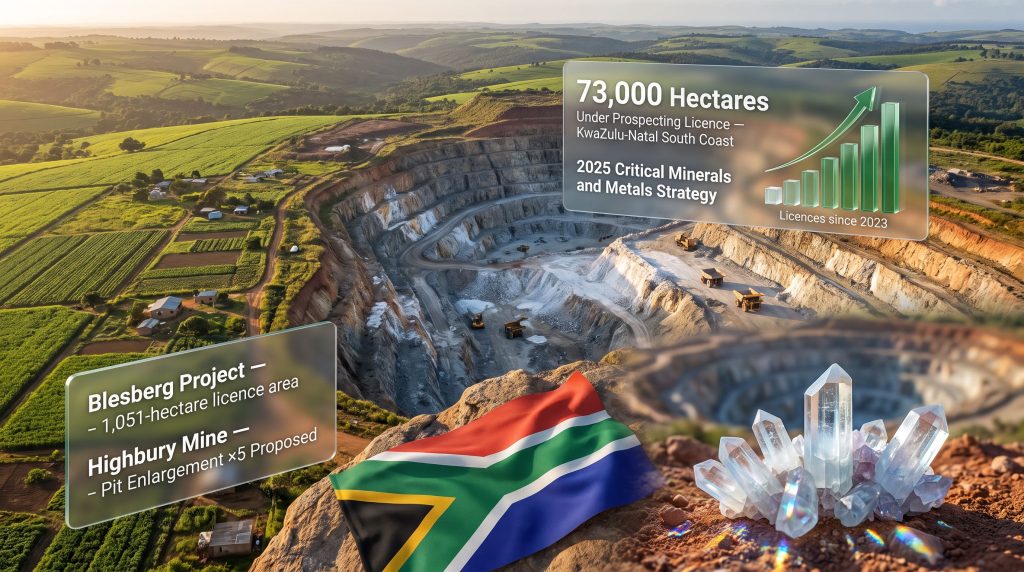
The KwaZulu-Natal South Coast has become the most contested zone, where a concentrated prospecting rush since 2023 has resulted in more than a dozen prospecting licences being granted across approximately 73,000 hectares. This figure is not a projection of eventual mine footprints, but it does signal the scale of exploration interest that precedes formal mining right applications.
The Northern Cape tells a different story. Projects like Blesberg, operated by Marula Mining, are progressing through structured regulatory milestones toward a full 10-year mining right over a 1,051-hectare licence area. The Norrabees operation near Steinkopf is already producing, providing a reference point for what commercial-scale lithium extraction looks like in the South African regulatory environment.
The Highbury Mine Expansion: Scale and Consequence
No single project illustrates the structural tensions within South Africa's lithium sector more sharply than the proposed expansion of the Highbury Mine on the KwaZulu-Natal South Coast, operated by SA Lithium. Understanding how lithium mining works helps contextualise why this expansion carries such significant implications for the surrounding landscape and communities.
The expansion proposal is not incremental. The open pit would be enlarged to approximately five times its current dimensions, while the associated waste dump infrastructure would grow by a factor of roughly four. Critically, a newly identified ore seam has provided the geological justification for a 20-year mine life extension, which transforms what was a modest operation into a long-duration industrial facility.
These are not refinements to an existing operation. A fivefold pit expansion fundamentally alters the relationship between a mine and its surrounding landscape, affecting hydrology, land access, noise, dust, and the viability of adjacent land uses for a generation.
The economic logic is straightforward: extending mine life over two decades amortises capital investment across a much larger production base, improving project economics even at lithium price levels well below the peaks seen in 2022 and 2023. However, the communities living in proximity to the expanded operation face a very different calculus.
Community Displacement and the Social Licence Problem
Nearly 1,000 people face relocation as part of the broader KwaZulu-Natal expansion plans, with between 142 and 153 households in the Magog area facing the prospect of relocation as a direct consequence of the Highbury expansion proposal alone. This is not a speculative risk; it is a documented component of the environmental and social impact assessment process currently underway.
The concerns extend well beyond household displacement. Community opposition along the KwaZulu-Natal South Coast has crystallised around several interconnected issues:
- Potential forced relocation of between 142 and 153 households in the Magog area
- Risk to local water systems and catchment integrity from pit dewatering and waste rock leachate
- Biodiversity loss in ecologically sensitive coastal and near-coastal zones
- Disruption to smallholder farming and subsistence-based livelihoods that have no formal monetary value but sustain food security
- Concerns about the adequacy of community consultation processes prior to prospecting licences being granted
Mining proponents typically frame expansion proposals through an employment and infrastructure investment lens. The creation of formal jobs, contributions to local procurement, and royalty flows to community trusts are the standard arguments mobilised to build consent. These benefits are real, but they are unevenly distributed and often accrue on timelines that do not align with the immediate costs borne by displaced households.
The concept of social licence to operate is not a legal instrument but a practical constraint. Mining projects that proceed without genuine community support face elevated risks of protest-driven operational disruption, legal challenges, and reputational damage that can affect financing. In South Africa's current political environment, where community land rights have deep historical resonance, the social licence challenge is particularly acute.
Regulatory Pathways: Progress, Gaps, and Inconsistencies
South Africa's Department of Mineral Resources and Energy (DMRE) oversees the licensing framework that governs both exploration and extraction. The regulatory pathway from prospecting licence to full mining right involves multiple gating mechanisms, with environmental authorisation representing one of the most consequential approval steps.
Regulatory Milestone Tracker: Blesberg Project (Northern Cape)
| Milestone | Status |
|---|---|
| Environmental authorisation | Secured |
| Partial approval process | Completed |
| 10-year mining right application | In progress |
| Full 1,051-hectare licence activation | Pending |
The Blesberg project's progression through this framework illustrates how a well-structured regulatory pathway can provide investment certainty. However, the KwaZulu-Natal experience suggests that the speed at which prospecting licences are being granted has not been matched by equivalent rigour in community consultation or environmental pre-screening.
The DMRE's 2024 operating mine list, which formally classifies and tracks active lithium operations, reflects a sector still in relatively early maturity. The number of listed operational lithium mines remains small, but the pipeline of prospecting licences strongly suggests this will change significantly within the next five to seven years.
A Speculative but Plausible Scenario
Industry observers have noted that the pattern of concentrated prospecting licence grants in KwaZulu-Natal mirrors early-stage land banking behaviour seen in other jurisdictions ahead of consolidation plays. If a small number of well-capitalised operators move to aggregate multiple prospecting licences into large, contiguous resource packages, the resulting mining right applications could dwarf anything currently proposed. This is speculative, but it is consistent with how similar pegmatite rushes have unfolded in Zimbabwe and the Pilbara region of Australia.
The next major ASX story will hit our subscribers first
Farming vs. Mining: A Structural Conflict Without a Ready Solution
One dimension of South Africa's lithium expansion that receives insufficient analytical attention is the direct competition between agricultural and extractive land uses in the KwaZulu-Natal coastal hinterland. This is not marginal land. Smallholder and subsistence farming systems in the region support livelihoods that are not captured in GDP statistics but are critical to household food security for communities with limited access to formal employment.
Comparative Framework: Land-Use Conflict in Lithium Jurisdictions
| Country | Conflict Type | Resolution Mechanism |
|---|---|---|
| South Africa (KZN) | Mining vs. smallholder farming | Contested – no formal resolution framework yet |
| Chile (Atacama) | Mining vs. indigenous water rights | Partial regulatory intervention |
| Australia (Pilbara) | Mining vs. pastoral leases | Native title negotiation processes |
| Zimbabwe | Mining vs. artisanal communities | Informal coexistence with periodic conflict |
South Africa currently lacks a formalised co-existence framework for resolving mining-agriculture land use conflicts at the community scale. Chile and Australia have developed, albeit imperfect, mechanisms through which affected communities can negotiate binding conditions on mining operations. South Africa's current framework relies primarily on the environmental impact assessment process, which is designed to evaluate impacts rather than broker durable co-existence arrangements.
South Africa's Position in Africa's Continental Lithium Race
Across sub-Saharan Africa, the competition to attract lithium investment is intensifying. Zimbabwe holds some of the continent's highest-grade lithium pegmatite resources and has moved aggressively to attract Chinese processing investment. The Democratic Republic of Congo dominates cobalt supply and is expanding its lithium profile. Zambia is leveraging copper infrastructure for broader battery minerals development.
Furthermore, the rising critical minerals demand globally is intensifying pressure on African nations, including South Africa, to accelerate project development without adequate community and environmental safeguards in place. South Africa's competitive advantage lies not in the size of its known lithium endowment, which remains modest compared to Zimbabwe or the DRC, but in its processing infrastructure, financial systems, and legal frameworks.
However, the country faces a strategic risk that analysts have characterised as a resource curse in miniature: the temptation to export raw spodumene concentrate rather than investing in the downstream refining capacity needed to capture battery-grade lithium carbonate and hydroxide value. Global Witness has documented how the rush for lithium across Africa risks fuelling corruption and failing citizens when proper governance frameworks are absent.
Battery-grade lithium hydroxide commands significantly higher margins than concentrate. For South Africa to capture this value, it would need to develop hydrometallurgical processing facilities capable of converting spodumene into the high-purity chemical forms required by cathode manufacturers. In addition, some industry voices have argued that without deliberate policy intervention to incentivise downstream processing — including technologies such as direct lithium extraction — South Africa risks becoming a raw material exporter in a supply chain where the economics increasingly favour value-added producers.
Frequently Asked Questions: Lithium Mining Expansion in South Africa
How many lithium mines are currently operating in South Africa?
The DMRE's 2024 operating mine classification list confirms a small number of active lithium operations, with Norrabees in the Northern Cape among the most established. The sector is in early growth phase, with the pipeline of approved prospecting licences far exceeding current operational capacity.
Which provinces have the most lithium mining activity?
The Northern Cape and KwaZulu-Natal are the two primary zones of current activity, representing distinct geological settings and regulatory contexts. The Northern Cape hosts more advanced project development, while KwaZulu-Natal is experiencing the most rapid prospecting licence growth.
What environmental risks are associated with lithium mining in South Africa?
Key environmental concerns include pit dewatering impacts on local water tables, waste rock acid mine drainage potential, dust and noise from open-cut operations, and habitat disruption in ecologically sensitive coastal and agricultural zones.
Is South Africa's lithium sector attracting foreign investment?
Interest from international capital has been growing alongside broader African critical minerals investment flows, though deal activity in South Africa's lithium sector remains less advanced than in Zimbabwe or the DRC. Regulatory clarity and social licence resolution will be key determinants of how quickly foreign capital commits.
Key Takeaways: Forces Driving and Constraining South Africa's Lithium Future
- South Africa's 2025 Critical Minerals Strategy has formally prioritised lithium, creating policy-level momentum for the sector without constituting project-specific government support or funding
- The KwaZulu-Natal South Coast and Northern Cape represent distinct but equally significant expansion corridors at different stages of development maturity
- More than 73,000 hectares of prospecting licences granted since 2023 signals that current operations represent only the earliest phase of a much larger extraction trajectory
- The proposed Highbury Mine expansion, involving a fivefold pit enlargement and a 20-year mine life extension, represents the sector's most consequential near-term approval decision
- Between 142 and 153 Magog households face potential displacement, making community consent the defining social challenge for the KwaZulu-Natal corridor
- South Africa lacks a formalised land-use co-existence framework, leaving mining-agriculture conflicts to be resolved through environmental impact processes not designed for that purpose
- The long-term value proposition for the sector depends critically on whether downstream processing capacity can be developed to capture lithium chemical value rather than exporting raw concentrate
This article contains forward-looking analysis and references to regulatory processes that are subject to change. Nothing in this article constitutes investment advice. Readers should conduct independent research and seek professional guidance before making investment decisions related to any mining project or company mentioned.
Want To Identify The Next Major Battery Minerals Discovery Before The Market Does?
Discovery Alert's proprietary Discovery IQ model scans ASX announcements in real time, instantly converting complex mineral data into actionable insights across more than 30 commodities — including the battery minerals reshaping the twenty-first century economy. Explore historic discoveries and their returns to understand the opportunity, then begin your 14-day free trial to position yourself ahead of the broader market.