July 22, 2026
The Hidden Engine Behind Falling Lithium Prices: What the Market Is Actually Telling You
Commodity markets have a long history of confusing participants who focus on today's headlines rather than tomorrow's fundamentals. In critical minerals especially, price signals rarely reflect current consumption in isolation. Instead, they encode forward-looking expectations, supply pipeline assumptions, and trader positioning that can diverge dramatically from real-world demand trends. The lithium market in mid-2026 is a textbook illustration of this dynamic, and understanding the gap between price weakness and structural demand growth may be one of the most important distinctions for clean energy investors right now.
The intersection of falling lithium prices and the clean energy boom is not the contradiction it first appears to be. It is, in many ways, the market functioning exactly as designed.
When big ASX news breaks, our subscribers know first
Why Lithium Futures Are Pricing 2027, Not 2026
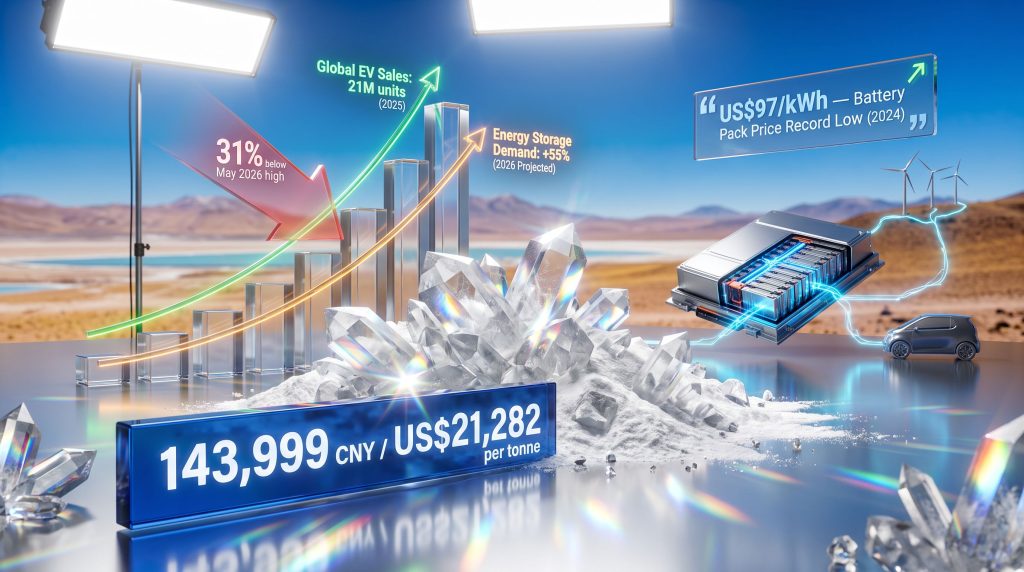
China's most actively traded lithium carbonate futures contract on the Guangzhou Futures Exchange fell to 143,999 yuan (approximately US$21,282) per tonne in July 2026, representing a five-month low and sitting roughly 31% below the May 2026 peak. On the surface, this looks alarming for a commodity that sits at the heart of the global energy transition.
But futures markets don't price today. They price anticipation.
Traders positioning in lithium carbonate futures are not responding to weak EV sales or collapsing battery demand. They are pricing a projected supply surplus expected to materialise in 2027, as a wave of mine expansions across Chile, Argentina, China, and Australia pushes new supply into a market that is growing, but not fast enough to absorb every tonne simultaneously.
This distinction matters enormously. Spot market weakness and structural demand growth are two separate forces operating simultaneously, and conflating them leads to flawed conclusions about the health of the broader energy transition. The lithium market downturn reflects supply-side anticipation, not a collapse in the underlying demand thesis.
Commodity cycles in critical minerals are not linear. What looks like market weakness is often a structural recalibration driven by supply-side dynamics, not a deterioration in the underlying demand thesis.
The Supply Expansion Wave Reshaping Lithium Market Expectations
The scale of new lithium supply coming online is significant, and it explains why traders are adjusting positions well ahead of the actual surplus arriving.
| Region | Key Development | Projected Impact |
|---|---|---|
| Chile (Atacama Desert) | Codelco-SQM Novandino joint venture targeting 470,000 metric tonnes/year | Up from approximately 270,000 tonnes in 2026, representing more than 70% capacity growth |
| China | CATL Jianxiawo mine restart | Up to 45,000 additional tonnes entering the market in H2 2026 |
| Argentina | Multi-billion dollar new project pipeline | Continued output growth through 2027 and 2028 |
| Australia | Existing producers expanding operations | Sustained global supply leadership across spodumene and chemical-grade lithium |
The Codelco-SQM Novandino expansion is particularly consequential. As part of a US$3 billion upgrade to operations in the Atacama Desert, the venture is targeting annual production of 470,000 metric tonnes, up from approximately 270,000 tonnes expected in 2026. That is a transformative addition to global supply from a single regional source.
Meanwhile, CATL's restart of the Jianxiawo mine injects up to 45,000 tonnes of lithium supply into the second half of 2026 alone, contributing to a near-term tightening of the supply gap that traders are already pricing into forward contracts. Furthermore, Argentina lithium brines represent a significant component of the multi-billion dollar pipeline adding sustained output growth through 2027 and beyond.
Benchmark Mineral Intelligence forecasts that new supply additions will outpace demand growth in 2027, creating the structural surplus that current prices are anticipating. According to the IEA, global investment in critical minerals reached a record high in 2024, with lithium remaining one of the fastest-growing sectors by capital deployment.
The Battery Tax Variable: China's Demand-Side Wildcard
One less widely discussed factor adding complexity to lithium's pricing outlook is China's introduction of a 2% battery consumption tax in September 2026, scheduled to rise to 4% in 2027. This policy creates a layered demand-side variable that traders are incorporating into their forward models.
Interestingly, the tax carries a dual effect. While higher taxes could moderate battery procurement over the medium term, they may simultaneously incentivise buyers to accelerate purchases ahead of the September 2026 implementation date, creating a short-term demand pull that could partially offset near-term price weakness.
EV and Energy Storage Demand: The Structural Engines That Haven't Slowed
While price signals suggest caution, consumption data tells a very different story about the underlying strength of lithium demand.
Global electric car sales exceeded 21 million vehicles in 2025, with EVs accounting for approximately 25% of all new passenger car sales worldwide, according to the IEA. China's EV penetration reached a record 58.5% of all new vehicle sales in June 2026, the highest monthly share ever recorded, per the China Association of Automobile Manufacturers (CAAM). China's first-half 2026 EV sales totalled 7.45 million vehicles, up 7.3% year-over-year, while EV exports surged 120% year-over-year during the same period.
These numbers are not consistent with a market losing confidence in electrification. They are consistent with a market in which supply is catching up with demand, not with demand that is retreating.
Energy storage has simultaneously emerged as a co-equal demand driver for lithium, and this development is less widely understood than the EV narrative. Indeed, battery storage expansion has fundamentally diversified the demand base in a way that didn't exist five years ago.
| Demand Sector | 2025 Performance | 2026 Projection | Long-Term Trajectory |
|---|---|---|---|
| Electric Vehicles | 21 million units globally; 25% of new car sales | Continued growth as battery costs fall | Dominant EV chemistry through 2030+ per IEA |
| Grid-Scale Battery Storage | 71% lithium demand growth | Approximately 55% demand growth projected | Nearly one-third of total lithium consumption by 2026 |
| Combined Structural Demand | Accelerating across both sectors | Broadening geographic and application base | Multi-decade growth runway intact |
Reuters data indicates that lithium demand from energy storage could grow 55% in 2026, following 71% growth in 2025. By 2026, grid-scale storage could account for nearly one-third of total global lithium consumption. This diversification fundamentally changes the risk profile of lithium demand, reducing its dependence on any single application or sales cycle.
The emergence of grid-scale storage as a structural demand pillar for lithium is one of the most underappreciated dynamics in the current market. It means that even if EV adoption cycles temporarily moderate, storage demand provides a meaningful demand floor that didn't exist five years ago.
How Falling Lithium Prices Accelerate the Clean Energy Transition
Here lies the genuine paradox at the heart of falling lithium prices and the clean energy boom: price weakness at the producer level translates directly into deployment acceleration at the consumer level.
The transmission mechanism works through a sequential cost reduction chain:
- Lower lithium carbonate spot prices reduce raw material input costs for battery cell manufacturers.
- Cell manufacturers pass savings downstream to battery pack assemblers and automotive OEMs.
- Automakers gain margin flexibility to lower EV sticker prices or improve range and feature specifications at the same price point.
- More affordable EVs improve accessibility across income segments, accelerating adoption rates.
- Higher adoption volumes generate additional economies of scale, compressing unit costs further.
- Cheaper grid-scale storage reduces the levelized cost of energy (LCOE) for solar and wind projects requiring storage pairing, expanding the geographic addressability of the energy transition.
The numbers behind this mechanism are significant. Average global battery pack prices fell below US$100 per kilowatt-hour for the first time in 2024, reaching approximately US$97/kWh according to the IEA. BloombergNEF's Lithium-Ion Battery Price Survey recorded a global average pack price of US$108/kWh in 2025, a record low, with lower lithium feedstock costs identified as a primary contributing factor alongside the growing adoption of lithium iron phosphate (LFP) chemistry.
These thresholds matter because battery cost parity with internal combustion vehicles has long been cited as a critical inflection point for mass-market EV adoption. The fact that this milestone arrived ahead of previous forecasts, partly due to lower lithium prices, represents a concrete example of how commodity price corrections can compress the clean energy transition timeline rather than delay it. However, as noted by analysts examining lithium prices in free fall, the private sector must navigate this volatility carefully.
The virtuous cycle: Lower lithium prices feed into cheaper batteries, which enable more affordable EVs and storage systems, which drive higher adoption volumes, which generate further economies of scale. The current price correction, while painful for producers, may be pulling the mass-market tipping point forward by years.
Who Benefits and Who Bears the Cost
The distributional effects of lower lithium prices are sharply asymmetric across the value chain.
| Stakeholder | Impact of Lower Prices | Mechanism |
|---|---|---|
| EV Automakers | Reduced battery input costs | Lower cell prices improve margin or enable retail price reductions |
| Grid Operators and Utilities | Cheaper storage procurement | Lowers the cost of integrating renewable energy at scale |
| Consumers | More affordable EVs and energy | Improved price parity between EVs and combustion vehicles |
| Battery Manufacturers | Improved cost competitiveness | Lower feedstock costs support margin expansion |
| High-Cost Miners | Margin erosion and project delays | Revenue falls below incentive pricing thresholds |
| Low-Cost, High-Grade Producers | Relative competitive advantage | Lower cost base sustains profitability across cycles |
The mining sector's internal bifurcation is becoming more acute. Several producers have already scaled back expansion timelines or deferred capital expenditure following sustained price weakness since 2023. This consolidation dynamic is a normal feature of commodity cycles and tends to remove higher-cost supply from the market over time, eventually supporting a price recovery as demand growth catches up.
Understanding Lithium's Boom-Bust Cycle in Context
Lithium's current correction phase is more comprehensible when viewed through the lens of its recent history:
- 2022: Acute scarcity narrative drives lithium carbonate prices to historic highs as supply infrastructure fails to keep pace with accelerating EV demand.
- 2023: The IEA records approximately a 75% price decline as new mining capacity comes online faster than demand can absorb it.
- 2024-2025: Sustained price weakness continues as the supply expansion cycle matures and battery costs reach record lows.
- 2026: Prices hit five-month lows as forward traders position for a 2027 supply surplus, even as real-world EV and storage demand continues growing.
Critical minerals including copper, nickel, and cobalt have all followed analogous cycles without undermining their long-term strategic importance. The pattern is consistent: a demand shock triggers a price spike, which draws capital investment, which creates supply overshoot, which compresses prices, which stimulates demand growth that eventually re-tightens the market. Understanding the broader battery raw materials market dynamics helps contextualise why this cycle behaves the way it does.
The next major ASX story will hit our subscribers first
Three Scenarios for Lithium Through 2027
| Scenario | Supply Assumption | Demand Assumption | Price Outcome |
|---|---|---|---|
| Base Case | Moderate surplus materialises as forecast | EV and storage demand grows steadily | Prices stabilise at lower levels; gradual recovery post-2027 |
| Bull Case | Supply additions delayed by permitting or capital constraints | EV adoption accelerates; storage exceeds forecasts | Faster price recovery; market re-tightens by late 2027 |
| Bear Case | Full surplus arrives; China battery tax dampens procurement | EV growth moderates; sodium-ion substitution accelerates | Extended price weakness; further producer consolidation |
Key risk factors that could extend or deepen the correction include:
- China's battery consumption tax rising from 2% in September 2026 to 4% in 2027, which could moderate battery procurement volumes in the world's largest market.
- The Novandino venture's planned expansion to 470,000 metric tonnes per year, representing a transformative supply addition if executed on schedule.
- Advancing sodium-ion battery chemistry as a potential substitute for certain stationary storage applications, which could displace lithium demand at the margin in specific use cases.
- Broader macroeconomic softness that could temporarily dampen EV sales growth across key markets.
In addition, innovations in direct lithium extraction technology could further alter supply timelines by lowering the cost and speed at which brine-based resources can be brought to market, adding another variable to the 2027 surplus projection.
The Long-Duration Investment Case: Cycle vs. Structure
For investors, the central question is not whether lithium demand will grow over the decade. The IEA's net-zero pathway identifies lithium-ion batteries as the cornerstone technology for EV electrification through at least 2030, and global aluminium demand, a proxy for broader clean energy infrastructure build-out, is projected to rise nearly 40% by 2030 according to the International Aluminium Institute.
The more nuanced question is whether current price weakness represents a cyclical correction within a structurally growing market, or a more fundamental deterioration in demand outlook. The weight of evidence, including record EV sales, surging storage deployments, record critical mineral investment, and accelerating battery cost reductions, points firmly toward the former.
Investors who can distinguish between these two dynamics and position accordingly are the ones that commodity market history consistently rewards. The current period of falling lithium prices and the clean energy boom coexisting is not a contradiction. It is the market telling you that the transition is maturing, costs are falling, and adoption is about to broaden.
The current lithium environment is consistent with a mid-cycle correction in a structurally growing market. The question for long-duration investors is not whether demand recovers, but which producers maintain balance sheet resilience through the surplus phase and which will be positioned to benefit when the cycle eventually turns.
Disclaimer: This article is for informational purposes only and does not constitute financial advice. Forecasts, price projections, and scenario analyses involve inherent uncertainty. Past commodity cycles do not guarantee future outcomes. Investors should conduct independent due diligence before making any investment decisions.
Want to Be First to Identify the Next Major Lithium or Critical Minerals Discovery on the ASX?
Discovery Alert's proprietary Discovery IQ model scans ASX announcements in real time, instantly identifying significant mineral discoveries across lithium and over 30 other commodities — explore historic discovery returns on the dedicated discoveries page to understand what early positioning can mean for investors, and begin a 14-day free trial to gain a market-leading edge before the next major announcement lands.