July 23, 2026
The Industrial Gap Holding Britain's Battery Ambitions Back
Western nations have spent decades watching critical mineral value flow eastward. Raw materials extracted in Africa, South America, and Australia travel thousands of kilometres to be transformed into high-value battery components in China, South Korea, and Japan, before returning to western markets embedded in finished products at a significant premium. This structural dynamic is not merely a trade statistic.
It represents a fundamental asymmetry in industrial capability that the UK, along with most of Europe and North America, is now racing to correct. The battleground for this correction is not the mine or the gigafactory. It is the midstream layer in between, and for the UK EV battery supply chain midstream processing remains the most consequential gap yet to be closed.
When big ASX news breaks, our subscribers know first
Understanding the Midstream Layer in Battery Supply Chains
The term midstream is borrowed from the oil and gas industry, where it describes the processing and transportation stages between upstream extraction and downstream retail. In the context of the UK EV battery supply chain, midstream processing covers the industrial transformation of raw and recycled critical minerals into the high-purity battery-grade materials that cell manufacturers actually require.
This layer encompasses several distinct but interconnected stages:
- Refining and chemical processing of lithium, nickel, cobalt, and manganese into battery-grade metal salts
- Precursor cathode active material (pCAM) production, which blends refined metal salts into the correct chemical ratios before cathode synthesis
- Cathode active material (CAM) manufacturing, where pCAM is calcined and processed into the final electrode material used in cell assembly
- Anode active material production, involving the processing of graphite and emerging silicon feedstocks into electrode-ready forms
- Electrolyte manufacturing, which produces the ionic conducting medium that enables charge transfer within a cell
Each of these stages generates substantially more commercial value per tonne of material processed than either upstream mining or downstream assembly. This is why retaining midstream capability domestically is not simply a matter of strategic pride. It is the economic core of an independent battery supply chain. Furthermore, understanding how the EV battery supply chain functions end to end is essential for appreciating why midstream investment is so consequential.
The Current State of UK Battery Infrastructure
| Supply Chain Layer | Current UK Status |
|---|---|
| Mining and raw material extraction | Minimal domestic role; heavily reliant on imported inputs |
| Refining and chemical processing | Strategic priority but commercially underdeveloped |
| pCAM and CAM production | Significant gap; pilot-scale activity only |
| Anode active materials | Rarely explored domestically; emerging |
| Cell assembly and gigafactories | Present and growing, but below forecast demand |
| Battery recycling and black mass recovery | Pre-processing established; hydrometallurgical refining absent at commercial scale |
The table above illustrates a supply chain with strong anchors at its two ends but a critical void in the middle. That void is where the most value is created, and currently, most of it leaves the country.
Gigafactories Are Coming Online, but the Feedstock Problem Persists
The UK gigafactory landscape has matured meaningfully in recent years. Envision AESC's Sunderland facility achieved a significant milestone when it commenced production in December 2025, reaching a nameplate capacity of 15.8 GWh. The plant manufactures lithium-ion cells for UK-assembled EVs, including the relaunched Nissan Leaf, and represents the first large-scale cell manufacturing operation to become operational in the country.
Agratas, the battery manufacturing subsidiary of the Tata Group, is progressing its Somerset facility toward a target capacity of 40 GWh. Construction is expected to reach completion by the second quarter of 2027, with cell production anticipated to begin before the end of that year. When both facilities are fully operational, they will represent a substantial step forward in domestic cell manufacturing capability.
However, the inputs that these gigafactories require, primarily CAM sourced from Asian suppliers, still travel intercontinental supply chains before arriving at UK production lines. This creates cost exposure, extended lead times, and a strategic dependency that domestic midstream processing could directly address.
Rising EV Adoption Is Creating Compounding Future Demand
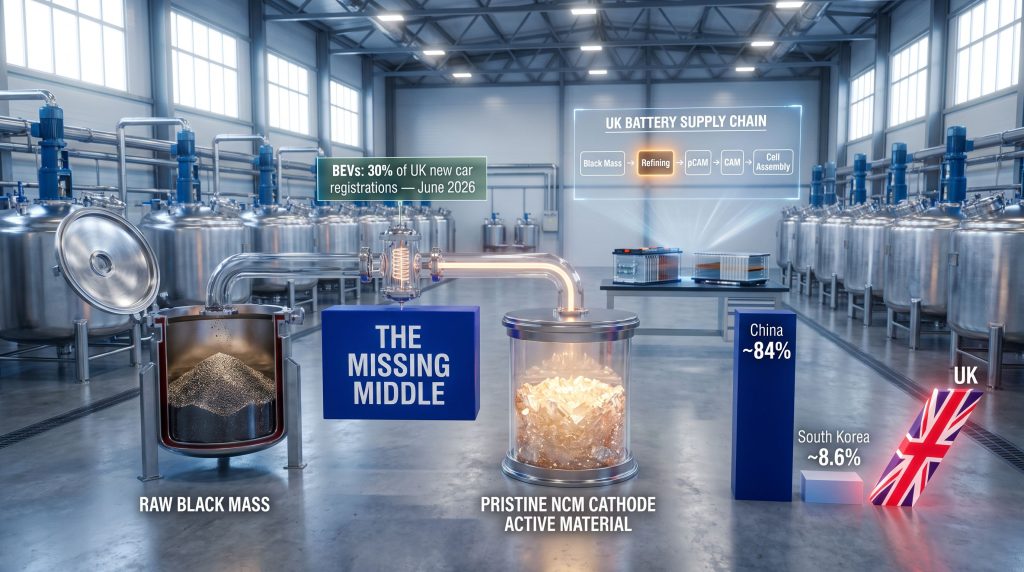
The urgency of resolving the midstream processing gap is amplified by rapidly accelerating domestic EV adoption. Battery electric vehicles captured a 30% share of new UK car registrations in June 2026, the highest monthly BEV penetration recorded in the UK in 2026, according to data from the Society of Motor Manufacturers and Traders (SMMT).
This growth trajectory creates a compounding dynamic across the supply chain. Rising EV sales today translate into growing volumes of end-of-life battery scrap in the 2028 to 2035 window, which in turn represents a substantial feedstock opportunity for domestic recyclers. But capturing that opportunity requires hydrometallurgical refining capacity that does not yet exist at commercial scale in the UK. The critical minerals demand driven by the energy transition will only intensify these pressures further.
The Black Mass Export Problem: Losing Value Twice
The most visible and immediate manifestation of the UK's midstream processing gap is the routine export of black mass, the shredded intermediate material produced when end-of-life lithium-ion batteries are mechanically processed. Black mass contains recoverable concentrations of lithium, nickel, cobalt, and manganese, but extracting and purifying these metals requires hydrometallurgical refining infrastructure that the UK currently lacks at commercial scale.
The consequence is straightforward but economically significant. Black mass produced from UK battery scrap is predominantly exported to Asian processing markets, particularly South Korea, where it is refined into battery-grade metal salts. Those refined materials then re-enter the supply chain, often returning to European buyers at a price that reflects both the processing margin and the transport cost of the round trip.
When the UK exports black mass and reimports refined cathode materials, it effectively subsidises the industrial capacity of overseas processors while remaining structurally dependent on the same supply chains it is trying to diversify away from.
This dynamic represents a double loss. Critical minerals leave the country as a low-value intermediate. They return as a high-value processed material, with the commercial margin captured entirely offshore. The embedded value in UK-origin battery scrap is, in effect, a subsidy to foreign refining industries. For instance, the battery recycling process in China demonstrates just how advanced and vertically integrated competing markets have become.
CAM Concentration Risk: A Western-Wide Structural Problem
The UK's midstream deficit in CAM and pCAM production is not unique, but the scale of global concentration makes it particularly acute. According to Fastmarkets research, China is projected to account for approximately 84% of globally announced CAM manufacturing capacity in 2026. South Korea represents the next largest national share at approximately 8.6% of globally announced CAM capacity.
This leaves the EU, North America, and the UK in broadly similar positions: operational gigafactory investment running ahead of any credible domestic midstream processing base. The structural challenge is that CAM production capacity in China was built over two decades of deliberate industrial policy and accumulated technical expertise. Replicating it quickly in western markets requires not just capital, but chemistry expertise, process engineering capability, and reliable feedstock supply, none of which can be assembled overnight.
Anode Materials: The Overlooked Midstream Opportunity
Most UK and European midstream discussions focus on cathode materials, but anode active material production represents an equally important and significantly less explored domestic opportunity. Graphite, the dominant anode material in current lithium-ion chemistries, faces its own supply concentration risk, with China also controlling the majority of global synthetic graphite processing capacity.
Pilot-scale demonstrations of recycled anode active material production from used batteries are beginning to emerge as a potential differentiation point for UK operators. Recovering and reprocessing graphite from end-of-life cells, rather than importing virgin synthetic graphite from Asian suppliers, could extend the value captured per tonne of processed black mass and reduce dependency on a second concentrated supply chain simultaneously.
How UK Recyclers Are Attempting to Close the Gap
Hydrometallurgical Processing: The Technical Bridge
Hydrometallurgical refining is the process pathway through which black mass transitions from a low-value shredded intermediate into the battery-grade metal salts that CAM manufacturers require. The process involves several distinct steps:
- End-of-life battery collection, sorting, and safe discharge
- Mechanical shredding and physical separation to produce black mass
- Hydrometallurgical leaching, where the black mass is dissolved in an acidic or alkaline solution to extract metal content
- Selective precipitation and solvent extraction to separate individual metal streams, producing lithium, nickel, cobalt, and manganese compounds
- Purification and synthesis of pCAM and CAM for re-entry into the battery manufacturing supply chain
Without this refining capability operating at commercial scale domestically, the UK cannot retain critical mineral value within its borders regardless of how much black mass its pre-processing operations generate.
Altilium Clean Technology: Scaling Toward Commercial Refining
Altilium Clean Technology represents the UK's most advanced effort to build commercial-scale hydrometallurgical refining capacity. The company currently operates a pilot-scale facility in Devon, southwestern England, and has demonstrated the ability to produce recycled NCM cathode active material from this operation. Altilium's mission to localise CAM production is widely regarded as one of the most strategically significant midstream initiatives currently under way in the UK.
Test batches have been delivered to the UK Battery Industrialisation Centre (UKBIC) for EV cell qualification, an important step toward establishing the material's suitability for use in commercial cell production. Consequently, Altilium's advances in UK EV battery production represent a meaningful proof point for the broader domestic midstream ambition.
The company's ACT 3 facility in Plymouth, also in southwestern England, is the primary scale-up project. It targets commissioning by 2027 with capacity to process 8,000 tonnes of black mass per year. Altilium has also demonstrated recycled anode active material production at pilot scale, a capability that distinguishes it from the majority of European recycling operators and positions it to capture value from both cathode and anode material streams.
According to Fastmarkets research, recycled metals are forecast to represent approximately 15% of total global cathode material supply by 2030, rising from an estimated 8% share in 2026. This trajectory indicates that the commercial window for UK recyclers to establish themselves as credible domestic suppliers of recycled battery materials is opening, but the timeframe for securing that position is finite.
Recyclus Group: Pre-Processing at Scale and the Feedstock Challenge
Recyclus Group operates a pre-processing facility in Wolverhampton, central England, with a nameplate capacity for consuming 22,000 tonnes of scrap batteries annually. The company currently processes a diverse feedstock mix including industrial batteries, e-bike packs, power tool batteries, warehouse robotics systems, and EV modules.
The company is evaluating technology options for recovering lithium from black mass within the UK, which would represent an important step toward extending its value capture beyond pre-processing. However, Recyclus faces a challenge common to all UK recyclers operating ahead of large-scale domestic cell manufacturing: feedstock inflows are irregular, driven by insurance write-offs, product recalls, and the absence of consistent manufacturing scrap streams from gigafactory operations.
This dynamic is expected to shift materially as Envision AESC's Sunderland plant increases output and Agratas commissions its Somerset facility. Manufacturing scrap from cell production provides a more predictable and consistent feedstock stream than end-of-life consumer materials, which could significantly improve the economics of UK recycling operations from the late 2020s onward.
The next major ASX story will hit our subscribers first
Pricing Dynamics and the Economics of Midstream Investment
Black Mass Payable Rates: Where Commodity Prices Meet Recycling Viability
| Black Mass Indicator | Payable Rate (July 15, 2026) | Week-on-Week Change |
|---|---|---|
| NCM black mass, cobalt payable (exw Europe) | 80-85% of standard-grade cobalt price | Unchanged |
| NCM black mass, nickel payable (exw Europe) | 80-85% of LME nickel cash official price | Unchanged |
(Source: Fastmarkets, July 2026)
Softening lithium and nickel prices through mid-2026 have compressed payable rates for NCM black mass across both European and Asian consumer markets. This compression is not merely a short-term pricing issue. It directly affects the revenue visibility that lenders and investors require to commit financing to midstream scale-up projects. When commodity prices are depressed, the payback period for capital-intensive hydrometallurgical facilities extends, making project financing more difficult to secure at precisely the moment when the industry needs capital to advance.
The Financing Gap: The Constraint That Overrides All Others
Financing access has been consistently identified by industry participants as the primary constraint on midstream scale-up across the UK EV battery supply chain midstream processing landscape. Several structural factors compound this challenge:
- Uncertain feedstock availability during the pre-gigafactory phase limits revenue visibility for prospective lenders
- Commodity price cycles create unpredictable payback periods for capital-intensive processing assets
- The failures of Britishvolt and AMTE Power in 2023, along with high-profile North American cases including Li-Cycle and Ascend Elements, have raised institutional investor due diligence thresholds significantly
- Long lead times between project announcement and first commercial revenue create sustained cash consumption periods that test the patience of conventional investors
The industry has responded by adopting more cautious, phased expansion models that seek to demonstrate technical capability at smaller scale before committing to full commercial build-out. This is a rational response to the lessons of 2023, but it also means the timeline to commercial-scale domestic midstream processing extends further into the decade.
Government Policy and the Strategic Framework for Midstream Development
The UK government's 2023 Battery Strategy provides the overarching policy architecture for domestic battery supply chain development. The strategy explicitly identifies primary cathode processing and secondary processing (recycling and refining) as high-value midstream targets for domestic industrial investment. Its approach integrates gigafactory development, midstream processing investment, and recycling infrastructure expansion into a single policy framework rather than treating them as separate objectives.
UK authorities have committed over £2 billion (approximately $2.69 billion) in automotive sector support directed toward zero-emission vehicle manufacturing, battery production, and battery supply chain development. This funding operates through direct grants, innovation support programmes, and broader industrial strategy mechanisms.
Parliamentary committee assessments have reached an important conclusion that shapes the strategic focus: full domestic onshoring of the entire battery supply chain from mine to cell is neither feasible nor desirable given the UK's resource base. The strategic emphasis therefore concentrates on midstream stages where domestic expertise and existing industrial infrastructure offer a credible foundation for competitive development, specifically critical mineral refining, CAM and anode material manufacturing, electrolyte production, and closed-loop recycling systems. In addition, developments in direct lithium extraction technology may offer further upstream solutions to complement domestic midstream ambitions.
How the UK Compares Globally on Midstream Capability
| Region | CAM/pCAM Capacity Status | Recycling Infrastructure | Midstream Strategy Approach |
|---|---|---|---|
| China | ~84% of globally announced CAM capacity (2026) | Extensive commercial-scale operations | Vertically integrated; decades of industrial investment |
| South Korea | ~8.6% of globally announced CAM capacity | Advanced commercial recycling | OEM-integrated, chaebol-led supply chains |
| European Union | Significant operational deficit | Growing but fragmented | Policy-driven catch-up investment |
| North America | Parallel midstream dependency challenges | Emerging; high-profile project failures noted | IRA-incentivised domestic build-out |
| United Kingdom | Commercial-scale CAM gap; pilot-scale recycling only | Pre-processing established; refining absent | Battery Strategy and £2bn+ public commitment |
The UK's position within this comparative framework is both genuinely vulnerable and strategically recoverable. The absence of domestic CAM capacity is a shared western problem, not a unique UK failure. The distinction lies in whether individual nations move decisively through the 2026 to 2030 window to establish commercial midstream capability before the global supply chain architecture ossifies around existing Asian dominance. Broader battery raw materials market dynamics will also play a significant role in determining how quickly western nations can close this gap.
What Needs to Happen to Build a Viable UK Midstream
Priority Investment Areas for the Next Four Years
The most urgent capability gap is commercial-scale hydrometallurgical refining. Without it, no amount of pre-processing investment can retain critical mineral value within the UK. Beyond refining, the priority investment areas include:
- Domestic pCAM and CAM production facilities, ideally co-located with or adjacent to gigafactory sites to reduce logistics complexity and establish direct material supply agreements
- Anode active material processing, leveraging both recycled graphite from end-of-life cells and emerging silicon-based anode chemistries
- Electrolyte manufacturing capability to reduce import dependency across all cell chemistries currently in commercial production
Structural Enablers That Must Accompany Capital Investment
Capital alone cannot build a midstream. Several structural conditions are required alongside investment:
- Long-term funding mechanisms that provide investor certainty across the extended development timelines of processing facilities
- Feedstock security agreements between domestic gigafactory operators and UK recyclers to establish reliable scrap material flows from manufacturing operations
- Regulatory frameworks that create economic incentives for domestic processing over black mass export, addressing the structural bias that currently channels UK-origin material to Asian refiners
- Engineering and chemistry skills pipelines capable of staffing hydrometallurgical and chemical processing operations at the scale required
The Circular Economy Argument Is Also a Commercial Argument
The case for closing the loop between battery recovery and battery material production is frequently framed in environmental terms. But it is equally compelling as a commercial and strategic proposition. Recycled critical minerals processed domestically reduce unit input costs for UK cell manufacturers, insulate the supply chain from global commodity price shocks, and progressively reduce the volume of virgin material that must be imported through exposed long-haul supply chains.
The decisions made by the UK battery industry and policymakers between now and 2030 will determine whether the UK EV battery supply chain midstream processing sector develops sufficient scale to anchor a genuinely independent battery supply chain, or whether the UK's gigafactories remain dependent on Asian midstream infrastructure for the foreseeable future. The technical pathways exist. The policy intent is established. The missing variable is the industrial commitment and financing to execute at scale, and time is not a resource the industry has in abundance.
This article contains forward-looking statements and market forecasts based on data available at the time of writing. Commodity prices, project timelines, and capacity figures are subject to change. Nothing in this article constitutes financial or investment advice. Readers should conduct independent research before making investment decisions.
Want to Track the Critical Mineral Discoveries Powering the Battery Revolution?
Discovery Alert's proprietary Discovery IQ model delivers real-time alerts on significant ASX mineral discoveries — instantly translating complex geological data into actionable investment insights for the critical minerals underpinning the global battery supply chain. Explore Discovery Alert's dedicated discoveries page to understand how historic mineral discoveries have generated substantial returns, and begin your 14-day free trial to position yourself ahead of the market.