July 23, 2026
The Chemistry Behind the Commodity: Understanding Battery-Grade Lithium Carbonate Production
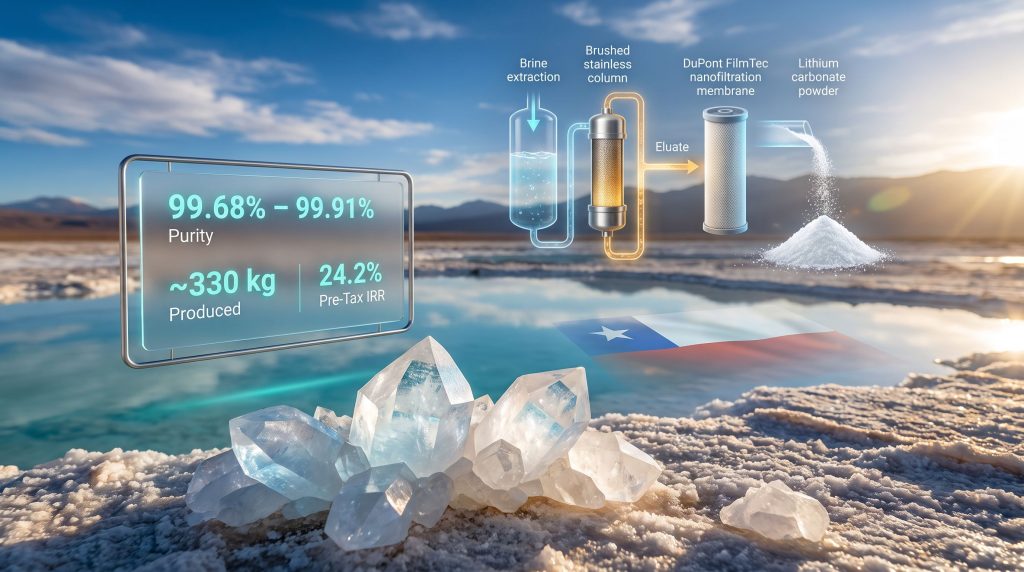
The gap between extracting lithium from a brine aquifer and delivering a product that meets the exacting specifications of a battery cell manufacturer is vast. Most discussions of lithium supply focus on resource size, grade, or geography, yet the actual commercial bottleneck for many emerging producers lies in the chemistry of conversion: turning raw brine into a consistently pure, commercially accepted material. That challenge sits at the heart of what CleanTech Lithium Laguna Verde lithium carbonate production is working to resolve at its Laguna Verde project in Chile, where a pilot programme has now produced approximately 330 kg of battery-grade lithium carbonate with purity grades ranging from 99.68% to 99.91%.
This milestone is not simply a production figure. It represents the first end-to-end validation of a process chain that begins with brine in a Chilean salar and ends with a refined chemical product ready for cathode manufacturing supply chains.
When big ASX news breaks, our subscribers know first
Why Lithium Purity Thresholds Are a Commercial Gateway, Not Just a Technical Target
Battery-grade lithium carbonate is not a loosely defined category. In practice, the specification most widely referenced in commercial offtake agreements is anchored to Chinese national standards, where the minimum purity threshold for battery-grade material sits at 99.5% lithium carbonate content, with strict limits on impurities including magnesium, calcium, sulphate, chloride, and sodium.
The reason Chinese standards dominate global procurement is structural: China accounts for the overwhelming majority of the world's lithium-ion battery cell manufacturing capacity and processes the bulk of global cathode active material. Consequently, producers who cannot meet Chinese battery-grade specifications are, in practical terms, locked out of the world's most liquid and highest-volume offtake market. Understanding dynamics in the lithium carbonate market is therefore essential for any producer seeking to commercialise their resource.
What makes the Laguna Verde pilot results commercially significant is that the purity range achieved, 99.68% to 99.91%, clears the Chinese battery-grade threshold with meaningful headroom. This is not a borderline result. The consistency of purity across the batch, derived from processing approximately 55,000 litres of eluate at a US-based downstream facility, suggests the process can repeatably deliver above-specification material.
Battery-grade lithium carbonate purity requirements are among the most demanding in the industrial chemicals sector, with total impurity tolerances often measured in parts per million rather than percentage points. Achieving consistent grades above 99.5% from a novel DLE process at pilot scale represents a meaningful technical proof point.
What Direct Lithium Extraction Actually Does to Brine Chemistry
To understand why the Laguna Verde pilot matters to the broader DLE industry, it helps to understand what conventional brine processing looks like by comparison.
Traditional salar lithium production relies on solar evaporation ponds that concentrate brine over periods of 12 to 24 months, depending on climate and brine chemistry. During this time, lithium concentrations increase while water and unwanted ions are removed through sequential evaporation stages. The process is slow, land-intensive, and highly sensitive to rainfall events that can dilute ponds and disrupt production schedules.
Direct lithium extraction takes a fundamentally different approach. Selective adsorbent materials, typically ion-sieve compounds based on manganese oxide or titanium oxide frameworks, preferentially bind lithium ions as brine flows through the system. The lithium-loaded adsorbent is then washed with fresh water or dilute acid to release the lithium into a purified solution called eluate. This entire cycle can be completed in hours rather than months.
The eluate produced at the Laguna Verde DLE pilot plant in Chile was then transported to the Empower EIT facility in Dallas, Texas, for downstream processing into battery-grade lithium carbonate. This geographic separation of the DLE stage from the carbonation stage is notable: it demonstrates that eluate from a high-altitude Chilean operation can be processed into a finished product at a remote advanced facility, an important proof of concept for modular supply chain architecture.
The Four-Stage Conversion Process at Laguna Verde
The end-to-end process validated by the pilot programme can be broken into four sequential stages:
-
Brine extraction and DLE processing at the Laguna Verde pilot plant in Chile, where raw brine is passed through adsorbent media to generate lithium-rich eluate.
-
Eluate transportation to the advanced downstream processing facility in Dallas, preserving solution chemistry for further treatment.
-
Nanofiltration membrane purification using DuPont FilmTec LiNE-XD high-productivity nanofiltration membranes, which selectively remove divalent ions such as magnesium, calcium, and sulphate while allowing lithium to pass through, achieving superior ion selectivity.
-
Carbonation and product verification, where purified lithium solution is reacted with sodium carbonate or carbon dioxide to precipitate lithium carbonate, followed by drying, milling, and independent laboratory verification of product purity.
Each of these stages introduces potential points of impurity ingress or lithium loss. Furthermore, the fact that the pilot programme achieved battery-grade results across all four stages suggests the process design is fundamentally sound at this scale.
Key Production Metrics from the Laguna Verde Pilot Programme
| Metric | Reported Value |
|---|---|
| Total lithium carbonate produced | ~330 kg |
| Purity range achieved | 99.68% to 99.91% |
| Volume of eluate processed | ~55,000 litres |
| Downstream processing location | Dallas, USA |
| Brine source | Laguna Verde, Chile |
| Target quality standard | Chinese battery-grade |
The DuPont FilmTec LiNE-XD Membrane: Why Nanofiltration Technology Matters
One technical detail from the Laguna Verde pilot that deserves closer examination is the use of DuPont FilmTec LiNE-XD nanofiltration membranes in the purification stage. Nanofiltration occupies a specific position in the membrane separation spectrum, operating at pressures and pore sizes between reverse osmosis and ultrafiltration. For lithium brine extraction processing, this is the critical range.
The challenge in purifying lithium brine is selective separation: lithium ions are monovalent and relatively small, while problematic impurities like magnesium and calcium are divalent. Nanofiltration membranes engineered for lithium applications exploit this valency difference, rejecting divalent ions at high rates while allowing lithium to permeate. The FilmTec LiNE-XD element is designed specifically for this application, delivering high throughput while maintaining selectivity.
The selective removal of magnesium is particularly important for Chilean brine projects. Many Atacama-region brines carry high magnesium-to-lithium ratios, and magnesium contamination is one of the primary barriers to achieving battery-grade purity from conventional evaporation-based processing. DLE combined with advanced nanofiltration addresses this directly.
For investors evaluating DLE projects, the choice of purification technology at the downstream stage is often overlooked but critically important. A DLE process that produces high-lithium eluate but cannot remove divalent impurities to battery-grade standards has not actually solved the commercial problem. The Laguna Verde pilot's use of purpose-engineered nanofiltration membranes, and its achievement of above-99.5% purity, indicates that both the extraction and purification stages are working in tandem.
Prefeasibility Study Economics: What the Numbers Signal to Investors
The pilot programme milestones sit within the context of a prefeasibility study that has already defined the commercial framework for Laguna Verde. Understanding how the PFS economics evolved from earlier conceptual work provides useful context for assessing the project's maturity.
| Parameter | Earlier Scoping Study | PFS Base Case |
|---|---|---|
| Annual production target | 20,000 tpa | 15,000 tpa |
| Project life | 30 years | 25 years |
| Pre-tax IRR | Not disclosed | 24.2% |
| Capital payback period | Not disclosed | ~4 years |
The reduction in annual production target from 20,000 to 15,000 tonnes per annum and the shortening of project life from 30 to 25 years might initially appear negative. However, this type of refinement in a feasibility study trajectory typically reflects more rigorous reservoir modelling and process engineering rather than a deterioration in project quality. A pre-tax internal rate of return of 24.2% with a ~4-year capital payback period remains a competitive return profile for a lithium carbonate project of this nature.
For context, the average pre-tax IRR for lithium brine projects that reached feasibility study stage in the preceding decade ranged widely, but projects achieving above 20% IRR with sub-5-year payback periods were typically considered economically robust. A 25-year mine life also provides the long-duration cash flow profile that institutional investors and potential project finance lenders typically require for critical minerals projects.
It is important to note that all feasibility study metrics are forward-looking estimates subject to lithium carbonate price assumptions, capital cost estimates, and operating cost projections that may change materially as the project advances. Past feasibility study results are not a guarantee of future project outcomes.
The next major ASX story will hit our subscribers first
Three Concurrent Validation Workstreams Running Simultaneously
What distinguishes the current phase of Laguna Verde's development is that CleanTech Lithium is not running a single sequential programme. Three distinct technical workstreams are advancing in parallel across multiple jurisdictions:
Workstream 1: PFS Process Validation Trial in Chile
A volume of 20 cubic metres of feed brine from Laguna Verde is being processed at the Xian Lanshen New Material Company pilot plant facility in Santiago. This programme is structured in three stages: verification of DLE process parameters, evaluation of advanced membrane and purification steps, and final carbonation to produce a 5 kg lithium carbonate sample meeting Chinese battery-grade standards. External laboratory testing will follow before results are reported to the market.
Workstream 2: DFS-Level Adsorbent Benchmarking in France
French consulting firm Hephaistos Insights is conducting DLE benchmarking and eluate analysis using Laguna Verde brine, with specialist bench-scale testing executed by subcontractor Seprosys. The programme assesses a range of adsorbent materials against the project's specific brine chemistry, focusing particularly on elution efficiency. Both CleanTech's current reference adsorbent and alternatives sourced from North American and European suppliers are being evaluated, with the objective of confirming optimal adsorbent selection ahead of the Definitive Feasibility Study.
Workstream 3: Spent Brine Reinjection Options Analysis
Specialist brine services company Zelandez has been engaged to lead a comprehensive study deploying hydrogeologists, reservoir engineers, and DLE experts to evaluate aquifer reinjection concepts. The analysis integrates basin dynamics, environmental permitting screens, and cost modelling to deliver a recommended DFS workplan for sustainable long-term brine management.
Running these three workstreams concurrently rather than sequentially compresses the overall timeline to DFS, consequently reducing the period of technical uncertainty for investors and project partners.
Spent Brine Reinjection: The Sustainability Variable That Determines Project Longevity
The spent brine reinjection study warrants specific attention because it addresses what may be the most significant long-term operational risk for any Chilean lithium brine project: aquifer sustainability.
When DLE or conventional evaporation processes extract brine from a salar basin, the spent brine (depleted of lithium but still containing water and other dissolved salts) must be managed. In conventional operations, this material is often discharged to surface evaporation ponds or returned to the salar in an uncontrolled manner. Both approaches carry environmental risks and are increasingly subject to regulatory scrutiny in Chile.
Aquifer reinjection offers a more sophisticated alternative: returning spent brine to the producing aquifer under controlled conditions to maintain reservoir pressure, support long-term aquifer sustainability, and demonstrate responsible resource stewardship. The technical complexity is significant, requiring hydrogeological modelling to understand basin dynamics, injection well engineering, and water chemistry analysis to prevent adverse reactions between injected and native brine.
Chilean environmental regulators are applying increasing scrutiny to brine management practices as the country navigates the tension between lithium development ambitions and water resource protection in arid ecosystems. Projects capable of demonstrating credible closed-loop brine management have a structural advantage in the permitting process.
For Laguna Verde, the outcome of the Zelandez reinjection study will directly inform the DFS environmental impact assessment and permitting strategy. In addition, this is not a peripheral sustainability exercise; it is central to securing the operational licences required for a 25-year production life. The broader Chile lithium strategy increasingly favours projects that demonstrate credible environmental stewardship from early development stages.
What the Adsorbent Selection Process Reveals About DLE Maturity
One aspect of the Laguna Verde development programme that receives less attention than production metrics is the ongoing adsorbent optimisation work. This matters because adsorbent performance is arguably the single most important variable in DLE process economics.
Adsorbent materials determine:
- Lithium recovery rate per extraction cycle
- Elution efficiency, or how completely lithium can be stripped from the adsorbent for downstream processing
- Adsorbent lifespan, measured in the number of extraction cycles before performance degrades
- Selectivity, meaning the degree to which lithium is captured preferentially over sodium, potassium, and other common brine constituents
The fact that CleanTech is conducting DFS-level adsorbent benchmarking in France, evaluating materials from multiple international suppliers rather than committing to a single source, reflects a sophisticated understanding of this variable. Different adsorbent formulations perform differently against different brine chemistries, and Laguna Verde's specific brine composition requires empirical testing rather than reliance on published specifications from other projects.
Risks and Uncertainties Before Advancing to Definitive Feasibility Study
Investors evaluating CleanTech Lithium Laguna Verde lithium carbonate production progress should maintain clear awareness of the unresolved risks that sit between current pilot validation and eventual commercial production:
-
Technical risk: Adsorbent performance demonstrated at bench and pilot scale does not guarantee equivalent performance at commercial scale. The relationship between adsorbent loading, elution efficiency, and cycle time can change non-linearly as equipment sizes increase.
-
Environmental and permitting risk: The outcome of the spent brine reinjection study and subsequent Chilean environmental impact assessment cannot be predicted with certainty. Permitting timelines for Chilean lithium projects have historically been subject to significant variation.
-
Market risk: Lithium carbonate prices are highly cyclical and have demonstrated extreme volatility over the past five years, ranging from below $10,000 per tonne to above $80,000 per tonne. PFS economics are sensitive to the price assumptions embedded in the financial model.
-
Execution risk: Running three parallel technical workstreams across Chile, France, and the United States introduces coordination complexity that could delay deliverables or create inconsistent datasets.
This article contains forward-looking information about a project that remains in the feasibility study phase. Readers should not interpret feasibility study metrics, pilot programme results, or project timelines as guarantees of future performance or investment returns.
Frequently Asked Questions: CleanTech Lithium Laguna Verde Lithium Carbonate Production
What purity of lithium carbonate has Laguna Verde produced so far?
The pilot programme has produced approximately 330 kg of lithium carbonate with purity grades between 99.68% and 99.91%, clearing the Chinese battery-grade threshold of 99.5%.
What is the planned annual production capacity at Laguna Verde?
The PFS base case targets 15,000 tonnes per annum of battery-grade lithium carbonate over a 25-year project life, revised from an earlier conceptual figure of 20,000 tpa over 30 years.
What is the pre-tax IRR for the Laguna Verde PFS?
The PFS reported a pre-tax IRR of 24.2% with an estimated capital payback period of approximately four years.
What is direct lithium extraction and how does it differ from conventional methods?
DLE uses selective adsorbent materials to extract lithium from brine in hours, bypassing the multi-year evaporation pond process. The extracted lithium-rich eluate is then processed downstream into battery-grade lithium carbonate. The lithium brine market is increasingly favouring this approach as producers seek faster processing timelines and improved environmental outcomes.
Why is spent brine reinjection important for Laguna Verde?
Reinjecting spent brine into the producing aquifer maintains basin sustainability, satisfies Chilean environmental permitting requirements, and demonstrates responsible resource management to regulators and investors.
What is the significance of the Chinese battery-grade standard?
Chinese battery-grade specifications represent the most stringent and widely referenced commercial quality benchmark globally, given China's dominant role in cathode material manufacturing and battery cell production. Meeting this standard is essential for accessing the world's largest lithium offtake market.
Key Takeaways: Laguna Verde in the 2026 Lithium Development Landscape
-
330 kg of battery-grade lithium carbonate produced at pilot scale, with purity between 99.68% and 99.91%, clearing the Chinese battery-grade threshold
-
55,000 litres of eluate processed at the Empower EIT facility in Dallas to demonstrate process repeatability across the full production chain
-
PFS base case targets 15,000 tpa of battery-grade lithium carbonate over 25 years, with a 24.2% pre-tax IRR and approximately 4-year capital payback
-
Three concurrent validation workstreams advancing simultaneously across Chile (PFS process validation), France (DFS adsorbent benchmarking), and a specialist reinjection study with Zelandez
-
Chinese battery-grade standard compliance is the target quality benchmark for the 5 kg carbonation sample currently in production at the Santiago-based Lanshen pilot facility
-
Spent brine reinjection analysis is underway to support environmental permitting and long-term aquifer sustainability, a critical variable in Chilean lithium project licencing
For further coverage of critical minerals development and emerging battery materials technology, Benchmark Mineral Intelligence provides in-depth analysis on lithium supply chains and pricing. In addition, Mining Weekly offers ongoing reporting on direct lithium extraction projects and South American resource development across the sector.
Want to Track the Next Major Lithium Discovery Before the Market Does?
Discovery Alert's proprietary Discovery IQ model scans ASX announcements in real time, instantly identifying significant mineral discoveries — including critical battery metals like lithium — and delivering actionable alerts to subscribers ahead of the broader market. Explore historic examples of major mineral discoveries and their returns, then begin your 14-day free trial to position yourself at the forefront of the next significant find.