July 24, 2026
The Global Battery Supply Chain Is Being Redrawn, and Africa Is Holding the Pen
For most of the past decade, battery manufacturing has been treated as an exclusively Asian industrial story. China's dominance over lithium-ion cell production grew so complete that by 2024, the International Energy Agency confirmed China was supplying approximately three-quarters of a one-terawatt-hour global battery market. That single statistic captures both the scale of concentration risk in the world's clean energy transition and the urgency driving investors, development finance institutions, and industrial policymakers to search for alternative production geographies.
Morocco has now stepped into that conversation in a significant way. The African Development Bank's approval of a €100 million (approximately $113.7 million USD) loan to Gotion Power Morocco marks the AfDB loan for Morocco battery gigafactory as a bankable industrial reality rather than a strategic aspiration. Understanding why this financing decision matters requires looking well beyond the headline loan figure.
When big ASX news breaks, our subscribers know first
How Development Finance Is Being Deployed Differently in Battery Manufacturing
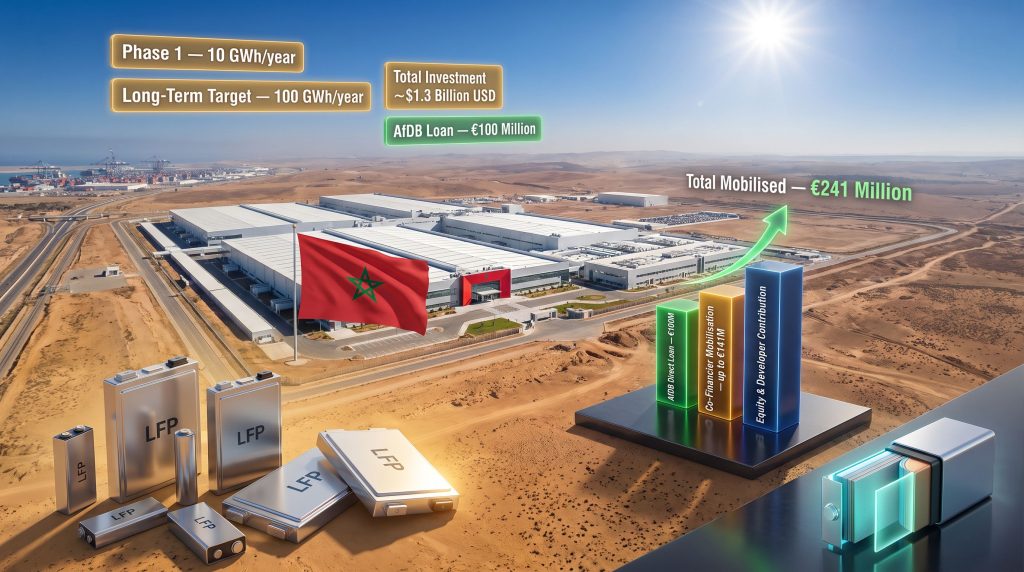
The AfDB loan for Morocco battery gigafactory is not structured as a conventional infrastructure grant or a government subsidy. It functions as a catalytic anchor tranche within a sophisticated project finance architecture. By acting as mandated lead arranger under its New African Financial Architecture for Development framework, the AfDB is using its €100 million commitment to unlock up to an additional €141 million from co-financiers, bringing the total mobilised financing package to approximately €241 million.
This leverage mechanism is central to understanding the project's significance. In emerging market project finance, a multilateral development bank's participation functions as a de-risking signal to commercial lenders and bilateral institutions that would otherwise price sovereign and construction risk prohibitively. The AfDB is, consequently, effectively lending its credit reputation alongside its capital.
Development finance institutions acting as mandated lead arrangers in industrial manufacturing projects represent a meaningful evolution in how multilateral capital is deployed. The traditional model funded power plants and roads; the new model funds entire supply chain nodes.
The illustrative capital stack for the Morocco gigafactory across all phases looks roughly as follows:
| Financing Layer | Estimated Amount | Provider Type |
|---|---|---|
| AfDB Direct Loan | €100 million | Multilateral DFI |
| Co-Financier Mobilisation | Up to €141 million | Bilateral DFIs / ECAs / Commercial |
| Equity and Developer Capital | Remainder toward ~$1.3B total | Gotion High-Tech / Project Co. |
The total project investment requirement across all development phases is estimated at approximately $1.3 billion USD, meaning the AfDB-anchored package covers only the initial phase while establishing the commercial credibility needed to attract private capital into subsequent expansion stages. Furthermore, African mining finance trends suggest this model of DFI-led capital mobilisation is becoming increasingly common across the continent.
Why Morocco's Geography Creates a Structural Competitive Advantage
Raw Materials and Market Access
The selection of the Rabat-Salé-Kénitra Free Trade Zone as the facility's home is not incidental. Morocco's industrial geography offers a combination of raw material proximity, logistics infrastructure, and market access that few competing locations on the African continent can replicate simultaneously.
Morocco holds the world's largest proven phosphate reserves, a fact that carries outsized significance for LFP battery manufacturing. Lithium iron phosphate chemistry relies on phosphate as a core cathode material input. A vertically integrated gigafactory built in the world's largest phosphate-producing nation operates with a raw material cost advantage that is structural rather than cyclical.
Beyond raw materials, Morocco's competitive positioning includes:
- EU Association Agreement access, enabling preferential market entry into Europe's rapidly growing battery import market
- Proximity to Tanger Med, Africa's largest container port by throughput capacity, providing logistics efficiency for export-oriented production
- Established automotive ecosystem with Renault and Stellantis both operating manufacturing facilities in Morocco, creating a ready-made supply chain network for EV battery integration
- Renewable energy infrastructure, with Morocco targeting approximately 45% renewable electricity generation by 2030, supporting the gigafactory's stated ambition to operate primarily on clean power
- AfCFTA signatory status, opening tariff-preferential access to African domestic markets as EV adoption accelerates across the continent
| Strategic Factor | Morocco's Position | Competitive Advantage Level |
|---|---|---|
| Phosphate Reserve Access | World's largest proven reserves | Very High |
| EU Trade Access | Association Agreement + AfCFTA signatory | High |
| Renewable Energy Capacity | ~45% renewable electricity target by 2030 | High |
| Existing Automotive Ecosystem | Renault, Stellantis manufacturing presence | Moderate to High |
| Port and Logistics Infrastructure | Tanger Med, Africa's largest container port | High |
| Skilled Industrial Workforce | Growing technical training pipeline | Moderate |
Gotion High-Tech's Global Manufacturing Calculus
The project developer, Gotion High-Tech Co., Ltd., is headquartered in Hefei, China, and listed on the Shenzhen Stock Exchange. The company is one of China's established LFP battery manufacturers and has been executing an international expansion strategy that includes announced facilities across Europe and North America.
Morocco represents a strategically distinct node in that global network. A plant operating within Morocco's EU trade agreement framework and supplied by domestic phosphate feedstock is positioned differently from Gotion's other international manufacturing investments. It combines African raw material advantage with European market access, a combination that few other jurisdictions can offer simultaneously.
There is also a less commonly discussed dynamic at work here. Chinese battery manufacturers establishing production capacity in trade-agreement-friendly jurisdictions are, in part, navigating the tariff and regulatory exposure that comes with exporting directly from Chinese facilities into European and US markets. Morocco's location and trade agreements make it a genuinely attractive production base rather than simply a symbolic diversification gesture. The African Development Bank's official project approval confirms this framing, noting the facility's strategic role in diversifying global battery supply chains.
LFP Chemistry: Why This Technology Was Selected for Africa's First Gigafactory
The choice of lithium iron phosphate chemistry for this facility reflects where the global battery industry's centre of gravity has shifted. LFP batteries offer a distinct performance and cost profile compared to nickel manganese cobalt (NMC) alternatives:
- Lower cost per kilowatt-hour due to the absence of cobalt and nickel in the cathode formulation
- Longer cycle life, making them particularly well-suited for stationary grid storage applications that require daily charge and discharge cycles over ten or more years
- Superior thermal stability, reducing the risk of thermal runaway events associated with NMC and NCA chemistries
- Reduced supply chain exposure to cobalt, a mineral with significant human rights and geographic concentration concerns
- Strong compatibility with both EV packs and battery energy storage systems (BESS), giving the Morocco facility flexibility across multiple end markets
The IEA's finding that China supplied approximately three-quarters of the global 1 TWh battery market in 2024 underscores both the technology's dominance and the supply chain concentration risk that facilities like Morocco's are designed to address. LFP has, furthermore, effectively become the default chemistry for high-volume, cost-sensitive battery applications globally, a shift that is reshaping the battery raw materials market in significant ways.
Critically, the Morocco facility is planned as an integrated cathode-to-cell operation rather than a simple cell assembly plant. This distinction matters enormously for value chain economics. A cell assembly plant that imports cathode active materials from China captures only a fraction of the manufacturing value. A fully integrated facility retains substantially more margin and creates deeper industrial capability within the host country.
Phase-by-Phase Expansion: From 10 GWh to a Globally Significant 100 GWh
The facility's production roadmap is structured in stages, with Phase 1 establishing commercial proof-of-concept before the longer-term expansion trajectory is executed.
| Development Phase | Target Capacity | Primary Output | Market Focus |
|---|---|---|---|
| Phase 1 | 10 GWh per year | LFP cells and battery packs | EV market, export-oriented |
| Long-Term Target | 100 GWh per year | Cells, packs, cathodes, anodes | Europe and African domestic market |
A 100 GWh annual production capacity would place Morocco among the genuinely significant battery manufacturing nations globally, not merely a regional first mover. To contextualise that number: 100 GWh of annual battery production is sufficient to power approximately 1.5 million battery electric vehicles at typical passenger vehicle pack sizes, or to supply meaningful quantities of grid-scale storage capacity to African utilities that currently depend entirely on imported systems.
The phase-by-phase approach also serves a financing logic. Phase 1's 10 GWh target establishes operational track record, bankable cash flows, and offtake relationships that de-risk the capital raise required for subsequent expansion stages. As critical minerals demand continues to accelerate through the energy transition, this staged approach provides a measured but credible path to scale.
The next major ASX story will hit our subscribers first
Battery Storage and Africa's Clean Energy Grid Challenge
Kevin Kariuki, the AfDB's Vice President for Power, Energy, Climate and Green Growth, has articulated the structural problem that the Morocco gigafactory is designed to address. His position is that battery storage represents the critical missing element in Africa's renewable energy transition, with locally manufactured, cost-competitive battery systems essential for enabling large-scale solar and wind integration across grids that currently lack adequate storage infrastructure.
This framing reflects a real and underappreciated constraint. Sub-Saharan and North African power grids face a structural storage deficit that limits how much variable renewable generation can be reliably integrated. The challenge is not simply the cost of importing battery systems. It is the combination of import cost, logistics complexity, foreign exchange exposure, and limited local technical expertise that makes deploying grid-scale storage in African markets structurally more expensive than headline battery price quotes suggest.
A domestic manufacturing base changes that equation considerably. The battery storage expansion underway globally makes this timing particularly strategic for Morocco. Locally produced LFP cells would:
- Reduce foreign exchange exposure for African utilities procuring storage assets
- Lower logistics costs and lead times for project developers
- Build domestic technical capacity for system installation and maintenance
- Enable locally denominated financing structures that are more accessible to regional utilities
The AfDB's country manager for Morocco, Achraf Tarsim, has indicated that the gigafactory is expected to strengthen Morocco's industrial competitiveness and accelerate its emergence as a manufacturing hub for sustainable mobility industries across the African continent, a positioning that goes well beyond serving European export markets alone.
Geopolitical Scenarios: Three Pathways This Facility Could Reshape the Battery Landscape
Scenario 1: European Supply Chain Diversification
Europe's battery strategy has increasingly recognised that dependence on Chinese cell imports creates systemic vulnerability. The EU Battery Regulation, which introduces Battery Passport requirements and supply chain due diligence obligations, creates both compliance pressure and commercial opportunity for production facilities operating within EU-aligned trade frameworks. Morocco's Association Agreement positions the gigafactory to potentially satisfy EU origin requirements in ways that Chinese-origin cells increasingly cannot, representing a significant regulatory tailwind for European offtake.
Scenario 2: African Industrial Value Capture
Morocco's phosphate industry has historically exported raw material with minimal downstream processing. An integrated LFP gigafactory begins to reverse that pattern by converting phosphate into high-value battery cathode material and finished cells domestically. If this model succeeds, it establishes a template that other African nations with critical mineral endowments may seek to replicate, including the Democratic Republic of Congo's cobalt reserves, Zimbabwe's lithium deposits, and Namibia's emerging green hydrogen sector.
Scenario 3: China's Overseas Manufacturing Evolution
Gotion's Morocco investment is part of a broader pattern visible across the Chinese battery industry: establishing manufacturing capacity in jurisdictions with preferential access to Western markets. This reflects a strategic adaptation to an evolving global trade environment where tariff barriers and local content requirements are reshaping where manufacturing capacity is economically optimal to locate. Morocco benefits from this dynamic whilst also accepting the geopolitical complexity that comes with a Chinese-led industrial project anchored by African development finance. A detailed analysis of China's battery strategy in Morocco highlights how this move fits within Beijing's broader overseas industrial positioning. Furthermore, the China battery recycling outlook suggests that Chinese manufacturers are simultaneously building out end-of-life infrastructure alongside new production capacity globally.
What This Project Signals for Battery Industry Investors and Supply Chain Strategists
Several less obvious implications deserve attention from investors and supply chain analysts tracking the global battery manufacturing landscape:
- DFI leverage ratios are the real story: The AfDB's €100 million is designed to catalyse over €241 million in total project financing in Phase 1 alone. This 2.4x leverage ratio, with potential for higher ratios across subsequent phases, demonstrates how strategically deployed public capital can unlock private investment in markets that commercial lenders would not otherwise enter on comparable terms.
- Integrated facilities outperform assembly plants economically: The cathode-to-cell integration model chosen for Morocco captures significantly more manufacturing value than simple cell assembly. Investors evaluating battery manufacturing projects should treat integration depth as a key differentiator when assessing long-term margin potential.
- LFP's cycle life advantage is underappreciated in stationary storage: In grid-scale BESS applications requiring daily cycling, LFP batteries' longer operational lifespan translates directly into lower levelised cost of storage over the asset's life. This economic advantage compounds over time in a way that headline energy density comparisons with NMC chemistry do not capture.
- Morocco's phosphate advantage is a natural hedge: In a battery materials market where input costs are volatile, producing LFP cells in a country with sovereign control over the world's largest phosphate reserves provides a natural cost hedge that is genuinely difficult to replicate elsewhere.
The AfDB loan for Morocco battery gigafactory therefore represents far more than a single project milestone. It signals a structural shift in how battery manufacturing capacity will be financed, located, and governed in the decades ahead. For investors, supply chain strategists, and policymakers tracking the global energy transition, this project deserves considerably more attention than it has thus far received.
Disclaimer: This article is intended for informational purposes only and does not constitute financial advice. Forecasts, capacity targets, and investment projections referenced in this article are subject to change and involve inherent uncertainties. Readers should conduct independent due diligence before making investment decisions.
Want to Stay Ahead of the Next Major Mineral Discovery Reshaping Global Supply Chains?
As Africa's battery manufacturing landscape evolves and critical mineral supply chains are redrawn, Discovery Alert's proprietary Discovery IQ model delivers real-time alerts on significant ASX mineral discoveries, turning complex data into actionable investment insights — explore historic discoveries and their extraordinary returns, then begin your 14-day free trial at Discovery Alert to position yourself ahead of the market.