July 26, 2026
When the Ground Beneath Your Feet Becomes Both a Power Station and a Mine
The global energy transition has quietly exposed a paradox at the heart of clean technology manufacturing: the materials required to decarbonise the world's energy systems are themselves produced using carbon-intensive processes. Lithium, the foundational element of modern battery chemistry, is overwhelmingly extracted and refined using fossil-fuel-derived electricity, high-pressure chemical processing, and in the case of lithium brine extraction, evaporation cycles spanning up to two years. The result is a structural irony that has long frustrated both policymakers and ESG-focused investors.
Against this backdrop, a different model has been taking shape in one of Europe's most geothermally active corridors. Rather than treating energy consumption as an unavoidable cost of lithium production, the Vulcan Lionheart geothermal power plant in Germany's Upper Rhine Valley fuses the two processes into a single, self-sustaining industrial system. The same subsurface brine that drives turbines also yields battery-grade lithium, collapsing the traditional separation between energy input and mineral output entirely.
When big ASX news breaks, our subscribers know first
What the Lionheart Project Actually Is
The Vulcan Lionheart geothermal power plant represents Phase One of Vulcan Energy's (ASX: VUL) integrated lithium and renewable energy development in Germany. The project is designed around a dual-output architecture: it simultaneously generates baseload renewable electricity and produces lithium chloride from naturally heated geothermal brines drawn from deep subsurface aquifers beneath the Upper Rhine Graben.
This isn't a conventional mine with an attached solar farm. The geothermal resource itself is the energy source, the lithium source, and the processing medium all at once, making Lionheart structurally distinct from every other lithium project currently in development globally.
Phase One Production Targets at a Glance
| Output Category | Annual Target | Equivalent Impact |
|---|---|---|
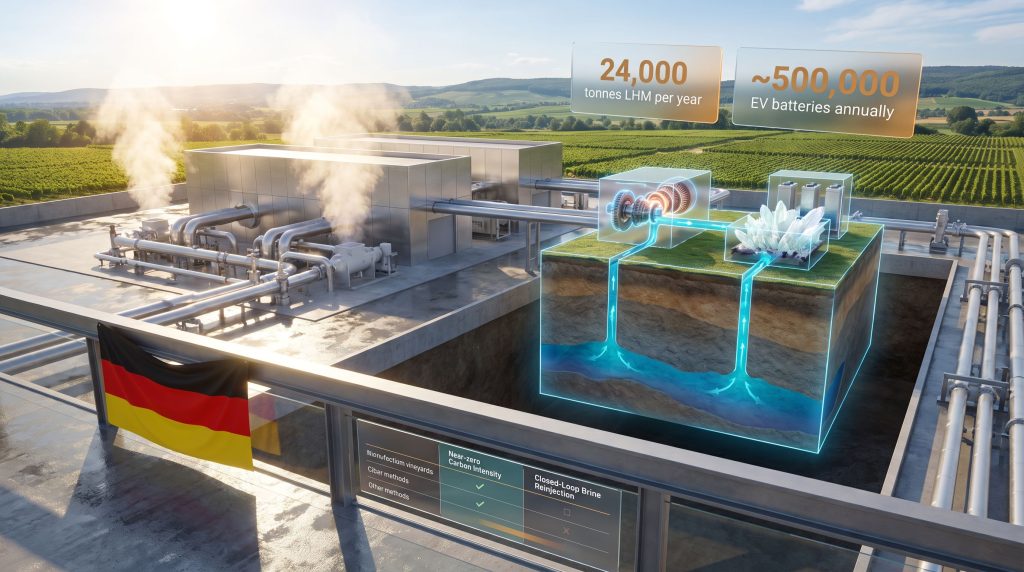
| Lithium Hydroxide Monohydrate (LHM) | 24,000 tonnes | ~500,000 EV batteries per year |
| Geothermal Electricity | 275 GWh | Baseload renewable power for regional grid |
| District Heat | 560 GWh | Sold to local consumers and industrial users |
| Installed Geothermal Capacity | 30-32 MWe | Organic Rankine Cycle (ORC) generation |
| Project Operational Lifespan | ~30 years | Long-duration strategic asset |
The project carries a total Phase One funding package of approximately €2.2 billion, including a €250 million financing commitment from the European Investment Bank. A positive Final Investment Decision has already been made, offtake agreements are contracted, and construction is actively progressing.
The Technology Stack: How Lionheart Converts Brine Into Power and Lithium
Organic Rankine Cycle: Baseload Power from Low-Temperature Fluids
Most people familiar with geothermal energy associate it with the high-temperature steam fields found in Iceland or New Zealand. The Upper Rhine Valley operates differently. Its brines are moderate-to-high temperature hydrothermal fluids rather than volcanic steam, which means conventional steam turbines are not the right tool for the job.
The Organic Rankine Cycle addresses this directly. Instead of flashing water into steam to drive a turbine, ORC systems use the geothermal fluid to heat a secondary organic working fluid with a lower boiling point, typically a refrigerant-class compound. This secondary fluid vaporises, spins a turbine to generate electricity, condenses back to liquid, and cycles continuously. The geothermal brine never contacts the turbine machinery, which reduces scaling and corrosion risks substantially.
The critical advantage for grid operators and offtake partners is dispatchability. Unlike solar generation that drops to zero at night and wind that fluctuates with weather systems, ORC-based geothermal delivers continuous, around-the-clock baseload power regardless of surface conditions. Indeed, these renewable mining solutions represent a materially different value proposition for industrial consumers in southern Germany than intermittent renewables.
VULSORB Direct Lithium Extraction: Precision Chemistry at Depth
Once the geothermal brine has passed through the ORC heat exchange system, it still carries dissolved lithium in ionic form. VULSORB, Vulcan's proprietary direct lithium extraction technology, is deployed at this stage to selectively capture lithium ions from the brine stream using adsorption materials engineered for high selectivity.
The selectivity aspect is commercially significant and often underappreciated. Geothermal brines contain a complex mixture of dissolved minerals including calcium, magnesium, sodium, potassium, and silica. Conventional extraction approaches would require extensive pre-treatment to separate lithium from these competing ions. VULSORB's selective adsorption approach dramatically reduces the downstream purification burden, which directly compresses per-tonne production costs.
The Upper Rhine Valley brines are characterised by relatively low impurity profiles compared to many global brine lithium deposits, meaning the raw material chemistry plays into Vulcan's processing economics before the VULSORB technology even engages. This geological advantage is not replicable in most other geographies.
After lithium extraction, the stripped brine is reinjected into the subsurface reservoir. This closed-loop design is central to the project's environmental credentials and its ability to operate within European regulatory frameworks, which carry far stricter surface disturbance and water consumption standards than most other mining jurisdictions globally.
Civil Construction: Why This Milestone Carries More Weight Than It Appears
Vulcan recently confirmed the commencement of civil construction activities at the Lionheart site, a transition that represents considerably more than a routine progress update.
In large infrastructure projects, there is a clear distinction between preparatory earthworks and civil construction. Bulk earthworks, which involve site clearing, levelling, and drainage preparation, are broadly reversible. A project can complete earthworks and still be abandoned or indefinitely deferred without significant sunk cost. Civil construction is categorically different.
Civil construction at Lionheart currently encompasses:
- Foundation preparation and concrete works for power plant buildings and key equipment bases
- Road infrastructure construction across the operational footprint
- Structural groundworks for process equipment positioning
- Site integration works connecting the power plant to broader project infrastructure
Once reinforced concrete foundations are poured and structural elements begin to rise from the ground, the project has crossed a point of no-return capital commitment. This is the signal that project financing, contractor mobilisation, and procurement lead times have all been successfully aligned. For offtake partners holding contracted supply agreements and for institutional co-investors, civil construction commencement is the tangible evidence that delivery timelines are credible, not aspirational.
The next sequential construction phases involve building erection and the arrival and assembly of process equipment, including the ORC turbine trains and VULSORB extraction modules. First commercial lithium production is targeted for 2028.
How Lionheart Compares to Conventional Lithium Production
The Lionheart model diverges from traditional lithium supply chains along nearly every operational dimension. Understanding these differences contextualises why the project has attracted institutional financing at a scale few critical minerals developers achieve.
| Dimension | Lionheart (Geothermal DLE) | Hard-Rock Mining (Spodumene) | Brine Evaporation (South America) |
|---|---|---|---|
| Energy Source | Self-generated geothermal | Grid electricity (often fossil) | Solar evaporation |
| Carbon Intensity | Near-zero (carbon-neutral target) | High | Low-to-medium |
| Water Consumption | Minimal (closed-loop reinjection) | High | Very high |
| Processing Timeline | Continuous baseload | Batch mine-to-refinery chain | 12-24 month evaporation cycle |
| Land Disturbance | Low (subsurface extraction) | High (open-cut or underground) | High (large evaporation ponds) |
| Co-Product Revenue | Yes (power and heat sales) | No | Minimal |
| European Regulatory Fit | High | Low | Not geographically applicable |
The dual-revenue architecture deserves particular attention from an investment analysis perspective. Most critical minerals projects carry a single commodity price exposure, meaning their economics rise and fall with one market. Lionheart generates revenue from lithium sales and from electricity and heat sales into local German markets. These two revenue streams are largely uncorrelated, providing a natural hedge that single-commodity peers simply cannot replicate structurally.
In an environment where lithium prices have demonstrated sharp cyclicality, the ability to generate baseload energy revenue independent of battery metal market conditions provides a structural earnings floor that most lithium developers lack entirely.
Europe's Supply Chain Vulnerability and the CRMA Imperative
The European Union's Critical Raw Materials Act sets ambitious domestic sourcing targets: at least 10% of annual consumption extracted within the EU and 40% processed domestically by 2030. Lithium is classified as a strategic raw material under this framework, and the supply gap it seeks to close is substantial.
Furthermore, Europe currently depends on imports from Australia, Chile, and China for virtually all of its lithium processing capacity. Post-2022 energy security concerns have intensified the policy focus on European critical raw materials, not merely as an economic efficiency matter but as a geopolitical resilience imperative. A Europe that cannot access battery-grade lithium from domestic sources faces compounding vulnerabilities across its automotive, defence, and grid storage sectors simultaneously.
Lionheart's location in Germany positions it directly within this supply gap. The project's output of 24,000 tonnes of LHM annually would contribute meaningfully to European battery gigafactory supply chains currently reliant on long, geopolitically exposed import routes.
It is worth noting that while the CRMA establishes a favourable regulatory and policy environment for domestic lithium projects, this should not be read as project-specific government endorsement or funding commitment beyond what Vulcan has explicitly confirmed through its EIB financing arrangement.
The next major ASX story will hit our subscribers first
The Lighthouse Concept: Lionheart as a Replicable Template
Vulcan's management has described Lionheart using the concept of a lighthouse project, a term with specific meaning in European industrial policy circles. A lighthouse project is intended not just to function as a single commercial asset but to serve as a proof-of-concept that validates a replicable model for broader rollout.
The Upper Rhine Graben is one of Europe's most extensive geothermal resource zones, stretching across portions of Germany, France, and Switzerland. If Lionheart successfully demonstrates commercial-scale geothermal DLE production, the technical blueprint becomes applicable to multiple sites across this geologically consistent corridor. Consequently, the broader influence on the global lithium market could prove significant well beyond Europe's borders.
The proprietary nature of VULSORB technology functions as a competitive moat in this context. Should the model prove scalable, Vulcan's ownership of the extraction technology creates a durable advantage that cannot be easily replicated by competitors entering geothermally active regions.
Vertical Integration as a Cost Structure Transformation
Traditional lithium mining treats energy as an input cost, a line item on the operating expense sheet subject to grid price volatility. Lionheart treats energy generation as a revenue line. This inversion of conventional cost structure logic is the most profound operational innovation the Vulcan Lionheart geothermal power plant represents.
By generating its own baseload heat and power from the same brine used for lithium extraction, the project eliminates the largest variable cost component in conventional lithium refining. Surplus energy sold into local markets then converts what would otherwise be a cost centre into an additional revenue stream. This positions Lionheart to be, as Vulcan's management has characterised it, among the lowest-cost lithium operations globally once at full production.
Frequently Asked Questions: Vulcan Lionheart Geothermal Power Plant Germany
What is the Vulcan Lionheart Geothermal Power Plant?
The Lionheart facility is a 30-32 MWe geothermal power plant under construction in Germany's Upper Rhine Valley. It forms the energy backbone of Vulcan Energy's integrated lithium and renewable energy project, using Organic Rankine Cycle technology to generate continuous baseload power from geothermal brine while simultaneously enabling lithium extraction via the VULSORB DLE process.
Where is the Lionheart Project Located?
The project is situated in the Upper Rhine Valley region of Germany, an area with well-documented deep geothermal resource potential and established industrial infrastructure supporting project logistics.
When Will Lionheart Produce Its First Lithium?
First commercial lithium production is targeted for 2028, following completion of civil construction, building erection, and process equipment installation and commissioning.
How Much Lithium Will Lionheart Produce Each Year?
At full Phase One capacity, the facility is designed to produce 24,000 tonnes of lithium hydroxide monohydrate per year, sufficient to supply battery-grade lithium for approximately 500,000 electric vehicles annually.
How is the Project Financed?
Phase One carries a total funding package of approximately €2.2 billion, including a €250 million financing commitment from the European Investment Bank, alongside contracted offtake agreements and equity financing components.
Why is Lionheart Described as Carbon-Neutral?
The carbon-neutral claim is grounded in the project's use of self-generated geothermal energy to power all extraction and processing operations, eliminating the fossil-fuel-derived grid electricity that represents the primary carbon source in conventional lithium production and refining.
Key Takeaways for Investors and Industry Observers
- Civil construction commencement signals the transition from reversible preparation to irreversible structural delivery, a material confidence indicator for institutional stakeholders
- The dual-revenue model combining lithium sales with geothermal electricity and heat sales creates an earnings structure with lower commodity price correlation than single-output peers
- VULSORB's selective adsorption advantage is amplified by the Upper Rhine Valley's naturally low-impurity brine chemistry, a geological factor that cannot be engineered elsewhere
- The €2.2 billion funding architecture and EIB participation reflect institutional validation of both technical feasibility and commercial viability at a scale rarely achieved by critical minerals developers
- A 30-year operational lifespan combined with 2028 first production targeting creates a defined near-term delivery catalyst while establishing long-duration strategic asset value
- Lionheart's potential role as a replicable template across Europe's geothermal brine corridor could extend the commercial significance of the project well beyond its Phase One footprint
This article is intended for informational purposes only and does not constitute financial or investment advice. Forecasts, production targets, and financial projections referenced herein are forward-looking statements subject to material risks and uncertainties. Readers should conduct independent due diligence and consult a licensed financial adviser before making investment decisions.
Want to Catch the Next Major ASX Mineral Discovery Before the Market Does?
Discovery Alert's proprietary Discovery IQ model scans ASX announcements in real time, instantly identifying high-potential mineral discoveries across more than 30 commodities and converting complex data into clear, actionable insights — explore historic discoveries and their exceptional returns, then begin your 14-day free trial at Discovery Alert to position yourself ahead of the broader market.