July 28, 2026
The Invisible Infrastructure Powering the AI Revolution
The electricity grid was not designed with artificial intelligence in mind. For decades, power engineers planned infrastructure around predictable industrial loads, residential consumption curves, and relatively stable commercial demand. What they did not anticipate was a technology that would create facilities consuming hundreds of megawatts each, switching computational loads at millisecond intervals, and requiring power quality so precise that even a brief voltage dip could corrupt billions of dollars of simultaneous processing.
That miscalculation is now forcing a fundamental rethink of how energy storage integrates with digital infrastructure. The result is one of the most consequential, and least widely understood, demand catalysts in the history of AI data centers battery storage demand — and indeed the broader battery industry.
When big ASX news breaks, our subscribers know first
The Power Problem No One Anticipated: How AI Is Rewriting Energy Infrastructure Rules
From Passive Load to Active Grid Participant
Conventional data centres were, for most of their history, passive consumers of electricity. They drew power, ran workloads, and relied on traditional uninterruptible power supply systems as a safety net during brief outages. That model worked adequately when facilities consumed tens of megawatts and processing tasks were relatively uniform in their power draw.
AI infrastructure has shattered those assumptions. Modern hyperscale facilities running advanced AI accelerators operate at fundamentally different power consumption profiles compared to earlier generations of computing infrastructure. The workload patterns are non-linear, the power draw per rack has increased by an order of magnitude compared to conventional servers, and the aggregate size of individual facilities now regularly exceeds 100MW, with multi-gigawatt campus developments becoming an increasingly common planning target.
Why Traditional Backup Systems Are No Longer Adequate
The core problem with conventional UPS architecture in an AI context is not reliability, it is scale. A traditional low-voltage UPS system is engineered to isolate a facility from the grid during a fault, run the load on battery or generator backup, and reconnect once conditions normalise.
That approach creates a structural problem at gigawatt scale. When a facility drawing 1GW suddenly disconnects from the grid during a fault, the instantaneous loss of that load does not simply inconvenience the operator, it can trigger cascading destabilisation across the wider grid, producing recurring faults and potentially broader outages. The grid was never designed to absorb the sudden appearance or disappearance of loads at this magnitude.
Industry participants have confirmed that AI data centres now require power infrastructure capable of staying connected during grid disturbances, actively stabilising voltage rather than retreating to an isolated backup mode.
The Three Core Power Challenges Driving Battery Adoption in AI Facilities
Understanding why battery storage expansion has become structurally essential to AI infrastructure requires separating three distinct technical problems:
-
Baseload duration continuity – the need to sustain uninterrupted power delivery across round-the-clock AI workloads, including during periods when renewable generation is insufficient or grid supply is constrained.
-
Power quality management – the need to absorb and smooth rapid fluctuations in load caused by AI accelerator chips cycling power states at extremely high frequencies.
-
Grid-interactive voltage ride-through – the need to remain connected to the grid during voltage transients rather than disconnecting, preventing the cascading grid instability that large-scale disconnection events can trigger.
AI data centres are not simply larger versions of conventional facilities. They represent a fundamentally different power consumption profile, one that demands infrastructure capable of managing rapid load swings, sustained baseload delivery, and grid-interactive stability simultaneously.
What Is Medium-Voltage UPS and Why Is It Transforming Battery Storage Demand?
How Medium-Voltage UPS Systems Differ from Conventional Low-Voltage Architecture
The distinction between low-voltage and medium-voltage UPS is not merely technical, it represents a complete redesign of where battery storage sits within a facility's power architecture and what role it plays relative to the grid.
A conventional low-voltage UPS system is located inside the data hall. It draws significant internal real estate, requires thick copper cabling and large busways to carry electrical current at the voltages involved, and is fundamentally designed to isolate the facility from the grid when conditions deteriorate. This architecture made sense when facilities were smaller and load disconnection carried minimal grid consequences.
Medium-voltage UPS systems, by contrast, sit outside the data centre, positioned between the facility and the grid connection point. Furthermore, this architectural change has several cascading implications:
- The system operates at higher voltage levels, reducing the copper and cabling requirements that consumed significant internal floor space under the legacy model.
- The internal real estate previously occupied by low-voltage UPS infrastructure can be reallocated to computational density, specifically more GPU or AI accelerator racks.
- The system maintains grid connectivity during faults, actively managing voltage ride-through rather than disconnecting.
- A full utility-scale battery energy storage system (BESS) can be integrated at the medium-voltage level, enabling grid-interactive capabilities that low-voltage systems cannot replicate.
The Grid-Interactive Advantage
The operational difference during a grid fault is the critical distinction. Under a medium-voltage UPS configuration, when the grid experiences a transient voltage event, the system remains connected and uses its integrated BESS to sustain stable power delivery to the data centre load. When the grid recovers, the facility returns to drawing power from the grid without interruption or reconnection delays.
This matters enormously at scale. A facility operating at 500MW to 1GW that disconnects from the grid during a fault represents a load swing large enough to destabilise regional transmission infrastructure. Medium-voltage UPS eliminates that risk while simultaneously providing the data centre operator with continuity of service.
Comparison Table: Low-Voltage UPS vs. Medium-Voltage UPS in AI Data Centre Environments
| Feature | Low-Voltage UPS (Traditional) | Medium-Voltage UPS (Next-Gen) |
|---|---|---|
| Grid interaction | Disconnects during faults | Remains grid-connected, stabilises load |
| Physical location | Inside the data hall | External, between facility and grid |
| Real estate efficiency | High copper/busway footprint | Reduced internal cabling costs |
| Battery integration | Limited BESS capability | Full utility-scale BESS integration |
| Scalability for AI loads | Insufficient at gigawatt scale | Designed for large, volatile AI workloads |
| Cascading fault risk | High at large load sizes | Significantly mitigated |
Why Physical Infrastructure Redesign Is Unlocking New Revenue for Battery Manufacturers
The space reclaimed from low-voltage UPS infrastructure carries significant economic value. In hyperscale AI facilities, the cost per square metre of data hall space is among the highest of any industrial real estate category globally. Redeploying that footprint for additional GPU density directly improves the facility's computational output and revenue potential per unit of floor space.
For battery manufacturers, the transition to medium-voltage UPS architecture means that each new AI data centre now requires a utility-scale BESS as a core infrastructure component, not an optional add-on. Consequently, this represents a structural shift in procurement patterns that is only beginning to register in upstream demand forecasting.
How Large Are the Numbers? Quantifying AI Data Centers Battery Storage Demand
Forecasting ESS Demand Linked to AI Electricity Consumption Through 2030
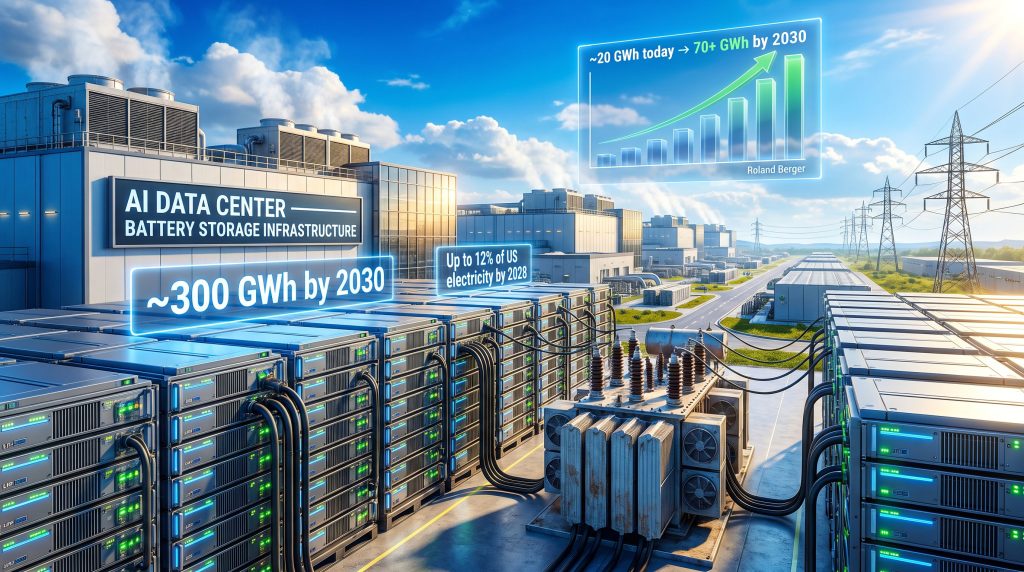
The scale of projected battery storage demand linked to AI data centre growth is substantial enough to reshape market dynamics across the entire lithium supply chain. According to Fastmarkets' Energy Storage Systems Outlook for the second quarter of 2026, energy storage system demand directly linked to AI data centre electricity consumption is projected to reach approximately 300 GWh by 2030.
Within that global figure, the United States alone accounts for an estimated 160 GWh of required storage capacity, reflecting the concentration of hyperscale AI infrastructure investment in North American markets. Furthermore, the global lithium market will need to respond rapidly to accommodate this accelerating demand.
Contextualising these figures against broader storage deployment forecasts reveals the magnitude of the AI contribution. Wood Mackenzie has projected annual battery storage deployments of approximately 110 GWh per year by 2030 across all applications. Roland Berger estimates global data centre battery demand has already reached roughly 20 GWh today, with growth toward 70+ GWh by the end of the decade.
Summary of Key Market Forecasts
| Source | Metric | Forecast |
|---|---|---|
| Fastmarkets | AI data center ESS demand (global) | ~300 GWh by 2030 |
| Fastmarkets | US AI data center storage requirement | ~160 GWh |
| Wood Mackenzie (via Reuters) | Annual battery storage deployments | ~110 GWh/year by 2030 |
| Roland Berger | Global data center battery demand | ~20 GWh today, 70+ GWh by 2030 |
| Fastmarkets | US power consumption growth | ~5% increase projected in 2026 |
| Fastmarkets | Data center share of US electricity | Up to 12% of total use by 2028 |
What 300 GWh of Projected Demand Actually Means for the Battery Supply Chain
To understand why 300 GWh matters, consider that this figure represents storage capacity specifically linked to AI data centre power requirements, separate from utility-scale grid storage, residential batteries, or electric vehicle demand. It is additive to existing demand forecasts, not a reallocation of them.
AI data centre energy storage demand is projected to reach approximately 300 GWh by 2030, driven by rising electricity consumption, grid-interactive power requirements, and the need to manage rapid load fluctuations from AI chip infrastructure. (Fastmarkets, Q2 2026 ESS Outlook)
The upstream implications extend well beyond battery cell manufacturers. The battery raw materials supply chain — encompassing lithium carbonate, lithium hydroxide, cathode active material production, and separator and electrolyte manufacturing capacity — sits directly in the path of this demand wave. Critically, industry participants have noted that medium-voltage UPS deployment at the scale now underway is not yet being captured in upstream lithium and battery demand estimates, suggesting that current lithium market pricing may not fully reflect AI-linked storage growth trajectories.
Why AI Chips Create a Unique Power Quality Problem for Grid Operators
The On/Off Switching Behaviour of AI Processors
At the chip level, AI accelerators — including the GPU clusters that underpin modern large language model training and inference — operate through rapid power state transitions. These processors cycle between high-draw and low-draw states at frequencies that generate voltage instability across the facility's power distribution system.
Marek Kubik, BESS expert and co-founder of Fluence, highlighted this dynamic at the Fastmarkets Battery and Energy Storage Summit in Las Vegas in June 2026, noting that the speed at which AI chips cycle power states creates a significant power quality challenge when left unmanaged. At the power levels involved in modern hyperscale AI facilities, this switching behaviour generates load swings that conventional UPS systems are not designed to absorb, making dedicated power quality management storage a structural necessity rather than an engineering preference. The IEA's analysis of energy demand from AI further underscores the scale of this growing challenge.
Two Distinct Storage Requirements
This chip-level behaviour clarifies why AI data centres require two fundamentally separate categories of battery storage — a distinction that is often missed in high-level market analysis:
-
Long-duration baseload storage – designed to provide sustained energy delivery across extended periods, supporting round-the-clock AI workloads and enabling voltage ride-through during grid disturbances.
-
Power quality management storage – designed to respond within milliseconds to rapid load fluctuations generated by AI chip switching behaviour, smoothing the power delivery curve at the facility level.
These two functions have different technical specifications, different battery system architectures, and in practice require separate infrastructure components. Conflating them into a single storage demand figure understates the complexity and total battery capacity required per facility.
Why Voltage Ride-Through Capability Has Become a Non-Negotiable Design Standard
Grid operators in markets with significant AI data centre concentration are increasingly requiring that large loads demonstrate voltage ride-through capability — the ability to remain connected and stable during temporary grid voltage deviations — as a condition of interconnection approval. This regulatory and technical requirement is itself a driver of medium-voltage UPS adoption, creating a compliance-linked demand layer on top of the operational performance case.
The Three Layers of Battery Demand in a Modern AI Data Centre
Modern AI facilities are evolving toward a three-tier battery storage architecture, each layer serving a distinct function:
-
External grid-interactive BESS – medium-voltage UPS systems positioned between the facility and the grid, managing voltage ride-through, grid stability, and long-duration power continuity.
-
Sidecar storage units – row-level battery systems located at the end of server rack rows, providing localised power quality management for clusters of GPU or AI accelerator hardware.
-
In-rack battery systems – chip-adjacent storage units providing microsecond-level power conditioning directly at the point of consumption.
This architectural evolution, described by Paul Charles, co-chair of NAATBatt International's Energy Storage and Data Centre Committee at the Las Vegas summit, represents a departure from the historical model where a single centralised UPS handled all backup and conditioning functions. The dispersal of storage responsibilities across multiple system layers multiplies the total battery capacity required per facility and creates new procurement categories that the battery supply chain is only beginning to address. In addition, data centre energy storage solutions are evolving rapidly to meet these complex, layered requirements.
The next major ASX story will hit our subscribers first
The Battery Supply Chain Opportunity: Who Benefits From AI-Driven Storage Growth?
How Softening EV Demand Is Redirecting Manufacturing Capacity
A structural realignment is underway within global battery cell manufacturing. As EV demand growth has moderated relative to earlier projections, cell manufacturers are finding that stationary storage now offers a more immediately attractive deployment channel for available capacity.
The scale of medium-voltage UPS deployment is drawing particular attention from manufacturers seeking to redirect production lines toward higher-margin, longer-cycle procurement relationships. AI data centre operators typically sign multi-year supply agreements with defined performance specifications, offering manufacturers more revenue visibility than spot-driven EV supply chains.
In the United States, several South Korean battery manufacturers have already converted EV cell production lines to ESS cell production, targeting both the expanding stationary storage market and the compliance requirements associated with US prohibited foreign entity guidance that restricts procurement from certain Chinese-linked supply chains.
LFP Chemistry: Why Lithium Iron Phosphate Dominates
Within the ESS segment, lithium iron phosphate chemistry has established a commanding market position driven by three core attributes: cost efficiency, thermal stability, and cycle life. Fastmarkets projects that LFP will account for approximately 80% of total ESS shipments by 2036, reflecting its structural advantages for stationary applications where energy density per kilogram is less critical than total cost of ownership over a decade-long deployment lifecycle.
Fastmarkets' inaugural assessment of the LFP prismatic cell 314Ah, priced on an ex-works domestic China basis, was recorded at 0.35 to 0.40 yuan per Wh (approximately $0.05 per Wh) on June 26, 2026. This price point reflects the maturity of Chinese LFP cell manufacturing and the scale economies achieved through years of EV-driven production expansion. Moreover, direct lithium extraction technologies are gaining traction as producers seek to meet the growing volumes required for LFP cathode production.
LFP Market Position Summary
| Metric | Data Point |
|---|---|
| Projected LFP share of ESS shipments by 2036 | ~80% of total |
| LFP prismatic cell (314Ah) benchmark price (June 2026) | 0.35-0.40 yuan/Wh (~$0.05/Wh) |
| Primary manufacturing origin | Domestic China |
| Key competitive advantage | Cost efficiency, thermal stability, cycle life |
Battery Chemistry Comparison for AI Data Centre Applications
| Chemistry | Energy Density | Cycle Life | Safety | Cost | AI Data Centre Suitability |
|---|---|---|---|---|---|
| LFP | Moderate | Very High | Excellent | Low | Primary choice for BESS |
| NMC | High | Moderate | Good | Medium | Selective use cases |
| Solid-State (emerging) | Very High | High (projected) | Excellent | Very High | Long-term potential |
| Lead-Acid (legacy) | Low | Low | Moderate | Very Low | Being phased out |
What Are the Structural Barriers Limiting Faster Deployment?
Grid Interconnection Queues and Behind-the-Meter Workarounds
One of the most significant constraints on AI data centres battery storage demand being met is not technology or capital availability — it is grid interconnection queue timelines. In many US markets, the wait time between submitting a grid connection application and receiving approval has extended to multiple years, creating a significant bottleneck for operators seeking to commission large new facilities on grid-connected power.
This delay is accelerating adoption of behind-the-meter battery configurations, where storage is installed within the facility boundary and does not require the same interconnection approval processes as grid-scale assets. While this approach addresses the immediate deployment constraint, it also means that the full demand contribution of AI data centre storage is even less visible to grid planners and commodity analysts than the headline numbers suggest.
The Upstream Demand Estimation Gap
Perhaps the most consequential insight for investors and raw material market participants is the gap between actual medium-voltage UPS deployment rates and the degree to which this demand is being reflected in upstream lithium and battery market forecasting.
Industry participants with direct visibility into medium-voltage UPS project pipelines have indicated that the scale of deployment is not being captured in the demand estimates that feed into lithium carbonate, lithium hydroxide, and cathode material pricing models. If accurate, this creates the conditions for a demand surprise in upstream battery material markets as AI data centre construction accelerates through 2027 and 2028. The broader critical minerals demand outlook reinforces the view that supply chains must adapt urgently to these emerging pressures.
The scale at which medium-voltage UPS is deploying is certainly not getting captured in upstream lithium and battery demand estimates. (Nitish Garg, Senior Director of Procurement, ON.energy, via Fastmarkets)
Frequently Asked Questions: AI Data Centres and Battery Storage Demand
What is a medium-voltage UPS system and how does it differ from a standard UPS?
A medium-voltage UPS operates at higher voltage levels than conventional low-voltage systems and is positioned externally between a data centre and its grid connection. Unlike traditional UPS systems that disconnect from the grid during faults, medium-voltage UPS maintains grid connectivity while using an integrated BESS to stabilise power delivery through voltage disturbances.
Why do AI data centres need two separate types of battery storage?
AI facilities require long-duration baseload storage to sustain continuous power delivery across extended operational periods, and separately, high-response power quality storage to absorb the rapid load fluctuations generated by AI accelerator chips cycling power states at high frequency. These functions have different technical specifications and require distinct system architectures.
How much battery storage capacity will AI data centres require by 2030?
According to Fastmarkets' Q2 2026 ESS Outlook, AI data centers battery storage demand linked directly to electricity consumption and power supply requirements is projected to reach approximately 300 GWh globally by 2030, with the United States accounting for roughly 160 GWh of that total.
What is LFP and why is it the preferred chemistry for energy storage systems?
Lithium iron phosphate (LFP) is a battery cathode chemistry that prioritises thermal safety, long cycle life, and low cost over maximum energy density. For stationary storage applications where operational longevity and total cost of ownership matter more than weight or volume constraints, LFP's combination of attributes makes it the dominant technology, projected to hold approximately 80% of ESS market share through 2036.
Why are some battery manufacturers shifting production from EV cells to stationary storage cells?
A moderation in EV demand growth relative to earlier forecasts has created surplus manufacturing capacity among several major cell producers. Simultaneously, AI data centre battery storage procurement is growing rapidly, offering manufacturers more predictable long-term supply contracts. In the US, the additional driver of prohibited foreign entity compliance requirements is encouraging South Korean manufacturers to convert production lines to ESS cells produced through non-Chinese supply chains.
Strategic Implications: What AI-Driven Battery Demand Means for Energy Markets Through 2030
Repositioning Battery Storage From Grid Asset to Core AI Infrastructure
The framing of battery storage as a grid management tool is giving way to a more expansive understanding of its role. Within AI data centre architecture, battery storage is increasingly a primary operational infrastructure component, as fundamental to facility function as the networking equipment or cooling systems. This repositioning has significant implications for how procurement decisions are made, how long-term supply agreements are structured, and how battery demand growth is modelled by commodity analysts.
How Stationary Storage Demand Could Reshape Lithium Price Trajectories
If medium-voltage UPS deployment continues to grow at rates that are not yet reflected in upstream demand forecasts, the adjustment process when markets do recognise the demand signal could be abrupt. Lithium carbonate and hydroxide prices have experienced significant volatility in recent years, and the addition of a large, previously undercounted demand category has the potential to shift price trajectories in ways that current consensus models do not capture.
This analysis involves forward-looking projections and should not be construed as investment advice. Commodity markets involve significant uncertainty, and actual outcomes may differ materially from forecasts.
Key Takeaways for Energy Investors, Battery Manufacturers, and Grid Planners
- AI data centres are transitioning from passive electricity consumers to active grid participants requiring sophisticated, multi-layered battery infrastructure.
- Medium-voltage UPS systems represent a structurally undercounted source of BESS demand not yet fully reflected in upstream commodity forecasts.
- LFP chemistry is positioned to capture approximately 80% of ESS deployments through 2036, benefiting from cost and cycle life advantages over competing chemistries.
- EV battery manufacturers pivoting to stationary storage production are well-positioned to capture AI-linked demand growth, particularly those operating US-based production lines compliant with prohibited foreign entity guidance.
- Grid interconnection delays are accelerating behind-the-meter battery adoption, compressing deployment timelines and further obscuring true demand volumes from market analysts.
- The upstream lithium market may be materially underpricing the AI data centre battery storage demand wave if current estimation gaps persist into 2027 and beyond.
Further market intelligence on battery raw materials, energy storage system pricing, and AI infrastructure power trends is available through Fastmarkets, including their Battery and Energy Storage Summit coverage and ESS Outlook reports.
Want to Capitalise on the Battery Storage Revolution Powering the AI Boom?
Discovery Alert's proprietary Discovery IQ model scans ASX announcements in real time, instantly identifying significant mineral discoveries across lithium and other battery raw materials that sit directly in the path of this accelerating demand wave — from LFP cathode inputs to critical minerals essential for utility-scale BESS deployment. Explore how historic ASX mineral discoveries have delivered extraordinary returns and start your 14-day free trial today to position yourself ahead of the market.