July 28, 2026
Europe's Battery Manufacturing Crossroads: The Capital Gap That Could Define the Energy Transition
The economics of battery cell manufacturing have never been purely commercial. Across every major industrial power that has successfully built domestic battery capacity at scale, the presence of sustained public financing has been a near-universal feature. This is not coincidence. Gigafactory-scale battery production requires capital commitments measured in billions, payback horizons that stretch far beyond typical private equity cycles, and technology risk profiles that institutional lenders find difficult to underwrite without structural support. Understanding this financial architecture is the essential starting point for making sense of why the EU battery cell manufacturing funding call has emerged as one of the most consequential industrial policy tools in Europe's energy transition toolkit.
When big ASX news breaks, our subscribers know first
Europe's Structural Vulnerability in Battery Supply Chains
For most of the past decade, European automakers and grid operators have sourced battery cells primarily from manufacturing clusters in China, South Korea, and Japan. This arrangement was economically rational when battery demand was relatively modest and domestic manufacturing alternatives did not yet exist at meaningful scale. The situation has changed fundamentally.
Europe's ICE vehicle phase-out target of 2035 has created a hard deadline that cannot be met without a credible domestic battery supply chain. The mathematics are stark: analysts tracking European battery demand consistently project that the continent will need hundreds of gigawatt-hours of cell production capacity by 2030, a figure that dwarfs current European output. The gap between what Europe can produce today and what it will need within the decade represents both a strategic risk and an investment opportunity of the first order.
What makes this vulnerability particularly acute is the layered nature of battery supply chain dependency. It is not simply a matter of importing finished cells. European manufacturers also depend heavily on Asian suppliers for cathode active materials, electrolyte formulations, and separator technology. Each layer of this dependency adds fragility to what European policymakers increasingly regard as a strategic infrastructure sector. The European critical minerals supply chain is therefore central to resolving this structural weakness.
Battery cell production sits at the intersection of energy security, industrial competitiveness, and climate policy in a way that few manufacturing sectors can match. A continent that cannot make its own cells cannot credibly claim energy sovereignty, regardless of how much renewable generation capacity it builds.
What the EU Battery Cell Manufacturing Funding Call Actually Comprises
The phrase EU battery cell manufacturing funding call now refers to two distinct but related instruments operating in sequence. Understanding the difference between them is critical for anyone seeking to engage with European battery manufacturing finance.
Innovation Fund 2024 Battery Call (IF24): Results and Analysis
The first instrument, the Innovation Fund 2024 Battery Call (IF24), opened in early December 2024 and closed on 24 April 2025. Administered by CINEA, the European Climate, Infrastructure and Environment Executive Agency, this programme committed up to €1 billion in non-repayable grants to support commercial-scale battery cell manufacturing projects across EU and EEA member states. Five innovative projects secured EU funding under an earlier Innovation Fund round, demonstrating the sustained institutional appetite for this type of support.
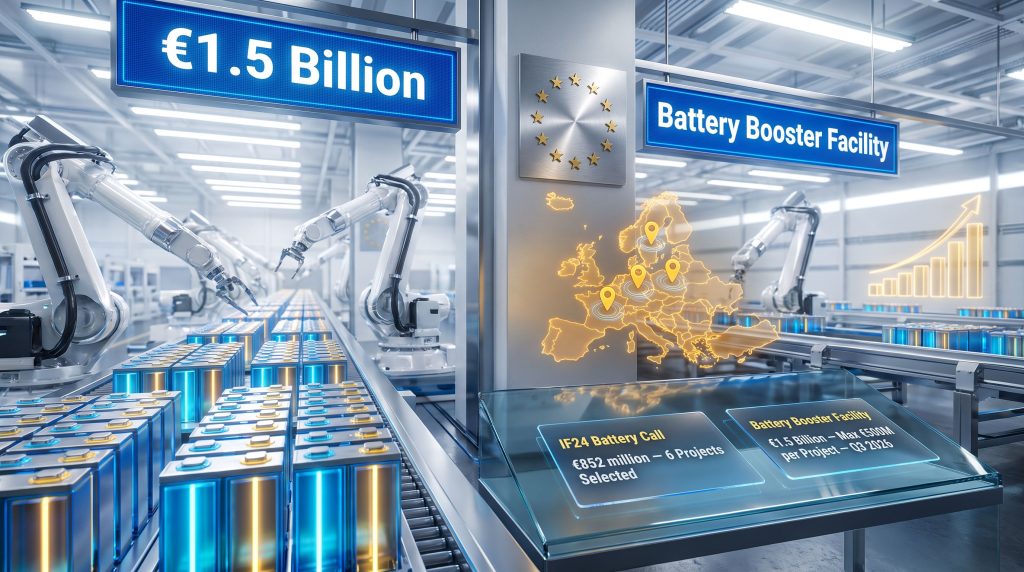
The final allocation fell just below the programme ceiling. Six projects were selected, receiving a combined €852 million in grant funding. These projects were concentrated across France, Germany, Poland, and Sweden, a geographic distribution that reflects the existing clusters of automotive industrial capacity and prior gigafactory investment in these countries.
| IF24 Battery Call Summary | Detail |
|---|---|
| Call opened | 3 December 2024 |
| Call closed | 24 April 2025 |
| Total envelope | €1 billion |
| Total grants awarded | €852 million |
| Projects selected | 6 |
| Countries covered | France, Germany, Poland, Sweden |
| Administering body | CINEA / Innovation Fund |
| Technology focus | EV lithium-ion battery cell manufacturing |
Eligibility under IF24 required applicants to satisfy several distinct criteria:
- Projects must have focused specifically on manufacturing electric vehicle battery cells, not stationary storage or other formats
- Technologies had to demonstrate sufficient maturity for industrial-scale deployment while representing a genuine advancement over conventional production methods
- Operations must be located within EU or EEA member states with demonstrable supply chain linkages to European industrial clusters
- Applicants were required to provide lifecycle assessment data showing meaningful greenhouse gas reductions relative to prevailing production benchmarks
This last requirement deserves particular attention. The IF24 was not structured as a research and development funding mechanism. Its explicit purpose was to accelerate the deployment of commercially ready battery cell manufacturing processes that could deliver measurable emissions improvements. This distinction shapes the competitive landscape considerably, favouring applicants with proven process technologies over those still at the pilot or demonstration stage.
Battery Booster Facility: The Next Generation Instrument
The second and larger instrument is the Battery Booster Facility, a €1.5 billion loan-based programme with a maximum allocation of €500 million per project. As of mid-2026, the formal call for proposals is expected to open in Q3 2026. The Battery Booster Facility was formally established by Commission decision, setting out its operational parameters and eligibility framework.
The structural shift from grant financing to concessional loans is more significant than it might initially appear. Grant programmes deploy capital once and cannot recover funds for redeployment. A loan-based facility, by contrast, allows the EU to recycle repaid capital into subsequent rounds, effectively extending the programme's reach over time. For a policy environment that faces competing demands on public budgets, this capital efficiency argument is compelling.
| Comparison | IF24 Battery Call | Battery Booster Facility |
|---|---|---|
| Instrument type | Grant | Concessional loan |
| Total envelope | €1 billion | €1.5 billion |
| Maximum per project | Not specified | €500 million |
| Status | Closed (April 2025) | Call expected Q3 2026 |
| Projects selected | 6 | TBC |
| Countries (selected) | France, Germany, Poland, Sweden | TBC |
| Administering body | CINEA | TBC |
The €500 million per-project ceiling also carries important implications for who is likely to compete effectively. At that scale, eligible projects are almost certainly gigafactory-scale manufacturing facilities requiring total capital investment well in excess of the loan ceiling itself. This means applicants must demonstrate the capacity to mobilise substantial private co-financing alongside the EU contribution, a requirement that tends to favour established industrial players, automotive joint ventures, or well-capitalised energy storage specialists over early-stage challengers.
The Regulatory Architecture Driving Battery Manufacturing Demand
The EU battery cell manufacturing funding call does not exist in isolation. It sits within an interlocking set of regulatory frameworks that collectively create the demand conditions these programmes are designed to serve.
The EU Battery Regulation (2023) introduces progressive requirements for recycled content in new batteries, mandatory carbon footprint declarations, and digital battery passports. These rules structurally advantage manufacturers operating within European regulatory and supply chain frameworks over importers, because compliance cost burdens fall disproportionately on products manufactured under different standards far from European markets.
The Critical Raw Materials Act addresses the upstream dimension of battery sovereignty. By setting targets for domestic sourcing, processing, and recycling of critical minerals including lithium, cobalt, nickel, and manganese, the Act creates a policy scaffold designed to reduce dependence on non-EU mineral supply chains. A dedicated critical raw materials facility is central to delivering on these upstream targets. For battery cell manufacturers, furthermore, the ability to demonstrate proximity to CRM-compliant material sources will increasingly become a competitive differentiator in funding applications.
The Net-Zero Industry Act designates battery manufacturing as one of eight strategic net-zero technologies. This classification carries practical consequences including frameworks for streamlined permitting and access to public support mechanisms, though the specific benefits flow through national implementation rather than through any single EU-level instrument.
How Europe Compares Globally
The scale of Europe's ambition becomes clearer when placed in an international context. The EU battery cell manufacturing funding call represents a meaningful commitment, but the competitive environment it must navigate is formidable.
| Region | Primary Instrument | Approximate Public Funding | Strategic Focus |
|---|---|---|---|
| European Union | Innovation Fund + Battery Booster Facility | €2.5 billion+ | Domestic gigafactory capacity |
| United States | Inflation Reduction Act (IRA) | USD 60 billion+ (battery and EV) | Tax credits for domestic production |
| China | State industrial subsidies | Estimated USD 100 billion+ | Full supply chain vertical integration |
| South Korea | K-Battery Initiative | Multi-billion KRW | Technology leadership and export competitiveness |
The contrast is instructive. While Europe's approach emphasises targeted capital deployment through competitive funding calls, the US IRA operates through a tax credit mechanism that effectively removes technology risk from private investment decisions at scale. Chinese industrial policy operates through an entirely different model: direct state coordination of supply chain infrastructure investment spanning mining, processing, cell manufacturing, and recycling within a single integrated industrial strategy.
European battery manufacturers face a cost structure challenge that public financing alone cannot fully resolve. State-backed Asian producers operating at multiples of European scale benefit from learning curve economics and vertically integrated supply chains that compress per-unit costs in ways that European policy instruments can partially offset but not eliminate through capital subsidies alone.
This asymmetry is why the Battery Booster Facility's emphasis on co-financing is strategically important. Projects that can demonstrate private capital participation at meaningful scale are signalling their capacity to compete commercially, not merely to survive on public subsidy. In addition, developments in UK EV battery production illustrate how adjacent markets are pursuing similar industrial strategies with comparable urgency, providing a useful benchmark for European programme design.
Who Should Be Positioning for the Battery Booster Facility
With the Q3 2026 call for proposals approaching, organisations with serious interest in the EU battery cell manufacturing funding call should already be in preparation mode. The competitive evaluation process for instruments of this scale typically involves multi-stage technical and financial assessment, and applications built without significant lead time are rarely competitive.
The following preparation sequence reflects best practice for prospective applicants:
- Confirm technology readiness by verifying that the proposed manufacturing process satisfies both the innovation threshold and the commercial maturity requirements that characterised the IF24 call and are likely to carry over into the Booster Facility
- Map and document EU supply chain integration, demonstrating that critical material inputs, component sourcing, and manufacturing operations are sufficiently localised to satisfy strategic autonomy criteria
- Commission lifecycle assessment data prepared in accordance with EU methodology standards to quantify greenhouse gas reductions relative to conventional production benchmarks
- Secure documented co-financing commitments from private capital partners, since loan instruments require applicants to demonstrate that public support is catalysing rather than substituting for private investment
- Engage with national industrial agencies in the relevant member state, given that country-level endorsement and alignment with national industrial strategy typically strengthens applications in competitive EU calls
- Monitor CINEA publications for the formal call documentation, which will contain precise eligibility rules, scoring criteria, and submission requirements
The next major ASX story will hit our subscribers first
Frequently Asked Questions: EU Battery Cell Manufacturing Funding
What is the EU battery cell manufacturing funding call?
The term covers two sequential European Commission instruments. The first, the IF24 Battery Call, was a grant programme that awarded €852 million to six projects in France, Germany, Poland, and Sweden from a €1 billion envelope, with applications closed as of April 2025. The second is the Battery Booster Facility, a €1.5 billion loan-based programme offering up to €500 million per project, with its call for proposals expected in Q3 2026.
Is the IF24 Battery Call still accepting applications?
No. The IF24 Battery Call closed on 24 April 2025. Organisations seeking EU support for battery cell manufacturing should focus preparation efforts on the Battery Booster Facility, with the call expected to open in Q3 2026.
What types of projects qualify for EU battery manufacturing support?
Eligible projects must manufacture electric vehicle battery cells using technologies that are both commercially mature and genuinely innovative relative to conventional methods. Projects must be located in EU or EEA member states and must demonstrate lifecycle greenhouse gas reductions compared to incumbent production technologies. The battery raw materials market context is also increasingly relevant to how projects frame their upstream supply chain credentials.
How does the Battery Booster Facility differ structurally from the IF24 grant?
The IF24 provided non-repayable grants, meaning recipients had no obligation to return funds. The Battery Booster Facility provides concessional loans that must be repaid, enabling the EU to redeploy recovered capital into future programmes. This shift reflects a maturing policy framework that seeks to leverage private co-investment rather than purely substitute for it.
What role does CINEA play?
CINEA administers the Innovation Fund on behalf of the European Commission, managing evaluation, selection, and grant agreement processes for programmes including the IF24 Battery Call.
The Road Ahead: Key Milestones Through 2030
The near-term calendar for European battery manufacturing finance is relatively clear. Looking further ahead, several structural questions will determine whether the current scale of public commitment proves sufficient or whether further instruments will be required.
Near-term milestones:
- Q3 2026: Battery Booster Facility call for proposals expected to open
- 2026 to 2027: IF24-funded projects across France, Germany, Poland, and Sweden expected to reach financial close and begin construction phases
- 2028 to 2030: First wave of EU-supported battery gigafactories expected to reach commercial production volumes
Longer-term structural questions:
- Whether the EU Battery Regulation's recycled content requirements, phasing in from 2027 to 2031, will materially improve the economics of European cell manufacturing by creating protected demand for domestically produced cells
- Whether the European Investment Bank will assume a larger co-financing role alongside Commission instruments as the Battery Booster Facility moves toward execution
- Whether a third, larger instrument will be required before 2030 if the IF24 and Battery Booster projects do not collectively close the production capacity gap projected to emerge from EV mandate-driven demand
The European battery materials plant investments already underway in Finland demonstrate, furthermore, that the upstream cathode materials sector is responding to these demand signals in parallel with cell manufacturing scale-up.
The Battery Booster Facility and the IF24 together represent the EU's most serious attempt to deploy public capital at a scale capable of competing with state-backed battery manufacturing in Asia. Whether this commitment proves sufficient, or whether European gigafactory economics require a further round of public support beyond 2030, will depend heavily on how quickly the six IF24-selected projects demonstrate that commercially viable battery cell production is achievable on European soil at competitive cost.
Key Data Summary
| Metric | Detail |
|---|---|
| IF24 total envelope | €1 billion |
| IF24 grants awarded | €852 million |
| IF24 projects selected | 6 |
| IF24 countries | France, Germany, Poland, Sweden |
| IF24 call closed | 24 April 2025 |
| Battery Booster Facility value | €1.5 billion |
| Battery Booster maximum per project | €500 million |
| Battery Booster call expected | Q3 2026 |
| Administering body (IF24) | CINEA |
| Technology focus | EV lithium-ion battery cell manufacturing |
This article contains forward-looking statements regarding funding timelines, programme structures, and market projections. These are subject to change based on European Commission decisions, regulatory developments, and evolving market conditions. Nothing in this article constitutes financial or investment advice. Readers should conduct independent due diligence before making decisions based on the information presented here.
Further coverage of European energy storage policy and battery manufacturing finance is available via Renewables Now at renewablesnow.com, which provides ongoing reporting on EU energy storage developments, regulatory frameworks, and project financing across the European renewables sector.
Want to Capitalise on the Mineral Discoveries Powering the Battery Revolution?
The critical minerals underpinning Europe's battery manufacturing ambitions — lithium, cobalt, nickel, and manganese — are driving significant ASX exploration activity, and Discovery Alert's proprietary Discovery IQ model delivers real-time alerts the moment a significant mineral discovery hits the ASX, turning complex geological data into actionable investment insights. Explore historic discoveries and their market returns, then begin your 14-day free trial to position yourself ahead of the market.