July 29, 2026
When Trading Houses Lead: What the Rock Tech Georgia Lake Supply Deal Reveals About Lithium Finance in 2026
The global lithium supply chain is undergoing a quiet but structurally important transformation. As institutional lenders remain cautious about committing capital to pre-production mining projects in a period of lithium price uncertainty, a new class of financing intermediary has stepped into the gap. Commodity trading houses, traditionally seen as buyers rather than backers, are increasingly offering prepayment facilities tied to future offtake volumes. The result is a financing model that sidesteps equity dilution, reduces reliance on conventional project debt, and gives developers a commercially credible path to production. The Rock Tech Georgia Lake supply deal is among the clearest examples of this trend crystallising into a binding commercial agreement.
When big ASX news breaks, our subscribers know first
Georgia Lake: Canada's Hard-Rock Lithium Proposition
Situated approximately 60 kilometres north of Nipigon in Ontario's Thunder Bay Mining District, the Georgia Lake project is a wholly owned hard-rock lithium asset that Rock Tech Lithium Inc. has been advancing as the upstream foundation of a vertically integrated supply chain. The deposit produces spodumene, a lithium-bearing silicate mineral found in pegmatite formations that is distinct from the brine-sourced lithium that dominates South American production.
Understanding spodumene lithium extraction is essential to understanding the deal's architecture. Unlike refined battery chemicals, spodumene concentrate is an intermediate product sitting between raw ore and the finished lithium hydroxide or lithium carbonate required by cathode manufacturers and battery cell producers. It typically assays between 5% and 7% lithium oxide (Li₂O) content after processing, and its value is priced against a benchmark that reflects both lithium market conditions and the cost economics of downstream conversion.
What makes hard-rock vs brine lithium strategically distinct is the processing timeline and capital intensity. Brine operations can take years to concentrate and evaporate lithium-bearing fluids before any product is available. Spodumene, by contrast, moves through a conventional crushing, flotation, and dense media separation circuit, producing a sellable concentrate relatively quickly once a mine is operational. This characteristic makes spodumene projects more compatible with the type of prepayment-and-delivery financing structure Rock Tech has arranged with Transamine.
Georgia Lake's planned output reflects an ambitious but staged production profile:
| Metric | Detail |
|---|---|
| Project Type | Hard-rock lithium (spodumene) |
| Location | ~60 km north of Nipigon, Ontario |
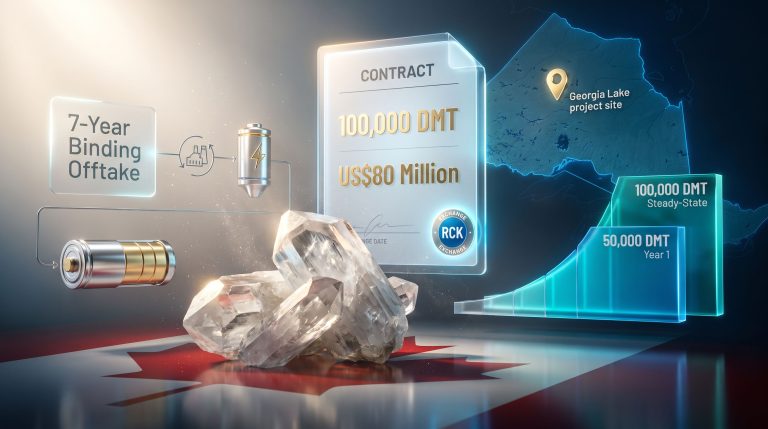
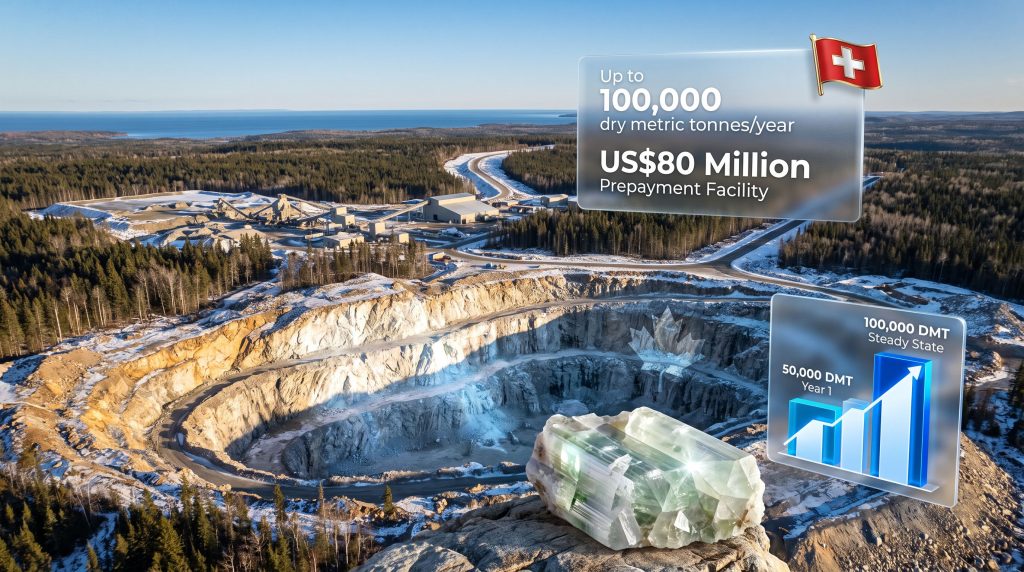
| Planned Offtake Volume (Year 1) | 50,000 dry metric tonnes |
| Planned Offtake Volume (Steady State) | Up to 100,000 dry metric tonnes/year |
| Volume Tolerance | ±10% in Rock Tech's favour |
| Planned Offtake Commencement | 2028 |
| Downstream Converter Capacity | Up to 32,000 metric tonnes LCE/year |
The ±10% volume tolerance in Rock Tech's favour is a commercially meaningful detail that is easy to overlook. In practice, this clause gives the company scheduling flexibility during the critical ramp-up phase, reducing penalty exposure if early-stage production runs below nameplate capacity due to equipment commissioning delays or ore variability.
The Transamine Agreement: Structure, Terms, and What They Signal
Why a Swiss Trading House and Not a Direct End-User?
Transamine SA is a Switzerland-headquartered commodity trading firm with a focus on nonferrous raw materials, including lithium. Its participation in this agreement as the offtake counterparty rather than a direct battery manufacturer or cathode producer is notable and reflects a particular logic that is common in early-stage mining finance.
Direct end-user offtake agreements, where an EV manufacturer or battery cell producer contracts directly with a mine, typically require the mine to have a more advanced product specification, demonstrated metallurgical consistency, and often a processing facility already in place or under construction. At the spodumene concentrate stage, commodity trading intermediaries like Transamine provide a liquidity bridge. They absorb the product into global trading networks, redirect it to processors, and accept the commercial risk of matching supply to demand across multiple downstream channels.
For Rock Tech, this means the Georgia Lake offtake does not depend on a single end-user's battery chemistry requirements or production schedules. Transamine's trading infrastructure creates market access diversity that a direct end-user deal would not provide at this project stage. Furthermore, this arrangement aligns well with Rock Tech's expanded Ontario supply chain strategy, which seeks to build resilient, multi-channel routes to market for its spodumene output.
Core Commercial Terms at a Glance
- Contract duration: Seven-year initial term commencing in 2028, with mutual annual extension rights for up to five additional years
- Volume ramp: 50,000 dry metric tonnes in Year 1, scaling to 100,000 dry metric tonnes annually at steady state
- Volume tolerance: ±10% in Rock Tech's favour, preserving production scheduling flexibility
- Definitive feasibility study prerequisite: Final volumes and delivery timing are subject to confirmation once the feasibility study is complete
- Extension mechanism: Annual mutual agreement renewals beyond the seven-year base term, up to a maximum of 12 years total
How the Offtake Delivery Mechanism Works Step by Step
- Georgia Lake achieves operational readiness and all required regulatory approvals are in place
- First spodumene concentrate shipment is dispatched to Transamine under the contracted volume schedule
- Concentrate is delivered and valued against the agreed pricing framework
- The value of concentrate deliveries is applied against the outstanding prepayment balance over a 24-month offset period
- Any balance remaining after 24 months of deliveries is settled in cash
- Annual extension provisions are reviewed and activated by mutual agreement at each anniversary of the contract
The US$80 Million Prepayment Facility: Decoding a Non-Dilutive Capital Instrument
What Makes a Prepayment Facility Different From Other Mining Finance Tools?
One of the most underappreciated aspects of the Rock Tech Georgia Lake supply deal is the conditional prepayment facility embedded within the commercial agreement. To understand why this matters, it is useful to compare it with the alternatives available to junior developers at this stage.
| Financing Mechanism | Repayment Method | Dilution Risk | Typical Provider |
|---|---|---|---|
| Offtake Prepayment | Commodity deliveries | Low | Trading house / end-user |
| Royalty Streaming | Revenue percentage | None | Streaming company |
| Project Debt | Cash interest + principal | None | Bank / development finance institution |
| Equity Raise | N/A | High | Capital markets |
The prepayment model is fundamentally different from equity issuance in that it does not reduce the ownership percentage of existing shareholders. It is also structurally distinct from royalty streaming, which permanently encumbers a percentage of future revenue. The repayment-in-kind mechanism means Rock Tech satisfies its obligation through the very product it was always going to produce, rather than through cash generated from operations or additional capital raises.
Financial Terms Unpacked
The facility carries a maximum size of up to US$80 million, priced at three-month CME Term SOFR plus 2.95%. SOFR (Secured Overnight Financing Rate) replaced LIBOR as the benchmark for US dollar trade finance from 2023 onward. As a floating rate instrument, the actual cost of the facility will move with prevailing short-term US dollar rates, introducing some interest rate exposure for Rock Tech during the drawdown period.
At current SOFR levels, the all-in rate on this facility would sit in a range that reflects the pre-production risk premium lenders and trading counterparties typically attach to development-stage assets. This is not unusually priced relative to comparable trade finance instruments in the critical minerals sector, and the repayment structure mitigates cash flow pressure during ramp-up.
Investor Note: The interest rate exposure embedded in a SOFR-linked facility is a risk variable worth monitoring. If short-term US dollar rates remain elevated through 2028, the effective cost of the prepayment increases. Conversely, a rate reduction cycle before first delivery would reduce Rock Tech's total repayment burden. This is not a guarantee of any outcome and investors should assess this alongside other project financing risks.
Conditions Precedent: What Must Happen Before the Funds Flow?
The US$80 million is conditional, not guaranteed. Rock Tech must satisfy all four of the following requirements before any drawdown:
- Full financing commitment: All capital required for Georgia Lake's development must be committed by investors
- Regulatory clearance: All necessary permits and government approvals for the project must be obtained
- Transamine due diligence: Satisfactory completion of legal, financial, and technical project reviews by the counterparty
- Product qualification: Acceptable metallurgical test results and product specifications must be delivered and approved by Transamine
This conditionality is standard practice in offtake-linked prepayment agreements but is important context for investors evaluating Rock Tech's near-term capital position. The prepayment is a component of the financing stack, not a standalone funding solution.
The Red Rock Converter: Why the Mine-to-Converter Vision Changes the Calculus
From Spodumene to Battery Chemicals: How the Conversion Process Works
Rock Tech's proposed Red Rock converter, located near Lake Superior in Ontario, is the downstream endpoint of the Georgia Lake supply chain. The converter is designed to accept spodumene concentrate as feedstock and process it into battery-grade lithium hydroxide monohydrate or lithium carbonate, with a planned output capacity of up to 32,000 metric tonnes of lithium carbonate equivalent (LCE) per year. In addition, the broader dynamics of the lithium carbonate market will directly influence pricing and demand for Rock Tech's eventual converter output.
The conversion process involves several technically demanding stages. Spodumene must first undergo high-temperature calcination to convert its alpha-spodumene crystal structure into the more reactive beta form, a phase transformation that occurs at approximately 1,050 to 1,100 degrees Celsius. The beta-spodumene is then subjected to acid roasting, leaching, and a series of purification stages to produce a lithium sulphate intermediate before final crystallisation into the target battery chemical. Each stage requires tight process control to achieve the purity thresholds demanded by battery cell manufacturers, typically 99.5% or higher for battery-grade lithium hydroxide.
This technical complexity is precisely why Rock Tech's dual-pathway model, where Georgia Lake concentrate can either be exported via Transamine or directed internally to Red Rock, carries meaningful strategic value. If converter commissioning is delayed, offtake volumes can continue flowing through the Transamine channel without disrupting production economics. Furthermore, innovations in direct lithium extraction technology, whilst more commonly associated with brine operations, are beginning to influence the broader landscape of lithium processing efficiency that projects like Red Rock will need to monitor.
Rock Tech's Broader Commercial Framework
The Georgia Lake offtake with Transamine sits alongside Rock Tech's previously disclosed commercial relationships, which include a feedstock supply arrangement for its Germany-based converter operation and an earlier supply agreement with Mercedes-Benz as an anchor end-user for battery-grade lithium chemicals. The Transamine agreement functions as an upstream supply security mechanism that complements rather than displaces these downstream commercial arrangements.
This layering of commercial agreements across different points in the value chain is a deliberate financing and risk management strategy. Each agreement de-risks a different part of the business: the Mercedes-Benz relationship provides demand visibility for finished lithium chemicals, the Transamine offtake provides revenue certainty for upstream spodumene production, and the prepayment facility provides non-dilutive development capital linked to future deliveries.
The 2028 Timeline: Critical Path Milestones and What Could Shift the Schedule
Development Work Still Required Before First Delivery
The 2028 commencement date is the commercial anchor of the agreement, but it is contingent on a sequence of technical, regulatory, and financing milestones that must be executed in parallel over the next two years. These include:
- Completion and publication of the definitive feasibility study, which will confirm final production volumes, capital cost estimates, and project economics
- Ongoing ore-sorting process development, a technology that can improve feed grade to the mill by rejecting waste rock before processing, reducing energy consumption and improving overall recovery economics
- Road and access infrastructure upgrades at the Georgia Lake site, which are necessary to support construction-phase logistics
- Securing all required environmental and mining permits within Ontario's regulatory jurisdiction
- Completion of Transamine's metallurgical test program approval, which will confirm that Georgia Lake concentrate meets the product specification requirements for commercial delivery
Completing a robust definitive feasibility study is, however, one of the most consequential of these milestones, as it underpins the credibility of Rock Tech's financing discussions with institutional lenders and equity investors alike.
The Seven Milestones on the Critical Path to 2028
- Completion and publication of the definitive feasibility study
- Securing full project financing commitments from investors
- Obtaining all required environmental and operational mining permits
- Finalising metallurgical test programs and product specification approval with Transamine
- Completing road and site access infrastructure upgrades
- Commissioning mine construction and processing facilities
- Achieving first concentrate production and initiating the 2028 delivery schedule
Each milestone carries its own timeline risk. Feasibility studies at this level of complexity typically require 12 to 18 months from initiation to completion. Permitting timelines in Ontario's mining jurisdiction have historically been more predictable than in some other Canadian provinces, but they remain subject to regulatory review cycles that developers cannot fully control.
The next major ASX story will hit our subscribers first
What the Georgia Lake Deal Signals for the Broader Lithium Offtake Market
Trading Houses as the New Infrastructure Finance Intermediaries
The structural dynamic underpinning the Rock Tech Georgia Lake supply deal is not unique to this transaction. Across the critical minerals sector in 2025 and 2026, commodity trading firms have been increasingly willing to provide pre-production capital to developers in exchange for long-duration offtake commitments. This trend reflects a specific market condition: institutional project finance lenders, including major banks and development finance institutions, have been slow to commit to junior lithium developers amid price volatility and offtake uncertainty, creating a financing gap that trading firms with physical market expertise are well positioned to fill.
For developers, the appeal is clear. A prepayment facility from a trading counterparty carries no ownership dilution, preserves equity value for existing shareholders, and aligns the funder's economic interest with the mine's operational success. For the trading house, the arrangement secures long-duration physical supply at a time when competition for battery-quality spodumene is intensifying.
Market Perspective: The willingness of a well-established commodity trading firm to commit a conditional US$80 million prepayment to a pre-production project reflects a judgment about the medium-term tightness of high-quality spodumene supply, not just the project's individual merit. Trading houses with deep physical market knowledge do not extend these arrangements to developers they believe will fail to reach production.
Canada's Thunder Bay District as a Critical Minerals Node
Ontario's Thunder Bay Mining District is emerging as one of the most consequential corridors for North American battery materials supply. The combination of hard-rock lithium deposits, proximity to existing infrastructure, access to hydroelectric power, and a mature mining regulatory framework positions the district to play a significant role in the continental shift toward domestically sourced battery materials.
The Rock Tech Georgia Lake supply deal contributes to this picture by demonstrating that commercial offtake demand for Canadian spodumene exists at sufficient scale to attract Swiss commodity trading capital. For other developers operating in the Thunder Bay corridor, this agreement provides a commercial precedent that could inform their own financing and offtake strategies. Consequently, detailed project analysis from NS Energy confirms the broader strategic significance of Georgia Lake within North America's emerging battery materials supply chain.
How Long-Duration Contracts De-Risk Project Finance
From a project finance perspective, a seven-year offtake agreement covering up to 100,000 dry metric tonnes per year is a material credit enhancement. Institutional lenders evaluating Georgia Lake's debt capacity will assess the contracted revenue stream under the Transamine agreement as a component of debt service coverage analysis. Long-duration offtake contracts reduce the revenue uncertainty that makes project loans difficult to structure at the junior developer stage, effectively improving the risk-adjusted return profile for debt providers considering participation in the broader Georgia Lake financing package.
This is the underlying logic of why offtake agreements and prepayment facilities tend to move together in critical minerals project finance: the offtake commitment makes the project more bankable to third-party lenders, while the prepayment provides interim capital to advance development work before the full debt and equity financing package is assembled.
Key Takeaways for Investors and Industry Observers
The Rock Tech Georgia Lake supply deal is worth examining not just for its headline numbers, but for what its structure reveals about the evolving mechanics of lithium project finance. Several points stand out:
- The binding nature of the Transamine agreement establishes a credible commercial foundation ahead of Rock Tech's project construction financing process
- The dual-pathway architecture, combining Transamine export optionality with internal Red Rock processing flexibility, protects the company against single-channel revenue risk
- The US$80 million conditional prepayment, if fully drawn, represents a substantial non-dilutive capital contribution that reduces the equity component required from the capital markets
- The 2028 delivery commencement creates a defined execution window that aligns with broader North American EV supply chain development timelines, though it remains subject to feasibility, permitting, and financing milestones
- The SOFR-linked interest rate structure introduces floating rate exposure that investors should monitor as part of the project's overall cost profile
Disclaimer: This article is intended for informational purposes only and does not constitute financial advice. The Rock Tech Georgia Lake supply deal involves conditions precedent, regulatory approvals, and financing milestones that have not yet been satisfied. All forward-looking statements regarding production timelines, offtake volumes, and financing outcomes involve risk and uncertainty. Readers should conduct their own due diligence and consult a licensed financial adviser before making investment decisions.
Want to Stay Ahead of the Next Major Lithium Discovery on the ASX?
Discovery Alert's proprietary Discovery IQ model delivers real-time alerts the moment significant mineral discoveries — including lithium — are announced on the ASX, transforming complex geological data into clear, actionable insights for investors at every level. Explore how historic discoveries have generated extraordinary returns on Discovery Alert's dedicated discoveries page, and begin your 14-day free trial today to position yourself ahead of the broader market.