
June 12, 2026
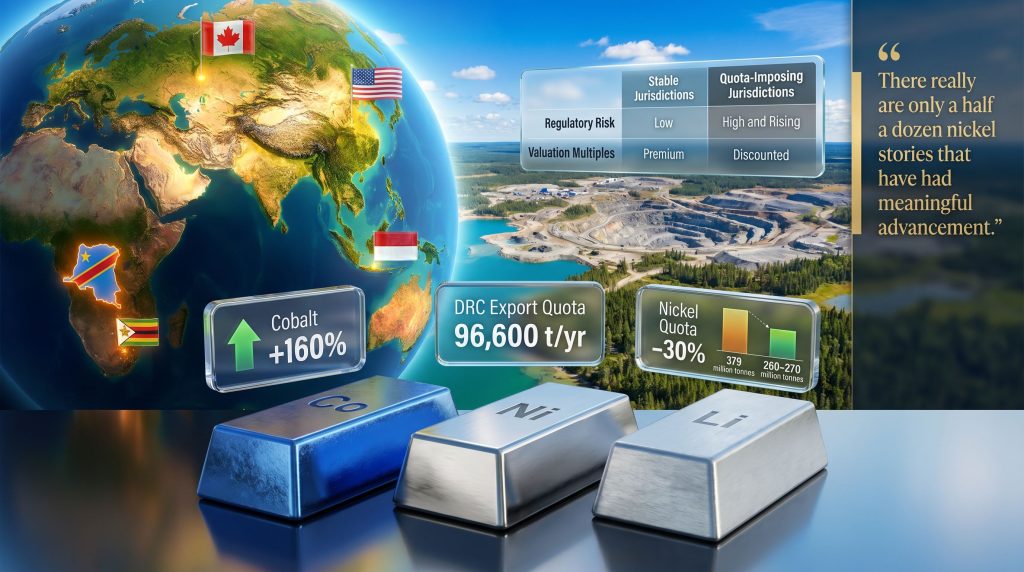
The Regime Change Hiding in Plain Sight: How Sovereign Policy Became the New Price Setter for Battery Metals
Consider what happens when the variables that investors have used to model commodity prices for a decade suddenly stop working. For most of the 2021 to 2024 cycle, battery-metal prices were proxies for electric-vehicle adoption forecasts. Analysts modelled lithium carbonate prices against gigafactory pipelines. Cobalt tracked cathode chemistry adoption curves. Nickel moved with battery-grade demand projections. The entire analytical framework was demand-led.
That framework has been structurally displaced. Battery-metal supply controls in stable jurisdictions have become the central variable for capital allocation in critical minerals, and the investors still anchoring their thesis to EV demand curves are solving yesterday's problem. In 2026, sovereign export quotas, beneficiation mandates, and processing restrictions in a small number of dominant producing nations have replaced consumer demand as the primary price-setting mechanism across cobalt, nickel, and lithium markets.
Understanding this shift is not merely academic. It has direct implications for which projects attract financing, which jurisdictions command valuation premiums, and which development-stage companies survive the current capital cycle.
When big ASX news breaks, our subscribers know first
From Demand-Led Cycles to Policy-Driven Pricing
The 2021 to 2022 battery-metal supercycle was genuinely demand-driven. EV penetration rates were accelerating across China, Europe, and the United States. Cathode manufacturers were chasing lithium and cobalt supply. Nickel sulphate premiums reflected a genuine scramble for battery-grade material. Prices overshot fundamentals, triggering a supply response that arrived in force by 2023.
New mine supply from Indonesia's nickel laterite sector, expanded DRC cobalt production tied to copper output growth, and Chinese-backed lithium projects in Africa and South America all came online within a compressed window. The result was a supply overhang that collapsed prices through 2023 and 2024, reinforcing the narrative that battery metals were structurally oversupplied relative to EV demand growth trajectories.
That narrative missed the second-order effect. As prices fell below the marginal cost of production for many operators, governments in resource-rich nations faced a deteriorating royalty and tax revenue base. The political economy of commodity export dependence made supply restriction not just possible, but fiscally necessary. Export quotas and processing mandates followed.
The critical insight for investors is that sovereign supply controls are structurally different from conventional market interventions. They are not temporary stimulus measures. They represent a permanent reconfiguration of the competitive landscape, redirecting value from raw material exporters to in-country processors and creating durable scarcity for material that cannot be rapidly sourced elsewhere.
Resource Nationalism as a Supply Control Mechanism: What It Actually Does
Resource nationalism in battery metals encompasses a specific toolkit of policy instruments that restrict raw material outflows, support domestic value-adding industries, and provide price floors for commodities that would otherwise trade near marginal production costs.
The core instruments in current use include:
- Export quotas: volumetric caps on the quantity of ore, concentrate, or processed material that can be exported in a given period
- Beneficiation mandates: requirements that raw materials undergo a specified level of processing within the producing country before export is permitted
- Export bans: outright prohibitions on the export of specific product forms, typically concentrates or ores, to compel in-country refining
- Royalty escalation: variable royalty regimes tied to commodity price levels, increasing the government take during price recovery phases
The critical distinction between these instruments and traditional monetary or fiscal policy interventions is their direct physical effect on commodity availability. A central bank interest rate change affects cost of capital across an entire economy. A cobalt export quota, however, physically removes tonnes from the global supply chain. Furthermore, as the IEA has noted, new export controls on critical minerals are making supply concentration risks a tangible reality for downstream manufacturers and policymakers alike.
Congo's Cobalt Framework: Cutting the Market's Lifeline by Half
No single policy action in 2025 or 2026 has had a more measurable impact on battery-metal prices than the Democratic Republic of Congo's cobalt export quota system. The DRC supplies approximately 75% of global mined cobalt, a concentration that gives its export policy an outsized influence over global availability.
The DRC cobalt export ban and its subsequent evolution into a structured quota framework unfolded as follows:
- February 2025: The DRC imposed an outright cobalt export ban, immediately signalling a structural shift in supply availability
- October 2025: The ban was replaced with a structured quota framework capping 2026 and 2027 exports at approximately 96,600 tonnes per year
- This quota represents roughly half of 2024 export volumes, creating an immediate supply constraint for downstream processors and cathode manufacturers
- Cobalt metal prices responded by appreciating approximately 160% from the February 2025 low, reaching above US$56,000 per tonne
- Actual hydroxide shipments tracked near one-third of allocated quota volumes due to permitting and logistics bottlenecks within the DRC
Fastmarkets projects a 2026 cobalt market deficit of approximately 10,700 tonnes, a figure that reflects both the quota ceiling and the operational constraints limiting actual shipments against even the reduced allowance. In addition, the cobalt export ban impacts on downstream cathode manufacturers have been swift and significant, forcing procurement teams to reassess multi-year supply agreements.
What makes cobalt uniquely sensitive to quota-driven supply cuts is its by-product status. Cobalt is overwhelmingly produced as a secondary output from copper and nickel mining operations. Producers cannot simply scale cobalt output in response to a price signal because the primary production decision is driven by copper or nickel economics. This structural inelasticity means supply cuts have a disproportionately large price impact relative to the volume removed.
Indonesia's RKAB Quota and the Nickel Market's Constrained Recovery
The Indonesian nickel industry has applied a similar logic to its nickel sector through the annual mining quota framework known as the RKAB (Rencana Kerja dan Anggaran Biaya). Indonesia controls the majority of global mined nickel supply, giving its quota decisions systemic importance for global battery supply chains.
| Metric | 2025 Approved Volume | 2026 Quota | Change |
|---|---|---|---|
| Nickel Ore Mining Volume | ~379 million tonnes | ~260-270 million tonnes | ~-30% |
| Nickel Price Range (Post-Quota) | Below US$16,000/t | US$18,500-US$20,000/t | Supported |
The approximately 30% reduction in approved mining volumes has provided meaningful price support, lifting nickel from its 2024 trough into the US$18,500 to US$20,000 per tonne range. The recovery has been constrained rather than explosive, however, because elevated inventory levels accumulated during the oversupply period of 2023 and 2024 continue to absorb incremental supply tightening.
A less widely appreciated dynamic is the declining ore grade problem. As the most accessible, highest-grade laterite deposits are progressively mined out, Indonesian operators are moving into lower-grade ore bodies that require more energy and processing input per tonne of output. This structural grade deterioration amplifies the price impact of volumetric quota reductions because effective contained-nickel output falls faster than the ore tonnage reduction would suggest.
Zimbabwe's Lithium Beneficiation Policy: The Third Pillar of the Supply Control Architecture
Zimbabwe has adopted a beneficiation-first approach to lithium, imposing export quotas on lithium concentrate and signalling a future outright ban on concentrate exports to compel domestic processing investment. This mirrors a deliberate pattern adopted by resource-rich developing economies seeking to capture downstream value rather than exporting raw or minimally processed material.
The policy logic is economically coherent. The difference in value between spodumene concentrate and battery-grade lithium carbonate or hydroxide is substantial. Governments that mandate in-country processing capture a larger share of the total value chain, attract foreign processing investment, and develop domestic industrial capability. The cost is paid by downstream manufacturers who must either build in-country processing capacity, source from alternative jurisdictions, or accept supply constraints.
The next major ASX story will hit our subscribers first
Why Stable Jurisdictions Now Command a Structural Valuation Premium
When major producing nations impose quotas or export bans, the investable universe of supply-secure assets contracts. Investors respond by reassigning valuation multiples and discount rate assumptions across the project pipeline. The five dimensions of jurisdictional stability that now drive this reallocation are:
- Permitting predictability: transparent regulatory timelines with low reversal risk and consistent assessment frameworks
- Fiscal stability: royalty and tax regimes that are established prior to investment commitment and do not change materially mid-project
- Sovereign alignment: membership in allied trade networks and free-trade agreements that provide preferential market access for critical mineral outputs
- Rule of law: enforceable contracts, independent court systems, and a credible track record of low expropriation risk
- Access to strategic capital: eligibility for development-finance institution lending, export-credit agency support, and industrial offtake arrangements from allied manufacturers
The contrast between stable and quota-imposing jurisdictions across these dimensions creates a measurable risk-return differential.
| Dimension | Stable Jurisdictions (Canada, Australia, US) | Quota-Imposing Jurisdictions (DRC, Indonesia, Zimbabwe) |
|---|---|---|
| Regulatory Risk | Low | High and rising |
| Valuation Multiples (EV/lb) | Premium | Discounted |
| Financing Cost | Lower | Higher |
| Strategic Capital Access | Strong | Limited |
| Supply-Control Exposure | None | Direct |
| Beneficiation Compliance Risk | Minimal | Structurally embedded |
The Nickel Case: Why Advanced Western Sulphide Projects Are a Rare Strategic Asset
Canada Nickel's Crawford project in Ontario represents the archetype of a stable-jurisdiction asset benefiting from this structural reallocation. It is among a very small number of advanced non-Indonesian nickel sulphide projects globally with a credible production timeline before the end of the decade.
Mark Selby, Chief Executive Officer of Canada Nickel, has described the scarcity of credible Western nickel development stories as a defining characteristic of the current market landscape. According to Selby, while the mining investment universe contains hundreds of advanced gold and silver projects, and over a hundred meaningful copper stories, the number of nickel projects that have achieved meaningful development advancement can be counted on one hand.
This scarcity has a geological basis that goes beyond project economics. Nickel sulphide deposits carry inherently lower processing complexity than Indonesian nickel laterite operations. Sulphide ores can be concentrated using conventional flotation, producing a high-grade matte or sulphate product with significantly lower energy intensity than the high-pressure acid leach (HPAL) processing required for laterites. This processing advantage translates into lower capital intensity per tonne of nickel produced and a smaller carbon footprint.
The combination of quota-driven Indonesian supply restriction, structural grade deterioration in laterite ore bodies, and the limited pipeline of advanced Western sulphide alternatives creates a supply-security argument for Canadian and Australian nickel projects that did not exist with comparable force in previous cycles.
The Graphite Problem: When Price Competition Is Structurally Impossible
The global graphite shortage presents an even more concentrated supply picture than cobalt or nickel. China produces approximately 1.2 million tonnes per annum of natural graphite, representing roughly 75% of global supply, at an average production cost of approximately US$257 per tonne. No other producing region can currently approach this cost structure at scale.
Ben Stoikovich, Chairman of Sovereign Metals, has noted that the cost gap between Chinese natural graphite production and the rest of the world is so wide that price competition alone cannot enable non-Chinese supply chains to develop. This cost reality means that ex-China graphite projects can only be viable if they are supported by strategic capital, policy-driven demand preferences, or both.
Sovereign Metals' Kasiya project in Malawi has attracted strategic attention not only for its graphite resource but for its significant monazite by-product. Monazite is a rare-earth-bearing mineral containing both light and heavy rare earths, with heavy rare earths including dysprosium and terbium being particularly sought after by allied-nation agencies. The presence of an economically meaningful monazite by-product broadens the capital pool available to finance graphite projects, drawing in rare-earth-focused strategic investors.
The Rare-Earth Parallel: Processing Strategy as a Valuation Driver
Energy Fuels' integrated rare-earth supply chain across the United States and Australia illustrates how processing strategy, combined with stable-jurisdiction positioning and by-product cash flows, can translate directly into financing quality and valuation outcomes.
The company's Phase 2 rare-earth separation project carries the following characteristics:
| Project Metric | Value |
|---|---|
| Phase 2 NPV8 | US$1.9 billion |
| Internal Rate of Return | 33% |
| Initial Capital Expenditure | US$410 million |
| Goldman Sachs Convertible Coupon | 0.75% |
| Time to Close Financing | Under one week |
| Deployable Capital | ~US$1 billion |
| Market Capitalisation Re-Rate | ~US$5 billion |
By processing monazite at its White Mesa mill in Utah, Energy Fuels becomes a heavies-capable rare-earth separator, distinguishing itself from peers whose bastnaesite feedstock produces primarily light rare earths. This matters because the critical bottleneck in Western rare-earth supply chains is not cerium or lanthanum abundance but the availability of separated dysprosium and terbium needed for permanent magnets used in EV motors and wind turbines.
The financing terms achieved — specifically a Goldman Sachs convertible note priced at three-quarters of a percent closed within a single week — demonstrate the tangible cost-of-capital advantage that accrues to stable-jurisdiction operators. Current uranium production cash flows at White Mesa bridge the company through the development phase, reducing equity dilution and demonstrating the compounding value of a self-funded balance sheet in a high-interest-rate environment.
Beneficiation Policy: Where Regulatory Risk and Competitive Advantage Intersect
Not every battery-metal project faces the same beneficiation policy risk. For developers whose processing technology is designed around in-country refining, government beneficiation mandates can become a competitive advantage rather than a compliance burden. For developers whose feasibility studies assume concentrate exports as the base case, policy evolution in the host jurisdiction introduces material uncertainty.
Lifezone Metals' Kabanga nickel project in Tanzania is one of the world's highest-grade undeveloped nickel sulphide deposits. Its hydrometallurgical processing technology is designed to enable lower-emission, in-country refining that aligns with the industrial policy objectives of the Tanzanian government. However, Lifezone's CFO Ingo Hofmaier has acknowledged that the company's current feasibility study assumes concentrate export, and that ongoing discussions with the Tanzanian government will determine whether future downstream processing requirements are added as development conditions.
This situation illustrates a broadly applicable principle: where government negotiations are ongoing regarding processing requirements and export conditions, project economics and development timelines carry optionality in both directions. Investors should treat such projects as carrying elevated regulatory optionality rather than straightforward development risk.
Financing Structure as a Competitive Differentiator
The financing toolkit available to stable-jurisdiction battery-metal developers is materially wider and cheaper than what is accessible to developers operating in or dependent on quota-imposing jurisdictions. Furthermore, the Junior Minerals Exploration Incentive provides an additional layer of support for smaller developers operating within eligible Australian jurisdictions, reducing the effective cost of early-stage capital.
| Financing Mechanism | Key Benefit | Applicable Jurisdiction |
|---|---|---|
| Flow-through shares | Reduces effective equity cost for exploration and development | Canada |
| Export-credit agency debt | Concessional rates, longer tenors | US, Canada, Australia |
| Development-finance institution equity | Patient capital with strategic alignment | Allied jurisdictions |
| Industrial offtake advance payments | Non-dilutive project financing | All stable jurisdictions |
| Government grants and loan guarantees | Reduces capital requirement | US, Canada, Australia |
| Low-coupon convertible notes (strategic) | Minimal dilution, rapid execution | Stable jurisdictions with strategic narrative |
Canada's flow-through share regime deserves particular attention as an underappreciated financing advantage. Flow-through shares allow mining companies to renounce certain exploration and development expenditures to shareholders, who can then deduct those costs against their own income tax obligations. The result is that investors effectively receive a government subsidy through the tax system, lowering the effective cost of equity capital for the issuing company.
The U.S. IRA and FEOC Rules: Demand-Side Supply Controls That Mirror Producer Quotas
The U.S. Inflation Reduction Act ties electric vehicle tax credits to critical minerals extracted, processed, or recycled in the United States or in qualifying free-trade partner countries. Foreign Entity of Concern rules further restrict battery supply chains linked to designated state-affiliated entities, effectively excluding materials processed through certain Chinese entities from IRA-compliant supply chains.
These mechanisms function as demand-side supply controls. They do not restrict the physical supply of battery metals, but they create a preferential demand channel for stable-jurisdiction supply by making IRA-eligible material worth more to U.S. automakers and battery manufacturers than non-eligible material of equivalent chemical specification. For stable-jurisdiction developers, IRA eligibility functions as a valuation premium embedded in offtake contract terms. Consequently, battery-metal supply controls in stable jurisdictions intersect directly with IRA eligibility to create a compounding valuation advantage for developers in allied nations.
Key Investment Risks in a Supply-Control Environment
Battery-metal supply controls in stable jurisdictions create a compelling investment thesis, but the risk framework is not one-directional. Investors should actively monitor and weight the following risks:
- Supply discipline breakdown: Quota systems depend on consistent enforcement. Economic pressure, political change, or diplomatic negotiation within producing countries can lead to quota relaxation, reducing the price support underpinning project valuations
- Project economics deterioration: NPV and IRR estimates are sensitive to capital expenditure overruns, input cost inflation, and discount rate assumptions. Projects that appear attractive at current metal prices can deteriorate rapidly if capital costs escalate during construction
- Financing execution risk: Development-stage companies that have not secured full project financing remain exposed to capital market conditions. Announced financing that has not yet closed represents a material contingent risk
- Beneficiation policy evolution: Host-government processing requirements can tighten faster than developers can adapt feasibility studies, particularly in jurisdictions with active beneficiation agendas where export terms remain under active negotiation
A Multi-Factor Framework for Evaluating Battery-Metal Projects in 2026
Given the structural shift from demand-led to policy-driven pricing, the variables that matter most for project evaluation have changed. For a broader perspective on the battery metals investment case, the following framework captures the key assessment dimensions:
- Jurisdictional stability score: permitting track record, fiscal regime consistency, and sovereign risk rating
- Strategic capital access: existing relationships with development-finance institutions, export-credit agencies, and industrial offtakers with strategic motivation
- Processing alignment: compatibility of the project's processing design with host-government industrial policy and beneficiation objectives
- Balance sheet bridge: whether existing production cash flows or near-term revenue streams can fund development without requiring external equity at unfavourable terms
- By-product optionality: presence of strategically valuable by-products, particularly heavy rare earths or monazite, that attract additional capital pools and broaden the investor base
- Permitting milestone proximity: nearness to key regulatory approvals that de-risk financing execution and trigger valuation re-rating events
| Development Stage | Impact of Supply Controls | Key Valuation Driver |
|---|---|---|
| Producer (stable jurisdiction) | Direct price uplift, margin expansion | Spot price multiplied by production volume |
| Advanced developer (stable jurisdiction) | Higher NPV multiples, lower discount rates | NPV8/IRR combined with financing certainty |
| Explorer (stable jurisdiction) | Increased strategic interest, earlier offtake discussions | Discovery potential plus jurisdiction premium |
| Developer (quota-imposing jurisdiction) | Elevated policy risk, higher cost of capital | Negotiation outcome optionality |
Frequently Asked Questions: Battery-Metal Supply Controls in Stable Jurisdictions
Why are battery-metal prices rising despite slowing EV demand growth?
Battery-metal prices in 2026 are responding primarily to government supply controls rather than end-market demand acceleration. The DRC has capped cobalt exports at roughly half of 2024 levels, Indonesia has reduced nickel mining quotas by approximately 30%, and Zimbabwe is restricting lithium concentrate exports to encourage domestic processing. These policies tighten physical availability and support prices independently of consumer demand trajectories.
What makes nickel sulphide deposits strategically different from Indonesian laterite projects?
Nickel sulphide ores can be processed using conventional flotation to produce high-grade concentrates or mattes, requiring significantly lower energy input and capital expenditure per tonne of nickel than the high-pressure acid leach processing required for laterite ores. Sulphide projects in Canada and Australia therefore carry lower processing risk, smaller carbon footprints, and greater compatibility with the ESG requirements of Western battery manufacturers. Understanding the EV battery supply chain helps contextualise why these processing distinctions translate directly into downstream commercial value.
How does Canada's flow-through share regime benefit battery-metal developers?
Flow-through shares allow Canadian mining companies to pass certain exploration and development expenditure deductions through to investors, who can apply those deductions against their own taxable income. The effective subsidy this creates for the investor reduces the return threshold required for participation, lowering the company's effective cost of equity capital compared to standard share issuances. This financing advantage is unique to Canada and is not available in most competing jurisdictions.
Why does monazite by-product content matter for graphite project financing?
Monazite is a rare-earth-bearing mineral containing both light and heavy rare earths. Heavy rare earths including dysprosium and terbium are critical inputs for permanent magnets used in EV motors and wind turbines, and the Western supply chain for these elements is extremely concentrated. Graphite projects with economically significant monazite by-products can attract rare-earth-focused strategic capital from government agencies and industrial manufacturers, broadening the financing base beyond conventional battery-material investors.
What is the single greatest risk to the stable-jurisdiction valuation premium in 2026?
A breakdown in supply discipline within quota-imposing jurisdictions represents the most direct threat. If the DRC relaxes its cobalt quota framework, or if Indonesia increases RKAB allocations in response to domestic industry pressure, the physical supply tightening underpinning current prices would reverse. This would compress margins for producers, reduce NPV estimates for developers, and potentially trigger a reassessment of the jurisdiction premium currently embedded in stable-country valuations. However, battery-metal supply controls in stable jurisdictions are likely to remain structurally important regardless of how quota discipline evolves in producing nations.
This article contains forward-looking analysis and projections based on publicly available information. It does not constitute financial advice. Commodity price forecasts, NPV estimates, IRR projections, and market deficit figures are subject to significant uncertainty and may not be realised. Investors should conduct their own due diligence before making investment decisions.
Want to Know Which ASX Battery Metal Discoveries Are Worth Watching Right Now?
Discovery Alert's proprietary Discovery IQ model scans ASX announcements in real time, instantly identifying significant mineral discoveries across cobalt, nickel, lithium, and other critical minerals — translating complex data into actionable insights before the broader market reacts. Explore historic discoveries and their returns or start your 14-day free trial today to position yourself ahead of the next major find.