August 21, 2026
When Capital Efficiency Defines the Junior Gold Opportunity
In the Western Australian gold sector, the most consequential moments rarely arrive with fanfare. They emerge from systematic, methodical work: drill holes logged one by one, assay results validated over months, and geological models refined until a deposit earns the formal economic classification that transforms it from a promising anomaly into a bankable asset. That transformation is what an ore reserve declaration represents, and the scale at which Beacon Minerals Iguana ore reserve tripled signals something more than a routine exploration milestone.
Understanding why requires stepping back from the headline number and examining the structural mechanics of how reserves are built, what they mean for project financing, and why a low-capital, high-conversion outcome like Iguana's is rarer than the industry often implies.
When big ASX news breaks, our subscribers know first
The Critical Difference Between a Resource and a Reserve
Before unpacking the Iguana numbers, it is worth clarifying a distinction that even experienced investors sometimes conflate. A mineral resource estimate is a geological statement. It describes the tonnage and grade of mineralisation that has been identified with sufficient confidence to be reported under the JORC Code, Australia's governing standard for public reporting of mineral exploration results.
An ore reserve, by contrast, is an economic statement. It represents the portion of a resource that can be extracted profitably under defined technical, environmental, legal, and financial conditions. Reserves must pass through a series of modifying factors, including pit optimisation, geotechnical assessment, metallurgical recovery assumptions, and cut-off grade economics before they qualify for classification.
This distinction matters enormously for project bankability. Lenders and institutional investors typically require a defined ore reserve before committing project finance, because reserves represent a legally defensible, audited commitment to extractability, not merely an indication of what might be there.
With that framework in place, the significance of Beacon Minerals Iguana ore reserve tripling becomes considerably clearer.
Iguana Reserve and Resource: The Numbers in Full
The updated estimates published in August 2026 represent a material step-change in the project's defined economic footprint.
| Metric | Ore Reserve Estimate | Mineral Resource Estimate |
|---|---|---|
| Tonnage | 11.0 million tonnes | 11.5 million tonnes |
| Grade | 1.20 g/t gold | 1.40 g/t gold |
| Contained Gold | 430,200 ounces | 533,000 ounces |
| Resource-to-Reserve Conversion | 81% | N/A |
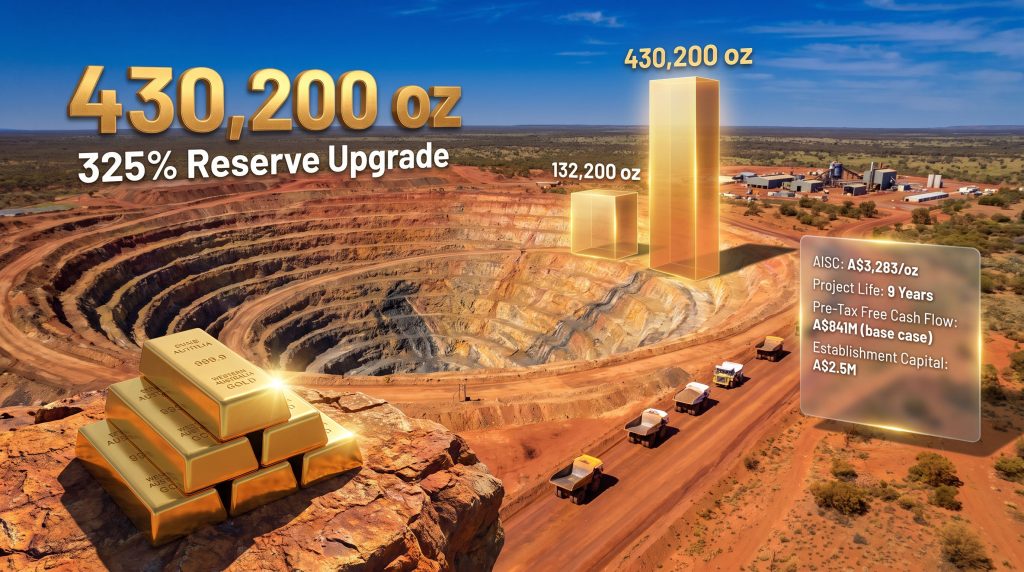
The prior ore reserve, reported in February 2025, stood at 3.4 million tonnes at 1.20 g/t gold for 132,200 ounces. The new estimate of 430,200 ounces represents a 325% increase in contained gold, achieved at an identical head grade, meaning the upgrade was driven entirely by deposit expansion rather than grade inflation.
What the Reserve Classification Split Reveals
Within the updated reserve, the classification breakdown carries its own analytical weight:
- Proved material: approximately 3,400 ounces
- Probable material: approximately 426,800 ounces
The overwhelming dominance of probable material over proved material is not unusual for a deposit at this stage of development. Proved status requires the tightest drilling density and the highest geological confidence, typically achieved through infill programs that are often deferred until a project is advancing toward a definitive feasibility study or construction decision. The current classification profile suggests that further infill drilling has a clear pathway to upgrading a meaningful proportion of the probable inventory to proved, which could strengthen lender confidence in a formal project financing process.
Why an 81% Conversion Ratio Is Harder to Achieve Than It Looks
The resource-to-reserve conversion rate of 81% deserves specific attention. In open-pit gold development, conversion ratios across the industry vary substantially depending on deposit geometry, metallurgical complexity, and local cost structures. Many projects convert between 50% and 70% of their resource into reserve, with higher ratios generally reflecting simpler deposit geometry, well-constrained grade continuity, and metallurgical characteristics that translate efficiently into economic pit shells.
An 81% conversion ratio indicates strong geological continuity across Iguana's mineralised envelope, meaning the grade and width of the deposit are consistent enough that the economic pit shell captures the vast majority of the in-ground resource. This is a meaningful quality signal for a deposit still progressing through feasibility.
The Drilling Architecture Behind the Reserve Growth
The reserve upgrade did not emerge from a single campaign or a fortunate discovery hole. It was the product of Beacon's largest-ever drilling program: a reverse circulation (RC) program exceeding 133,000 metres in total, of which more than 75,000 metres was specifically directed at Iguana. The campaign concluded in May 2026, with all results received and validated by July 2026.
RC drilling is the workhorse technique of Australian open-pit gold exploration. It delivers rapid, cost-effective penetration of shallow to intermediate depth targets, with sample quality sufficient for grade estimation across large volumes of rock. Furthermore, interpreting drill results of this scale requires systematic validation across thousands of individual samples before they can underpin a formal reserve statement.
Two Mineralisation Styles: Complexity and Opportunity
Diamond drilling conducted in the weeks following the RC program completion confirmed the presence of two structurally distinct mineralisation styles at Iguana:
-
Sulphide-rich gold mineralisation without quartz (the dominant style): This represents the bulk of the deposit's tonnage and is characterised by disseminated gold hosted within sulphide minerals, a style amenable to carbon-in-pulp (CIP) processing.
-
Quartz-fuchsite style mineralisation: Present in smaller volumes, this style can host coarse visible gold. Quartz-fuchsite assemblages are associated with hydrothermal alteration systems and are commonly found in greenstone belt gold deposits across the Yilgarn Craton.
The presence of two mineralisation styles introduces nuance into processing assumptions. Coarse visible gold can be problematic for some CIP circuits due to the risk of gold being trapped in activated carbon or bypassing fine-grinding circuits. However, it also opens the door to gravity circuit optimisation and differential grade sorting strategies that can improve overall recovery rates beyond what standard CIP recovery modelling assumes.
The diamond drilling results were expected to refine the geological model underpinning the resource, with potential implications for both recovery assumptions and the categorisation of high-grade zones within the deposit.
Pre-Feasibility Study Economics: A Closer Look
The economics outlined in the pre-feasibility study (PFS) present a profile that is unusual in the context of ASX junior gold development, primarily because of the relationship between capital intensity and projected cash flow.
| Economic Parameter | Estimate |
|---|---|
| Gold Price Assumption (flat) | A$5,500/oz |
| Recovered Gold (forecast) | 379,190 ounces |
| Average Recovery Rate | 88.1% |
| All-In Sustaining Cost (AISC) | A$3,283/oz |
| Establishment Capital | A$2.5 million |
| Undiscounted Pre-Tax Free Cash Flow (base case) | A$841 million |
| Undiscounted Pre-Tax Free Cash Flow (spot, A$6,190/oz) | A$1.085 billion |
| Cash Flow at A$4,500/oz (downside sensitivity) | A$486 million |
| Project Life | 9 years |
The A$2.5 Million Establishment Capital Figure: What It Means
For context, greenfield open-pit gold projects in Australia with comparable production profiles routinely require initial capital expenditures in the range of A$100 million to A$500 million or more, covering processing plant construction, power infrastructure, water management, and access development. Iguana's A$2.5 million establishment capital covers only camp infrastructure and haul road construction, because the processing infrastructure, the Jaurdi CIP plant, already exists and is already operating.
This structural advantage fundamentally alters the project's risk profile. Capital intensity is one of the primary valuation drivers in junior gold project economics, because high upfront capital requirements compress net present value (NPV), extend payback periods, and introduce execution risk associated with construction. Iguana sidesteps all of those constraints by leveraging an existing asset. For further context on how the gold price outlook influences project valuations at this stage, the current environment remains highly supportive of developments with low capital thresholds.
Sensitivity Analysis: Margin of Safety at Lower Gold Prices
The project's sensitivity to gold price movements is one of its more investor-relevant characteristics:
- At A$5,500/oz (base case): A$841 million pre-tax free cash flow
- At A$6,190/oz (spot price as of August 17, 2026): A$1.085 billion pre-tax free cash flow
- At A$4,500/oz (downside scenario): A$486 million pre-tax free cash flow
With an AISC of A$3,283/oz, the project maintains a gross margin of approximately A$1,217/oz at the downside gold price assumption. That represents a 27% buffer between the downside price assumption and the all-in cost base, which is a meaningful margin of safety by industry standards.
Disclaimer: Pre-feasibility study economics are based on assumptions and estimates that may not reflect actual outcomes. Gold prices, recovery rates, and cost structures are subject to change. Investors should conduct their own due diligence and not rely solely on PFS-level economic modelling when making investment decisions.
From Reserve to Production: The Operational Pathway
Open-Pit Method and the 43-Kilometre Haul
Iguana will be mined using conventional owner-operated open-pit methods. The 43-kilometre haul route from the Iguana pit to the Jaurdi CIP facility is a logistical consideration worth examining. Owner-operator trucking arrangements, where the mining company controls its own fleet rather than engaging a contract miner, can offer cost advantages at scale but require capital allocation for equipment and introduce operational complexity around maintenance and staffing.
At a processing rate above 1.2 million tonnes per annum (Mtpa), the haulage volume is substantial but manageable for a well-resourced fleet operation. The 43-kilometre distance adds haulage cost to the operating cost structure, which is already captured in the A$3,283/oz AISC, suggesting the economic model accounts for this logistical overhead.
The Jaurdi Mill Upgrade: November 2026 Completion
The Jaurdi CIP facility is already processing ore at annualised rates above 1.2Mtpa, a throughput level achieved during the June 2026 quarter, which was the first full production quarter following Iguana's inaugural gold pour on April 1, 2026. A scheduled mill upgrade, targeted for completion in November 2026, is designed to expand processing capacity in alignment with the enlarged ore reserve base.
The timing of the upgrade is strategically logical. Completing the mill expansion after the reserve has been formally declared and a PFS has validated the project's economics allows capital to be deployed with greater confidence in the production profile it is designed to support.
Lady Ida and the Transition to Iguana-Dominated Output
During the June 2026 quarter, Lady Ida ore contributed approximately 90% of Beacon's production, reflecting the early-stage nature of the Iguana production ramp at that point. As the Iguana ramp progresses and the mill upgrade is commissioned, the production mix is expected to shift materially toward Iguana as the primary ore source, underpinning the nine-year mine life outlined in the PFS.
The next major ASX story will hit our subscribers first
Benchmarking Iguana Against the ASX Junior Gold Landscape
Cost Curve Positioning
An AISC of A$3,283/oz positions Iguana in the lower half of the Australian gold industry cost curve, where the national average AISC for operating mines has been trending upward due to labour cost inflation, energy price increases, and declining ore grades at established operations. A project with a sub-A$3,300/oz AISC and a nine-year mine life occupies a structurally advantaged position relative to higher-cost producers who face margin compression at current gold prices.
Capital Efficiency as a Differentiating Factor
Among ASX small-cap gold developers, the combination of:
- A $2.5 million establishment capital requirement
- An existing CIP processing facility
- A nine-year mine life with 430,200 ounces of reserve
- An 81% resource-to-reserve conversion ratio
creates a development profile that is considerably de-risked relative to peers who must simultaneously raise capital for processing plant construction, navigate permitting timelines for new infrastructure, and manage the technical execution risk of greenfield development.
The pre-existing Jaurdi infrastructure effectively compresses the timeline to meaningful cash flow, which is the metric that most directly influences how junior gold developers are valued in the current market environment. In addition, the gold drilling results from the broader Iguana program suggest that further resource extension drilling beyond the current pit shell remains a genuine possibility.
FAQ: Beacon Minerals Iguana Ore Reserve Update
What was the Iguana ore reserve before the August 2026 update?
The previously reported reserve was 3.4 million tonnes at 1.20 g/t gold for 132,200 ounces, as disclosed in February 2025.
By how much did the Beacon Minerals Iguana ore reserve triple in contained gold terms?
The contained gold increased from 132,200 ounces to 430,200 ounces, representing a 325% increase.
What mining method will Iguana use?
Conventional owner-operated open-pit extraction, with ore trucked 43 kilometres to the Jaurdi CIP plant.
What is Iguana's all-in sustaining cost?
The PFS estimates an average AISC of A$3,283 per ounce across the nine-year project life.
When will the Jaurdi Mill upgrade be complete?
The upgrade is scheduled for completion in November 2026.
What gold price underpins the base-case economics?
A flat gold price assumption of A$5,500 per ounce was applied in the base-case PFS modelling.
Is Iguana already producing gold?
Yes. The first gold pour occurred on April 1, 2026, with Iguana contributing to Beacon's production profile from that point forward.
Key Takeaways: What This Reserve Upgrade Signals
The Beacon Minerals Iguana ore reserve tripling, from 132,200 ounces to 430,200 ounces, is not simply a larger number on a corporate announcement. It represents the culmination of a structured, multi-year delineation program that has converted exploration success into a formally defined, economically validated asset. Consequently, several dimensions of this outcome are worth retaining:
- A 325% reserve increase at an unchanged head grade reflects genuine deposit expansion rather than grade re-estimation, which is a more durable form of reserve growth
- The 81% resource-to-reserve conversion ratio signals exceptional geological continuity and supports the case for further classification upgrades through infill drilling
- An A$2.5 million establishment capital requirement is genuinely anomalous in the context of Australian open-pit gold development and substantially reduces financial execution risk
- The project generates positive free cash flow at gold prices 27% below the August 2026 spot price, providing meaningful downside protection
- The identification of two distinct mineralisation styles through diamond drilling adds geological complexity but also potential for processing optimisation strategies that the current PFS may not fully capture
For investors assessing junior gold developers on the ASX, Iguana's updated reserve represents a case study in how systematic drilling, combined with the strategic advantage of existing processing infrastructure, can compress the typical junior gold development timeline and risk profile into something approaching near-term producer territory.
Want to Track the Next Major ASX Gold Discovery Before the Market Does?
Discovery Alert's proprietary Discovery IQ model delivers real-time alerts the moment significant mineral discoveries are announced on the ASX, translating complex geological data into actionable investment insights for both short-term traders and long-term investors — start your 14-day free trial today and explore historic discovery returns that demonstrate just how transformative early positioning can be.