August 6, 2026
The Commodities Supercycle Has Arrived — And Australian Miners Are Cashing In
Every few decades, the global economy enters a phase where raw material demand outpaces supply for an extended period, driving a sustained upward repricing of commodities across the board. These supercycles are not random events. They tend to emerge from structural shifts in technology, infrastructure, and geopolitics that fundamentally rewire where capital flows and which physical resources underpin economic growth.
The world is currently navigating one of the most significant such transitions in a generation. The electrification of transport, the buildout of renewable energy infrastructure, and the reshaping of global supply chains away from single-point dependencies have created a multi-year demand tailwind for a broad basket of metals. Australia, sitting atop some of the world's most significant mineral endowments, is positioned directly in the path of that capital flow.
For investors searching for the best ASX mining shares to buy now, the challenge is no longer whether the sector has momentum. The data from FY26 makes that case unambiguously. The real question is how to evaluate opportunity across a landscape that ranges from giant blue-chip producers paying reliable dividends to high-risk pre-production developers with transformational upside.
When big ASX news breaks, our subscribers know first
FY26: A Sector-Defining Year for ASX Mining Shares
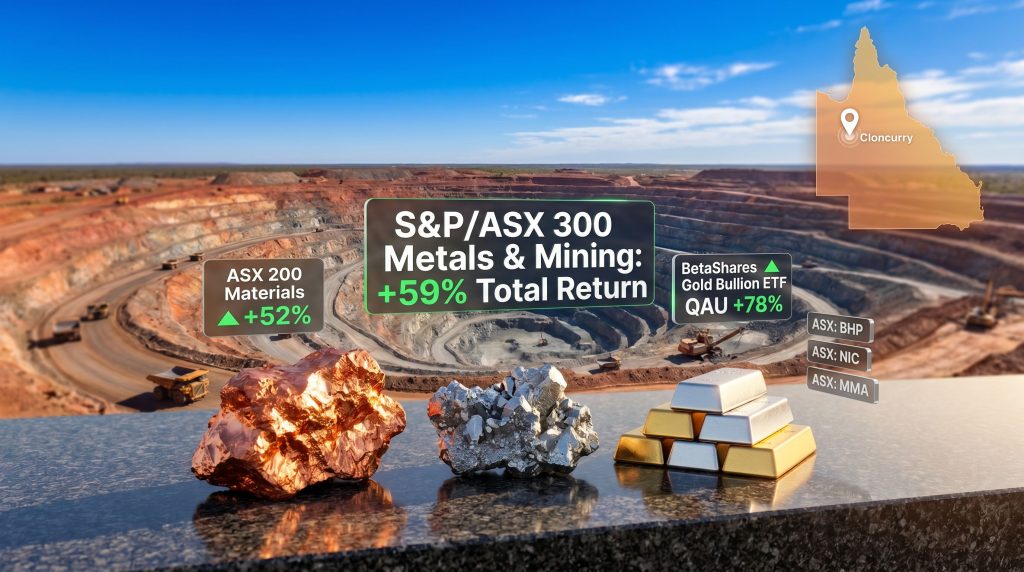
The numbers from the most recently completed financial year represent a genuine inflection point for Australian resources investment. The S&P/ASX 300 Metals & Mining Index rose 53% in price terms and delivered a total return of 59%, making it the standout index across the Australian sharemarket. The broader ASX 200 materials sector was not far behind, rising 47% and returning 52% in total, placing it first among all 11 market sectors tracked across the ASX 200.
| Index | Price Return (FY26) | Total Return (FY26) |
|---|---|---|
| S&P/ASX 200 Materials Sector | +47% | +52% |
| S&P/ASX 300 Metals & Mining Index | +53% | +59% |
The gap between these two indices is instructive. The ASX 300 version of the metals and mining benchmark captures a broader universe of companies, including smaller explorers and developers that are not represented in the ASX 200. In a rising commodity environment, these earlier-stage companies tend to outperform because their valuations are more directly leveraged to commodity price movements, without the hedging programmes and operational overhead that large producers carry.
Which Commodity Classes Drove FY26 Outperformance?
Performance across the sector was not uniform. Gold performed exceptionally well throughout FY26, with elevated bullion prices benefiting producers and developers alike. The BetaShares Gold Bullion ETF (ASX: QAU) delivered approximately 78% over the 12 months to January 2026, illustrating the scale of the gold price rally. Copper also posted strong gains, supported by tightening supply projections and surging critical minerals demand from the energy transition. Silver followed gold higher, with industrial demand adding an additional layer of price support. Lithium, after a period of severe price compression, showed early signs of recovery.
Five Structural Drivers Behind the New Australian Mining Boom
The FY26 performance did not emerge from a single catalyst. It reflects the convergence of several durable structural forces:
- Global decarbonisation requiring vast quantities of copper, nickel, and lithium for electric vehicles, grid storage, and renewable generation infrastructure
- Infrastructure investment cycles across Asia and the United States driving sustained demand for steel-making inputs, including the iron ore demand outlook remaining broadly supportive
- Tightening supply pipelines globally, as decades of underinvestment in new mine development create structural deficits in key metals
- A weaker Australian dollar amplifying export revenues for local miners who sell into USD-denominated global markets
- Geopolitical realignment favouring Australian resource exports as major economies seek to diversify supply chains away from single-country dependencies
What Makes a High-Quality ASX Mining Share? A Framework for FY27
Not every company that benefited from FY26's rising tide will sustain that performance. Disciplined stock selection requires evaluating mining shares across several dimensions simultaneously. Furthermore, a comprehensive ASX mining stocks guide can help investors develop a more structured approach to screening opportunities across the sector.
Four Investment Dimensions to Assess
1. Commodity Price Leverage and Cycle Positioning
Understanding where a commodity sits within its long-term price cycle matters enormously. A miner exposed to a commodity near a cyclical trough may offer asymmetric upside; one at peak pricing carries reversion risk.
2. Balance Sheet Strength and Debt Management
Mining operations are capital-intensive. Companies carrying excessive debt during a commodity downturn can face existential pressure. Net debt levels, cash generation capacity, and funding runway are non-negotiable screening criteria.
3. Operational Stage: Producer vs. Developer vs. Explorer
Risk profiles diverge sharply across these categories. Producers generate revenue today. Developers are building toward production but require capital. Explorers are furthest from cash flow and carry the most speculative risk, alongside the highest potential reward. In addition, the junior mining investment landscape has become increasingly active as commodity prices have risen.
4. Earnings Visibility and Broker Price Target Upside
Consensus broker targets provide a useful market-level gauge of risk-adjusted upside. However, broker models are only as reliable as their commodity price assumptions, and investors should stress-test those assumptions independently.
| Dimension | Large-Cap Producers | Small-Cap Developers/Explorers |
|---|---|---|
| Earnings Stability | High | Low to Moderate |
| Commodity Price Sensitivity | Moderate (hedged) | High (unhedged) |
| Dividend Income | Yes (typically) | Rarely |
| Capital Growth Potential | Moderate | High (with execution risk) |
| Liquidity | High | Low to Moderate |
| Key Risk | Operational disruption, impairments | Feasibility, financing, permitting |
Portfolio Construction Note: A well-structured approach to ASX mining shares typically combines a foundation of large-cap, dividend-paying producers for stability and income, with a smaller allocation to higher-risk developers or explorers where the investor has conviction on the underlying commodity thesis and project fundamentals. The appropriate split depends on individual risk tolerance, investment horizon, and existing portfolio composition. This article contains general information only and does not constitute personal financial advice.
BHP Group (ASX: BHP): The Blue-Chip Anchor of Any Mining Portfolio
For investors seeking the best ASX mining shares to buy now with a bias toward income and capital preservation, BHP Group (ASX: BHP) remains the natural starting point. The world's largest mining company by market capitalisation delivered approximately 52% share price appreciation over 12 months, making it one of the strongest performers among ASX 200 large-cap shares in FY26.
Iron Ore and Copper: Twin Pillars of Commodity Exposure
BHP's earnings engine rests on two primary commodity pillars. Iron ore, extracted from the company's vast Pilbara operations in Western Australia, generates the majority of current earnings and cash flow. Copper, produced across operations in Chile and Australia, provides the energy transition leverage that increasingly underpins the long-term investment thesis.
What makes this combination particularly compelling is the divergent demand profiles of the two commodities. Iron ore demand is anchored in traditional steel production, particularly from China's construction and manufacturing sectors. Copper demand, by contrast, is being structurally amplified by the energy transition, where a single electric vehicle requires roughly three to four times more copper than a conventional internal combustion engine vehicle, and utility-scale solar and wind installations are similarly copper-intensive.
Catapult Wealth analyst Blake Halligan holds a buy rating on BHP, noting the company's dominant positions in both iron ore and copper provide meaningful leverage to rising energy transition demand. Despite a significant asset impairment linked to the Jansen potash project and the possibility of industrial action at Pilbara iron ore operations, near-term earnings momentum is described as intact, with the balance sheet carrying low net debt and a dividend yield above 3% adding defensive income appeal.
BHP at a Glance: Investment Snapshot
| Metric | Detail |
|---|---|
| Primary Commodities | Iron ore, copper, potash |
| Dividend Yield | Above 3% |
| 12-Month Share Price Return | ~52% |
| Balance Sheet | Low net debt |
| Analyst Stance | Buy (Catapult Wealth) |
| Key Upside Driver | Energy transition copper demand |
Key Risks to Monitor in FY27
- Potential industrial action at Western Australian iron ore operations creating production disruptions
- Ongoing implications from the Jansen potash project impairment, which remains a drag on reported earnings
- Iron ore price sensitivity to Chinese steel demand cycles, including property sector health and infrastructure investment levels
- Currency volatility, as a stronger Australian dollar would reduce the local-currency value of USD-denominated commodity revenues
Nickel Industries (ASX: NIC): Integrated Value Chain Play on Battery Metals
Nickel is one of the most contested metals in the energy transition narrative. It is an essential component of high-energy-density lithium-ion battery cathodes, particularly the NMC (nickel-manganese-cobalt) chemistry favoured by electric vehicle manufacturers. Yet the nickel market has experienced significant volatility in recent years, driven partly by the flood of Indonesian nickel supply processed through pyrometallurgical routes that produce nickel pig iron rather than battery-grade material.
Nickel Industries (ASX: NIC) has carved a distinctive position in this complex landscape by building an integrated value chain that spans mining, processing, and downstream refining. The company's share price rose approximately 21% over 12 months, with Bell Potter holding a buy rating and a 12-month price target of $1.55, implying potential upside of approximately 75% from the prevailing price of around $0.89.
Understanding the HPAL Expansion Strategy
The most significant strategic development at Nickel Industries is its expansion into High-Pressure Acid Leach (HPAL) processing. This is a metallurgical process that converts laterite nickel ores into mixed hydroxide precipitate (MHP), which can then be refined into battery-grade nickel sulphate. HPAL is technically demanding and capital-intensive, but it produces a form of nickel that commands a premium over conventional ferronickel or nickel pig iron because it is directly usable in battery cathode production.
The strategic logic is clear. By moving further downstream into HPAL-processed output, Nickel Industries reduces its dependency on the spot nickel price for ferronickel, which is subject to greater commodity cycle volatility. Battery-grade nickel products are increasingly sought under long-term offtake arrangements with battery manufacturers and electric vehicle producers, providing more stable and higher-margin revenue streams.
Bell Potter's view is that the HPAL expansion transactions will rebalance NIC's earnings further toward downstream, higher-margin operations, helping preserve earnings quality through commodity price cycles rather than being entirely subject to spot market fluctuations.
Nickel Industries at a Glance: Investment Snapshot
| Metric | Detail |
|---|---|
| Primary Commodity | Nickel |
| Current Share Price | ~$0.89 |
| Bell Potter 12-Month Price Target | $1.55 |
| Implied Upside | ~75% |
| 12-Month Share Price Return | ~21% |
| Key Strategy | HPAL downstream expansion |
| Analyst Stance | Buy (Bell Potter) |
Maronan Metals (ASX: MMA): High-Conviction Speculative Developer in Queensland
At the speculative end of the mining investment spectrum sits Maronan Metals (ASX: MMA), a pre-production developer advancing what is considered one of Australia's largest undeveloped silver-lead and copper-gold deposits. The company's share price surged approximately 93% over 12 months, yet Morgans initiated coverage with a speculative buy rating and a 12-month price target of $0.66, implying further upside of approximately 53% from the prevailing price of around $0.43.
The Maronan Project: Resource Base and Location
The Maronan deposit is located in Queensland's Cloncurry region, a geologically prospective part of the Mount Isa mineral province that has historically produced world-class copper, lead, zinc, and silver deposits. The Cloncurry district sits within the Eastern Fold Belt of the Mount Isa Inlier, a Proterozoic geological terrane that has been host to significant mineralisation events over hundreds of millions of years of geological history.
The project's JORC 2012-compliant mineral resource is substantial:
- 122 million ounces (Moz) of silver
- 2 million tonnes (Mt) of lead
- 271,000 tonnes (kt) of copper
- 0.76 Moz of gold
The Preliminary Economic Assessment (PEA) evaluated a 10-year underground mine life based on utilising just 22% of the total resource, suggesting meaningful potential for mine life extension in subsequent feasibility work. Projected annual production is 5.4 Moz silver equivalent (AgEq) per year at an all-in sustaining cost (AISC) of A$30.18/oz (~US$20/oz) AgEq, a cost position that would place the operation in a highly competitive position on the global silver production cost curve.
Why the AISC Figure Deserves Attention
An AISC of approximately US$20/oz AgEq is a notable number in context. The global average all-in sustaining cost for primary silver producers typically sits in the range of US$14 to US$18 per ounce, though many operations with significant silver by-products report considerably lower costs due to by-product credits. At current silver prices well above US$30/oz, a cost position of US$20/oz would imply healthy margins assuming the PEA economics translate into a bankable feasibility study.
However, it is critical to note that a PEA is not a feasibility study. PEAs are prepared at a lower level of engineering accuracy and carry a significantly higher margin of error on capital and operating cost estimates. Investors who have watched junior miners move from promising PEA economics to disappointing feasibility results understand the importance of this distinction.
Commodity Exposure Breakdown
| Commodity | Approximate Revenue Exposure |
|---|---|
| Silver | 40-45% |
| Lead | 20-25% |
| Copper | Remainder |
| Gold | Remainder |
The multi-metal nature of the deposit is both a strength and a complexity. Silver and lead together account for roughly 60-70% of projected revenues, meaning the project's economics are most sensitive to these two commodity prices. Silver has characteristics of both a precious metal and an industrial metal, with growing demand from solar panel manufacturing providing a structural industrial demand floor alongside its traditional monetary and investment demand.
Lead, while less glamorous, maintains steady demand from lead-acid battery markets, which continue to dominate stationary energy storage and automotive starter battery applications globally.
Key De-Risking Milestones Still Ahead
The Maronan Mineral Development Lease (MDL 2028) was approved in September 2025, representing a meaningful regulatory milestone. However, investors must clearly understand the distance between current status and production:
- Completion of a bankable feasibility study with a higher level of engineering accuracy than the current PEA
- Securing development financing from institutional or strategic sources, which is a significant capital raise for a company of this size
- Receipt of a formal Mining Lease, which is a separate and more definitive approval than the current Mineral Development Lease
- Construction commencement and ramp-up to nameplate production capacity
Each of these milestones carries execution risk and timeline uncertainty. The speculative buy designation from Morgans accurately reflects this risk profile.
Maronan Metals at a Glance: Investment Snapshot
| Metric | Detail |
|---|---|
| Location | Cloncurry region, Queensland |
| Primary Commodities | Silver, lead, copper, gold |
| JORC Resource (Silver) | 122 Moz |
| Projected AISC | A$30.18/oz AgEq (~US$20/oz) |
| 12-Month Share Price Return | ~93% |
| Morgans 12-Month Price Target | $0.66 |
| Implied Upside from Current Price | ~53% |
| Analyst Stance | Speculative Buy (Morgans) |
| Development Stage | Pre-feasibility / MDL approved |
The next major ASX story will hit our subscribers first
Broadening the ASX Mining Universe: Other Sectors Worth Watching in FY27
While BHP, Nickel Industries, and Maronan Metals represent three well-defined risk-return profiles, the broader ASX mining landscape offers additional angles worth monitoring. For investors seeking broader market exposure, a commodity ETCs guide can be a useful starting point for understanding diversified commodity access without direct stock-picking risk.
Gold Miners in a Structurally Elevated Price Environment
Gold's rally in FY26 was driven by a combination of central bank buying, geopolitical uncertainty, and the repricing of long-term real interest rate expectations. Mid-tier Australian gold producers have been among the primary beneficiaries. Furthermore, broker analysis of top ASX mining picks continues to highlight gold-exposed names as compelling opportunities in the current environment.
| Company | Ticker | Positioning |
|---|---|---|
| Evolution Mining | ASX: EVN | Mid-tier Australian gold producer |
| Newmont Corporation | ASX: NEM | Global gold major with Australian operations |
| Ramelius Resources | ASX: RMS | High-growth Australian gold miner |
Ramelius Resources recently confirmed it had achieved its FY26 production guidance while growing cash flow, underscoring the operational leverage available in a strong gold price environment.
Lithium's Volatile Recovery: PLS Group (ASX: PLS)
Pilbara Minerals (ASX: PLS) remains the most prominent pure-play ASX lithium exposure, though the stock has faced renewed selling pressure as lithium prices remain under pressure. The lithium market is grappling with a supply-demand imbalance that emerged from the rapid expansion of new projects during the 2021-2023 lithium boom, and the timeline for rebalancing remains contested. Investors considering lithium exposure need to form a view on the demand ramp-up trajectory for electric vehicles, particularly in China and Europe.
ETF-Based Access: Diversification Without Stock-Picking Risk
For investors who want broad participation in the commodities cycle without the concentration risk of individual stock selection, diversified resources ETFs and commodity-focused ETFs offer an alternative pathway. The BetaShares Gold Bullion ETF (ASX: QAU) returned approximately 78% over the 12 months to January 2026, a figure that illustrates the strength of gold as a portfolio asset during this period. For those seeking in-depth sector analysis before committing capital, Morningstar's guide to finding value in the Australian mining sector provides a useful independent perspective.
Due Diligence Checklist: Evaluating ASX Mining Shares Before You Buy
Given the complexity of the mining sector, a systematic due diligence process significantly reduces the risk of common mistakes. The following framework applies across all operational stages:
- Identify the commodity and understand its demand drivers, supply outlook, and current position in the price cycle
- Assess the operational stage because producers, developers, and explorers carry fundamentally different risk profiles and require different valuation approaches
- Review the resource base using JORC-compliant estimates, which provide standardised, independently verified measures of deposit size and confidence
- Examine the balance sheet with particular attention to net debt levels, available cash, and funding requirements relative to project capital costs
- Analyse broker consensus across multiple research houses, recognising that individual broker targets reflect specific commodity price and operational assumptions
- Model commodity price sensitivity to understand how share value changes under bear, base, and bull commodity price scenarios
- Review permitting and regulatory status carefully, as the gap between exploration licence, mineral development lease, and mining lease is often underappreciated by retail investors
- Consider portfolio fit to ensure speculative positions are balanced by stable income-generating large-cap miners
Common Mistakes That Erode Mining Share Returns
- Treating a PEA as equivalent to a bankable feasibility study when assessing project economics
- Ignoring the time value of money and development timeline risk in pre-production developer valuations
- Overconcentrating in a single commodity without considering cross-commodity correlation during market stress
- Underestimating the capital required to take a deposit from resource definition to production, which frequently exceeds early estimates
- Failing to account for AUD/USD exchange rate dynamics in commodity revenue and cost models
Frequently Asked Questions: Best ASX Mining Shares to Buy Now
What are the best ASX mining shares to buy now?
Broker recommendations for FY27 span a meaningful risk spectrum. BHP (ASX: BHP) suits investors prioritising income stability, capital growth, and blue-chip resilience. Nickel Industries (ASX: NIC) offers a mid-tier opportunity with Bell Potter's 12-month price target of $1.55 implying approximately 75% upside. Maronan Metals (ASX: MMA) is a speculative developer with a large multi-metal resource and a Morgans price target of $0.66 implying around 53% further upside, though it carries material development-stage execution risk.
How did ASX mining shares perform in FY26?
The S&P/ASX 300 Metals & Mining Index delivered a total return of 59% in FY26, while the ASX 200 materials sector returned 52% in total, making resources the best-performing sector across all 11 ASX 200 market segments.
What is a JORC resource and why does it matter?
A JORC-compliant resource is a mineral deposit estimate prepared under the Australasian Code for Reporting of Exploration Results, Mineral Resources and Ore Reserves (the JORC Code). It provides standardised, independently competent-person-verified measures of deposit size and geological confidence, categorised into Inferred, Indicated, and Measured resource classifications. Higher-classification resources carry less geological uncertainty and are generally more bankable for financing purposes.
What is the difference between a Mineral Development Lease and a Mining Lease?
A Mineral Development Lease (MDL) is an intermediate tenure that allows a company to conduct detailed feasibility work, including bulk sampling and technical studies, but does not authorise full-scale commercial mining. A Mining Lease is the definitive tenure that permits production operations. Moving from an MDL to a Mining Lease involves additional regulatory process, environmental approvals, and public consultation, and its timing is not guaranteed.
Is now a good time to invest in ASX mining shares?
The structural case for the sector is supported by genuine demand drivers, including energy transition metals requirements and infrastructure investment cycles. However, commodity prices are cyclical, individual stock outcomes depend on execution, and past sector performance does not guarantee future returns. Investors should seek personal financial advice before making investment decisions, as this article provides general information only.
Disclaimer: This article contains general financial information only and does not constitute personal financial advice. It has not taken into account your personal circumstances, financial objectives, or investment goals. Past performance is not indicative of future results. Investments in mining shares, particularly small-cap developers and explorers, carry significant risk including the potential loss of capital. You should seek independent financial advice before making any investment decision.
Ready to Catch the Next Major ASX Mineral Discovery Before the Market Does?
Discovery Alert's proprietary Discovery IQ model scans ASX announcements in real time, instantly identifying significant mineral discoveries across gold, copper, nickel, and beyond — delivering actionable alerts to subscribers ahead of the broader market. Explore historic discoveries and their exceptional returns to understand just how transformative early positioning can be, then begin your 14-day free trial at Discovery Alert to secure your edge in the next commodities supercycle.