
July 24, 2026
The Hidden Cost That Determines Whether You Actually Bought the Dip
Most investors who buy precious metals during a price correction believe they have made a shrewd move. Spot prices have fallen, the thesis remains intact, and the instinct to accumulate more metal at lower prices is fundamentally sound. What many fail to account for is a second price variable operating entirely independently of spot: the dealer premium. This markup above the wholesale benchmark price can silently absorb the entire discount a correction appears to offer, leaving the buyer no better off than before prices fell, and sometimes worse.
Understanding which physical products to prioritise during a pullback is not a secondary consideration to timing. It is equally decisive. The best physical precious metals to buy during a correction are not simply the most familiar or most widely marketed products. They are the formats that minimise the premium-to-spot ratio, preserve global resale liquidity, and convert the spot price discount into a genuine per-ounce cost advantage.
When big ASX news breaks, our subscribers know first
Why the Price You See Is Never the Price You Pay
The Wholesale Market vs. the Retail Market
The spot price of gold or silver represents a wholesale institutional rate. On COMEX, the standard gold contract covers 100 troy ounces. On the London Bullion Market, the benchmark is the 400-troy-ounce Good Delivery bar. These contracts move between central banks, bullion banks, and large institutional traders. Retail investors never access this market layer directly.
When a private buyer purchases a one-ounce gold coin or a ten-ounce silver bar, a series of value-adding steps have already occurred: the raw metal has been refined to a specific purity, cast or pressed into a standardised form, assayed, packaged, insured, and distributed through a dealer network. Every one of those steps carries a cost, and every one of those costs is embedded in the final retail price as a premium above spot. The relevant question is never whether a premium exists, but how large it is, and how it interacts with whatever spot price discount the correction has created (GoldSilver, June 2026).
How Premiums Behave Differently During Market Corrections
A critically underappreciated dynamic is that premiums do not hold steady during corrections. They expand. When spot prices fall sharply, retail demand surges as buyers attempt to capitalise on lower prices. That wave of demand drains dealer inventory, tightens fabrication supply chains, and compresses refiner output relative to immediate needs. Dealers respond by widening premiums to manage inventory and protect margin.
The practical consequence is severe. A buyer who waits for a ten percent spot correction but then purchases a product carrying a twelve percent elevated premium has not bought the dip in any meaningful sense. Their all-in per-ounce cost exceeds what they would have paid in a calm market with normalised premiums. During the COVID-19 demand surge of March 2020, American Silver Eagle premiums briefly exceeded forty percent above spot, more than double their typical range. A ten percent spot decline paired with a fifteen percent premium spike produces a net loss for the buyer.
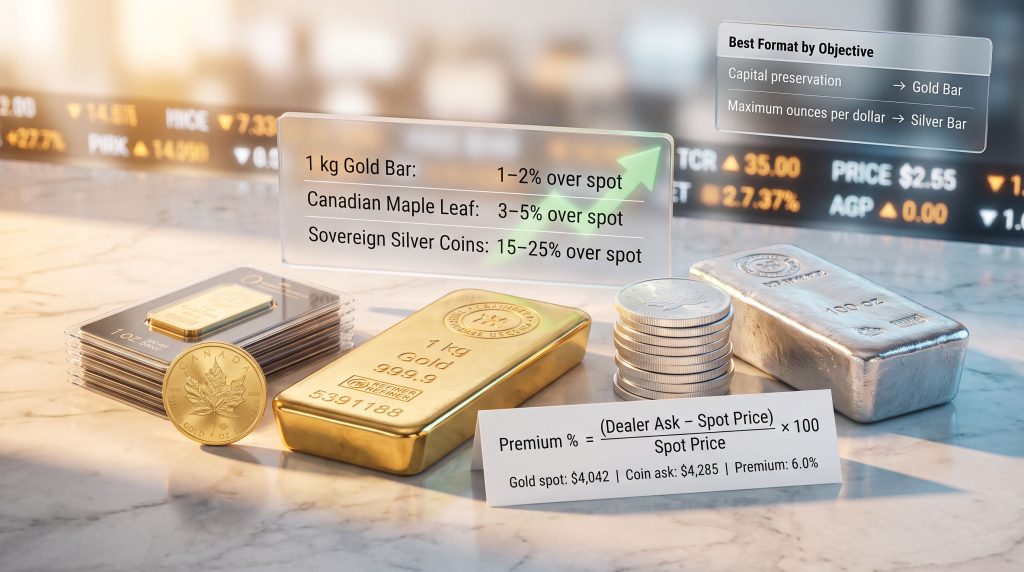
The Core Calculation: Premium % = (Dealer Ask Price minus Spot Price) divided by Spot Price, multiplied by 100. If gold spot is $4,042 and a coin is quoted at $4,285, the premium is 6.0%. Any gold premium above 8% or silver premium above 20% warrants immediate comparison shopping or a product format change.
Premium Benchmarks by Product Type
The following table reflects typical retail dealer premium ranges under mid-2026 normalised market conditions. Premiums widen materially during demand-surge events. Buyers should treat the upper bounds as floor references during acute corrections rather than ceilings.
| Product Type | Typical Premium Range | Key Notes |
|---|---|---|
| 1 kg Gold Bar (LBMA-accredited) | 1–2% over spot | Lowest cost-per-ounce format available |
| 1 oz Gold Bar (LBMA-accredited) | 1.5–3% over spot | Best standard entry point for most buyers |
| Canadian Gold Maple Leaf (1 oz) | 3–5% over spot | Lowest premium among sovereign gold coins |
| South African Krugerrand (1 oz) | 3–5% over spot | Competitive with Maple Leaf; recognised since 1967 |
| American Gold Eagle (1 oz) | 4–7% over spot | Dominant U.S. domestic resale benchmark |
| Fractional Gold Coins (1/10–1/4 oz) | 8–15%+ over spot | Structurally inefficient; avoid during corrections |
| Silver Bars (10–100 oz, accredited) | 3–8% over spot | Most cost-efficient silver format for stackers |
| Generic Silver Rounds (private mint) | 5–10% over spot | Best balance of premium efficiency and divisibility |
| Sovereign Silver Coins (Eagles, Maples) | 15–25% over spot | Highest liquidity; highest structural premium |
Sources: GoldSilver (June 2026), MetalCharts (May 2026), FindBullionPrices (July 2026)
The Best Gold Products to Buy During a Correction
Gold Bars: Maximum Metal Per Dollar Spent
For investors whose primary objective is accumulating the greatest number of ounces at the lowest all-in cost, LBMA Good Delivery-accredited gold bars represent the most efficient format in the retail bullion market. Refiners such as PAMP Suisse, Valcambi, and Argor-Heraeus produce bars that carry minimal manufacturing and distribution overhead relative to government-minted coins, and that efficiency passes directly to the buyer as a lower premium.
A one-ounce bar from an accredited refiner typically carries a premium of 1.5 to 3 percent over spot under normal conditions. Larger formats compress further: ten-ounce bars sit below that range, and one-kilogram bars often land between one and two percent above spot (MetalCharts, May 2026). The inverse relationship between bar size and per-ounce premium is consistent and predictable. Furthermore, understanding physical gold vs ETFs can help buyers decide which format best suits their broader strategy.
Two purchasing disciplines matter significantly here:
- Restrict purchases to refiners appearing on the LBMA Good Delivery List to eliminate authentication friction at resale
- Insist on sealed assay card packaging, the tamper-evident card from the originating refiner that verifies purity and weight, and which substantially reduces buyer friction in any secondary transaction
Breaking the assay seal to test a bar destroys its packaging integrity and introduces resale complications. Bars in original, sealed packaging from recognised refiners can typically be sold without testing requirements, a meaningful advantage at the point of liquidation.
Sovereign Bullion Coins: Paying a Modest Premium for Global Liquidity
The four primary sovereign gold coin formats each carry premiums of roughly three to seven percent above spot (MetalCharts, May 2026). That additional cost relative to bars represents a genuine trade-off rather than an inefficiency. What a buyer receives in exchange for the higher premium is instant global recognition, elimination of authentication requirements at resale, legal-tender status, and government guarantees of weight and purity.
| Coin | Purity | Typical Premium | Key Advantage |
|---|---|---|---|
| Canadian Gold Maple Leaf | .9999 fine | 3–5% | Lowest premium in sovereign class; radial-line security |
| South African Krugerrand | 22-karat | 3–5% | Globally recognised since 1967; often matches Maple Leaf |
| Austrian Philharmonic | .9999 fine | 3–5% | Strong European market liquidity |
| American Gold Eagle | 22-karat | 4–7% | Unmatched domestic U.S. resale speed; IRA-eligible |
Sources: MetalCharts (May 2026), MintedMetal (April 2026)
Sovereign coins also satisfy IRS fineness requirements for self-directed precious metals IRAs, which most private refiner bars do not. For investors building IRA-eligible physical holdings, sovereign coins from government mints meeting the IRS minimum fineness thresholds are the functionally required format. In addition, gold as a safe haven remains a compelling rationale for holding these formats across market cycles.
What to Avoid: Fractional Gold During a Correction
Fractional gold coins, those in 1/4 oz or 1/10 oz denominations, carry structural premiums of eight to fifteen percent or more above spot under normal conditions (GoldSilver, June 2026). The manufacturing cost of a 1/10 oz coin is nearly identical in absolute terms to a full one-ounce coin, but that fixed cost is spread across one-tenth of the metal content. The premium compounds with any correction-period widening, making fractional formats particularly punishing precisely when buyers believe they are getting a deal.
During periods of acute demand, fractional coins deplete from dealer inventory faster than full-ounce products, pushing premiums even higher. Investors whose budget does not support a full one-ounce gold purchase will achieve substantially better metal-per-dollar efficiency by redirecting that capital toward generic silver rounds.
The Best Silver Products to Buy During a Correction
Why Silver Requires a Different Premium Framework
Silver's premium structure operates on different arithmetic than gold. The absolute fabrication, shipping, and dealer overhead costs associated with producing and distributing a one-ounce silver coin are comparable in dollar terms to the same costs for a one-ounce gold coin. Because silver's per-ounce price is a fraction of gold's, however, those fixed costs represent a far larger percentage of the underlying metal value. This is a structural feature of the silver market, not a dealer pricing anomaly.
Tracked data shows that the average sovereign silver coin premium runs near nineteen percent above spot across the retail market, while silver bars and rounds compress to five to ten percent (FindBullionPrices, July 2026). That spread, ten to fifteen percentage points between product formats, is the primary lever a silver buyer controls during a correction. Consequently, awareness of silver supply deficits adds further context to why physical silver accumulation during dips can be a strategically sound approach.
Silver Bars: Lowest Per-Ounce Premium for Aggressive Accumulation
Cast bars of ten to one hundred ounces from LBMA-accredited refiners including Asahi Refining, PAMP Suisse, and Valcambi carry the lowest per-ounce premiums in the retail silver market (GoldSilver, April 2026). The larger the bar, the more dramatically fabrication cost is diluted across a greater weight of metal.
The practical trade-offs are worth acknowledging directly:
- A 100 oz silver bar represents approximately $5,800 at mid-2026 silver prices, a meaningful single asset exposure
- Selling requires finding a buyer for the entire unit, which is less flexible than coin or round formats
- Storage and insurance costs become significant at scale and should be factored into the all-in holding cost
- This format suits investors with secure storage capacity who intend to hold for the medium to long term
Generic Silver Rounds: The Optimal Balance of Cost and Flexibility
A silver round is a privately minted, .999 fine silver disc in coin form. It carries no legal-tender face value and no government mint premium. Established private mint rounds from producers such as Sunshine Minting typically carry premiums of five to ten percent above spot, compared to fifteen to twenty-five percent for sovereign silver coins (GoldSilver, June 2026). That gap represents real dollars at any accumulation scale.
Rounds offer one-ounce divisibility, making partial liquidation far easier than with large bars. They are widely recognised in secondary markets from established producers. The primary limitation is IRA ineligibility: most private mint rounds do not satisfy IRS sourcing requirements for self-directed retirement accounts.
A critical distinction: Rounds from obscure or low-volume private mints may require assay testing at resale, which introduces friction and cost. Buyers should restrict purchases to established producers with demonstrable secondary market presence and high production volumes.
Sovereign Silver Coins: When the Liquidity Premium Is Justified
The American Silver Eagle, Canadian Silver Maple Leaf, Austrian Philharmonic, and British Britannia all command premiums of fifteen to twenty-five percent above spot in normalised conditions. That premium is not arbitrary. These coins carry government guarantees of weight and purity, instant recognition at any dealer globally, and no testing requirements at the point of resale.
For investors who hold physical silver partly as a convertible emergency asset, where speed of liquidation and frictionless dealer acceptance outweigh cost efficiency, sovereign silver coins retain their justification. For pure ounce-per-dollar accumulation during a correction, bars or rounds will consistently deliver better outcomes. Morgan Stanley's gold and silver investment guide offers additional perspective on weighing these trade-offs across different investor profiles.
Products to Avoid During a Precious Metals Correction
Three categories consistently erode buyer value during correction-period purchases:
-
Numismatic and collectible coins derive their value from historical significance, condition grades, and collector sentiment rather than metal content. Their pricing does not correlate with spot price movements. A twenty percent gold correction may have no effect on a numismatic coin's market value, or may move it in an opposite direction entirely. During a correction, all purchases should be restricted to standard bullion products priced at or near their metal content.
-
Jewellery and decorative metalwork incorporates design markup, retail margin, and sales tax in many jurisdictions, often absorbing twenty percent or more of metal value above spot at the point of purchase. Resale typically returns melt value only, after refining costs are deducted, which is below the spot price. Jewellery is a consumption good with precious metal content, not a bullion accumulation vehicle.
-
Fractional gold coins during demand surges carry structural premiums that compound on top of correction-period widening, producing the worst possible premium-to-spot ratio at precisely the moment buyers believe they are getting a discount.
The next major ASX story will hit our subscribers first
How to Verify You Are Paying a Fair Premium
A Step-by-Step Verification Framework
-
Pull a live spot price immediately before transacting. Spot moves continuously during trading hours; a price from earlier that session may be meaningfully stale.
-
Calculate your premium: (Dealer Ask Price minus Spot Price) divided by Spot Price, multiplied by 100.
-
Benchmark the result against product norms: gold bars should sit below 3%; sovereign gold coins below 7%; silver bars below 8%; silver rounds below 10%; sovereign silver coins below 20%.
-
If the premium exceeds the upper benchmark, check at least two competing dealers before transacting, or shift to a lower-premium product format.
-
Apply the net-cost test: if the combined all-in per-ounce cost (spot price plus premium paid) exceeds what you would have paid in a calm market with normalised premiums, the correction has not actually benefited you.
How to Authenticate Bars Before Purchase
- Sealed assay packaging from the originating refiner is the primary verification method for new bars; the tamper-evident card confirms purity and weight without requiring any additional testing
- Electronic metal verifiers such as the Sigma Metalytics unit use electromagnetic resonance to confirm metal composition without surface contact, the most reliable non-destructive method for bars outside original packaging
- Precision scales verify stated weight within manufacturer tolerances
- Magnet testing eliminates obvious ferrous counterfeits but does not confirm purity; treat it as a baseline screen only
- Provenance documentation should be requested for any bar arriving outside its original sealed packaging, particularly from secondary market sources
The Structural Case That Survives a Price Correction
Why the Long-Term Thesis Remains Intact
Precious metals corrections typically reflect short-term catalysts acting on assets whose long-term value rests on a fundamentally different foundation. A hawkish central bank pivot, a demand shock, or profit-taking after an extended run can all compress spot prices meaningfully without altering the structural conditions that make physical ownership compelling over longer time horizons.
Several of those structural conditions were firmly in place heading into the mid-2026 period:
- Central bank gold demand reached approximately 863 tonnes in 2025, reflecting sustained institutional demand from sovereign reserve managers (World Gold Council, 2025 annual data)
- The silver supply deficit extended through five consecutive years to end-2025, with the Silver Institute projecting a sixth consecutive year of structural undersupply through 2026 (Silver Institute, World Silver Survey 2026)
- U.S. federal interest payments exceeded $1 trillion annually, representing ongoing and measurable erosion of fiat currency purchasing power (U.S. Treasury Fiscal Data)
- The Federal Reserve held policy rates at 3.50 to 3.75 percent under Chair Kevin Warsh through mid-2026, a rate environment that maintained real costs across the financial system
Physical gold and silver carry no counterparty risk. Their value does not depend on any issuer's capacity to pay. The mechanisms that underpin their long-term role, monetary debasement, persistent institutional demand, and supply constraints, do not reverse because spot prices decline. A correction simply means acquiring the same scarce asset at a lower dollar cost per ounce, provided the premium is managed correctly.
Gold vs. Silver During a Correction: Choosing the Right Metal
| Objective | Preferred Metal | Rationale |
|---|---|---|
| Capital preservation | Gold | Lower volatility, tighter premiums, deeper institutional liquidity |
| Maximum ounce accumulation per dollar | Silver | Lower absolute price creates greater unit accumulation opportunity |
| Currency debasement hedge | Gold primary, Silver secondary | Gold's monetary role is more deeply institutionalised |
| Aggressive recovery upside | Silver | Historically amplifies gold's recovery moves with higher beta |
| IRA-eligible physical holding | Both, with format restrictions | Sovereign coins and IRS-approved bars qualify |
The gold-silver ratio analysis, which has historically mean-reverted toward lower levels from elevated readings, suggests silver may offer asymmetric upside relative to gold during recovery phases. This comes with commensurately higher volatility and structurally wider premiums that must be factored into any cost basis analysis. For most investors, a combined approach makes practical sense: LBMA-accredited gold bars or sovereign gold coins as the core position, supplemented by silver bars or established rounds as a satellite allocation weighted toward cost efficiency.
Dollar-Cost Averaging vs. Lump-Sum Buying
Corrections rarely bottom in a single session. Gold's 2026 correction unfolded across several months, offering multiple better entry points to buyers who staged their purchases rather than deploying full capital at the first perceived floor. Spreading an intended allocation across two or three tranches spaced weeks apart allows buyers to average into a lower cost basis if prices continue declining, without remaining entirely on the sidelines.
The trade-off is worth understanding clearly. Multiple smaller purchases often carry a slightly higher per-unit premium than a single large order, since many dealers offer volume discounts above certain thresholds. Dollar-cost averaging does not maximise ounces if the absolute bottom is timed perfectly. What it eliminates is the risk of deploying full capital at a temporary low point before further declines materialise. The ASX provides further insight on precious metals performance expectations that buyers staging purchases may find useful context.
Frequently Asked Questions
Does Buying Physical Metal During a Correction Change My Tax Position?
The IRS classifies physical gold and silver as collectibles. Long-term capital gains on collectibles are taxed at a maximum rate of 28 percent, materially higher than the 15 to 20 percent rate applicable to most other long-term investment gains. This rate applies regardless of when the metal was purchased. Short-term gains on metal held under twelve months are taxed as ordinary income. Precise purchase records, including acquisition date, total price paid, and premium amount, are essential for accurate cost basis calculation at the point of sale.
Can Premium Spikes Completely Eliminate the Spot Price Discount?
Yes, and this has occurred in documented episodes. During the COVID-19 demand surge of March 2020, American Silver Eagle premiums briefly exceeded forty percent above spot. A ten percent decline in spot price paired with a twelve to fifteen percent premium increase produces a net outcome where the buyer pays more per ounce than before the correction began. This is the core reason product format selection carries as much weight as entry timing when constructing a correction-period buying strategy for the best physical precious metals to buy during a correction.
Are Sovereign Coins or Bars Better for a Self-Directed Precious Metals IRA?
IRS regulations require that metals held in a self-directed IRA meet minimum fineness standards: .995 for gold bars and .999 for silver bars. Eligible coins include American Gold Eagles, Canadian Gold Maple Leafs, and Austrian Philharmonics. Most private mint silver rounds do not qualify. Confirm IRS eligibility with your IRA custodian before purchasing any product intended for a retirement account.
How Many Dealers Should You Compare Before Transacting?
At minimum, check three competing dealers before committing to any purchase during a correction, when premiums are most likely to have widened unevenly across the market. Price aggregator tools that display live dealer premiums across multiple platforms allow rapid comparison without contacting dealers individually. If all checked dealers are showing premiums above the upper benchmarks outlined above, a product format shift to a lower-premium equivalent will typically deliver better value than waiting for premiums to normalise.
This article is for informational purposes only and does not constitute financial or investment advice. Precious metals involve risk, including the risk of partial or total loss of capital. Always consult a qualified financial adviser before making investment decisions.
Want to Know When the Next Major ASX Mineral Discovery Hits the Market?
While managing premiums is key to maximising value in physical precious metals, investors seeking high-conviction opportunities in the broader resources sector can gain a decisive edge with Discovery Alert, a service powered by its proprietary Discovery IQ model that delivers real-time notifications on significant ASX mineral discoveries the moment they are announced. Explore historic discoveries and their remarkable returns to understand the potential, then begin a 14-day free trial to position yourself ahead of the broader market.